108 résultats
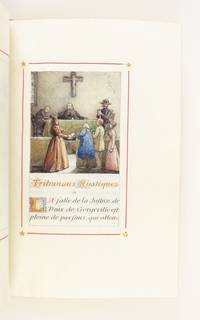
1896ST17129-026Paris 1896. 200 x 135 mm. 7 7/8 x 5 3/8". 11 leaves. Single column 16 lines plus headline in a thin graceful italic script. <br/> Attractive red crushed morocco by Marcellin Lortic stamp-signed on front doublure covers framed by multiple-rule gilt strapwork raised bands spine compartments with gilt French fillet gilt titling vellum doublures with gilt frame in the Romantic style leather hinges vellum endleaves all edges gilt. In matching morocco-trimmed slipcase. Title in burnished gold embellished with red and blue penwork text with red-ruled border and burnished gold stars at corners numerous one-line burnished gold initials with red or blue penwork two-line opening initial in burnished gold on a blue white and pink background and A HALF-PAGE MINIATURE measuring 71 x 64 mm. SHOWING A COURTROOM SCENE. Front free endleaf with morocco bookplate of Robert Hoe. ◆Just the slightest hint of rubbing to joints but A VERY FINE SPECIMEN entirely fresh bright and clean inside and out.<br/> <br/> This elegant little manuscript in French recounts Guy de Maupassant's satirical tale of a trial in the provinces; it was created by a man who knew the inside of a courtroom all too well. Bouton 1819-1901 was a young rebel during the 1848 Revolution who spent five years in jail for his participation in a bombing in Paris. Oddly enough the dedicated republican was also an expert on heraldry and paleography publishing pamphlets on those subjects as well as on politics and producing manuscripts like the present one. De Maupassant 1850-1893 is generally acknowledged as one of the great masters of the short story. In the present tale a wealthy older woman who had tried to buy a young peasant's love by giving him land sues unsuccessfully for the return of her property when the object of her affection forsakes her for a younger woman. According to Beverly Chew the library of Robert Hoe 1839-1911 founding member and first president of the Grolier Club was "the finest America has ever contained." Hoe acquired illuminated manuscripts early printing he owned a Gutenberg Bible on paper and one on vellum fine bindings French and English literature and Americana and when his library was sold in 1911-12 it fetched nearly $2 million a record that held until the Streeter sale more than 50 years later. Hoe owned several Bouton manuscripts of de Maupassant stories and the Morgan Library also has Bouton creations. The Lortic name was made famous in the history of French binding by Pierre Marcellin Lortic 1822-92 a leading Parisian binder for 40 years; the binder here was Lortic's son Marcellin or "Lortic Fils" 1852-1928. unknown
1882ST16453Glasgow: Printed by Robert Anderson for Private Circulation 1882. ONE OF ONLY 50 COPIES. 195 x 122 mm. 7 3/4 x 4 7/8". 1 p.l. x 103 1 pp.From George Bannatyne's manuscript compiled A.D. 1568. <br/> BEAUTIFUL CITRON CRUSHED MOROCCO ELABORATELY TOOLED IN GILT BY RAMAGE stamp-signed on front turn-in covers with six concentric frames--intricate filigree roll pointillé-tooled floral vine and alternating small ornaments--enclosing a central panel with cornerpieces semé with rows of fleurs-de-lys large oval medallion at center radiating ornate fleurons raised bands spine compartments with large central medallion containing a vase of flowers delicate tooling in corners gilt titling turn-ins framed by filigree roll and alternating small ornaments brown and tan silk jacquard endleaves patterned in a Medieval motif top edge gilt. Printer's device on title page decorative woodcut initials and headpieces. Spines evenly sunned to a warm honey brown corners lightly rubbed short faint scratch to lower board but the binding virtually unworn and happily free of the splaying that plagues vellum books. Leaves lightly rumpled but A VERY FINE COPY the vellum leaves creamy clean and bright and the binding glittering with gold.<br/> <br/> Printed on luxurious vellum and limited to just 50 copies presumably for private circulation among friends of the printer this is a lovely edition of 16th century poems by a mysterious author believed to have been a poet and musician associated with the court of Mary Queen of Scots. This work contains all 36 extant poems attributed to Scott ca. 1520-82/3 including what is considered to be his most historically important work "Ane New Yeir Gift to Quene Mary" 1562 written in support of the young Scottish queen caught between Catholic and Protestant agendas. His other poems consist largely of lyric verses on love and sexuality which DNB describes as possessing "exceptional metrical variety and vernacular directness" with "a musician's ear for rhythm and melody." Scott's poems are known to us via the Bannatyne manuscript now held in the National Library of Scotland which ranks among the most important documents of Scottish Medieval literature. Written by George Bannatyne in 1568 during a period of confinement due to an outbreak of plague it contains a mixture of both secular and religious material including the sole extant copies of several texts. In the preface to the present work the publisher notes that Scott's poetry has been faithfully reproduced from that manuscript and thus "for the first time accurately printed." Very little is known regarding the life of Alexander Scott but he seems to have been attached to the court of Mary Stuart through John Erskine a guardian and counselor to the queen. Given the very limited number of copies made it is not surprising that this work is extremely rare on the market. Printed [by Robert Anderson] for Private Circulation unknown
1898110521898 P., Bibliothèque-Charpentier, 1898, 1 fort vol. in-12° (195 x 130) relié plein cartonnage moderne à la Bradel recouvert de papier anthracite à motifs noir, dos lisse orné d'une pièce de titre en maroquin noir souligné d'un filet doré, gardes de papier noir, de (2) ff. (faux-titre et titre) - 608 pp. Très bel exemplaire non rogné à grands témoins conservés.
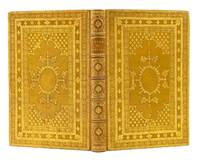
18287462Paris, Baudouin frères, 1828. 4 volumes in-8 en demi-maroquin vert à grains longs, avec coins, dos lisse orné de fers romantiques, doubles filets dorés sur les plats, non rogné, avec les couvertures conservées des 10 livraisons de l'édition de Baudouin, mais également les couvertures - verte et jaune de 6 de livraisons de l'édition des vignettes chez Perrotin, avec un envoi autographe de ce dernier. Belles reliures Pastiches dues au maître du genre, Bernasconi. La reliure est signée par Bernasconi.
1882ST12705Paris: A. Quantin 1882. UNIQUE COPY ON VELLUM printed for M. A. Werlé. 206 x 140 mm. 8 1/8 x 5 1/2". xxxii 247 pp. 1 leaf colophon.With a bio-bibliographical notice by Fernand Drujon. <br/> Pleasing burgundy Jansenist crushed morocco by Canape et Corriez stamp-signed in gilt on front turn-in dated 1930 on rear turn-in raised bands turn-ins richly gilt marbled endpapers all edges gilt on the rough. Decorative head- and tail-pieces throughout and eight engraved plates comprised of a frontispiece portrait in four states one on vellum three on paper and an allegorical vignette also in four states. Verso of front free endpaper with ex-libris of Jean Furstenberg. ◆Two small dark spots to upper cover a couple of leaves with naturally occurring minor discoloration to vellum but A FINE COPY--especially clean fresh and bright internally and in a lustrous unworn binding.<br/> <br/> Given its illustrious provenance and its singular status as the only copy printed on vellum this is a quintessentially bibliophilic copy of the poems of French cleric and diplomat Cardinal François-Joachim de Pierre de Bernis 1715-94. Admired as a witty epigrammist at the court of Louis XV where Madame de Pompadour presided Bernis composed poems on such conventional themes as love and the natural world but also verses contemplating manners and mores fashion independence and love of country. Since none of his poems was published before his death he was not widely known as a poet during his lifetime but in another sphere he performed important service to his country as France's ambassador to Rome. He provided shelter and succour there for refugees from the French Revolution earning the papal epithet "Protector of the Church of France." The present work was printed for Count Alfred Werlé whose father had inherited the Veuve Clicquot Champagne house from the Widow Clicquot. Alfred took over the operation in 1884 and greatly expanded the Veuve Clicquot-Ponsardin vineyards. The volume subsequently passed into the library of the great collector Jean or Hans Furstenberg 1890-1982 who put together one of the finest collections of 18th century books ever assembled. In 1974 the Furstenberg collection was sold en bloc to Dr. Otto Schäfer whose marvelous library had already become distinguished for its fine and historic bindings. A. Quantin unknown
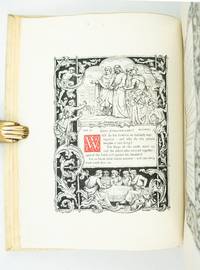
1862ST20857London: Edmund Evans for Sampson Low Son and Co 1862. ONE OF PERHAPS 10 COPIES PRINTED ON VELLUM. 260 x 195 mm. 10 1/4 x 7 3/4". vii 1 235 1 pp. <br/> Publisher's stiff vellum smooth spine with gilt lettering edges untrimmed. In a modern felt-lined blue buckram drop-back box. Decorative initials in red or blue title page and text leaves with full criblé border of vined foliation occasionally inhabited eight or 10 leaves with more extensive illustrations at head or foot all engraved by W. J. Linton after illustrations by John Franklin. Front pastedown with ex-libris of Marion Hope Rattey. A Large Paper Copy. McLean "Victorian Book Design" p. 184. Short thin cracks to head and tail of front joint spine vaguely soiled upper cover with two very small brown spots and one trivial red mark occasional mild rumpling or naturally occurring variations in the grain or thickness of the vellum as usual a couple of minor smudges but still a very agreeable copy the binding solid and without the splaying common in vellum books the interior clean fresh and bright and the margins extraordinarily wide.<br/> <br/> This is an infrequently encountered copy of a beautiful Victorian book on vellum issued by one of the era's top printers. The volume was printed by Edmund Evans 1826-1905 who is now best remembered for his illustrations and advances in color wood engravings. Relatively little is known about this book's production: Ruari McLean tells us that it was "entirely printed" by Evans but it is unknown whether he was responsible for the design as well McLean remarks that "if Evans was responsible for its design it shows his superiority in book-making". We also are unsure how many copies were printed on vellum although the general consensus is 10. Regardless as McLean tells us "it is one of the prettiest books of the 'sixties" with sharp deep impressions of the type on the rich creamy vellum jewel-like colored initials and elegant wood-engraved illustrations. These illustrations are the work of John Franklin ca.1800-68 a painter and draftsman who was highly respected in his own time. The precisely realized borders feature idealized human forms posed within a robust botanical largely acanthus context the figures posing with balletic grace their expressive faces often turned gently away from the reader. The size of the leaf here is significant: the untrimmed edges retain their tiny printing pinholes which would normally have been trimmed away with regrettable loss. And not surprisingly our vellum printing is almost never seen: we could trace just two copies at auction since 1924. Former owner Marion Hope Rattey 1922-97 was likely the daughter of bibliographer Clifford C. Rattey 1886-1970 whose impressive library featured incunabula and block prints. [Edmund Evans for] Sampson Low, Son, and Co unknown
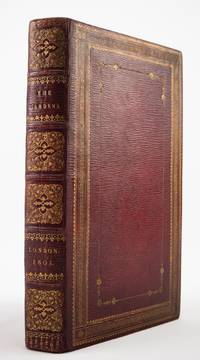
1805ST21016London: Printed by T. Bensley 1805. APPARENTLY THE ONLY COPY PRINTED ON VELLUM. 260 x 152 mm. 10 x 1/4 x 6". 2 p.l. 146 pp. 1 leaf notes. Translated by Maria Henrietta Montolieu. <br/> Very pleasing contemporary straight-grain scarlet morocco gilt by Charles Hering binder's ticket on verso of front flyleaf covers bordered with a wide frame of multiple patterned rolls with rosette cornerpieces enclosing a delicate frame of a dotted roll cornered small floral tools raised bands spine gilt in compartments wide turn-ins sumptuously gilt cream silk endleaves with gilt borders and fleuron cornerpieces all edges gilt. WITH EIGHT ENGRAVINGS BY FRANCESCO BARTOLOZZI IN TWO STATES one on gold silk and the second on paper. EXTRA-ILLUSTRATED with two engravings depicting Princess Izabela Czartoryska and her daughter Zofia. A Large Paper Copy. Henrey 624. See also Clemens Alexander Wimmer "The Princess and the Poles" Historic Gardens Review no. 10 2002: 14-17. Spine slightly darkened joints and edges with minor barely noticeable wear vellum a bit and naturally rumpled and consequently the book yawning a bit a handful of light spots but still an extremely appealing copy with fine impressions of the plates vast margins and a special story to tell.<br/> <br/> Printed on vellum richly bound and illustrated with attractive plates on silk this is an extraordinarily luxurious copy of Delille's famous poem on gardens that almost certainly belonged to a noblewoman whose gardens are mentioned in the text. First published in 1780 our poem condemns formal gardens and broad promenades in favor of a gardening art which hides its artistry by reproducing the asymmetrical groupings of nature and careless bounty of the countryside. This view accords with the translation of Virgil's "Georgics" done by Delille 1738-1813 in 1769 a version that brought him great acclaim for its supple and sonorous versification. In fact it so pleased the Count of Artois the future Charles X that he named Delille abbot of Saint-Séverin; however revolution disrupted things and the poet for a time led a wandering life in Switzerland Germany and England where this updated and expanded version of "Gardens" was published in 1801. The present special edition includes the plates which had appeared as head- and tailpieces in the first edition but now used as stand-alone plates in two states. These were executed by Bartolozzi after originals by Portuguese neoclassical painter Francisco Vieira. In addition to the called-for suite of illustrations our copy includes two inserted plates portraits of Princess Izabela Czartoryska 1745-1835 and her daughter Zofia. Czartoryska was a major figure in the Polish Enlightenment as a writer and patron of the arts as well as an advocate for improving the lives of the poor. She is best remembered for the sprawling gardens at her palace in Pu awy which included a formal garden a "wild promenade" or landscape park and multiple structures including the neoclassical Temple of the Sibyl which became one of Poland's first museums. She made the acquaintance of the author while travelling through Paris in 1791 and the two struck up a friendship. She financially backed the second edition of the work in exchange for a mention of her gardens which duly appears in heightened verse on pp. 11-13: "Favoured Pulhavi! You from Heaven obtain / Each separate charm Earth's choicest scenes contain; / Bright glow thy features fresh from Nature's hand / Excite our wonder and our praise command." The presence of this poetic tribute--and especially the inserted plates showing the princess and her daughter-- clearly suggest that the our apparently unique luxury edition must have been a presentation copy to Czartoryska herself. The present copy is as striking outside as it is inside. Charles Hering was the most distinguished and influential English binder of the first decade of the 19th century and although his career was brief from about 1795-1812 Ramsden focuses on his work as representing the transition in binding styles from those of the German émigrés of the late 18th century to the new generation of binders headed by Charles Lewis. Dibdin states that until "the star of Charles Lewis rose above the bibliopegistic horizon no one could presume to 'measure business' with Hering. There was a strength squareness and a good style of work about his volumes which rendered him deservedly a great favourite." We have been unable to trace any other copies of the present edition on vellum. Printed by T. Bensley unknown
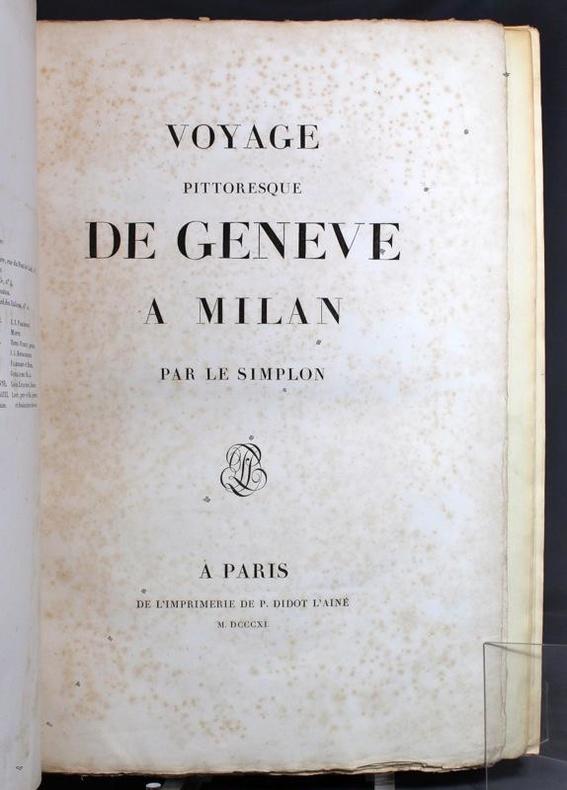
181110857Paris, Didot l'aîné, 1811. In-folio de 48 feuillets et 35 planches hors-texte, demi-veau chamois à coins, dos à nerfs, coiffes, mors et coins frottés. Reliure moderne. Exemplaire non rogné. Quelques rousseurs aux feuillets initiaux et finaux. Voici la collation des 96 pages de texte: [8] pages soit 1ff. blanc, faux-titre, titre, 1 ff. de table des planches, 6p. pour le Tableau général du lac de Genève (dernière bl.), [8]p. pour la description des planches, 10p. pour le Tableau général du Valais (dernière bl.), [8]p. pour la description des planches, 4p. pour le Tableau général du Simplon, [34]p. pour la description des planches, 2p. pour le Tableau général du lac Majeur, [12]p. pour la description des planches, [2]p. pour 1 ff. blanc.