SADE, Chevalier Louis deLivre Rare Book

19 résultats
1837447441 vol. in-8 br., A. Pougin & Théodore Tarbé, Paris, Sens, 1837, 2 ff., 443 pp.
182337711823 cart. bradel papier époque (un peu frotté). in-8, XXVIII, 340pp., Paris Lamy 1823,
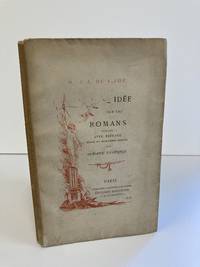
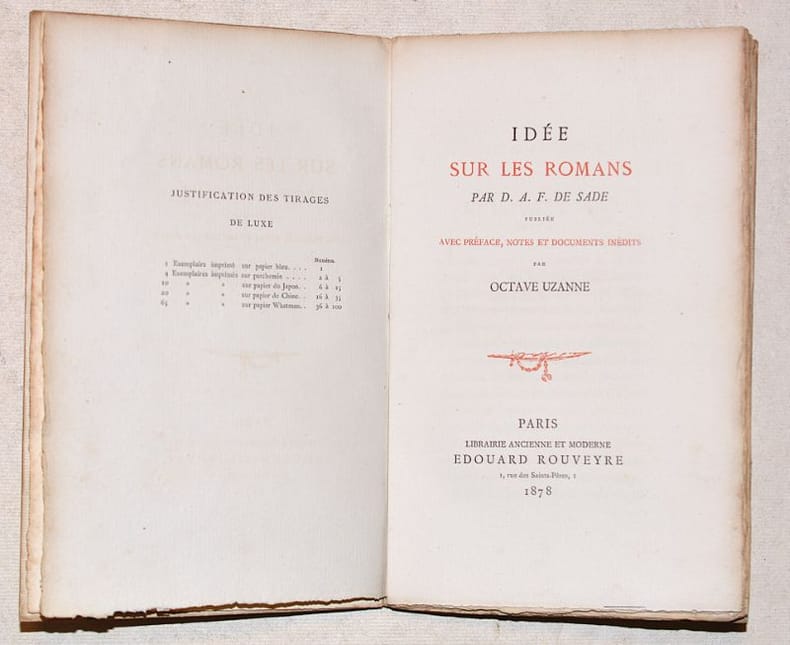
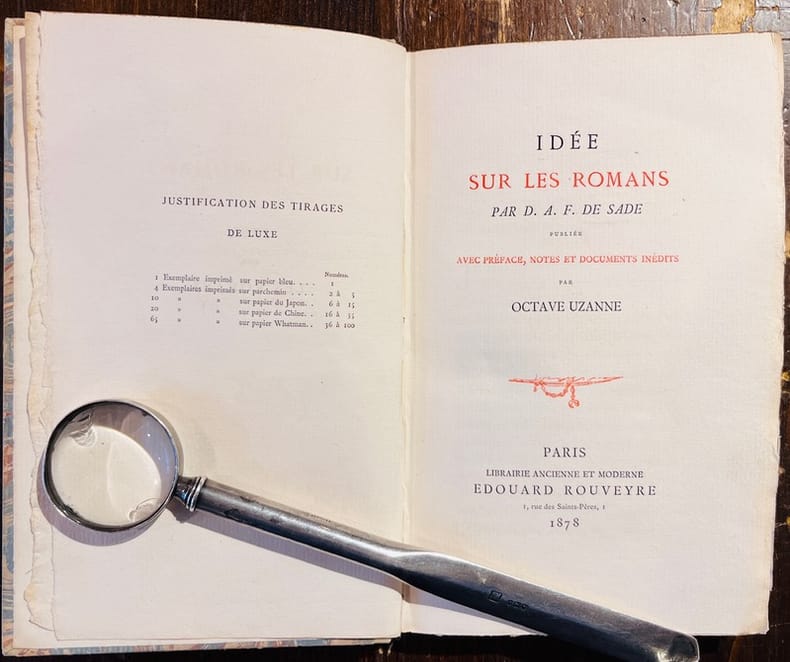
18781370627Paris France: Edouard Rouveyre 1878. First Edition. Softcover. Octavo xlviii 53 pages. In Very Good condition. Bound in publisher's printed wrapper with black lettering to spine black and red lettering to cover and red designs to both covers. Numer '118' written in pencil on bottom left of front cover. Age toning to paper covers and textblock. Minor foxing to textblock. Deckled pages sewn in unevenly. This text explores Sade's ideas on novels including his as taken from his original letters and writings kept at the Comédie-Française's archive. In the preface Uzanne is adamant that the reader give de Sade's "Idée Sur Les Romans" a chance despite his "infernal reputation." 1370627. Special Collections - Downstairs. Edouard Rouveyre unknown
18780037211878 Paris, Rouveyre, 1878. In-12 étroit (184 X 113 mm) broché ; XLVIII pages de faux-titre, titre imprimé en rouge et noir et préface, 53 pages, (5) pages de catalogue de l'éditeur, (1) f. d'achevé d'imprimer. Bande brune d'1 cm en tête des plats, dos uniformément bruni, salissures claires et frottements au second plat, quelques rousseurs très éparses, plus marquées aux premier et dernier feuillets blancs.
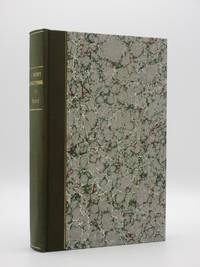
187820478Paris, Librairie ancienne et moderne Édouard Rouveyre, 1878. In-12 de XLVIII-53-[7| pages, cartonnage de papier marbré, dos isse, étiquette de titre beige.
1823R300278169Chez Lamy/Opigez/Mongie. 1823. In-12. Relié demi-cuir. Etat d'usage, Coins frottés, Manque en coiffe de pied, Rousseurs. XXVIII + 340 pages. Plats, contreplats et tranches jaspés. Dos cuir à titre, auteur et filets dorés. 1er plat désolidarisé. Mors fendus. Léger manque en coiffe de pied.. . . . Classification Dewey : 840.08-XIX ème siècle
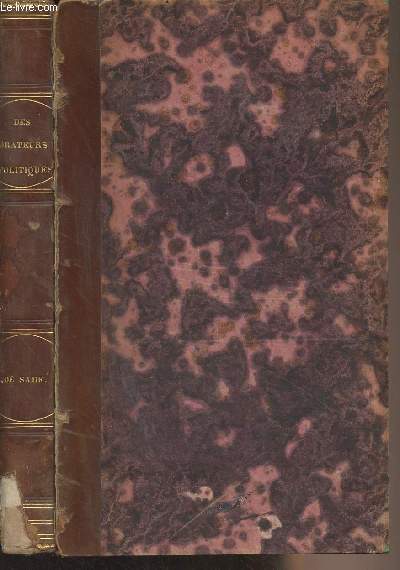
182346400820Paris, Lamy, Opigez, Mongie, 1823 ; in-8, demi - veau fauve, filets dorés et fleurons à froid au dos, coins, tranches marbrées. (Reliure de l'époque). - 340 pp. - Cet ouvrage reparaîtra sous plusieurs titres : "" L'art de faire des lois "" ; "" Le lexicon politique "", "" Les préceptes politiques ""... L'auteur réclame le "" rétablissement complet de l'Ordre social "". Louis de Sade, littérateur, est né à Antibes en 1753 et mort en 1832. Emigré, il est l'auteur de plusieurs brochures anti-révolutionnaires et combattit le système gouvernemental de la Restauration. Rousseurs sur les 7 premiers feuillets et les 7 derniers."
18221197E029Paris: Ponthieu 1822. 1st Edition . Hardback. Printed pages: 8vo. vi 532. Very Good. 5.25 x 8 inches 13.5 x 20 cm. Recent quarter green cloth binding with marbled boards marbled page edges. First few pages have browning and some light staining to margins. Light foxing and a few occasional marks to text. French language. Scarce. Overall condition is Very Good. Size: 5.25 x 8 inches 13.5 x 20 cm. Ponthieu hardcover
1803273373London : Printed by T. Maiden for Vernor and Hood ect. 1803. Fifth Edition. Hardcover. Worn set bound in half aniline calf over marble boards with gilt-blocked label to the spine. Some minor wear and tear to the spine and boards along with some dust-toning. Remains well-preserved overall; bright clean and sharp-cornered. Provenance; from the library of Alex R. Stewart with the owner's bookplate. Physical description; 2 v : ill ; 22 cm. Notes; Includes indexes. Subject; Petrarca Francesco 1304-1374. London : Printed by T. Maiden for Vernor and Hood [ect.] hardcover
1866FOS-364Sadopolis/Chez Justin Valcourt, Paris, 1866. Edition originale. L'un des 150 exemplaires sur Hollande, seul grand papier. Belle reliure in-16 demi-maroquin vieux rouge à coins, dos à 5 nerfs. Très peu courant.
187819823Paris ROUVEYRE (EDOUARD) 1878 1 Paris, 1878, Editions Edouard Rouveyre, in-8, broché, 53 et 48 pages.
18831370730Brussels Belgium: J.-J. Gay Libraire-Éditeur 1883. First Edition Thus. Softcover. Octavos four volumes. In Very Good minus. Bound in beige paper spines are tanned beige with red lettering. Moderate shelfwear and creasing to spines. Paper covers are tanned at edges with minor soiling and chipping. Mild discoloration to covers due to shelfwear. Volume two has minor hole to front cover and tearing along right side edges. Edges of textblock are tanned with age-toning to pages. Deckled pages not sewn in evenly. First free edges in volumes two three and four cropped leaving offset marks on second first free edges. Rear free edges in all volumes cropped leaving offset marks to second rear free edges. Textblocks clean. An epistolary novel written during Sade's incarceration in the Bastille this set is subtitled the "Roman Philosophique Écrit à la Bastille un an avant la Révolution de France." Artist Man Ray was a great admirer of Sade's and named one of his paintings after this novel. 1370730. Special Collections - Downstairs. J.-J. Gay, Libraire-Éditeur unknown
18811370646Paris France: Charavay Frères 1881. First Edition: #129/269. Hardcover. 12mo. 61 pages. In Very Good condition. Three quarter bound in genuine fine brown leather with marbled paper boards. Paneled spine has gilt lettering. Minor shelfwear to head tail and along length of spine. Minor shelfwear to leather and paper boards with chipping along edges of paper boards. Slight bumping to fore-edges. Top edge of textblock gilt. Age-toning tanning to edges and minor foxing to textbock made of Holland paper. Marbled endpapers. Detailed ink illustration protected by loose paper tipped in before title page. Pages not sewn in evenly. Multicolored ribbon. Textblock clean. Shelved in Case 12. Dorci is a novella written by Sade which became his first important--and most popular--posthumous publication. The ink illustration is attributed to G. Charpentier a well-known French writer and publisher. 1370646. Shelved Dupont Bookstore. Charavay Frères hardcover
189877549Paris et London: Privately Printed 1898. Rare as early as 1898. In three volumes. Very Good condition. Privately Printed unknown
1870248597Brussels: chez tous Les libraires 1870. Third edition no. 1 of 4 copies on papier de chine total edition 150 copies. Frontispiece in two states sepia and black. cii ii 178 pp. Imp. de J.H. Briard. 1 vols. Small 8vo. Full green gilt-stamped morocco t.e.g. rest uncut by Amand. Spine slightly faded; occasional foxing. Very good copy. Third edition no. 1 of 4 copies on papier de chine total edition 150 copies. Frontispiece in two states sepia and black. cii ii 178 pp. Imp. de J.H. Briard. 1 vols. Small 8vo. Violent satire of Joséphine de Beauharnais wife of the First Consul Napoléon Bonaparte -- the acolytes being Thersa Tallien and Madame Visconti. "On reconnait Bonarparte dans dans le baron d'Orsec being an anagram of 'Corse'; Barras dans le vicomte de Sabar." Along the way Sade attacks a number of notables as well and it was shortly after this pamphlet was published ca. 1800 that Sade was incarcerated at Charenton. Zoloé was reprinted in 1867; and here again with a bio-biographical essay by Paul Lacroix under his pseudonym "Paul L. Jacob".<br /> A choice copy. in its rarest state of a book which is difficult enough to find even in in its "ordinary" limitation - OCLC locates copies only in the British Library and Biblithèque Nationale. Gay IV: 1405 chez tous Les libraires unknown
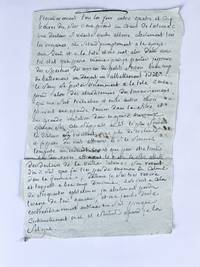
180385841Charenton [1803-1808] | 15 x 22.80 cm | un feuillet composé deux papiers encollés
180185841Charenton 1801. Fine. ""I experience spasms a sort of shivering a lot of yawning disgust total despondency the blood rushes violently to my head then I feel dizzy spinning which makes me stumble and a thousand other things proving a great tension in the body and a great irritation in the nervous system."" Charenton 1801 15 x 22.80 cm un feuillet composé deux papiers encollés Original autograph letter by the Marquis de Sade consists of 27 lines of relatively tight handwriting. Most likely written to his wife as evidenced by the letter's origin from Sade's family. The letter is physically composed of two glued pieces of paper. On the verso the Marquis wrote 19 lines and scrupulously crossed them out - a few words and letters are still quite visible. Cited in Maurice Lever's biography 'Donatien Alphonse François marquis de Sade' Paris Fayard 1991 p. 631. On March 7 1801 Armand de Sade the Marquis's son received a letter from the Minister of Police Joseph Fouché notifying him that his father had been arrested yesterday and that handwritten pages from the novel 'La nouvelle Justine' Justine or the Misfortunes of Virtue had been found on his person: Nevertheless sensitive to your request for leniency and concerned to preserve the honor of your name I have decided to have your father transferred to the Charenton nursing home.. It should be noted that for Fouché Charenton an insane asylum was nothing more than a nursing home a prison. It should not be forgotten that a large proportion of the population of these asylums did not fit into the social and moral field and psychiatry has long had no other aim than to normalize to make them fit for social life. Contrary to what has been said Sade fits in perfectly. However as soon as he entered Charenton Sade's attitude led to his expulsion to Bicêtre the Bastille of scoundrels but his family succeeded in getting him back into the Charenton asylum. Charenton was not only the Marquis de Sade's last incarceration but also the last place he lived in where he died in 1814. The 19 lines scrupulously crossed out on the back of the leaf reveal a few words or letters; in this respect we can conjecture that it's a coded message which Sade was quite fond of for if censorship had been behind these erasures absolutely everything would have been yet the message clearly shows that almost everything has been conscientiously crossed out apart from a few words or letters. We can still make out a few of them: 'Nécessaire' 'à tous' 'ger' 'ue' 'quel' 'je trouve' 'de'. As for the letter itself it is remarkable for the homogeneity of its message. It is a lengthy complaint describing the physical ailments Sade has suffered. It is an account of the sum total of the symptoms that overwhelm the writer. In a hyperbolic style using among other figures of speech adverbs of intensity si tel très. Sade methodically spells out the violent pains his body is suffering with the whole of this violence constituting a system a structure in which all the parts are linked. In the writer's correspondence it can be said that each time he found himself incarcerated his letters mention uncontrollable physical attacks although we know of no other letter so uniform and systematic.The pain originates in the pit of the stomach radiating out to the periphery: head eyes legs all converging on vertigo loss of balance. .because that's what it's all about: Sade isn't suffering from any illness he's besieged by anguish whose ultimate meaning is vertigo the wavering of a reality from which his freedom to live as he pleases his freedom of movement and his name have been taken away. The loss of these fundamental elements of his existence sends Sade in turmoil. In addition and as regards the formation of these particular symtoms if we consider that the fulfillment of a certain sexual sadism is necessary to him the deprivation of this satisfaction turns this sadistic driv unknown
180858602S. n. | [Asile de Charenton ] août 1808 | 17.50 x 21.50 cm | broché sous chemise et étui
180858602Charenton asylum: S. n. 1808. Fine. S. n. Charenton asylum août 1808 17.50 x 21.50 cm broché sous chemise et étui The complete original manuscript of one of Sade's first works ruled in pencil throughout comprising 40 leaves written recto and verso. This manuscript like the other extant items from the Marquis was dictated to a scribe and corrected by Sade himself. Contemporary green paper wrappers with a small lack to middle of spine. Ink title partly erased to upper cover: 9/ Net et corrigé en août 1808 bon brouillon. Les Antiquaires. Comédie en prose en 1 acte Copied and corrected August 1808 a good draft. The Antiquaries. A prose comedy in 1 Act. This title is repeated on the verso of the upper cover. Numerous manuscript corrections annotations and deletions in Sade's hand principally adding blocking and rich in both stage and acting directions. Written in 1776 and re-copied at Charenton in 1808 and most likely augmented at the time with various topical references notably including an allusion to Napoleon of whom he was hoping in vain to receive permission to leave the asylum at Charenton as a free man p.94 Les Antiquaires is one of the first theatrical pieces written by the Marquis and therefore one of his first literary works overall written eight years before the Dialogue entre un prêtre et un moribond Dialogue Between a Priest and a Dying Man. Though the precise dating of these pieces is made difficult due to the lack of the original manuscripts several clues have allowed bibliographers to date the initial composition of this piece to 1776 possibly with a corrected version during the Revolution and a few final changes at the time of this last edit which is today the only extant manuscript of this play. These clues include the status of the Jewish and English characters the style of the dialogues and Sade's correspondence with theatres; the strongest clue being biographical in nature. Les Antiquaires can essentially be considered the true theatrical version of Sade's Voyage en Italie with which it shows a sustained intertextuality. The play is about an antiquary in the 18th century sense of the term which is to say a learned devotee of Classical culture who wants to marry off his daughter to a friend with the same passion who nonetheless finds a way of convincing him to let her marry her young lover. Whether it be in the learned dialogues of the antiquaries or in their eccentric parody by the young lover imitating them Sade draws upon his own experience and observations from his travels which he expands or twists according to the viewpoint of his various characters. Hence the description of Mount Etna by the lover Delcour is a parody of Sade's detailed description of the Pietra Malla volcano and the made-up subterranean tunnel linking Etna to America is directly inspired by the tunnel of the Crypta Neapolitana described by Sade in his Voyage. The Marquis would reach back to this same experience of volcanoes in one of the most famous scenes in his Histoire de Juliette. Barely returned from his latest grand tour and almost at the same time as writing his passionate and detailed account of the experience Sade was thus also writing a satirical version of his own work until his problems with the military authorities. The work is at the same time a social critique of pointless erudition and a self-mockery of his own passion for history and of his zeal to see everything his insatiable curiosity cf. Maurice Lever preface to Voyage en Italie. This virulent satire is paradoxically twinned with a very erudite display of the author's knowledge of the latest architectural discoveries and the major contemporary questions in the field. This was in fact the element criticized by the two heads of theatres to whom Sade sent the play for consideration most likely during 1791 or 1792: The work is well-written. It shows the author's spirit and depth of knowledge but it's too serious too scientific S. n. unknown