[JIEFANG DAILY PRESS]. 解放日报社.Biblio.com
8 306 résultats
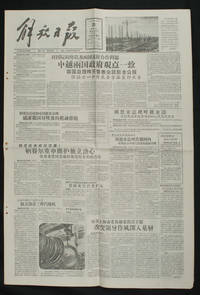
1956163839上海.Shanghai.: 解放日报社.Jie fang ri bao she. 1956. Two issues of Chinese language daily newspaper covering reports of the 1956 Melbourne Olympic Games published by Jiefang Daily Press on November 22nd 1956 issue no. 2710 and 23rd issue no. 2711 in Shanghai. Black and white illustrations each issue a single sheet printed on double sided folded complete. Small pin-holes along central folds with stain marks occasional tear on folds overall in very good condition. Text in Chinese language. Sheet measures 57 x 77.6cm. The Melbourne Olympic coverage is on Page 3 in both issues. Issue no. 2710 gives general information about soon to be opened ceremony in Melbourne with more than 60 countries and regions athletes' participating. It also forecasts the possible win of the Soviet Unions' basketball team. Issue no. 2711 explains that China had to withdraw from the Games because the Republic of China/Taiwan had been allowed to compete. Nations include Egypt Iraq Lebanon Netherlands Spain and Switzerland also pulled out of the Olympics. It states that Egypt Iraq and Lebanon's boycott is due to the Suez Crisis. However the article avoids mentioning that it was the Soviet Union's involvement in Hungarian Revolution which led to the boycott of the Games by three nations. The Australian Middle-distance runner John Landy took the Olympic Oath to mark the official opening of 1956 Summer Olympics. <br> <br>Jiefang Daily was first published in May 28th 1949 covering international domestic and Shanghai local news. These two issues feature Premier Zhou Enlai's state visit to Vietnam. It is the Party newspaper for the Shanghai Committee of the Communist Party of China. These two issues feature Premier Zhou Enlai's state visit to its communist neighbour Vietnam and the hot news of Israel's invasion in Egypt. It also reports on the thank you note from the Egyptian President Gamal Abdel Nasser to Premier Zhou for the financial support of Swiss Franc Fr.20000000. . 解放日报社.[Jie fang ri bao she]. unknown
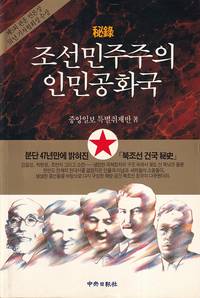
1992221177서울 Seoul.: 中央日報社 Chungang Ilbosa. 1992. Profuse black and white photographic illustrations and plates 422pp. 22 x 15cm. Text in Korean. Small remainder stamp lower edge paperback covers little shelf worn otherwise a very good copy. . 中央日報社 [Chungang Ilbosa]. paperback
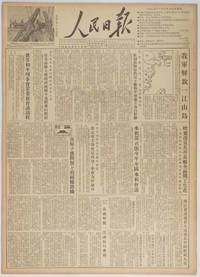
1919218294Bejing. Number 2385. January 191955. Line map cartoon in text black and white photographic images in text 4pp 53.5 x 38cm text in traditional Chinese characters. Light browning a few areas with washi repair in good condition. The article surrounding the page one map shows where the Chinese army and air force liberated Yijiangshan Island near Dachen Island to the north of Taiwan. Jiang Kai-shek's army had been using this island to carry out attacks from Dachen Island. Another article on page 1 welcomes USSR providing their experience in the peaceful use of atomic energy. In fact the Chinese nuclear weapons program had just begun under an agreement with the USSR only days before this newspaper was published; it would culminate in their first atomic test in October 1964. . unknown
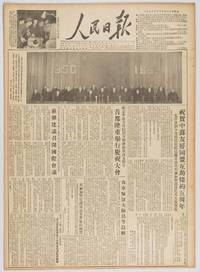
1419218250Number 2411. February 141955. 2 photographic illustrations 53.5 x 38cm text in traditional Chinese characters. Browning a few washi repairs good condition. This edition of the People's Daily celebrates the 5th anniversary of the Sino-Soviet Treaty of Friendship Alliance and Mutual Assistance signed in 1950 with congratulatory messages the text of speeches on cooperation details of USSR's assistance to China and explanations about why China had been lagging behind industrially and economically. Although privately less than happy with some aspects of the treaty China had to appear enthusiastic in the public arena. The talking-up of China's relationship with the USSR would have been seen as essential at this time; just a month prior the US had signed a Mutual Defense Treaty with the Republic of China and drawn up the 'Formosa Resolution' authorising the use of US forces to defend Taiwan. <br> <br>The front page features a wide-angle photographic illustration of the celebration of the Fifth Anniversary of the signing of the Sino-Soviet Treat of Friendship Alliance and Mutual Assistance; in the front row L to R are Chen Shutong Dong Biwu Shen Junru Lin Boqu Liu Shaoqi Song Qinlin Guo Moruo Luo Maijin Russian Delegate Zhou Enali Li Jishen Wu Yuzhang Peng Zhen and Huang Yanpei. Includes the text of a speech by Song Qingling. . unknown
Brossura in catonato flessibile, copertina ruvida illustrata a colori al piatto, titoli su piatto e dorso, impercettibili segni di usura. Tagli ben preservati, legatura salda, pagine chiarissime, conservate come non lette, pulite e prive di segni particolari, con numerose foto in nero, nel testo con didascalia. Occasionali becche di lettura. Numero di pagine 77. USATO
24748No date circa 1920 or place but circa 1920 On paper watermarked ‘The Club Note Thomas & Sons London’. The circumstances surrounding this extraordinary original composition in Latin verse are obscure. See Phillips’s entry in the Oxford DNB which notes that there was ‘an air of Proust’ about him and quotes Oliver Brown’s description of him as ‘a stout man immaculately dressed and heavily scented who talked continuously while he looked at the pictures'. It may be that Phillips and the author of the poem had been educated together or that they were members of the same club the Athenaeum for example. Whatever their relationship the author of the present work was clearly a capable classicist. Until the handwriting has been compared the suggestion cannot be dismissed that he might be the Professor of the Classical Association and Corpus Christi Professor of Latin at Oxford Albert Curtis Clark described in his own ODNB entry as a man who ‘could carry his learning lightly was the best of company full of humour and of wit and a perfect raconteur’. 2pp 12mo. Bifolium. In good condition lightly aged and creased. Central horizontal crease. Written in black ink. Poem and translation face one another with the Latin text beneath the heading ‘IN CLAUDIUM PHILIPPSIUM. EQUITEM.’ on the recto of the second leaf and the translation headed ‘IN LIBIDINOSUM.’ on the verso of the first. The Latin poem is twelve lines long in three four-line stanzas. It begins: ‘Cur stercoratae verba licentiae / Libidinosus semper in auribus / Emittis obscaenisque gaudes / Colloquiis .’. The English translation reads in its entirety: ‘Why dost thou lustful discharge ever in our / ears words of licence reeking of the dungheap: / why dost thou rejoice in obscene conversations O / Veteran Claudius / Old age presses on: thy last word inserted language planted with dirty last word inserted refuse / dishonours thy white hair: a forehead ploughed / with hardset wrinkles is out of keeping with / lascivious words. / Do thou at least case from foul gossip: last word an emendation of ‘talk’ let thy / bawdy stories be silenced remembering / thy industrious youth O Old Man worthy / of a better reputation.’ No date [circa 1920?] or place, but circa 1920? On paper watermarked ‘The Club Note | Thomas & Sons | London’. unknown
24875Not dated but published in the London magazine ‘Books and Bookmen’ in 1974. See his entry in the Oxford DNB. From the papers of Philip Dosse who was proprietor of Hansom Books publisher of a stable of seven arts magazines including Books and Bookmen and Plays and Players. See ‘Death of a Bookman’ by the novelist Sally Emerson editor of ‘Books and Bookmen’ at the time of Dosse’s suicide in Standpoint magazine October 2018. Rees-Mogg’s book was published in 1974 and the present item appeared in ‘Books and Bookmen’ in the same year. A late draft neatly written out on 5pp small 4to with each page on separate leaf. Signed at end ‘Colin R. Coote’. Minor emendations to the first second and last pages. Begins: ‘This brilliantly sensible essay does something to redress my conviction that nothing good can come out of Printing House Square except by dismissal. The verdict was reached afterr over 20 year’s service with the former Thunderer when it became a ringleader in the foolish flimsy and almost lethal flummery called appeasement. But I now rejoice that God has answered Belloc’s prayer to be with Balliol men by clearly inspiring one of them - Mr Rees-Mogg.’ ‘What is the “Reigning Errorâ€â€™ Coote asks. ‘It is failure to realise that an imaginary test is the enemy of a practical good. There are two basic themes in this essay. The first is the behaviour of money; the second is the behaviour of men.’ At one point he writes: ‘The only advantage I have over Mr Rees-Mogg is that I have actually experienced rabid deflation here and rabid inflation in four separate countries.’ He concludes on the subject of ‘human behaviour’ ‘What is really distressing is not the venom of mindless militancy but its stupidity. You need only be able to read and to see in order to know that if strikes are substituted for honest sweat the end will be ghastly unemployment; that if Parliamentary Democracy is destroyed the alternative will be either tyranny or anarchy; that the real danger is not from known indignants but from “leaders†who say “I am their leader I must follow themâ€.’ Not dated, but published in the London magazine ‘Books and Bookmen’ in 1974. unknown
23776Anstey's TLS on his Daily Telegraph Magazine letterhead and dated 20 March 1970. Hayden-Guest's article evidently written shortly before that date. A curious artefact indicating Garbo’s iconic status and an early example of a journalistic trend which has gained ground since the late 1960s. Hayden-Guest still active as a writer is the son of the diplomat Peter Haden-Guest 4th Baron Haden-Guest and brother of the 5th Baron Christopher who is won fame as ‘Nigel’ in the film ‘Spinal Tap’. Anstey who edited the Daily Telegraph magazine for twenty-two years from its inception in 1964 has been variously described as ‘the last of the great autocratic magazine editors’ ‘tyrannical’ and ‘completely terrifying’ with a habit of sending his employees ‘alarming memos on the eve of their summer holidays’. He ‘did not often meet his reporters personally instead he wrote notes and invited them once a year to the magazine’s Christmas party’. While grateful for the money John Betjeman found working for the magazine ‘hateful’. Gitta Sereny who contributed extensively to what she considered ‘the best of the weekend colour supplements’ found Anstey ‘difficult’ but ‘extraordinary’. Both are items in fair condition lightly aged and stapled together. ONE: Unsigned Carbon Typescript of article titled ‘GRETA GARBO - a Personal Memoir Anthony Haden-Guest’. 5pp long 8vo. Single-spaced on five leaves. As Item Two makes clear the article is a spoof of the ‘type of article’ which Anstey describes as the ‘anti-profile’: pretentious and implying in conspiratorial tones an implausible familiarity with the subject. It is the sort of writing which Martin Amis would begin by satirizing. The beginning sets the tone: ‘Some people just a few call her ‘Greta’ right to her face That face. Charlie Chaplin does to name but one. All the same most people who are so close that they could call her ‘Greta’ in fact call her ‘G. G.’. Acquaintances But wouldn’t that be enough call her “Miss Garbo†and a very few indulge her own conspiratorial urges and refer to her as “Miss Brownâ€. As indeed she sometimes does herself. I am indebted for this information to the writings of Mr Norman Zierold who does not say what he calls her or what she calls him. / Personally I like to call her simply “Greta Garboâ€.’ Further on comes a passage which like the rest of the article may or may not be a complete fiction: ‘Actually the first time that I was introduced to Greta Garbo was under pretty funny circumstances but Destiny as so many of her great motion pictures have pointed out gets up to some pretty funny things. Certainly it seemed funny to see Garbo at a party especially this sort of party a flourescent celebration of . . . Well not Garbo though she is incontestably the centre of it all. An acid/rock group is pounding nervily away into the statutory light-machine and a film is being projected onto a wall which is white and narrow - so narrow that most of the party is taking place without artistic licence in the movie.’ Towards the end Haden-Guest stretches the bounds of credulity with the following: ‘Great Garbo! Now she is looking at me . . . The ageing roue is nowhere to be seen. Her shoulders are working hugely and her throat and the face . . . planes shift as conflicting emotions do massive internal furniture removals but now Garbo looks so worried and she says it - She actually says it - “I want to be aloneâ€. / Yes she is really saying it and not just once because she repeats it - “I want to be aloneâ€. / Well yes. Great Garbo want to be alone -’. TWO: Typed Letter Signed ‘J A’ from John Anstey 20 March 1970 addressed to ‘Anthony Haden-Guest Esq. C/o Chateau Marmont Los Angeles California U.S.A.’ ‘c. c. Pat Kavanagh’ 1p 8vo. He begins: ‘Dear Anthony I read the Great Garbo article when it first came in. Last night I read it again. It is a difficult one. However I know that you have misgivings about it - and I fear that I have them too.’ Anstey’s opinion is that the piece ‘just does not work at the moment. ‘It does not come across as the sort of “anti-profile†we were thinking about. It starts off by being intriguing. But then one just gets confused and there is a danger of it seeming rather pretentious: which is one of the faults of the type of article which it should be satirizing.’ He suggests that they ‘look at it again’ when Haden-Guest gets back from America. ‘The formula is right at the moment but we must overcome the danger of pretentiousness and it must seem less pointless than it is at the moment. The last paragraph cleverly suggests that there is nothing more to know about Greta Garbo than we learn here: but somehow I think that we have got to say more.’ The letter ends: ‘How is California Can you let me know about the Hollywood idea as soon as possible.’ Not known if published in any form despite Googlebooks. Anstey's TLS on his Daily Telegraph Magazine letterhead, and dated 20 March 1970. Hayden-Guest's article evidently written short unknown
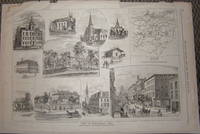
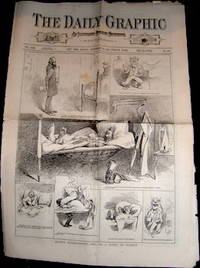
71-7678New York: The Daily Graphc June 10 1878. Wood engraving. pp. 707-708. 52 x 35 cm sheet. Good tears along sheet edges missing some areas at left and top sheet edges.Provenance: From the collection of the late Frederick G. Ruffner Jr. founder of Gale Research Detroit. New York: The Daily Graphc, June 10, 1878. unknown
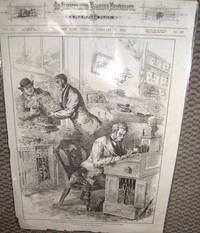
71-7600New York: The Daily Graphic: An Illustrated Evening Newspaper February 17 1874. Wood engraving. 45 x 33 cm sheet. Very Good tears along sheet edges.Provenance: From the collection of the late Frederick G. Ruffner Jr. founder of Gale Research Detroit. New York: The Daily Graphic: An Illustrated Evening Newspaper, February 17, 1874. unknown
71-7601New York: The Daily Graphic: An Illustrated Evening Newspaper September 20 1880. Wood engravings. pp. 598-608. 54 x 38 cm sheet. Very Good tears along sheet edges stain on front page sheet folded in quarters.Provenance: From the collection of the late Frederick G. Ruffner Jr. founder of Gale Research Detroit. New York: The Daily Graphic: An Illustrated Evening Newspaper, September 20, 1880. unknown
204149Brisbane: The Standard Press: 1924 First Edition. Pictorial wrappers that is paper covers pp. xvi 308 viii. Illustrated. Signed presentation copy from trainer Jack Morrison who has a chapter devoted to him in the book. First Edition. Spine sunned and chipped at its head and foot; wrappers a little soiled and worn at corners; otherwise a very good copy. unknown
Introduzione di Janine Di Giovanni, traduzione e note di Christina Pribichevich-Zoric, pagine appena ingiallite, arricchite da foto a colori nei testi e con onda verticale che interessa tutte le carte, brossura editoriale completamente illustrata, con alcune piccole abrasioni ed usura da scaffalatura. Numero pagine 200 USATO
Book is in excellent condition with light scuffing/shelf wear only to creaseless covers and spine. Binding is solid and square, covers have sharp corners, exterior shows no blemishes, text/interior is clean and free of marking of any kind. The glue in this perfect bound book is over 50 years old and is likely fragile. 161 pages, b&w full page drawings throughout depicting every day life, contents include: Life of humility, of labor, of service, of meditation, etc.
0267166516.Ghardcover. Good. Access codes and supplements are not guaranteed with used items. May be an ex-library book. hardcover
1330200446.Gpaperback. Good. Access codes and supplements are not guaranteed with used items. May be an ex-library book. paperback
1980KOS01201155TBD 1980. Soft Cover. Fine. KOS01201155 TBD paperback
2019KOS01202220Daily ones 2019. Soft Cover. Fine. KOS01202220 Daily ones paperback
1980KOS01206777TBD 1980. Soft Cover. Fine. KOS01206777 TBD paperback
1714448622.Gpaperback. Good. Access codes and supplements are not guaranteed with used items. May be an ex-library book. paperback
19612111902158301316future company 1961. Soft Cover. Fine. Number of pages: 172 p Out of print Size: Size cm: 18.7 x 13.2 x 1.1 Number of books: 1 future company paperback
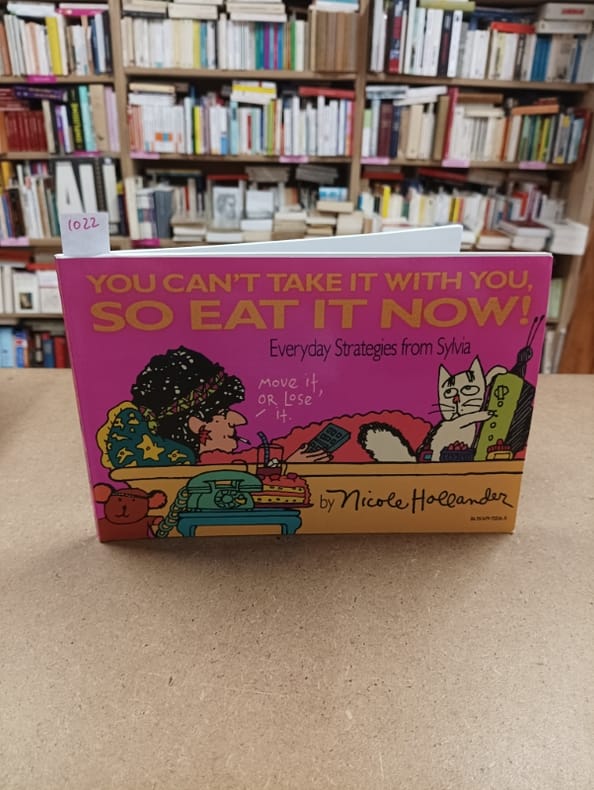
198910221989 - broché - Vintage Books, a Division of Random House, Inc. - Vintage Original - Mai 1989 - In-12 format à l'italienne (15,5 x 23 cm) broché - 127 pages - Planches en noir et blanc - ISBN : 679-72236-X / 9780679722366 - Ouvrage en anglais
1998073531D-Books Publishing Inc. 1998. Hardcover. Near Fine. Large hardcover in excellent unmarked near-pristine condition slight handling. 96 pages with vintage photographs throughout including visits to Woodland by Muhammad Ali Bill Walton and Billy Mills. 1.6 lbs <br/> <br/> D-Books Publishing, Inc. hardcover
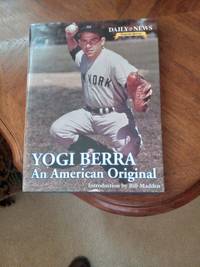
y=001<p>A large book that follows Berra throughout his career with wonderful articles by New York Daily News writers from across the decades. These include Dick Young Bill Madden Joe Trimble Phil Pepe and Mike Lupica. Signed by Berra. Condition of book and dust jacket fine.</p> hardcover
DADAX1582613397Brand: Sports Publishing LLC 0000-00-00. paperback. New. 8.04x0.57x10.56. Buy with confidence. Excellent Customer Service & Return policy. Brand: Sports Publishing LLC paperback