805 résultats
1877008666New York: Harper & Brother Publishers 1877. SCARCE in collectible condition. A lovely copy in original gilt-stamped grey beveled cloth boards all edges gilt grey end papers 12 numbered pages plus 38 plates with tissue guards illustrated frontispiece and title vignette. Very Good Plus small loss of cloth at spine ends and tips rear covers stained and soiled small tear to edge blank front end page. Copies this lovely uncommon in recent commerce. . Second American Edition . Decorative Cloth. Very Good Plus/No Jacket As Issued. Elephant Folio - over 15" - 23" tall. Harper & Brother Publishers Hardcover books
178035911France 1780. Line engraving. Proof before title state ii/iv. Image size: 16 11/16 x 12 11/16 inches. An impressive proof impression of this famous portrait of George Washington and one of the first accurate likenesses of the General to be produced in Europe.<br/> <br/>This is a remarkably rare proof impression of this fascinating portrait of George Washington and one of the earliest European prints to produce an accurate likeness of this celebrated American hero. Public curiosity for prints of Revolutionary heroes was not limited to America but spread to the English and European print shops where an inquisitive audience clamored for a glimpse of the key figures of the war. One of the first correct likenesses of Washington to make its way over to Europe was Charles Wilson Peale's magnificent painting. At this time Peale had executed a number of similar portraits of Washington and so it is impossible to determine which exact painting was taken to France. The inscription on Le Mire's print informs us that Le Paon based his portrait on a painting of Washington he saw in the collection of the Marquis de Lafayette. This verifies since Washington's countenance and stance in Le Paon's portrait and Le Mire's engraving echo Peale's fine portraits. Washington's face and uniform are identical as are his stance and gestures; his hand cupped inside his vest was used repeatedly by Peale in his series of works on the General. A very similar companion portrait of Lafayette was also executed by Le Paon and Le Mire which makes the link between Peale's painting and this image almost definitive. By adding a more complicated composition Le Mire's has converted Peale's simplified portrait to suit European taste. Washington is cloaked in the grand tradition of French portraiture. A simple background has been changed to show a military encampment and the scattered papers act as a symbol of his involvement in the Revolution. The inclusion of a horse and groomsman shows the more decorative style of French portraiture and the complex composition and meticulous details combine to create an image that reflects the taste of its European audience. In his hand Washington holds a copy of the Declaration of Independence and the Treaty of Alliance and he stands on a mound of shredded British conciliatory bills. This engraving is an indicator of Washington's image in Europe; he is pictured as a powerful military and political leader and a genteel figure whose sagacity and expertise over threw British rule in America.<br/> <br/>Hart Catalogue of Engraved Portraits of Washington 31 ii/iv; Wick George Washington an American Icon p.28-33; Fowble Two Centuries of Prints in America 1680-1880 no.81; Cresswell The American Revolution in Drawings and Prints no.229; Baker 21. unknown books
184821535London: WIlliam Smith 1848. Hardcover. Near fine. Two volumes in four extra-illustrated with the insertion of the illuminated plates from Humpheys' "Illuminated Illustrations of Froissart" in addition to the hand-colored plates of this edition. <br/> <br/>Dark green levant morocco spines in five compartments intricately gilt board tooled in gilt and blind inner dentelles gilt linen endpaper all edges gilt. Bindings signed The Knickerbocker Press and G. P. Putnam's Sons. <br/> <br/>The handcolored plates are heightened with gold and silver in imitation of the manuscript originals.<br/> <br/>A fine set handsomely bound with bright plates the spines showing only a pleasant lightening toward brown. WIlliam Smith hardcover books
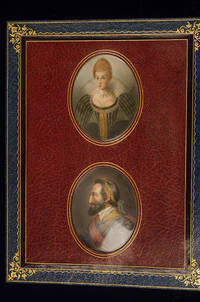
04479London and New York: Harper & Brothers 1907. A Superb Mid-Twenties Cosway-Style Binding by Bayntun of Bath with Two Fine Oval Miniatures<br/>Extra-Illustrated by the Insertion of Twenty-Five Engraved Plates of which Six are Hand-Colored<br/><br/>COSWAY-STYLE BINDING. BAYNTUN binder. WILLIAMS H. Noel. Queen Margot Wife of Henry of Navarre. With sixteen illustrations in photogravure. London and New York: Harper & Brothers 1907. <br/><br/>Quarto 9 3/8 x 7 3/8 inches; 238 x 188 mm. xviii 409 1 blank pp. Colored frontispiece and nineteen photogravure plates with tissues printed in red & brown. Extra-illustrated by the insertion of twenty-five engraved plates of which six are hand-colored.<br/><br/>Bound ca. 1925 by Bayntun stamp-signed in gilt "Bayntun. Binder. Bath. Eng." on front turn-in. Full dark blue crushed levant morocco over beveled boards covers with elaborate gilt frames spine with five raised bands elaborately decorated and lettered in gilt in compartments gilt ruled board edges wide elaborate gilt turn-ins all edges gilt. Front doublure of red morocco surrounded by a frame of inlaid maroon morocco. Set into the front doublure are two very fine oval miniature paintings set under beveled glass within a double gilt frame. The upper miniature is of Margaret de Valois Queen Margot of Navarre. The lower miniature is of her spouse Henry III of Navarre later Henry IV of France. Both miniatures measure 3 3/16 x 2 1/2 inches; 81 x 63 mm. The rear doublure is of red morocco surrounded by a frame of inlaid maroon morocco. Blue watered silk end-leaves. A very fine example housed in its original felt-lined blue cloth clamshell case.<br/><br/>Margaret of Valois 1553-1615 was a French Princess of the Valois dynasty who became Queen Consort of Navarre and later also of France. By her marriage to Henry III of Navarre later Henry IV of France she was Queen of Navarre and then France at her husband's 1589 accession to the latter throne. Their marriage was annulled in 1599 by decision of the Pope. She was the daughter of King Henry II of France and Catherine de' Medici and the sister of Kings Francis II Charles IX and Henry III. Her marriage which was to celebrate the reconciliation of Catholics and Huguenots was tarnished by the St. Bartholomew's Day massacre and the resumption of the religious troubles which ensued. In the conflict between Henry III and the Malcontents she took the side of Francis Duke of Anjou her younger brother and this caused a deep aversion of the King against her. As Queen of Navarre she also played a pacifying role in the stormy relations between her husband and the French Monarchy. Shuttled back and forth between the two courts she endeavored to lead a happy conjugal life but her sterility and the political tensions inherent in the French Wars of Religion caused the end of her marriage. Mistreated by a brother quick to take offence and rejected by a fickle and opportunistic husband she chose the path of opposition in 1585. She took the side of the Catholic League and was forced to live in Auvergne in an exile which lasted twenty years. London and New York: Harper & Brothers, 1907 unknown books
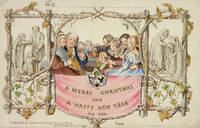
1843BBO14<p>One of 1000 copies printed it was sold for one shilling each a hefty price at the time the concept suggested by Sir Henry Cole who is best remembered as the intellectual designer of the Victoria & Albert Museum and responsible for the modern British postal system. However because the central design depicted feasting and drinking as designed by <b>John Calcott Horsley</b> the card was attacked by the Temperance League and thought to promote drunkenness so it was suppressed soon after publication and there are believed to be less than 30 examples thought to survive. The 2nd Christmas card did not get issued until three years later in 1846.<br /></p><p>The two side panels on the card illustrate images of the <i>Christmas Spirit of giving alms to the poor</i> feeding and clothing the needy. Its release literarily coincided the same week with the publication of Dickens' <i>A Christmas Carol</i> and certainly helped perpetuate the celebration of the holiday.</p><p>Printed on one side this is possibly a salesman's sample copy as an ink notation on the reverse side indicates the wholesale cost of buying multiples. It is also amongst the very best examples that survive.</p> [Joseph Cundall for Henry Cole, December books