883 résultats
1856R66464Parisiis [Paris] / Petit-Montrouge, apud Ludovicum Vivès / J.-P. Migne 1856-1878 (1963) / 1858 'Opera omnia' complete in 28 volumes: 26 volumes + 2 volumes of indices, text in latin, original 1856-1878-edition (except 'Indices'), Editio nova (second edition, the first of which was printed in 1740-1751 in Venice), 27cm., text printed in 2 columns, all vols. including the compendium are uniformely bound (cart.cover with marbled plates, gilt lettering & decorations on leather spines, marbled endpapers) except for the indices (vols.27-28, anastatic reprint of the Paris 1878-edition: Bruxelles, Culture et civilisation, 1963, 29cm., full cloth), few foxing, small library stamp at titlepages, nice set in a beautiful binding, to which is added: 'Summa seu Compendium' by Fr.Noel (complete in 2 volumes, original Migne-edition of 1858), [Opera omnia: cfr. De Backer & Sommervogel, VII col.1680 no.24, Suarez Franciscus S.J., Grenada 1548 - Lisbon 1617 / Compendium: cfr. De Backer & Sommervogel V col.1793 no.12, Franciscus Noel, Hestrud 1651 -Lille 1729], R66464
1888g5899London: Vizetelly & Co. G: in Good condition without dust jacket. Boards lightly rubbed and bumped with slight lean to spine. Tissue guard missing from frontispiece. Rear endpaper missing. 1888. Reprint unexpergated edition. Brown decorated hardback cloth cover with gilt titles. 190mm x 130mm 7" x 5". 392pp. This seemingly insignificant book is from the Mermaid Series of Best Plays of the Old Dramatists belonged to Aubrey Beardsley. On the ffep a hand drawn bookplate by Aubrey Beardsley is pasted dated Xmas 1888. On the half title page there is the signature A V Beardsley Xmas 1888. On the reverse of the frontispiece in the top corner is an ink stamp BEARDSLEY. . Vizetelly & Co hardcover
184821535London: WIlliam Smith 1848. Hardcover. Near fine. Two volumes in four extra-illustrated with the insertion of the illuminated plates from Humpheys' "Illuminated Illustrations of Froissart" in addition to the hand-colored plates of this edition. <br/> <br/>Dark green levant morocco spines in five compartments intricately gilt board tooled in gilt and blind inner dentelles gilt linen endpaper all edges gilt. Bindings signed The Knickerbocker Press and G. P. Putnam's Sons. <br/> <br/>The handcolored plates are heightened with gold and silver in imitation of the manuscript originals.<br/> <br/>A fine set handsomely bound with bright plates the spines showing only a pleasant lightening toward brown. WIlliam Smith hardcover books
184821535London: WIlliam Smith 1848. Hardcover. Near fine. Two volumes in four extra-illustrated with the insertion of the illuminated plates from Humpheys' "Illuminated Illustrations of Froissart" in addition to the hand-colored plates of this edition. <br /> <p><br /> Dark green levant morocco spines in five compartments intricately gilt board tooled in gilt and blind inner dentelles gilt linen endpaper all edges gilt. Bindings signed The Knickerbocker Press and G. P. Putnam's Sons. <br /> <p><br /> The handcolored plates are heightened with gold and silver in imitation of the manuscript originals.<br /> <p><br /> A fine set handsomely bound with bright plates the spines showing only a pleasant lightening toward brown.<br /> <p>. WIlliam Smith hardcover
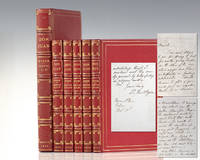
1819142573London: Thomas Davison i.e. John Murray 1819-1821 Cantos I-V Volumes I-II/John Hunt 1823-24 Cantos VI-XVI Volumes III-VI. Scarce complete first edition set of Byron's great work which was widely criticized as immoral upon publication and is now considered one of the greatest poems of the Romantics; from the library of American writer Erica Jong. Volume one was produced in quarto format and the subsequent 5 volumes in octavo Davison abandoned the quarto format after disappointing sales of the first volume six volumes uniformly bound in full morocco with gilt titles and tooling to the spine double gilt ruling to the front and rear panels gilt inner dentelles marbled endpapers all edges gilt. With an autograph letter signed by Lady Byron bound into the first volume. Written from Moore Place Esher the letter reads in part "Dear Sir I am much obliged to you for offering to look for another young Teacher in place of the one who is engaged but I have no difficulty in finding a Substitute. I should however be glad if you could find me an older master for a situation in Warwickshire - to manage a day-school on the Garden plan for Bogs - the emolument would not exceed 20 to 24 pounds with Board - He would be under the direction of a very good Clergyman - A single man would be preferred there being no room at the Schoolhouse for him - she must lodge at some distance. Lady Olivia Sparrow is still active in her charitable undertakings though I sometimes wish they were less governed by hasty feelings in religious matters. Yours truly A.I. Noel Byron Moore Place Esher Nov 19th." From the library of Erica Jong. Jong remains best known for her 1973 novel Fear of Flying which became famously controversial for its portrayal of female sexuality and figured prominently in the development of second-wave feminism. Written in the first person and narrated by its protagonist 29-year-old American poet Isadora Wing Fear of Flying was written in the throes of the Sexual Revolution of the 1970s and encapsulated the movement’s redefinition of female sexuality. In interviews Jong stated: “At the time I wrote Fear of Flying there was not a book that said women are romantic women are intellectual women are sexual—and brought all those things together… What Isadora is looking for is how to be a whole human being a body and a mind and that is what women were newly aware they needed in 1973.†The novel remains a feminist classic and has sold more than 20 million copies worldwide. Jong notable used a quotation from Don Juan as the epigraph in Fear of Flying "Alas! the love of women! it is known To be a lovely and a fearful thing; For all of theirs upon that die is thrown And if 'tis lost life hath no more to bring To them but mockeries of the past alone And their revenge is as the tiger's spring Deadly and quick and crushing; yet as real Torture is theirs -- what they inflict they feel. They are right; for man to man so oft unjust Is always so to women; one sole bond Awaits them -- treachery is all their trust; Taught to conceal their bursting hearts despond Over their idol till some wealthier lust Buys them in marriage -- and what rests beyond A thankless husband -- next a faithless lover -- Then dressing nursing praying -- and all's over. Some take a lover some take drams or prayers Some mind their household others dissipation Some run away and but exchange their cares Losing the advantage of a virtuous station; Few changes e'er can better their affairs Theirs being an unnatural situation From the dull palace to the dirty hovel: Some play the devil and then write a novel" Lord Byron Don Juan 1824. In fine condition. Scarce and with fine provenance. "The War and Peace of English poetry Don Juan contains an epic sweep that moves from Spain to the East and to Russia before ending in England… At the same time that Byron's broad canvas foretells the scope of the great 19th-century novels the poet's own sensibilities echo the picaresque 18th-century novels of his early reading Smollett and Fielding with their bawdy humor and sly inversions of vice and virtue. Unlike these prose narratives however Don Juan has no beginning middle or end. It draws us in not to learn 'what happens next' but to hear what this seductive confidential teasing voice is going to tell us" Eisler 610. When Cantos I through V appeared they did so without the name of either author or publisher on the title page. Publisher John Murray refused to print Byron's dedicatory poem which ridiculed English poet laureate Robert Southey and Byron refused to put his name on a censored publication. Because of Byron's change from his long-standing publisher Murray to John Hunt brother of writer Leigh Hunt midway through Don Juan complete first-edition copies with all cantos are scarce. Thomas Davison [i.e., John Murray] unknown
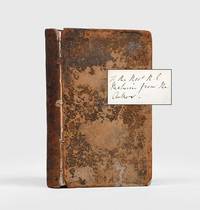
1816174164London: John Murray 1816. Inscribed by Byron to inspire his fellow writer and later by Maturin in memory of his friend Presentation copy of Childe Harold's Pilgrimage inscribed by Byron on the half-title "To the Revd R. C. Maturin from the Author". Following Byron's death in 1824 Maturin inscribed a quatrain from a contemporary poem by James Montgomery on the rear free endpaper in memoriam: "Friend after friend departs; / Who hath not lost a friend / There is no union here of hearts / That hath not here an end". Byron and Maturin enjoyed a warm literary friendship beginning in December 1815 when they were introduced by Walter Scott. That month Maturin sent Byron the manuscript for his Gothic tragedy Bertram. Byron adored the play writing to John Murray that he received the manuscript "late in the evening and read it through without being able to stop" Murray letter to Scott 25 December 1815. In a letter to Maturin he praised the work as "a very extraordinary production - of great & singular merit as a composition" 22 December 1815. Byron helped Maturin bring his work to the stage sending the manuscript to George Lamb with whom he managed the Drury Lane Theatre Lamb like Byron read the play by candlelight and "could not go to bed without finishing it". Despite his enthusiasm for Maturin's tragedy Byron found himself exiled from England from April 1816 and never saw the play performed. His Childe Harold was nonetheless an important influence on its success: "Bertram undoubtedly benefitted from the great popularity of Byron's Childe Harold's Pilgrimage the first two cantos of which had been published in 1812 for the hero of Maturin's play was spoken of by a number of contemporary critics as a 'Byronic figure'" Lougy p. 45. The play became Maturin's first critical and commercial success and his touching inscription at the rear of the volume reveals the gratitude and affection he felt for the poet. This copy of Childe Harold is from the 1816 edition of Byron's collected works. Vol. I of IV only duodecimo 165 x 106 mm. Engraved plate by Thomas Stothard with tissue facing p. 10. Contemporary unlettered calf. Housed in a custom brown quarter morocco folding box by the Chelsea Bindery. Book label of J. O. Edwards to front pastedown. Binding worn front joint cracked but cords firm contents clean. A good copy in unrestored condition. Robert E. Lougy Charles Robert Maturin 1975. unknown
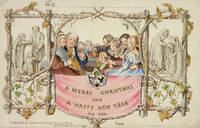
1843BBO14<p>One of 1000 copies printed it was sold for one shilling each a hefty price at the time the concept suggested by Sir Henry Cole who is best remembered as the intellectual designer of the Victoria & Albert Museum and responsible for the modern British postal system. However because the central design depicted feasting and drinking as designed by <b>John Calcott Horsley</b> the card was attacked by the Temperance League and thought to promote drunkenness so it was suppressed soon after publication and there are believed to be less than 30 examples thought to survive. The 2nd Christmas card did not get issued until three years later in 1846.<br /></p><p>The two side panels on the card illustrate images of the <i>Christmas Spirit of giving alms to the poor</i> feeding and clothing the needy. Its release literarily coincided the same week with the publication of Dickens' <i>A Christmas Carol</i> and certainly helped perpetuate the celebration of the holiday.</p><p>Printed on one side this is possibly a salesman's sample copy as an ink notation on the reverse side indicates the wholesale cost of buying multiples. It is also amongst the very best examples that survive.</p> [Joseph Cundall for Henry Cole, December books
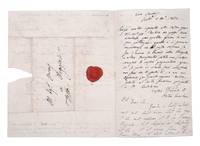
1823352339Cephalonia 1823. 3 pp. on a single sheet bifolium with address To Msgr Stevens Argostoli. 8vo. Small tear above signature from opening wax seal still present. Old docketing in French. 3 pp. on a single sheet bifolium with address To Msgr Stevens Argostoli. 8vo. A notable Byron letter showing his commitment to join the armed struggle in Greece just before he left Cephalonia for the Greek mainland. As is frequently the case Byron writes beneath a letter from Count Gamba whose sister was Byron's mistress Countess Guiccioli addressed "Caro Stevens". The correspondent George Stevens was a customs official at Argostoli on Cephalonia and a recipient of several letters from Byron in 1823.<br /> <br /> "P.S. Dear sir Gamba is half asleep and and sic don't know what he says. I do not suppose it to be Parry's Brigade - but whoever or whatever it be - if it came from the committee I will attend to it with all diligence. The boats had better be engaged because if this intelligence is not confirmed I must sail at any rate and even if it be I shall sail as soon as possible after communicating with the vessels on their voyage which if my instructions do not err or I for them are committed to my direction. I do not perceive however how a ship directed to Greece Continental from London can touch at Ancona in its propoer course unless it has continued to pass the Alps by Steam or a special wind of Providence added to a new Deluge. But whether correct or otherwise the repeat of our friend Count Delladecima believe that I am ever and truly ."<br /> <br /> Byron had been staying on Cephalonia since August. Edward Trelawny his opportunistic and self-aggrandizing sometime travelling companion had gone to Greece in September and was soon converted to another faction in the Greek struggle for independence. In November Byron was besieged by requests for money and a week after this letter would pledge large sums to the cause. Here he demonstrates a considerable flash of wit and knowledge of current technology as he reminds his correspondent of the realities of Italian geography and suggests Steam power or a new Deluge as the only possible explanation for a proposed itinerary Ancona is on the Adriatic far to the north of Cephalonia.<br /> <br /> As the representative of the London Greek Committee "Byron remained in Cephalonia with Pietro Gamba multiplying his Greek contacts and assessing information he was gathering as a prelude to action. When Prince Alexander Mavrocordatos who eventually became first president of independent Greece moved to Missolonghi in December he invited Byron to join him and his forces" ODNB. Byron and Gamba departed from Argostoli on 29 December 1823. Gamba's vessel was captured and briefly held by the Turks; Byron reached Missolonghion 4 January 1824.<br /> <br /> This letter was previously known only in an excerpt from the description in catalogue 44 of F. Naylor July 1878 incorrectly dated to May and lacking the name of the correspondent published in A Heart for Every Fate: Byron's Letters and Journals Vol. 10 1980 pp. 161-162.<br /> <br /> A CHOICE BYRON LETTER FROM JUST BEFORE HIS FATEFUL EXPEDITION TO MISSOLONGHI. Marchand 10:161-2 a partial transcription misdated to May 1823 unknown