Denis DiderotBiblio.com
2 127 résultats
0260459143.Ghardcover. Good. Access codes and supplements are not guaranteed with used items. May be an ex-library book. hardcover
0266074618.Gpaperback. Good. Access codes and supplements are not guaranteed with used items. May be an ex-library book. paperback
0266120679.Gpaperback. Good. Access codes and supplements are not guaranteed with used items. May be an ex-library book. paperback
1334868956.Gpaperback. Good. Access codes and supplements are not guaranteed with used items. May be an ex-library book. paperback
048324080X.Ghardcover. Good. Access codes and supplements are not guaranteed with used items. May be an ex-library book. hardcover
1922mon0004077072Paris: Edouard Pelletan 1922. Hardcover. Very Good. . half-leather cover in red with marbled boards and gilt shows minimal wear. top edges gilt marbled endpapers. pages tanned and clean. Paris: Edouard Pelletan hardcover
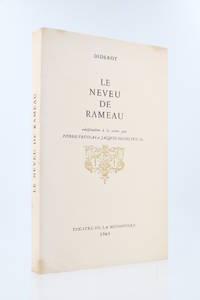
196380123Paris: Théâtre de la Michodière 1963. Fine. Théâtre de la Michodière Paris 1963 14.50 x 23 cm broché First edition of the theatrical adaptation by Pierre Fresnay and Jacques-Henri Duval one of 100 numbered copies on pure rag Arches laid paper deluxe copy. Two small light sunning marks to spine without significance. Handsome copy. Théâtre de la Michodière unknown
182139082Paris: Delauney and J.L.J. Brière 1821. THE TWO FIRST EDITIONS OF DIDEROT'S GREATEST LITERARY AND PHILOSOPHICAL MASTERPIECE. The first item published by Delaunay in 1821 is actually a re-translation into French of Goethe's German translation. vii 262 pp complete with the publisher's catalogue and the frontispiece depicting the title character with a crazed expression. The second item published in 1823 but dated 1821 is the first edition of the true French text. 3 XXVII 394 pp complete with the "table chronologique des uvres de Diderot" which is often missing. 8vos. The first item is bound late 19th-century three-quarters morocco and decorated boards. ORIGINAL WRAPS AND BACKSTRIP PRESERVED. Top edge gilt other edges uncut. A bit of wear to extremities of binding but internally fine and bright. The second item is bound in recent white ivory boards. Some discoloration to paper as always but otherwise fine and bright. AN OUTSTANDING SET OF THE TWO FIRST EDITIONS OF ONE OF THE GREAT MASTERPIECES OF THE EUROPEAN LITERARY TRADITION. <br/><br/> Delauney [and] J.L.J. Brière paperback
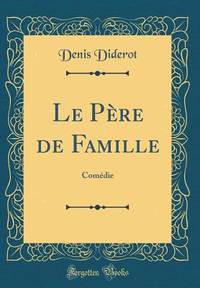
175937978à Amsterdam: Chez Marc-Michel Rey 1759. Fine. Chez Marc-Michel Rey à Amsterdam 1759 9 x 16.50 cm relié New edition after the first published in 1758. Full glazed blonde sheep binding. Spine with raised bands decorated with 4 fleurons in compartments; roulette at foot. Red morocco title label. Upper joint cracked. Corners slightly bumped. Headcap amateurishly restored. This play Diderot's second published work after Le Fils naturel in 1757 for which he was accused of plagiarizing Goldoni and which would not be performed until 1761 marks a remarkable turning point in the history of theater. Advocating a natural and realistic plot based on contemporary characters Diderot developing his ideas in the essay that follows the play invents bourgeois drama and definitively disrupts traditional dramaturgy. Chez Marc-Michel Rey hardcover
0656908548.Ghardcover. Good. Access codes and supplements are not guaranteed with used items. May be an ex-library book. hardcover
194739236Paris: Editions du Val de Loire 1947. Two volumes complete. A wonderful example of art déco erotica like many books illustrated by Dulac with 38 explicit original color etchings. Edition limited to 298 numbered copies beautifully printed on Rives laid paper. THIS IS A SPECIAL COPY PRINTED FOR THE ARTIST AND SIGNED BY HIM. It includes THE ORIGINAL DRAWING FOR ONE OF THE ETCHINGS a hand-colored proof for another etching with colors very different from those eventually used and the 4-leaf 8-page appendix with the two planches refusées. Large 8vo. Loose as issued in original wraps. FINE AND BRIGHT in the original lightly worn board chemises and slipcase. <br/><br/> Editions du Val de Loire paperback
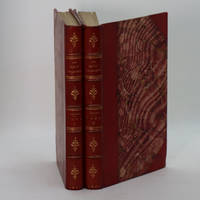
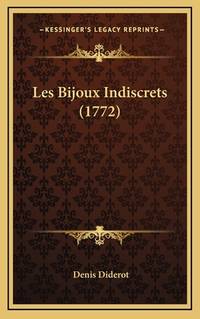
1881FB920 (1 & 2) /6A<p>Red leather spine and corners. Red marbled boards. Gilt lettering and banding on the spine. No 499 of a limited edition of 500. Dimensions are for one volume. Could be described as early humorous pornography <strong> In French</strong></p><p><strong><em>The Indiscreet Jewels</em></strong> or <strong><em>The Indiscreet Toys</em></strong> or <strong><em>The Talking Jewels</em></strong>; French: <strong><em>Les Bijoux indiscrets</em></strong> is the first novel by Denis Diderot published anonymously in 1748. It is an allegory that portrays Louis XV of France as Mangogul Sultan of Congo who owns a magic ring that makes women's vaginas "jewels" talk. The character of Mirzoza represents Louis XV's mistress Madame de Pompadour. Diderot portrayed Pompadour in a flattering light in <em>The Indiscreet Jewels</em> most likely to ensure her support for his <em>Encyclopedie.</em> <em>'Sultan Mangogul of Congo is bored with life at court and suspects his mistress Mirzoza of infidelity. A genie presents him with a magical ring that has unique properties. When the ring is rubbed and pointed at the vagina of any woman the vagina begins speaking about its amorous experiences to the confusion and consternation of its owner. The Sultan uses the ring about thirty times usually at a dinner or other social gathering and on these occasions the Sultan is typically visible to the woman. However since the ring has the additional property of making its owner invisible when required a few of the sexual experiences are recounted through direct observation as the Sultan makes himself invisible in the unsuspecting woman's boudoir.'</em></p><p><strong>Denis Diderot</strong> 5 October 1713 – 31 July 1784 was a French philosopher art critic and writer best known for serving as co-founder chief editor and contributor to the <em>Encyclopédie</em> along with Jean le Rond d'Alembert. He was a prominent figure during the Age of Enlightenment. Diderot initially studied philosophy at a Jesuit college then considered working in the church clergy before briefly studying law. When he decided to become a writer in 1734 his father disowned him. He lived a bohemian existence for the next decade. In the 1740s he wrote many of his best-known works in both fiction and non-fiction including the 1748 novel <em>The Indiscreet Jewels</em>. In 1751 Diderot co-created the <em>Encyclopédie</em> with Jean le Rond d'Alembert. It was the first encyclopedia to include contributions from many named contributors and the first to describe the mechanical arts. Its secular tone which included articles skeptical about Biblical miracles angered both religious and government authorities; in 1758 it was banned by the Catholic Church and in 1759 the French government banned it as well although this ban was not strictly enforced. Many of the initial contributors to the <em>Encyclopédie</em> left the project as a result of its controversies and some were even jailed. D'Alembert left in 1759 making Diderot the sole editor. Diderot also became the main contributor writing around 7000 articles. He continued working on the project until 1765. He was increasingly despondent about the <em>Encyclopédie</em> by the end of his involvement in it and felt that the entire project might have been a waste. Nevertheless the <em>Encyclopédie</em> is considered one of the forerunners of the French Revolution. Diderot struggled financially throughout most of his career and received very little official recognition of his merit including being passed over for membership in the Académie française. His fortunes improved significantly in 1766 when Empress Catherine the Great who heard of his financial troubles paid him 50000 francs to serve as her librarian. He remained in this position for the rest of his life and stayed a few months at her court in Saint Petersburg in 1773 and 1774. Diderot's literary reputation during his life rested primarily on his plays and his contributions to the <em>Encyclopédie</em>; many of his most important works including <em>Jacques the Fatalist Rameau's Nephew</em> <em>Paradox of the Actor</em> and <em>D'Alembert's Dream</em> were published only after his death.</p><p>The <strong>Age of Enlightenment</strong> also known as the <strong>Age of Reason</strong> or simply <strong>the Enlightenment</strong> was an intellectual and philosophical movement that dominated the world of ideas in Europe in the 17th and 18th centuries. The Enlightenment included a range of ideas cantered on the value of human happiness the pursuit of knowledge obtained by means of reason and the evidence of the senses and ideals such as liberty progress toleration fraternity constitutional government and separation of church and state. The Enlightenment has its roots in a European intellectual and scholarly movement known as Renaissance humanism and was also preceded by the Scientific Revolution and the work of Francis Bacon among others. Some date the beginning of the Enlightenment back to the publication of René Descartes' <em>Discourse on the Method</em> in 1637 featuring his famous dictum <em>Cogito ergo sum</em> "I think therefore I am". Others cite the publication of Isaac Newton's <em>Principia Mathematica</em> 1687 as the culmination of the Scientific Revolution and the beginning of the Enlightenment. European historians traditionally date its beginning with the death of Louis XIV of France in 1715 and its end with the 1789 outbreak of the French Revolution. Many historians now date the end of the Enlightenment as the start of the 19th century with the latest proposed year being the death of Immanuel Kant in 1804. Philosophers and scientists of the period widely circulated their ideas through meetings at scientific academies Masonic lodges literary salons coffeehouses and in printed books journals and pamphlets. The ideas of the Enlightenment undermined the authority of the monarchy and the Catholic Church and paved the way for the political revolutions of the 18th and 19th centuries. A variety of 19th-century movements including liberalism communism and neoclassicism trace their intellectual heritage to the Enlightenment. In France the central doctrines of the Enlightenment philosophers were individual liberty and religious tolerance in opposition to an absolute monarchy and the fixed dogmas of the Church. The Enlightenment was marked by an emphasis on the scientific method and reductionism along with increased questioning of religious orthodoxy—an attitude captured by Immanuel Kant's essay <em>Answering the Question: What is Enlightenment</em> where the phrase <em>Sapere aude</em> Dare to know can be found.</p> Gay & Douce. hardcover
A9781165572045New. unknown
A9781165547982New. unknown
B9781727838596Paperback / softback. New. paperback
B9781165572045New. unknown
B9781165547982New. unknown
1334636303.Gpaperback. Good. Access codes and supplements are not guaranteed with used items. May be an ex-library book. paperback
193072837Paris: Gallimard 1930. Fine. Gallimard Paris 1930 14.50 x 22.50 cm 3 volumes brochés Edition with most parts in first edition one of the numbered copies on laid paper the only deluxe copies after 79 Japan. Introduction variants and notes by André Babelon. Spines slightly sunned otherwise a handsome complete set in three volumes. Gallimard unknown
0266455255.Ghardcover. Good. Access codes and supplements are not guaranteed with used items. May be an ex-library book. hardcover
025902094X.Gpaperback. Good. Access codes and supplements are not guaranteed with used items. May be an ex-library book. paperback
0483182109.Ghardcover. Good. Access codes and supplements are not guaranteed with used items. May be an ex-library book. hardcover
45483882like new. unknown
1972015230Milano: Longanesi 1972. Un volume 195 cm di 495-7 pagine; 9 illustrazioni fuori testo. Il testo segue l'autografo originale conservato a Mosca. Introduzione bibliografia e note di Paul Vernière. Traduzione di Maria Vasta Dazzi. Tela editoriale con acetato in cofanetto rigido illustrato nella collana I Cento Libri. Edizione numerata di milleduecento copie su carta d'India e cinquanta con numerazione romana per uso interno della casa editrice questo il n. VI. Ottime condizioni. Longanesi unknown
0656668644.Ghardcover. Good. Access codes and supplements are not guaranteed with used items. May be an ex-library book. hardcover