151 résultats
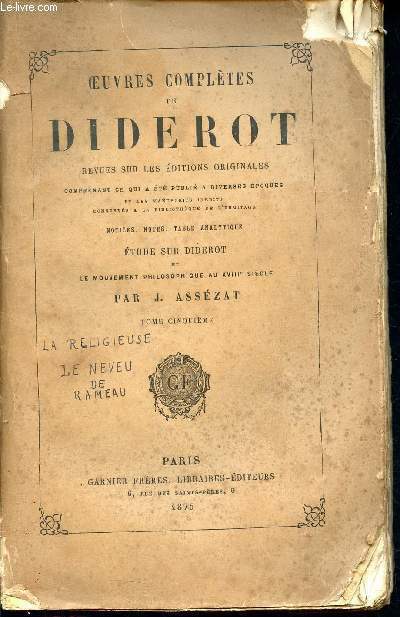
1875177963Paris, Freres, 1875. LXVIII, 492 S. Hldrbd. d. Zt. m. Rückengoldtit. u. kl. Rsign. Einbd. bestoßen. Mehr. St. a. Tit. (Oeuvres complètes de Diderot, Philosophie; 1)
187977381Paris:: D. & J. L. D'Alambert. ca. 1879-70. modern cloth. Some light staining around the edges of just one engraved plate; otherwise fine. Folio. 12 engraved plates depicting a variety of earthenware forms kilns tools moulds racks etc. D. & J. L. D'Alambert. hardcover
182119877Paris, J.L.J. Brière, 1821-1823 ; 22 tomes. Suivi de : Mémoires, correspondance et ouvrages inédits de Diderot, publiés d’après les manuscrits confiés, en mourrant par l’Auteur à Grimm. Deuxième édition augmentée. Paris, Paulin, 1834, 4 tomes, soit en tout 26 tomes in-8 en reliure uniforme : demi-veau fauve, dos à nerfs décoré et doré, pièces d’auteur et de tomaison rouge et de titre vert empire, tête dorée. Cet ensemble comprend :T1-2 : Philosophie, avec la préface de Naigeon dans l’édition de 1798. Frontispice : Portrait de Denis Diderot par Mme Therbouche 1823, gravé par Bertonnier ; planche I et II dépliante montrant le système de Saunderson (pour les aveugles) ; 3 planches HT au tome II ; les quatre textes en fin de volume sont aujourd’hui attribués à Mme D’Epinay.T3 : Mélanges de littérature et de philosophie.T4 : Théâtre.T5-6-7 : Romans et Contes.T8-9-10 : Salons ; Mathématiques.T11-12 : Essai sur les règnes de Claude et de Néron ; Essai sur les études en Russie ; Plan d’une université pour le gouvernement de Russie ; Correspondance.T13 à 20 : Dictionnaire encyclopédique. T1 p.20 Tableau dépliant du Système figuré des connaissances humaines. Histoire complète de l’Encyclopédie et table des matières et table générale des articles.T21 : Oeuvres inédites de Diderot : Le Neveu de Rameau. Voyage de Hollande. Correspondance. Table générale et analytique des matières contenues dans les Oeuvres de Diderot.T22 : Mémoires historiques et philosophiques sur la Vie et les Ouvrages de D. Diderot par J.A. Naigeon. A la mémoire de D. Diderot par M. de Meister, 1786.T23-26 : Mémoires pour servir à l’histoire de la vie et des ouvrages de Diderot, par Madame de Vandeul, sa fille. Mémoires de Diderot. Lettres à Mademoiselle Voland de 1759 à 1774. Voyage à Bourbonne et à Langres. Correspondance avec Falconet. Paradoxe sur le comédien. Entretien entre D’Alembert et Diderot. Rêve de D’Alembert. La Promenade du sceptique ou les Alliées, 1747. Est-il bon ? Est-il méchant ? ou l’officieux persifleur.
1892B120Paris, Dentu, 1892 ; in-32, 329 pp., relié demi-veau brun, dos lisse. Denis Diderot, né le 5 octobre 1713 à Langres et mort le 31 juillet 1784 à Paris, est un écrivain, philosophe et encyclopédiste français des Lumières, à la fois romancier, dramaturge, conteur, essayiste, dialoguiste, critique d'art, critique littéraire, et traducteur. Diderot est reconnu pour son érudition, son esprit critique et un certain génie. Il laisse son empreinte dans l'histoire de tous les genres littéraires auxquels il s'est essayé : il pose les bases du drame bourgeois au théâtre, révolutionne le roman avec Jacques le Fataliste, invente la critique à travers ses Salons et supervise la rédaction d'un des ouvrages les plus marquants de son siècle, la célèbre Encyclopédie. En philosophie également, Diderot se démarque en proposant plus de matière à un raisonnement autonome du lecteur plutôt qu'un système complet, fermé et rigide. Illustrations de Marold et Mittis. Bon état.
187911958Paris Hachette et Cie 1879 In-8 369 pp, caissons décorés et filets simples estampés au dos, décors estampés à froid sur les plats passés et frottés. Rousseurs et mouillure claire, surtout en début de volume.
1875R200118467Garnier frères. 1875. In-8. Broché. Etat d'usage, 1er plat abîmé, Dos abîmé, Quelques rousseurs. pages. Coiffes abîmées. Annotation sur le 1er plat.. . . . Classification Dewey : 840.05-XVIII ème siècle
1813mon0003477182Paris: Longchamps; F. Buisson 1813. Hardcover. Very Good. . 16-volume set complete. Uniformly bound with green leather spines marbled boards gilt lettering and decoration. Pages lightly tanned with occasional minor scattered foxing. Slight rubbing to the boards and spine ends. Paris: Longchamps; F. Buisson hardcover
1813033116Paris: F. Buisson 1813. Book. Near Fine. Hardcover. First Edition. 8vo 18.5 x 12.5 cm. complete set of 15 volumes published from 1812 - 1813 portrait frontispiece to vol. 1 series two. The set comprising of; First series 1813 Longchamps & F. Buisson Paris depuis 1753 jusqu'en 1769 in 6 volumes. Second series 1812 Seconde Edition revue et corrigee F. Buisson Paris depuis 1770 Jusqu'en 1782 in 4 volumes . Third series 1813 F Buisson Paris pendant une partie des annees 1775 - 1776 et pendant les annees 1782 a 1790 inclusivement in 5 volumes. Attractively bound in half leather ornate bright gilt decoration to spine compartments two contrasting title labels on the spine. Binding fine and Content clean and tight A near fine complete frontispiece plate title page and numerous engraved plates. Bound in red leather with marbled covered boards page edges marbled six gilt decorated spine compartments with two contrasting leather title labels. Bindings near fine strong with very little sign of wear and rubbing joints firm no cracking. now with protective archival removable wrappers. Contents clean and tight a little toning to some blank pages private book plate belonging to Sir John Stuart Forbes no inscriptions or other marks. A near fine attractive set. Sir John Stuart Hepburn Forbes 8th Baronet of Monymusk of Fettercairn and Pitsligo FRSE 1804-1866 was a Scottish baronet landowner advocate and agriculturalist. F. Buisson Hardcover
1813RO80189877F.BUISSON. 1813. In-8. Cartonné. Etat d'usage, Plats abîmés, Dos satisfaisant, Quelques rousseurs. 699 Pages. Quelques rousseurs et mouillures sans conséquence pour la lecture. Déchirures et taches sur les plats. Nombreuses taches.. . . . Classification Dewey : 840.08-XIX ème siècle
1813R240160695Longchamps/F. Buisson. 1813. In-8. Relié. Etat d'usage, Coins frottés, Dos abîmé, Quelques rousseurs. VII + 509 pages. Dos frotté, coiffes abîmées, mors légèrement fendus par endroits.. . . . Classification Dewey : 846-Lettres, correspondance littéraire
181277785Paris, F. Buisson, Libraire, 1812, 1813, in-8, demi-basane, dos long, décor et titre à l'or, Les volumes se décomposent en trois séries classées par années : Tome I. Première partie : Depuis 1753 jusqu'en 1769 (509p.). Tome II. Première partie : Depuis 1753 jusqu'en 1769 (478p.). Toem III. Première Partie : Depuis 1753 jusqu'en 1769 (550p.). Tome IV. Première Partie : Depuis 1753 jusq'en 1769 (571p.). Tome V. Première Partie : Depuis 1765 jusqu'en 1768 (564p.). Tome VI : Première Partie : Depuis 1753 jusq'en 1769 (559p.), Tables in fine. Tome PREMIER : Depuis 1770 jusqu'en 1782 (515p.). Tome SECOND : Depuis 1770 jusqu'en 1782 (525p). Tome TROISIEME : Depuis 1770 jusqu'en 1782 (440p.). Tome QUATRIEME : Depuis 1770 jusqu'en 1782 (394p.). Tome CINQUIEME : Depuis 1770 jusqu'en 1782 (397P.), in fine Table générale des cinq volumes de cet ouvrage. Tome I. Troisième et Dernière partie : une partie des années 1775-1776, et pendant les années 1782 à 1790 inclusivement (512p.). Tome II. Troisième et dernière Partie : Pendant une partie des années 1775-1776, et pendant les années 1782 à 1790 exclusivement (557p.). Tome III. Troisième et dernière Partie : Pendant une partie des années 1775-1776, et pendant les années 1782 à 1790 inclusivement (574p.). Tome IV. Troisième et dernière Partie : Pendant une partie des années 1775-1776, et pendant les années 1782 à 1790 inclusivement (694p.). Tome V. Troisième et dernière Partie : Pendant une partie des années 1775-1776, et pendant les années 1782 à 1790 inclusivement (699p.), in fine Table des Articles contenus dans ce cinquième volume et Table générale. Supplément contenant : 1. Les Opuscules de Grimm. 2. Treize lettres de Grimm à Frédéric II, Roi de Prusse. 3. Plusieurs morceaux de la Correspondande de grimm, qui manquent aux 16 volumes. 4. Des Remarques sur les 16 volumes, par Ant.-Alex. Barbier, Bibliothécaire de S.M. l'Empereur et Ri, et de son conseil d'Etat (424p.).Importantes épidermures aux dos, un manque en tête du tome 5. 1ere partie. Rousseurs variables selons les volumes. Bons exemplaires. Solides.
18069095Leipzig, Friedrich Gotthelf Baumgärtner, 1797, 1801, 1806. Halbledereinbände, Lederecken, blaue [Bd.3 marmorierter] Deckel, Farbschnitt, montierte Rückenschildchen 8°, 1: XXIV, 734 S., 2 gefaltete Tafeln/ 2: 717 S., 1 Bl, 2 gefaltete Tafeln/ 3: 798 S., 2 gefaltete Tafeln/ 4.1: VI, 312 S.; 4.2: XVI, 388 S., 2 Bl; -Deckel berieben und mit kleineren Beschädigungen, Papier in Bd 4 stärker gebräunt, Tafeln und Papier überwiegend in sehr gutem Zustand, Bände 1+2 einheitlich gebunden, Bde 3+4 leicht abweichend / half leather, leather corners, a.e.m., mounted back-plates, 8vo, 1: XXIV, 734 pp., 2 folded sheets / 2: 717 pp., 1 leaf, 2 folded sheets / 3: 798 pp, 2 folded sheets/ 4.1: VI, 312 pp., 4.2: XVI, 388 pp., 2 leaves; -boards rubbed and with small damages, paper browned in vol 4, plates and paper in very good condition, vol 1+2 with a uniform binding, vol 3+4 with slight differences.
1881RO40006548Bibliothèque nationale. 1881. In-18. Broché. Etat d'usage, Couv. légèrement passée, Dos satisfaisant, Rousseurs. 192 pages. Coiffes abîmées. Non coupé. Tampon sur le premier plat.. . . . Classification Dewey : 34.1-Encyclopédie Diderot Alembert
1879R260129886LIBRAIRIE DES BIBLIOPHILES. 1877-1879. In-12. Broché. A relier, Couv. légèrement passée, Dos abîmé, Intérieur frais. 5 vulumes d'environ 300 pages chacuns. Dos des tomes 1, 3 et 5 coupés. Légers manques au dos fanés.. . . . Classification Dewey : 840-Littératures des langues romanes. Littérature française
185260249Paris typographie Panckoucke 1852 1 vol. relié in-8 (208 x 128 mm), cartonnage demi-toile grise, 117 pp. Complet des deux livraisons extraites du Compte-rendu de l'Académie des sciences morales et politiques de janvier et de février-mars 1852. Petit manque de papier angulaire aux dix premiers et dix derniers feuillets. Sinon bon état général, dans une agréable reliure toilée moderne. Rare.
182139082Paris: Delauney and J.L.J. Brière 1821. THE TWO FIRST EDITIONS OF DIDEROT'S GREATEST LITERARY AND PHILOSOPHICAL MASTERPIECE. The first item published by Delaunay in 1821 is actually a re-translation into French of Goethe's German translation. vii 262 pp complete with the publisher's catalogue and the frontispiece depicting the title character with a crazed expression. The second item published in 1823 but dated 1821 is the first edition of the true French text. 3 XXVII 394 pp complete with the "table chronologique des uvres de Diderot" which is often missing. 8vos. The first item is bound late 19th-century three-quarters morocco and decorated boards. ORIGINAL WRAPS AND BACKSTRIP PRESERVED. Top edge gilt other edges uncut. A bit of wear to extremities of binding but internally fine and bright. The second item is bound in recent white ivory boards. Some discoloration to paper as always but otherwise fine and bright. AN OUTSTANDING SET OF THE TWO FIRST EDITIONS OF ONE OF THE GREAT MASTERPIECES OF THE EUROPEAN LITERARY TRADITION. <br/><br/> Delauney [and] J.L.J. Brière paperback
1881FB920 (1 & 2) /6A<p>Red leather spine and corners. Red marbled boards. Gilt lettering and banding on the spine. No 499 of a limited edition of 500. Dimensions are for one volume. Could be described as early humorous pornography <strong> In French</strong></p><p><strong><em>The Indiscreet Jewels</em></strong> or <strong><em>The Indiscreet Toys</em></strong> or <strong><em>The Talking Jewels</em></strong>; French: <strong><em>Les Bijoux indiscrets</em></strong> is the first novel by Denis Diderot published anonymously in 1748. It is an allegory that portrays Louis XV of France as Mangogul Sultan of Congo who owns a magic ring that makes women's vaginas "jewels" talk. The character of Mirzoza represents Louis XV's mistress Madame de Pompadour. Diderot portrayed Pompadour in a flattering light in <em>The Indiscreet Jewels</em> most likely to ensure her support for his <em>Encyclopedie.</em> <em>'Sultan Mangogul of Congo is bored with life at court and suspects his mistress Mirzoza of infidelity. A genie presents him with a magical ring that has unique properties. When the ring is rubbed and pointed at the vagina of any woman the vagina begins speaking about its amorous experiences to the confusion and consternation of its owner. The Sultan uses the ring about thirty times usually at a dinner or other social gathering and on these occasions the Sultan is typically visible to the woman. However since the ring has the additional property of making its owner invisible when required a few of the sexual experiences are recounted through direct observation as the Sultan makes himself invisible in the unsuspecting woman's boudoir.'</em></p><p><strong>Denis Diderot</strong> 5 October 1713 – 31 July 1784 was a French philosopher art critic and writer best known for serving as co-founder chief editor and contributor to the <em>Encyclopédie</em> along with Jean le Rond d'Alembert. He was a prominent figure during the Age of Enlightenment. Diderot initially studied philosophy at a Jesuit college then considered working in the church clergy before briefly studying law. When he decided to become a writer in 1734 his father disowned him. He lived a bohemian existence for the next decade. In the 1740s he wrote many of his best-known works in both fiction and non-fiction including the 1748 novel <em>The Indiscreet Jewels</em>. In 1751 Diderot co-created the <em>Encyclopédie</em> with Jean le Rond d'Alembert. It was the first encyclopedia to include contributions from many named contributors and the first to describe the mechanical arts. Its secular tone which included articles skeptical about Biblical miracles angered both religious and government authorities; in 1758 it was banned by the Catholic Church and in 1759 the French government banned it as well although this ban was not strictly enforced. Many of the initial contributors to the <em>Encyclopédie</em> left the project as a result of its controversies and some were even jailed. D'Alembert left in 1759 making Diderot the sole editor. Diderot also became the main contributor writing around 7000 articles. He continued working on the project until 1765. He was increasingly despondent about the <em>Encyclopédie</em> by the end of his involvement in it and felt that the entire project might have been a waste. Nevertheless the <em>Encyclopédie</em> is considered one of the forerunners of the French Revolution. Diderot struggled financially throughout most of his career and received very little official recognition of his merit including being passed over for membership in the Académie française. His fortunes improved significantly in 1766 when Empress Catherine the Great who heard of his financial troubles paid him 50000 francs to serve as her librarian. He remained in this position for the rest of his life and stayed a few months at her court in Saint Petersburg in 1773 and 1774. Diderot's literary reputation during his life rested primarily on his plays and his contributions to the <em>Encyclopédie</em>; many of his most important works including <em>Jacques the Fatalist Rameau's Nephew</em> <em>Paradox of the Actor</em> and <em>D'Alembert's Dream</em> were published only after his death.</p><p>The <strong>Age of Enlightenment</strong> also known as the <strong>Age of Reason</strong> or simply <strong>the Enlightenment</strong> was an intellectual and philosophical movement that dominated the world of ideas in Europe in the 17th and 18th centuries. The Enlightenment included a range of ideas cantered on the value of human happiness the pursuit of knowledge obtained by means of reason and the evidence of the senses and ideals such as liberty progress toleration fraternity constitutional government and separation of church and state. The Enlightenment has its roots in a European intellectual and scholarly movement known as Renaissance humanism and was also preceded by the Scientific Revolution and the work of Francis Bacon among others. Some date the beginning of the Enlightenment back to the publication of René Descartes' <em>Discourse on the Method</em> in 1637 featuring his famous dictum <em>Cogito ergo sum</em> "I think therefore I am". Others cite the publication of Isaac Newton's <em>Principia Mathematica</em> 1687 as the culmination of the Scientific Revolution and the beginning of the Enlightenment. European historians traditionally date its beginning with the death of Louis XIV of France in 1715 and its end with the 1789 outbreak of the French Revolution. Many historians now date the end of the Enlightenment as the start of the 19th century with the latest proposed year being the death of Immanuel Kant in 1804. Philosophers and scientists of the period widely circulated their ideas through meetings at scientific academies Masonic lodges literary salons coffeehouses and in printed books journals and pamphlets. The ideas of the Enlightenment undermined the authority of the monarchy and the Catholic Church and paved the way for the political revolutions of the 18th and 19th centuries. A variety of 19th-century movements including liberalism communism and neoclassicism trace their intellectual heritage to the Enlightenment. In France the central doctrines of the Enlightenment philosophers were individual liberty and religious tolerance in opposition to an absolute monarchy and the fixed dogmas of the Church. The Enlightenment was marked by an emphasis on the scientific method and reductionism along with increased questioning of religious orthodoxy—an attitude captured by Immanuel Kant's essay <em>Answering the Question: What is Enlightenment</em> where the phrase <em>Sapere aude</em> Dare to know can be found.</p> Gay & Douce. hardcover
1821mon0003515468Paris: J.L.J. Briere 1821. Hardcover. Good. . 3-volume set French language text. Rebacked spines covers show minor wear and fading. Pages are lightly foxed. Paris: J.L.J. Briere hardcover
1818019000Paris: Belin 1818-19. Sei volumi 13x22 cm il Supplement nel sesto volume. Buona legatura ottocentesca in mezza pelle avana titolo dorato e fregi al dorso piatti e risguardie con carta marmorizzata. Importante edizione collettiva delle Opere di Diderot che nel Supplement contiene vari inediti: Voyage de Hollande ; Salon de 1761 ; 5 dernières lettres sur le Salon de 1759 ; 3 dialogues ; Mon père et moi ; Fragments poitiques ; Sur les études en Russie ; Le joueur. Qualche fioritura sparsa. Condizioni peraltro molto buone. NB- Spedizione con Paccocelere3 - Oversized: International shipping may require additional postage. Please inquire. Belin unknown
1864018081Paris: Dubuisson Marpon 1864. Un volume mini 85x135 cm di 191 pagine. In lingua francese. Graziosa legatura coeva in mezza pelle rossa con titolo dorato fregi e iniziali JP al dorso usure agli angoli. Risguardie con carta marmorizzata. L'opera di Diderot sulla recitazione teatrale scritta tra il 1773 e il 1777 venne pubblicata per la prima volta postuma nel 1830. Questa nella collana Bibliothèque Nationale si può considerare la seconda edizione. Dubuisson, Marpon unknown
18801708787041805Ouvrage demi cuir entretenu à la cire 213 de la BnF ; GLN-942, Garnier Frères, Libraires-editerus, Paris 1880
1892R300316483E. Dentu. 1892. In-18. Relié cuir dos-coins. Etat d'usage, Couv. légèrement passée, Dos abîmé, Quelques rousseurs. 329 pages - quelques illustrations en noir et blanc dans et hors texte, en frontispice et en vignette en page de titre. 1er plat légèrement déchiré. Dos décollé des cahiers, déchiré en coiffes.. . . . Classification Dewey : 840.08-XIX ème siècle
1879RO30334852Alphonse Lemerre. 1879. In-12. Cartonn. Etat passable, Coins frotts, Dos frott, Intrieur acceptable. 246+263+254+309 pages. Certains volumes aux pages non coupes. Quelques rousseurs. Papier lgrement jauni. Etiquette d'ex libris de Raymond Auvray en 1er contre-plat de chaque volumes.. . . . Classification Dewey : 840.8-Anthologies, recueils
1879R160125805ALPHONSE LEMERRE. 1879. In-12. Relié. Etat d'usage, Couv. convenable, Dos satisfaisant, Mouillures. Tome 1: 244 pages. Mouillures en marges des pages, les fragilisant et créant parfois des manques. Signature d'un particulier sur la page de faux titre et la page de titre.Tome 2: 261 pages. Mouillures en marges des pages, les fragilisant et créant parfois des manques. Signature d'un particulier sur la page de faux titre et la page de titre. Bords des plats mouillurés et fragiles.. . . . Classification Dewey : 840-Littératures des langues romanes. Littérature française