37 résultats
183025217Leipzig: Kohler 1830. hardcover. very good-. Nach der dreizehnten Auflage aus dem Franzosischen bearbeitet und mit Anmerkungen begleitet von einem Arzte. 204pp. 12mo contemporary calf-backed boards rebacked with cloth tips worn front hinge reinforced. Leipzig: Karl Franz Kohler 1830. Good.<br/> <br/> Translation of De la connaissance du temperament.Paris 1830 a handbook on diagnosing all diseases. Extremely rare; not in NUC or Wellcome.<br/> <br/> Kohler unknown
187828585Paris: Quantin 1878. Quantin unknown
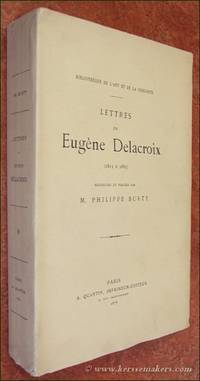
187830347Paris: A. Quantin 1878. Original wrappers paperback xx394 pp.: portr. 2x facs. fold-out lithograph plate in color; 26x17 cm. Uncut unopened. "Bibliothèque de l'Art et de la Curiosité" Text in French spine slightly folded some minor spots protection paper of lithograph plate bit damaged because because he was stuck to the plate Although in very good original condition see picture. Limited edition: '50 exemplaires sur papier de Hollande numérotés. Exemplaire No 30' A. Quantin paperback
189317456AB1893. 3e édition 2 volumes off 3 Paris Plon 1893. LV 462; 2 leaves 496 pages 2 plates. Original wrappers. Uncut in original wrappers. unknown
1893052165Paris: Paul Chevallier Georges Petit 1893. First Edition . Stiff Wrappers. Very Good/Good Dustjacket. 36.7 Cm / 14.5" Tall. Plain Stiff Cardboard Wrappers Printed Dust Jacket. Descriptions Of 75 Works Of Art With Full-Page Rotogravures Of 21 Each Description Accompanied By The Price In Pencil. Spine Cracked Very Worn Chipped With Some Loss Of Paper Cover Along Spine. Dampstain To Front Cover At Bottom Not Affecting Interior. <br/> <br/> Paul Chevallier, Georges Petit unknown
187510531London, Sampson Low/ Marston/ Low and Searle, 1875 [printed by William Clowes]. Schwarz- und goldgeprägter Leineneinband, 2° [Folio], Goldschnitt, unpaginiert, 24 Kupferstiche auf Tafeln mit ihren Seidenhemdchen; -Kanten etwas berieben, Vorsätze berieben, Papier minimal stockfleckig, sehr schönes Exemplar/ black and gilt stamped cover, cloth, 2vo folio, gilt edges, not paginated, 24 copper prints on plates; -cover and end papers slightly worn, little foxing, near fine copy.
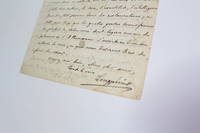
1852713631852. Fine. 13 septembre 1852 12.20 x 19 cm une feuille Long autograph letter signed by the archaeologist and curator of antiquities at the Louvre Museum Adrien de Longpérier to a journalist 4 pages on a folded sheet. In this fascinating letter about Eugène Delacroix the curator of Egyptian antiquities Longpérier castigates a journalist author of a harsh critique of the painter's ceiling at the Galerie d'Apollon in the Louvre: ""mais quand il s'agit seulement d'un plafond fait pour une galerie roccoco quand du reste j'ai reconnu que cet ouvrage produit un excellent effet décoratif que le ton général est parfaitement adapté à la place et qu'outre cela le tableau contient un certain noombre de détails traités avec un véritable talent je ne vois pas la nécessité d'aller attaquer très vivement très rudement non seulement l'oeuvre mais encore la personne de l'artiste"" ""but when it concerns merely a ceiling made for a rococo gallery when moreover I have recognized that this work produces an excellent decorative effect that the general tone is perfectly adapted to the place and that besides this the painting contains a certain number of details treated with real talent I do not see the necessity of going to attack very vigorously very harshly not only the work but also the person of the artist"". Delacroix had created a composition entitled Apollon terrassant Python for the gallery built under Louis XIV and newly restored under the Second Republic. In the midst of the Romantics' quarrel Longpérier also mentions Jean-Auguste Dominique Ingres himself the author of a ceiling at the Louvre L'apothéose d'Homère: ""Comme vous avez l'imprudence de mettre le plafond d'Homère en parallèle avec celui d'Apollon vous n'eussiez pas pu empêcher que dans la discussion on ne s'en prit à votre vénérable ami. Croyez vous que si Ingres qui aime si peu la discussion vous eu su un bien grand gré de ces horizons que vous lui eussiez procurés . Imaginez-vous que vous ayez fait le sacrifice d'une somme assez considérable pour fonder un journal et que je vous apporte un article violent contre M. Ingres Je dis : imaginez car je suis moi un admirateur de M. Ingres et n'ai en aucune manière envie de le critiquer . Iriez-vous donner aide à celui qui voudrait le combattre "" ""Since you have the imprudence to put Homer's ceiling in parallel with that of Apollo you could not have prevented that in the discussion people would attack your venerable friend. Do you believe that if Ingres who so dislikes discussion would have been very grateful to you for these horizons that you would have provided him . Imagine that you had made the sacrifice of a considerable sum to found a journal and that I bring you a violent article against M. Ingres I say: imagine for I am myself an admirer of M. Ingres and have no desire whatsoever to criticize him . Would you go to aid the one who would want to fight him"". Ingres the painter representing the classical school had his preference unlike Delacroix the Romantic whose style he did not appreciate but whose human qualities he nevertheless recognized: ""J'ai reconnu que c'est un homme très doux très poli fort instruit et fort modeste . Je parle de l'homme ; quant à ses oeuvres elles sont plus ou moins bonnes. Il y en a même de fort mauvaises"" ""I have recognized that he is a very gentle man very polite well educated and very modest . I speak of the man; as for his works they are more or less good. There are even some very bad ones"". Longpérier speaks at length about the restoration work at the Louvre led by the architect Félix Duban who supervised the renovation of the Galerie d'Apollon and other major projects: ""Je verrais avec grand plaisir que vous fissiez sentir le mérite de la restauration de la galerie d'Apollon de la façade du jardin de l'infante de la façade d'Henri IV sur le quai et du plafond de la Salle des sept cheminées décoré avec tout de goût de f unknown
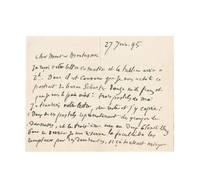
1895Degas4<p><strong>DELACROIX DEGAS Edgar 1834-1917</strong></p><p>Autograph letter signed <em>"Degas"</em> to collector Montagnac<br />Np 27 June 1895 2 pages in-8 oblong on laid paper in bespoke leather sleeve.<br />Fold marks previous and discreet tape repair on verso</p><p><strong>Degas collector acquires a painting by Delacroix in exchange for three of his pastels of dancers as currency</strong></p><p><em>" Cher Monsieur Montagnac<br />Je reçois votre lettre ce matin et le tableau </em>de Delacroix <em>arrive à 2h. Donc il est convenu que je vous achète ce portrait du baron Schwiter douze mille francs et que <strong>je vous paie ainsi : trois pastels de moi.</strong> Je transcris votre lettre du reste j'y copie : <strong>Deux de ces pastels représenteront des groupes de danseuses et le troisième une ou deux blanchisseuses. Pour ce dernier je me réserve la faculté de les remplacer par des danseuses si ça m'allait mieux</strong>.<br />Si vous pouvez me dites-vous me livrer un de ces pastels d'ici un ou deux mois vous me feriez le plus grand plaisir. Vous ajoutez : Il est entendu que les 3 pastels seront terminés pour l'hiver prochain. Tout cela est bien et j'y souscris.<br />Au revoir cher Monsieur et recevez mes remercîments.<br />Degas "</em></p><p>A shrewd collector Degas had assembled a remarkable collection of paintings from the Renaissance to Romanticism including Greco Ingres Courbet Delacroix etc. Of the latter of which he owned thirteen paintings it is the portrait of Baron Schwiter that is here the object of his lusts.<br />This full-length portrait of Baron Louis de Schwiter 1805-1889 an important collector and familiar of Delacroix was painted in 1827. Refused by the jury of the Salon the same year it is now kept at the National Gallery in London which had acquired it during the dispersal of Degas' property after his passing in 1917.</p><p><u>Provenance:</u><br />Bibliothèque Bernard Loliée</p>
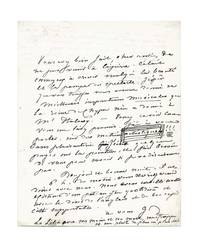
1842Sand29<p><strong>DELACROIX SAND George 1804-1876</strong></p><p><u>Two autograph letters</u> signed " GS " to Eugène Delacroix<br />Nohant 6 & 7 July 1842 3 p. in-8° in total in black ink<br />Autograph addresses on verso<br />Stamp marks previous trace of mounting</p><p><strong>Saddened by the departure of her "good little" Delacroix after the latter's stay in Nohant in the company of Chopin and the rest of the Sand family the writer found herself immersed in her reading of <em>Les Mystères de Paris</em></strong></p><p><strong><u>From the Marc Loliée library</u></strong></p><p><em>" <strong>Cher bon petit</strong> J'espère que vous êtes arrivé à bon port sans trop souffrir de la chaleur qui a été modérée le jour de votre départ. Vous avez oublié ici quelques effets dont Maurice a fait une caisse laquelle part aujourd'hui. Comme le port en est payé accusez-en réception afin qu'elle ne s'égare pas sans que nous la fassions réclamer. J'ai encore retrouvé dans mes mouchoirs un mouchoir à vous. Je vous le mets à part ainsi que ceux qui pourraient se retrouver au prochain blanchissage. <strong>Que Jenny</strong></em> la gouvernante de Delacroix <strong><em>ne nous accuse donc pas de vous avoir grinché vos zardes</em></strong>¹<em>. – <strong>Je lis le Chourineur et je vous assure que malgré l'horreur du sujet et des détails</strong></em>²<strong><em> c'est jusqu'à présent fort intéressant et fabriqué avec beaucoup de talent</em></strong><em>. – <strong>Nous sommes restés tout tristes et tout déconfits de votre départ</strong>. Nous tâchons de jouer au billard mais je crois que vous avez emporté le carambouillage</em>³<em> dans votre poche et que vous ne nous avez laissé que le manque de touche. J'attends avec impatience un petit mot de vous. <strong>Nous sommes encore trop chagrins pour vous en dire long aujourd'hui</strong>. Et puis l'heure me presse. À présent cher soyez bien portant. Si vous nous regrettez autant que nous vous regrettons faites un effort pour nous oublier jusqu'à notre retour </em>Sand et Chopin rentreront à Paris le 31 juillet<em> alors vous nous raimerez de nouveau. <strong>Adieu moi et tous vous embrassons et vous aimons</strong>.<br />GS. "</em></p><p><em>" Cher ami mon dadet </em>sic <em>de Thomas </em>peut-être Thomas Aucante autrefois vacher<em> a commencé le cours de bêtises auxquelles je dois m'attendre en ne payant pas le port de la caisse que je vous ai envoyée hier. Si bien qu'il faut que vous le sachiez afin de n'avoir pas de contestation avec l'administration. Accusez-moi réception car tout ceci a été fort mal fait malgré mes précautions.<br />Nous nous portons bien. <strong>Nous vous aimons. J'ai rêvé de vous toute la nuit</strong> ; j'espère que c'est bon signe et que vous êtes bien portant.<br />À vous<br />GS. "</em></p><p>In response to his friend's repeated invitations Delacroix spent nearly two weeks in Nohant in June 1842. He wanted above all to rest "vegetate" as he put it and enjoy the pleasures of the countryside. Back in Paris he replied on the 8th stating that he had received the crate and calling the person who had brought it to him a cheat and an imposter demanding postage. He asked his friend for a small purse left in Nohant a purse that Solange had given him and a small cord from Algiers. He concluded: "The weather is awful for the nerves. When you dreamed that you saw me did you dream that you were the Duchess of Berry I send you all my sincere embraces but I am very sad" Corr. gén. de Delacroix t. II p. 116.</p><p>Using the slang present in Eugène Sue's work we understand that Sand is here in the middle of reading The Mysteries of Paris. The serial novel published in the Journal des débats from June 19 1842 to October 15 1843 inaugurated mass literature in the 19th century and earned its author immense fame in all social classes.</p><p><u>Provenance:<br /></u>Bibliothèque Marc Loliée<br /><u><br />Bibliography:<br /></u><em>Correspondance</em> t. V éd. G. Lubin Garnier n°2477 & 2478</p>
1841Sand14<p><strong>DELACROIX SAND George 1804-1876</strong></p><p>Autograph letter signed " G.S. " to Eugène Delacroix<br />Paris Postal mark 23rd December 1841 1 p. 1/2 in-8°<br />Autograph address on fourth folio wax seal : " Monsieur Delacroix rue des Marais Saint Germain 17 "</p><p><strong>Superb letter to her friend Delacroix about her desire to write "a few pages on painting" the <em>Femmes d'Alger</em> her contempt for the <em>Ingresque</em> school and other artistic news</strong></p><p><em>" Vous avez bien fait cher ami de ne pas venir à l'Opéra. <strong>C'était ennuyeux à crever malgré la beauté et la pompe du spectacle.</strong> J'espère que vos truffes vous auront donné de meilleures inspirations musicales que la reine de Chypre n'en a donné à Mr Halevy.1</em><br /><strong><em>Venez ce soir comme vous me l'avez promis. J'ai à vous parler sur des matières artistiques !!!</em></strong> le mot est entouré par Sand d'un triple trait de plume.<strong><em> Sans plaisanterie j'écris quelques pages sur la peinture et j'ai besoin de vous pour savoir si je ne déraisonne pas. </em></strong><em>2</em><br /><em>Bonjour et bonne nuit. Il est 6h du matin. Vous devriez venir dîner avec nous. Nous avons embelli notre existence d'un pot-au-feu quotidien et avec le dîner de l'anglais3 et du bon café c'est supportable.</em><br /><em>G.S.</em><br /><strong><em>La Lélia</em></strong><em>4<strong>avec son moine et son mort me frappe et me plaît de plus en plus c'est ce qui m'a mise en veine d'écrire sur la couleur et ce qu'il faut entendre par la forme. Avec ça j'ai vu vos femmes d'Alger</strong>5 ce matin. Si vous m'encouragez je suis capable de faire le prochain salon dans notre revue</em> La Revue indépendante<em> et <strong>vous savez que je ne caponnerai pas</strong></em> ne se montrera pas lâche <strong><em>avec tout cette école silhouettiste</em></strong><em>6<strong> qui se dit en possession du dessin</strong> ".</em></p><p>1 <em>La Reine de Chypre</em> an opera in five acts by Halévy to a libretto by St. George took place the day before December 22 1841. Unlike George Sand Richard Wagner who was also present at the premiere considered the music "noble moved and even new and exhilarating" although he criticized Halévy's failings in simple orchestration.<br />2 In Horace which George Sand was then writing she staged a rapin a pupil of Delacroix but there were no "few pages on painting". Is this an article intended for the Independent Review – which it has just created – but which it has renounced The word written in postscript confirms that it is an aesthetic reflection that focuses on "color" and "form".<br />3 Possible reference to an English restaurateur or caterer frequented by George Sand.<br />4 <em>Lélia avec son moine et son mort</em> is the third work offered by Delacroix to George Sand for the gifts of 1842. It is a pastel depicting Lélia kneeling near Stenio's corpse while the monk Magnus "in the shadows leaning stiffly against the wall of the cave darted on her his sparkling eyes". The subject was treated several times by Delacroix.<br />5 This is the <em>Femmes d'Alger dans leur appartement</em> a painting presented at the Salon of 1834 where it caused a sensation. A synthesis of orientalism and romanticism this painting expresses a deep "melancholy" for the poet and art critic Baudelaire.<br />6 George Sand refers to the school of Ingres as a "Silhouettist school". We know the adversity between the two painters that animated the artistic scene of the nineteenth century. The writer had resolutely taken Delacroix's side that of "form" and "color".</p><p><u>Bibliography:</u><br /><em>George Sand</em> – Correspondance t. V Lubin Garnier p. 529-531 lettre n°2369<br /><em>Correspondance</em> éd. Françoise Alexandre Les éditions de l'Amateur p. 117-118 n°50</p><p><u>Provenance:</u><br />Achille Piron Delacroix's universal legatee<br />Bibliothèque Marc Loliée</p>