(Vaudeville music)Biblio.com
3 résultats
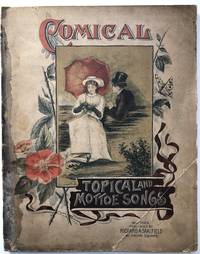
1887H7060New York: Richard A. Saalfield 1887. Good. Quarto 11.5 inches tall pictorial color wraps 171 pp of music plus a few ads. Good with some staining and loss to spine crease on cover mended on the verso with old tape; it has not stained the page light wear and soil some wear to title page and to table of contents page soil but generally very good and clean inside. RARE with only one copy cited by OCLC at Brown University. Unusually the cover artist misspelled 'motto' as 'mottoe' -- see one of the pics for a shot of the table of contents. Richard A. Saalfield unknown
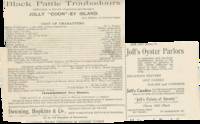
1899List2923Portland Oregon 1899. Two double-sided clippings measuring approximately 7 ½ x 4 ¾ inches both put together with tape. Slightly wrinkled and toned; excellent. Matilda Sissieretta Jones 1869–1933 was an African-American opera singer from Portsmouth Virginia. She studied at the Providence Academy of Music and the New England Conservatory in Boston. At the start of her career Jones sang solo or in small groups touring North and South America the Caribbean and Europe. Jones’ talent was renowned; she was the first Black artist to sing at Carnegie Hall and she performed for multiple US presidents and the English royal family among many other accomplishments.1 In 1896 she formed Black Patti’s Troubadours—Jones was given the nickname “Black Patti†by a critic after famed Spanish opera singer Adelina Patti. The Troubadours would perform comical vaudeville and minstrel skits without Jones followed by Jones performing her “operatic kaleidoscope†of musical excerpts.<br /> <br /> Offered here are two magazine clippings—based on the advertisements these were printed in Portland Oregon—promoting two Black Patti’s shows: “A Rag Time Frolic at Ras-Bury Park†and “Jolly ‘Coon’-ey Islandâ€. The latter was written by Ernest Hogan a musician widely credited with creating the ragtime genre; he would become the first African-American performer to produce and star in a Broadway show 1907’s The Oyster Man. Jones’ kaleidoscope pieces include excerpts from Faust Pirates of Penzance and others; both shows also feature an audience-judged cakewalk. Of interest to scholars of M. Sissieretta Jones and African-American entertainers at the turn of the century.<br /> <br /> 1 “Jones M. Sissieretta ‘Black Patti’†in Africana: The Encyclopedia of the African and African American Experience ed. Anthony Appiah and Henry Louis Gates Basic Civitas Books 1999 1064. unknown
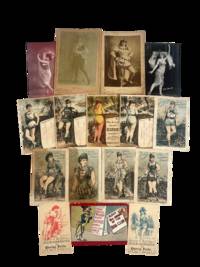
1880222891880. Photographs and printed ephemera of female stage performers dating from the 1880s through the 1910s document the emergence of women as visible figures within vaudeville and burlesque entertainment at a time when theatrical labor offered one of the few public professions available to working women. The archive identifies named performers including Gracie Wilson Jennie Joyce and Mlle. Marcia and records their presentation within commercial and studio imagery that circulated widely in mass print culture. These materials support research into women's history performance studies and the development of popular entertainment industries particularly the ways female performers navigated public visibility economic opportunity and gender norms in the late nineteenth and early twentieth centuries.<br /> <br /> Archive consists of sixteen pieces including two sepia cabinet cards mounted on cardstock chromolithographic advertising trade cards hand colored and monochrome postcards and real photo postcards measuring approximately 3.5 x 5.5 inches to 4.25 x 6.5 inches. The cabinet cards issued by Newsboy of New York include studio portraits of Jennie Joyce dressed in breeches and jacket and Gracie Wilson in a militarized costume with exposed legs both demonstrating the use of theatrical costume to construct stage identity. Additional items include postcards and trade cards depicting British and American burlesque performers in staged poses often accompanied by advertising text for commercial products such as barbershops and hair dressing parlors. Several pieces from series such as "British Burlesque Artists" present lithographed and photographic images of performers in theatrical settings including classical backdrops and studio interiors emphasizing pose costume and visual composition associated with stage publicity.<br /> <br /> These materials were produced during a period when mass printing technologies expanded the circulation of performer imagery allowing actresses and dancers to reach audiences beyond the theater through postcards and advertising media. The inclusion of cross gender costume stylized poses and commercial branding reflects the intersection of entertainment gender presentation and consumer culture in this period. Female performers used such imagery to establish recognizable personas while operating within a commercial system that marketed their appearance and performance. Light edge wear creasing and surface wear to some items with foxing present on certain advertising cards; overall very good condition. This archive provides concentrated visual and material evidence of women's participation in early popular entertainment and the commercial frameworks that shaped their public image. unknown