Strategy. get arts. Edinburgh International Festival August 23 to September 12 1970
1970OP-2355Forth Studios Ltd Edinburgh Edinburgh 1970. staple binding. fine. Forth Studios Ltd Edinburgh, Edinburgh unknown

artecontemporanea · Italie700,00 €
412 résultats
1974BN32251Bielefeld Luther-Verlag; Göttingen Vandenhoeck & Ruprecht 1974. 1974. Softcover. Pietismus und Neuzeit. Ein Jahrbuch zur Geschichte des neueren Protestantismus. Im Auftrag der Historischen Kommission zur Erforschung des Pietismus herausgegeben von Martin Brecht Klaus Deppermann Andreas Lindt u. a. Konvolut von 22 Bänden 1974-1997. von Martin Hrsg. Deppermann Klaus Hrsg. Lindt Andreas Hrsg. u. a. Brecht Autor <br/><br/>Pietismus und Neuzeit. Ein Jahrbuch zur Geschichte des neueren Protestantismus. Im Auftrag der Historischen Kommission zur Erforschung des Pietismus herausgegeben von Martin Brecht Klaus Deppermann Andreas Lindt u. a. Konvolut von 22 Bänden 1974-1997. von Martin Hrsg. Deppermann Klaus Hrsg. Lindt Andreas Hrsg. u. a. Brecht Autor Bielefeld, Luther-Verlag; Göttingen, Vandenhoeck & Ruprecht paperback
1970OP-2355Forth Studios Ltd Edinburgh Edinburgh 1970. staple binding. fine. Forth Studios Ltd Edinburgh, Edinburgh unknown
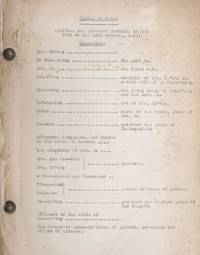
19303243881930. Duplicated typescript printed rectos only. Prologue and 4 acts paginated individually. 6 20 17 9 12 pp. 1 vols. 4to. Metal brads. Toned some light inking of a few pages. Duplicated typescript printed rectos only. Prologue and 4 acts paginated individually. 6 20 17 9 12 pp. 1 vols. 4to. My station in life<br /> Is that of a clerk.<br /> But privately <br /> There are two things I love<br /> Surpassingly:<br /> Good wine<br /> And the women<br /> Of other men.<br /> <br /> Acting script of the Ethel van der Veer translation of a Chinese play Circle of Chalk which tells a tale of disputed inheritance discord and murder in the tenth century C.E. <br /> The play was first popularized in the west through a German translation by Klabund Alfred Henschke produced in Berlin in 1925 and also produced in London from a script by James Laver with Anna May Wong as the heroine. Independent of these productions Ethel van der Veer's translation was published in 1933.<br /> The Circle of Chalk must be counted as a key source for Bertholt Brecht's postwar drama Die Kaukasische Kreidekreis. The present text is uncredited but follows the van der Veer with the frequent addition of stage directions many of which now seem "Brechtian" in the way characters turn to face and often directly address the audience. unknown
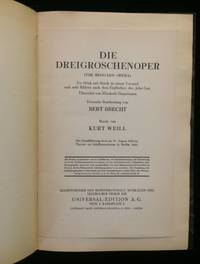
1928011176Vienna: Universal- Edition A. G. 1928. Hardcover. Near Fine. Rebound copy lacking paper covers with 220 stamped in the middle of the right margin on page 31 thus indicating either one of 300 copies of the first printing or perhaps less likely one of 500 copies of the second printing. Rebound in 1/4 cloth over dark beige and black marbelized boards oversized to original leaf dimensions with separate sheets bound in between each leaf of text. 79 pp 1. Internally fine. Covers a wee soiled. Universal- Edition A. G. hardcover
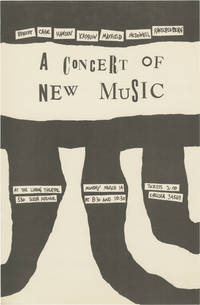
1960160202New York: The Living Theatre 1960. Vintage flyer for an experimental music show held at The Living Theatre on March 14 1960. Flyer advertises performances by John Cage George Brecht Alfred Hansen Allan Kaprow Richard Maxfield John Herbert McDowell and Robert Rauschenberg. <br /> <br /> Among the pieces performed were Kaprow's "Sound Piece 1958" Brecht's "Candle Piece for Radios" and "Card Piece for Voice" Rauschenberg's "Telephone Music" Maxfield's "Cough Music" and "Symphonie Pastorale" Cage's "Imaginary Landscape No. 5" and "Suite for Toy Piano" Hansen's "Bibbe's Tao" and McDowell's "Music for a While." <br /> <br /> Founded in 1947 The Living Theatre laid the foundation for a robust underground art scene in the New York City. After more than a decade of successful original radical stage productions and adaptations of works by playwrights such as Bertold Brecht and Gertrude Stein founders Judith Malina and Julian Beck used their space and resources for the nourishment of the arts more broadly offering the theatre for literary benefits film screenings and musical performances such as the ones advertised here. <br /> <br /> 8.5 x 12.75 inches. Near Fine. The Living Theatre unknown
1933138407Germany: Kinematrade 1933. Vintage US poster for the 1932 German communist propaganda film "Kuhle Wampe oder Wem gehort die Welt" The subtitle is seen here under the English translation "Whither Germany." Circa 1933 as identified by the name of the Philadelphia theatre on the poster. <br /> <br /> The last and arguably most important communist film of the Weimar era "Kuhle Wampe oder" is according to screenwriter Brecht a "Collective Presentation" that tells the tale of a family in early 1930s Berlin. After the son is prolongedly unemployed he commits suicide and the family is forced to relocate to a shantytown known as "Kuhle Wampe" or "Empty Stomach." Created under severely limited material conditions with filming constantly being broken up by the Weimar government's paramilitary SA agency the film attempts to depict archetypes of the times including an intellectual clash on a subway between members of the bourgeoisie and the proletariat. <br /> <br /> Banned first by the failing Weimar Republic and subsequently by the Nazi Reich the film was believed to have been lost until it reappeared over 20 years later in East Germany in 1958. This poster likely originates from screenings held in November 1933 by an unknown pro-communist organization in Philadelphia at the short lived left-leaning Philkino theater. A US screening of this film dating before the film's disappearance and only just after the very beginnings of Hitler's rise to power makes this poster not only very scarce but one of significant historical value. <br /> <br /> The poster touting "Kuhle Wampe" as "The Film Hitler Burned" features an image of a man with a hammer and sickle attacking two snakes that form the Nazi swastika and touts the involvement of members of the "Labor Sports Union" in the film. <br /> <br /> 9.5 x 13 inches letterpress on pale faded pink stock. Very Good with expected moderate wear. Kinematrade unknown
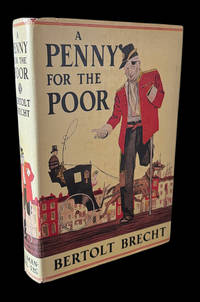
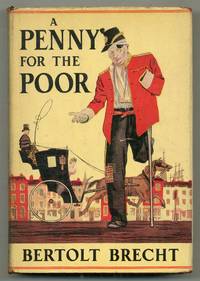
1938112233445566782<p>The First USA Printing published by Hillman-Curl Inc. New York in 1938. The BOOK is in near Fine condition. 8vo. bright red publisher's cloth lettered lined and decorated with hand and arm devices in black to upper cover and spine; yellow top-stain remains bright. else untrimmed; together in the vibrant pictorial wrapper featuring a man with one leg to the upper panel and spine unclipped displaying the correct price of $2.50 to the front flap; An excellent bright copy with just a couple of tiny marks to the rear board; light offsetting and toning to the blank end-papers ; with a small shop sticker of Miller & Rhoads to the lower rear paste-down. The WRAPPER also in excellent Very Good or better condition retaining much of its original colour with just a hint of sunning to the spine; light edge-wear to the spine tips and one small closed tear to the rear flap fold; aside from marginal shelf wear a very attractive example. The wrapper is protected in a removable Brodart archival cover. First USA printing translated from the German by Desmond I. Vesey with the chapter-head verses translated by Christopher Isherwood. A novel based on the author's famous 1928 musical play 'A Threepenny Opera' later re-issued as 'Threepenny Novel' which he co-wrote with Kurt Weill itself loosely based on John Gay's 'The Beggar's Opera'. The play was filtered through Brecht's experiences among the criminal fringe elements of the Weimar Republic. It was the first of Brecht's plays to appear in English. This edition was not issued in the UK. Bertolt Brecht was born in 1898 in Augsburg Germany and was 16 when the First World War broke out. Exploiting a loophole which allowed medical students to be deferred from the army he enrolled at Munich University and began to study theatre under the guidance of Arthur Kutscher. His first works of theatre criticism began to appear as early as 1919 and over the following few years he took part in a political cabaret of the Munich comedian Karl Valentin. Valentin became a huge influence for the young writer and he wrote his first full-length play Baal in response to an argument he had with Kutscher during one of his drama seminars. This re-writing of other's work - as well as his own - would become a key theme in his writings. As he claimed "Anyone can be creative.it's rewriting other people that's a challenge." Over the following years of the 1920s Brecht began studying Marxism and Socialism in earnest. By the 1930s he had formed a writing collective which was composed of such names as Elisabeth Hauptmann Margarete Steffin and Ruth Berlau. Together they adapted John Gay's 'The Beggar's Opera' into 'The Threepenny Opera' with Brecht's lyrics set to music by Kurt Weill. The resulting opera was a huge hit in Berlin and helped to renew public interest in the musical genre worldwide. Set in Victorian London the plot follows Macheath the leader of a criminal gang who marries Polly Peachum at the displeasure of her father. In revenge he seeks out Macheath's death - but is hindered by the chief of police Tiger Brown. ""You are about to hear an opera for beggars" Brecht famously narrates ahead of the performance "Since this opera was intended to be as splendid as only beggars can imagine and yet cheap enough for beggars to be able to watch it is called the Threepenny Opera." Fearing persecution Brecht fled Nazi Germany in February 1933 and after stints in Denmark and Finland he settled in California to continue his career as a screenwriter. Very scarce with the wrapper. More images available on request. Ashton Rare Books welcomes direct contact.</p> Hillman-Curl, Inc., New York hardcover
1938576859New York: Hillman-Curl 1938. Hardcover. Fine/Near Fine. First American edition. Translated by Desmond I. Vesey. Verse translation by Christopher Isherwood. Tiny stamped initials on half-title and copyright page else fine in handsome near fine dust jacket with a light toning on the spine. A novel later re-issued as Threepenny Novel loosely based on John Gay's The Beggar's Opera filtered through Brecht's experiences among the criminal fringe elements of the Weimar Republic. A novelization by Brecht of his famous collaboration with Kurt Weill the 1928 musical drama The Three-Penny Opera the opera had not previously appeared in America. The play continues to be widely performed was filmed on many occasions and provided the popular hit song "Mack the Knife." A nick copy of an important title. Hillman-Curl hardcover
196948050Mönchengladbach.: Städtisches Museum Mönchengladbach. 1969. Card box. 210 x 160 x 20 mm. Large card box with printing to replicate a matchbox containing a smaller real matchbox with similar printing to front cover contsaining four metal screw-hooks; also included loose are cards and booklets a text by Cladders a list of works by Robert Filliou and George Brecht before their collaboration and then work completed by the pair during their stay at Villefranche all on different paper stock and with the upper right corner removed in order to fit within the box together with the matchbox. Robert Filliou and George Brecht's Mönchengladbach kassettenpublikation catalogue / multiple.From the edition limited to 440 numbered copies.The exhibition 'La Cedille Qui Sourit' was held at the Städtisches Museum Mönchengladbach from June 18th to July 27th 1969. The three parts of the joint exhibition were: 'I. Vorspiel zum Cédille / Prelude to the Cedilla / Prélude à la Cédille. II. Le Cédille Qui Sourit 12 rue du May Villefranche-sur-Mer A. M. September 1965 - Oktober 1968. III. Das ständige Geschehen / The Eternal Network / La Fête Permanente. Was das Cédille sein wird ist / What the Cedilla will be is / Çe que deviendra la Cédille est devenue.''La Cédille Qui Sourit' was Brecht and Filliou's artist run shop or rather 'non-shop' - the raison-d'etre was to eschew typical commercial activities - in Villefranche-sur-Mer. Stocked with artist books and multiples from Filliou and Brecht's Fluxus associates together with examples of their own work and other ephemera from their working process: letters jokes puzzles recipes poems and sketches. The venture lasted as indicated above from 1965 to 1968 before its metamorphosis into 'The Eternal Network'.Whilst the format of boxes as exhibition catalogues follows the Mönchengladbach format the use of a matchbox design was unique and appears to have been the brainchild of Museum Director Johnanes Cladders.Rennert / Titz 7. Städtisches Museum Mönchengladbach. unknown
197714183New York New York U.S.A.: Grove Press. As New. 1977. Paperback. FREE UPGRADE to Courier/Priority Shipping Upon Request - IN STOCK AND IMMEDIATELY AVAILABLE FOR SHIPMENT - Book In fine Condition -- with a bonus offer-- . Grove Press paperback
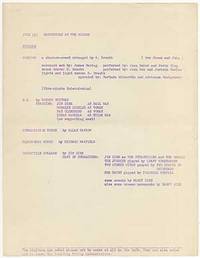
1960384904New York: Reuben Gallery 1960. Softcover. Near Fine. Single spirit-duplicated sheet. Quarto. Near fine with light wear along the foredge with a few tiny tears. A program for an early Happening performance held at the Reuben Gallery in New York by Allan Kaprow who coined the phrase to describe the emerging performance art that incorporated various forms of artistic expression such as text dialogue sounds colors music and audience participation. The pieces at this show featured: "Gossoon a chamber event movement" arranged by George Brecht with performances by James Waring John Baker and Jerry King; "E.G." by Robert Whitman starring Jim Dine Rosalyn Drexler Pat Oldenburg and Lucas Samaras; "Intermission Piece" by Kaprow; "Electronic Music" by Richard Maxfield who co-curated the Fluxus concerts at Yoko Ono's loft with LaMonte Young; and "Vaudeville Collage" written and performed by Dine. An important piece of ephemera from the then-emerging New York performance art scene of the early 1960s. OCLC locates no copies of this 1960 performance but one from 1959. Reuben Gallery unknown
1931157959N.p.: N.p. 1931. Vintage oversize reference photograph from the 1931 film showing actress Lotte Lenya. With annotations in German in manuscript pencil identifying Lenya and photographer Tobin Warner on the verso along with an annotation noting the photograph as property of "Close Up" magazine. <br /> <br /> Based on the 1928 stage play "Die Dreigroschenoper" by Bertolt Brecht and Kurt Weill. A biting socialist "play with music" based on Elisabeth Hauptmann's translation of John Gay's eighteenth-century ballad opera "The Beggar's Opera" and on four ballads by François Villon. <br /> <br /> Lenya would go on to receive a Tony Award for her performance in Marc Blitzstein's English version of the play in 1956. <br /> <br /> 9.25 x 12 inches. Very Good plus faintly age toned with light creasing on the top right corner. N.p. unknown