7 632 résultats
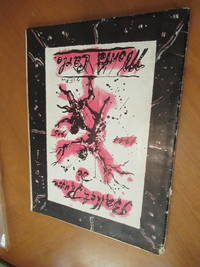
19807523-2<p>Dallas: Pressworks 1980. <i><b>Signed by Robert Penn Warren and Bill Komodore.</b> <b>Limited edition</b></i> / First printing of 350 copies. <i><b>This is copy number 16 and has been signed by Robert Penn Warren and Bill Komodore.</b></i> A separate edition of the score has been laid in. Black cloth spine with pink blue and yellow marbeled boards. Very fine issued without dust jacket. Mylar jacket supplied. <b>All three tipped-in color plates are present. Each is protected by a clear plastic sheet as issued. The plates are missing from many copies.</b></p> Pressworks, hardcover
1980100146<p>Dallas: Pressworks 1980. First edition limited to 376 copies <em>signed</em> by Warren & illustrator Bill Komodore of which 350 were numbered and meant for sale and 26 lettered meant for use of the contributors and publisher. This copy is one of the 26 lettered issue. Copy "W ." Quarter cloth and paper-covered boards in acetate dustwrapper. With actetate inserts protecting color illustrations laid-in as issued. 4 pp music score by Alexie Haieff in stapled printed wraps laid-in as issued. Fine condition. Lettered copies are not commonly available. Hardcovers. 8vo - over 7¾" - 9¾" tall. Limited Edition.</p> Pressworks hardcover
1980100146Dallas: Pressworks 1980. First edition limited to 376 copies signed by Warren & illustrator Bill Komodore of which 350 were numbered and meant for sale and 26 lettered meant for use of the contributors and publisher. Copy "W ." Quarter cloth and paper-covered boards in acetate dustwrapper. With actetate inserts protecting color illustrations laid-in as issued. 4 pp music score by Alexie Haieff in stapled printed wraps laid-in as issued. Fine condition. Lettered copies are not commonly available. Signed By Author & Artist. First Edition. Hardcovers. Fine/Not Issued. 8vo - over 7¾" - 9¾" tall. Limited Edition. Pressworks Hardcover books
194996397Hamburg u. Stuttgart, Rowohlt, ( 1949). 77 S.,1 Bl. (Verlagsanz.). 21 cm. Illustr. OKarton.
1944058006New York 1945: Ballet Russe De Monte Carlo 1944. First Edition . Illustrated Wrappers. Very Good. B/W Photographs and Color Plates. Large size program inscribed by Frederic Franklin over a full page photograph in mid-step; Nathalie Krassovska over a full page photograph while en point; Leon Danielian over a full-page photograph in mid-leap; Ruthanna Boris Yurek Lazowski Dorothy Etheridge Maria Tallchief Mary Ellen Moylan over their own full page individual photographs; Michel Katcharoff; Nicholas Magallanes; and on a page with Ballanchine at center and Nijinska Fokine Schwezoff and Agnes Demille at corners by George Balanchine as "G. Balanchine". <br/> <br/> Ballet Russe De Monte Carlo unknown
Clean and unmarked; tight binding. Staple-bound program. 9 1/4"w x 12 1/8"h. Approx. 50 pages. Includes synopses of ballets and b&w portraits of performers.
Clean and unmarked; tight binding. Staple-bound program. 9 1/4"w x 12 1/8"h. Approx. 50 pages. Cover illustration by Salvador Dali. Wear and blemish from price tag removal on cover. Includes synopses of ballets and portraits of performers and photo of sets by Salvador Dali for Labyrinth. Photo of Salvador Dali.
123p. Original cloth backed decorated paper binding, showing a large red balloon rising in front of a people filled windows. Binding edges worn, otherwise a nice copy. Padraic Colum (1881-1972) was an Irish poet, novelist, dramatist, biographer, and collector of folklore. He was one of the leading figures of the Celtic Revival. LIT 8
0364164964.Gpaperback. Good. Access codes and supplements are not guaranteed with used items. May be an ex-library book. paperback
0365746436.Gpaperback. Good. Access codes and supplements are not guaranteed with used items. May be an ex-library book. paperback
19822081502111703261Not Available 1982. Soft Cover. Fine. The book is in fine condition. Not Available paperback
92038aafBargfeld, Arno Schmidt Stiftung im Haffmans Verlag, 1990, in-8vo, ca. 250 S./Buch, Original-Leinenbände. Orig. Kasette (Schuber mit Papier-Titelschild).
92039aafBargfeld, Arno Schmidt Stiftung im Haffmans Verlag, 1986, in-8vo, Original-Leinenbände. Orig. Kasette (Schuber mit Papier-Titelschild)
92040aafBargfeld, Arno Schmidt Stiftung im Haffmans Verlag, 1986, in-8vo, Original-Leinenband.
92041aafBargfeld, Arno Schmidt Stiftung im Haffmans Verlag, 1990, in-8vo, 250 S./Buch, Original-Leinenband, O.-Schuber.
92043aafBargfeld, Arno Schmidt Stiftung im Haffmans Verlag, 1988, in-8vo, 665 S./Buch, Original-Leinenband + Schuber
92044aafBargfeld, Arno Schmidt Stiftung im Haffmans Verlag, 1991, in-8vo, 446 S., Original-Leinenband, O.-Schuber.
1946EDzz7019Wien, Alfred Ibach (1946). 143 S., OBrosch., papierbed. gebräunt, Umschlag mit kl. Einriss.
194618409Wien, Alfred Ibach Verlag, 1946. 8°. 143 S. Orig.-Broschur. Erste Ausgabe. Einband etwas gebräunt.
194918315(Amsterdam), Bermann-Fischer, 1949. 226 S. OBrosch. (mit SU).
Scholars' name to halftitle (Mark Golden). Very light shelfwear. ; In this volume William S. Anderson sets Plautus, who wrote Rome's earliest surviving poetry, in his rightful place among the Greek and Roman writers of what we know as New Comedy (fourth to second centuries). Anderson begins by defining major innovations that Plautus made on inherited Greek New Comedy (Menander, Philemon, and Diphilus) , transforming it from romantic domestic drama to a celebration of rollicking family anarchy. He shows how Plautus diminished the traditional importance of love and replaced it with a new major theme: 'heroic badness,' especially embodied in the rogue slave (ancestor of the impudent servant, valet, or maid). Anderson then examines the unique verbal texture of Plautus' drama and demonstrates his revolt against realism, his drive to have his characters defy everyday circumstances and pit their intrepid linguistic wit against social order, their Roman extravagant impudence against Greek self-control. Finally, Anderson explores the special form of metatheatre that we admire in Plautus, by which he undermines the assumptions of his Greek models' and replaces them with a new, confident Roman comedy. ; Robson Classical Lectures; 194 pages
Faint creasing to spine. Light shelfwear. Scholar's name to half-title (Robert Brown). ; In this volume William S. Anderson sets Plautus, who wrote Rome's earliest surviving poetry, in his rightful place among the Greek and Roman writers of what we know as New Comedy (fourth to second centuries). Anderson begins by defining major innovations that Plautus made on inherited Greek New Comedy (Menander, Philemon, and Diphilus) , transforming it from romantic domestic drama to a celebration of rollicking family anarchy. He shows how Plautus diminished the traditional importance of love and replaced it with a new major theme: 'heroic badness,' especially embodied in the rogue slave (ancestor of the impudent servant, valet, or maid). Anderson then examines the unique verbal texture of Plautus' drama and demonstrates his revolt against realism, his drive to have his characters defy everyday circumstances and pit their intrepid linguistic wit against social order, their Roman extravagant impudence against Greek self-control. Finally, Anderson explores the special form of metatheatre that we admire in Plautus, by which he undermines the assumptions of his Greek models' and replaces them with a new, confident Roman comedy. ; Robson Classical Lectures; 194 pages
Ex-library copy with usual stamps, call numbers. Pocket has been removed from ffep causing some damage. Else VG. ; Greeks divided the world into Greece vs. The land of foreigners, into Hellenes vs. Barbarians, seeing their country as a bastion of culture, learning, and military might surrounded by a sea of the uncivilized. Long shows how comedy expressed the Greek feeling of superiority over the barbarians, how it dealt with the so-called barbarian-Hellene antithesis. The result is a contribution to the study of ancient Greek comedy—both the comedy itself and the beliefs, the prejudices, the limitations, and the variety in the society from which the plays emerged. The comedians’ responses to the barbarians ranged from idealization to neutrality to raw racism. Although contemptuous of barbarians, the Hellenes could not keep elements of foreign culture from entering their own. Long’s major contention is that the Greek reaction to Oriental and other foreign influence can be seen in the treatment of barbarians in Greek comedy. ; 240 pages
Foxing/dustsoiling to top of textblock. Minor Foxing to DJ. ; Greeks divided the world into Greece vs. The land of foreigners, into Hellenes vs. Barbarians, seeing their country as a bastion of culture, learning, and military might surrounded by a sea of the uncivilized. Long shows how comedy expressed the Greek feeling of superiority over the barbarians, how it dealt with the so-called barbarian-Hellene antithesis. The result is a contribution to the study of ancient Greek comedy—both the comedy itself and the beliefs, the prejudices, the limitations, and the variety in the society from which the plays emerged. The comedians’ responses to the barbarians ranged from idealization to neutrality to raw racism. Although contemptuous of barbarians, the Hellenes could not keep elements of foreign culture from entering their own. Long’s major contention is that the Greek reaction to Oriental and other foreign influence can be seen in the treatment of barbarians in Greek comedy. ; 240 pages
Play based on Socrates and his trial and death in Athens.101p. Blue-Green blue cloth binding faded on spine and edges Faint foxing on end papers, but interior very neat and clean. Book