Antiquariat.de
7 résultats
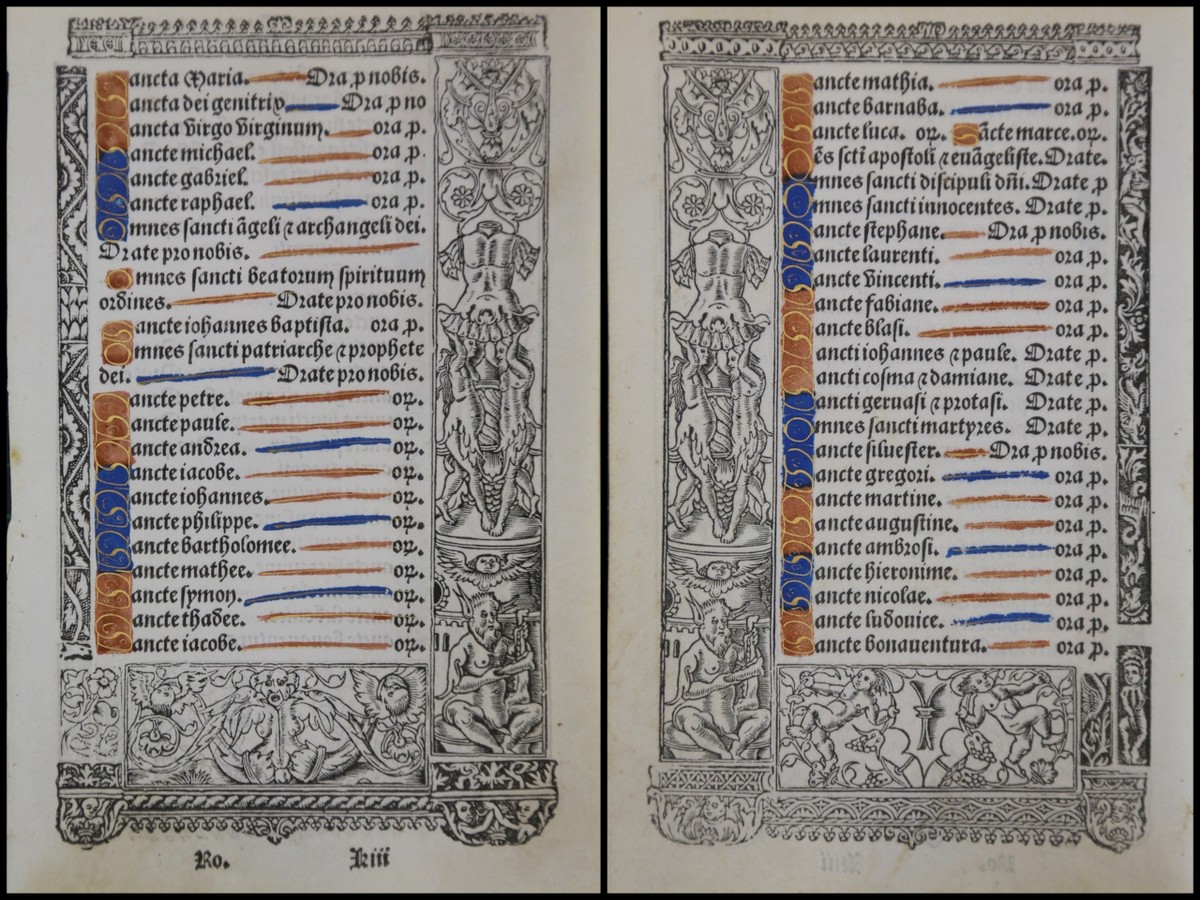
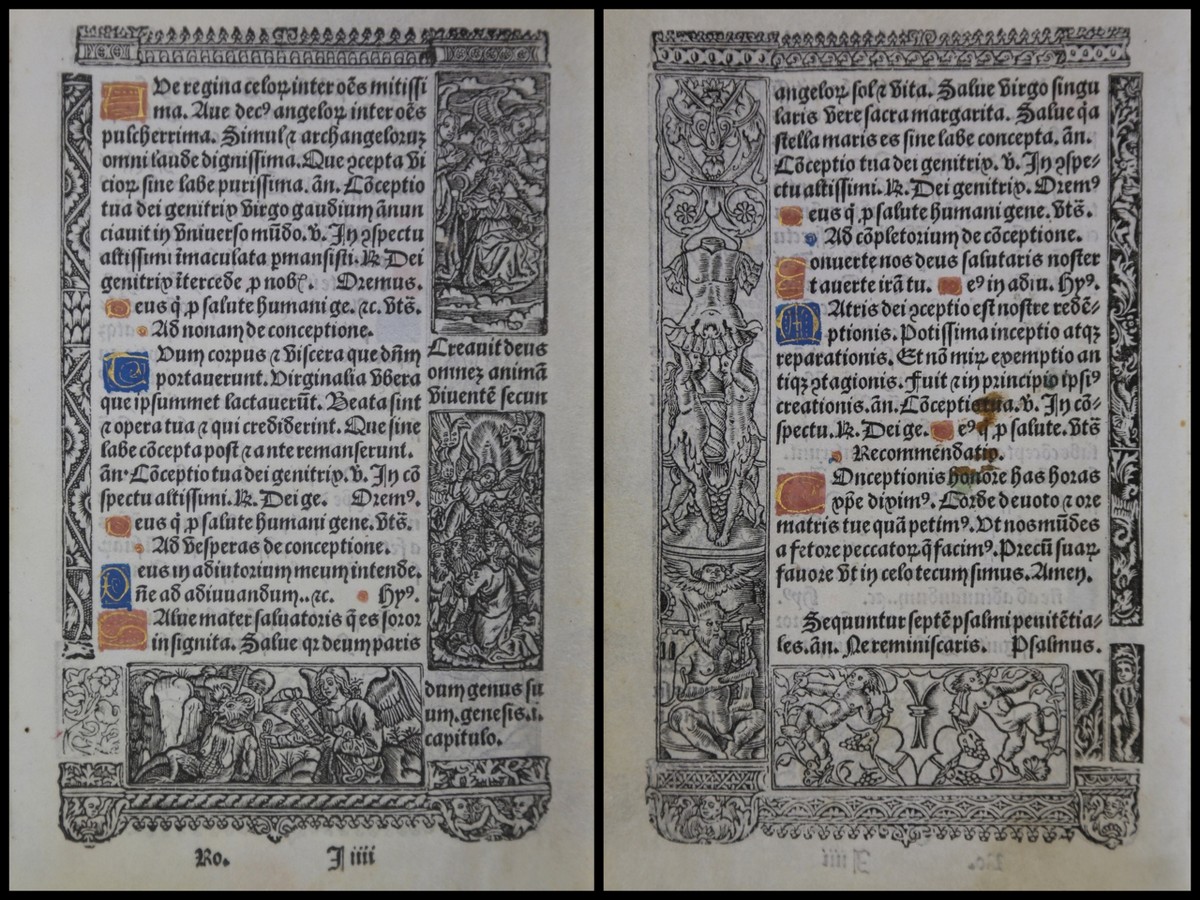
1510151128(Paris, um 1510). Blattgröße: 17,5 x 11,5 cm. Schriftspiegel: 16 x 9,5 cm.
1510151127(Paris, um 1510). Blattgröße: 17,5 x 11,5 cm. Schriftspiegel: 16 x 9,5 cm.
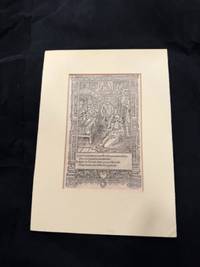
1530107233<p>Very busy woodcut 4" x 6 1/4". Matted with window for illustration includes plastic protection of illustration includes four lines of text Aging top margin very narrow; otherwise very good condition. Very busy engraving that some may view as a line engraving. Center scene is a woman on her knees holding a flower. She may be visiting another woman who is either sick in bed or nursing a child. The presence of a demon in this illustration could imply serious illness. Some text in the border.</p>
1510151129(Paris, um 1510). Blattgröße: 17,5 x 11,5 cm. Schriftspiegel: 16 x 9,5 cm.
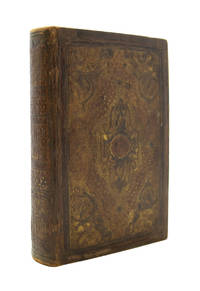
157068799Paris: Nicolas Du Chemin 1570. BOOK OF HOURS. Paris: Nicolas Du Chemin 1570.<br> <br> Rare early printed Book of Hours. Two parts in one octavo volume 7 x 4 1/4 inches; 177 x 110 mm. 43 114 98 pp. Bound without first title-page. Printed in red and black with engraved allegorical borders throughout. Numerous woodcut miniatures throughout the text. Section two with separate section title with engraved vignette. Final page with engraved printer's device of griffin. We could only find two copies at libraries one of which was also missing its title-page. Aside from this copy we could only find one other copy at auction.<br> <br> Contemporary calf rebacked with original spine laid down. Boards and spine elaborately stamped in gilt and blind. With arabesque central devices. Professional repairs to bottom margin of leaves 91-109 114generally only affecting the blank bottom margin and occasionally touching the engraved border. Section two with some worming also just along blank bottom margin occasionally repaired. Leaf 98 with closed tear repaired no loss of text. Final leaf with colophon and printer's imprint with some repairs but with minimal loss.<br> <br> Nicolas du Chemin was a French printer primarily of music. He was active in Paris between about 1549 and his death in 1576. "Described as a bookseller in a document dated November 1540 Du Chemin issued his first printed book in 1541. In 1543 he moved his shop to the rue St-Jacques-de-Latran under the sign of the silver Griffin the address from which he issued music as well as many books on medicine grammar arithmetic law and Latin literature to the end of his career." Oxford Music Online.<br> <br> "During the early 1540's Du Chemin established himself in Paris as a printer of religious medical philosophical and historical texts. Among his publications for instance we know of an edition of the Latin Psalter with commentaries by the Italian theologian Marcantonio Flamino M. Antonii Flamini in Librum Psalmorum brevis explanatio; 1546 François Chappuys' treatise on cures for the plague Sommaire de certains et vrays remedes contre la peste; 1545 Polydore Vergil's Latin history of the world Polydore Vergil Historiographe a French translation of his De inventoribus rerum libri tres; 1546 and many other works too. 1 Du Chemin continued this line of work even as he ventured into music printing." 2009 Digital Duchemin Project - Richard Freedman.<br> <br> "Nicolas Du Chemin followed by Guillaume Le Bé would attain renown as pioneering engravers type-founders and printers if only because they were among the first in France to design and manufacture their own types and printing equipment." Copyright history dot org.<br> <br> Bohatta 1282; Not in Lacombe.<br> <br> HBS 68799.<br> <br> $4500. Nicolas Du Chemin unknown
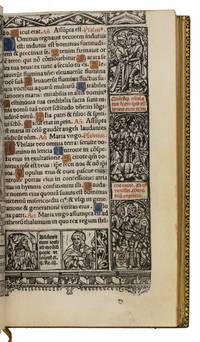
156168705Paris: Par Jacques Kerver 1561. BOOK OF HOURS. Heures hours de nostre dame a l'usage de Paris. Paris: Par Jacques Kerver 1561.<br> <br> Printed on vellum. Octavo 6 7/8 x 4 1/4 inches; 175 x 110 mm. With Calendar. With eight large oval illuminated miniatures in the calendar forty-one full page miniatures some with borders and some without for a total of forty-nine large miniatures. And with thirty smaller miniatures in the text of saints and other holy figures. With 171 of 184 leaves. Text leaves after calendar are numbered XV- CLCCCI and the 14 previous leaves not numbered. Of these 14 preliminary and calendar leaves present copy is lacking A1-A5 Title-page next page and the months January-April. Also lacking B6 the calendar facing the miniature for December. Text pages lacking leaves D2 I7 K7 V1 and Z6-8. Text ruled in red. Numerous illuminated one and two-line initial heightend in gold with alternating red and blue backgrounds. Miniatures are beautifully hand-colored and heightened in gold. Some of the large miniatures have architectural borders. We could find no copy of this at auction. Title date and publisher based on Lacombe 453-454.<br> <br> Early French red morocco. Rebacked with spine laid down. Boards triple-ruled in gilt. Spine elaborately stamped in gilt. Board edges gilt. Gilt dentelles. All edges gilt. Marbled pastedown endpapers. Front free endpaper with a small oval illumination on vellum of flaming heart invisibly tipped in not part of the miniature count. Front pastedown with small leather bookplate of famous book collector W.A. Foyle Beeleigh Abbey. Back pastedown with bookseller sticker of W. & G. Foyle LTD. Overall a beautiful example of a French printed book of hours with more illuminated miniatures than usually seen.<br> <br> Printer Jacques Kerver was the son of well known printer Thielman Kerver who left his business to his wife and then son Jacques. "Thielman Kerver was a highly successful Parisian publisher whose business continued for generations within his family. In the early 16th century he published several Books of Hours that conceptually followed the segmented border format used in the manuscript shown nearby. For him the advantage lay in making small metal printing plates that could be recombined and reused. The plates were attached to wooden blocks to make them the same height as the type for the text. The pictorial metalcuts are so densely overpainted that it is hard to see that the images are printed. Kerver inked his types in both red and black in emulation of manuscript text. The main type font however is very different from French manuscripts of a few years earlier and signals a shift in orientation from medieval monasticism to renaissance humanism." Minneapolis Institute of Art.<br> <br> "Miniatures were a large part of the appeal of the Book of Hours the bestselling book in the Middle Ages. It should not come as a surprise therefore that some of the earliest printed Books of Hours are illustrated with woodcuts and metalcuts that were overpainted in imitation of miniatures. These hybrid books demonstrate how the new technologies of printing were used to complement-rather than rival or replace- traditional methods of artistic production. Books of Hours or Horae from the Latin for "hours" get the name from the Hours of the Virgin: a set of devotional texts usually in Latin that in monastic practice are recited at the eight canonical hours of the day. Typically each of the canonical hours has an image of a significant event in the life of the Virgin Mary: Annunciation matins Visitation visit to Elizabeth lauds Nativity birth of Jesus prime Annunciation to the shepherds terce Adoration of the Magi sext Presentation purification in the temple none Flight into Egypt vespers and the Coronation Mary's coronation in heaven by Jesus compline. A number of other texts contained in the Horae including a calendar gospel readings Office for the Dead and prayers to saints as well as the page borders often incorporated images. At the turn of the sixteenth century Parisian printers greatly expanded the market for Horae. Because of the costly materials and especially the skilled labor of scribes and illuminators manuscript Books of Hours were too expensive for most people. Luxury editions-written on large fine sheets of vellum and illuminated by established artists-were the reserve of royalty and the wealthiest religious institutions. With the advent of the printing press Books of Hours became accessible to the members of the professional merchant and artisan classes." The Mass-Produced Original: Printed Books of Hours. Maureen Ward.<br> <br> Bohatta 354. Brunet. Lacombe 453-454.<br> <br> HBS 68705.<br> <br> $29500. [Par Jacques Kerver] unknown
1511LC8BK00LLGOIcolophon: Paris: Thomas Kees for Antoine Vérard 1511. Dark brown gold- and blind-tooled goatskin morocco ca. 1870 signed HARDY-MENNIL in the foot of the front turn-in sewn on 5 supports gold-tooled turn-ins gold double-fillets on boards edges marbled endpapers similar to Wolfe 150 headbands in red blue and yellow with a matching ribbon marker gilt edges. 8vo 18 x 12 x 2.5 cm. Printed on vellum in red and black throughout with illustrations printed from mostly metal relief blocks: 17 nearly full-page mostly 12.5 x 8 cm plus 1 repeat 27 small about 3.5 x 2 cm plus 2 repeats in the text many additional small in the decorated border pieces that surround nearly every page many in all three groups with criblée backgrounds and further un-illustrated decorative border pieces. Set in a roman type 77 mm/20 lines with incidental textura 118 mm/20 lines. With manuscript initials in gold on red blue or red and blue divided diagonally three 3-line hundreds of 2-line and thousands of 1-line and about 60 manuscript line-fillers in gold on red or blue. Second known copy apparently the only known copy printed on vellum of a Paris book of hours in Latin probably published in 1511 the almanac and calendar for 20 years covers the years 1511 to 1530 the only known book of hours printed by Thomas Kees or Caseus from Wesel in the Rhine valley recorded as a printer in Paris from 1507 to 1516. The illustrations are finely cut many with criblée backgrounds and many are thought to have been printed from metal relief blocks rather than woodcuts. Most of the small illustrations in the text depict saints. The illustrations in the border strips include scenes from the Old and New Testament dance of death scenes apostles saints scenes from daily life fantastic beasts and more. The large illustrations may have been cut for Antoine Vérard ca. 1503 to 1507. The work was rebound by Hardy-Mennil in Paris ca. 1870. Little is known about Hardy himself. "Mennil" is not separately recorded. He used the name Hardy-Mennil by 1864 and was certainly a celebrated binder by 1868 when the books he bound were often gold-tooled by one of the most famous finishers of all time Jean Michel 1821-1890.Possibly from the great library assembled by Robert Harley 1661-1724 first Earl of Oxford chief advisor to Queen Anne and his son Edward Harley 1689-1741 which descended to Edward's daughter Margaret Cavendish Bentinck 1715-1785 Duchess of Portland many of whose printed books were sold in London 1816-1817.Trimmed close to the decorative borders at the head shaving a border on 1 page and just touching a few others with a tiny chip slightly affecting the corner of another border but generally in very good condition the binding fine.l Bohatta 932; French vernacular books 67388 BN Paris copy only; KVK & WorldCat BN Paris copy only; Moreau II 115 p. 83 BN Paris copy only; Van Praet Cat. Livres imprimés sur vélin bibl. Tant publiques que particulières I 1824 176 citing Bibl. Harl. 18352 possibly the present copy; Robins Bibliotheca Harleiana: a catalogue of the Harleian Library 18352 vol. IV 1817 p. 781 not seen possibly the present copy; Ludwig Rosenthal Bibliotheca evangelico-theologica cat. 70 part 7 1892 p. 96 not seen possibly the BN Paris or the present copy; Tenschert Horae B.M.V.: 158 Stundenbuchdrucke der Sammlung Bibermühle 2003 80 lacking title-page & 2 text ll.; USTC 183113 BN Paris copy only; cf. Davis Fairfax Murray French 253-259 & table on p. 289; very similar illustrations in Pigouchet eds. 1496-ca. 1508; MacFarland Antoine Vérard table on p. 133 the present illustrations in Vérard eds. 1503-1511; Mortimer Harvard French 295 ca. 1507 Hardouyn ed. noting the present illustrations in a 1510 Vérard ed.; not in Alston & Hill Books printed on vellum in the British Library; Brunet; Graesse; Paul Lacombe Livres dheures imprimés 1907; Van Praet Cat. livres imprimés sur vélin Bibl. Du Roi; for the binder Hardy and finisher Marius-Michel: Fléty pp. 120-121 183. Thomas Kees [for Antoine Vérard?]), hardcover