1 307 résultats
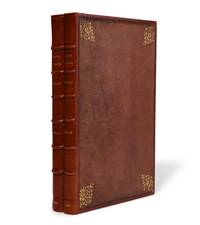
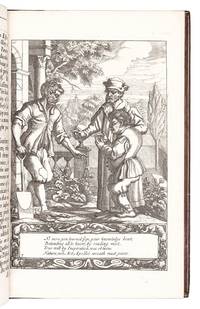
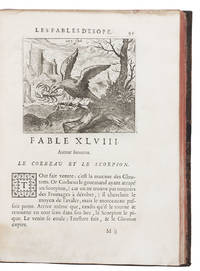
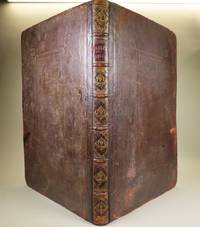
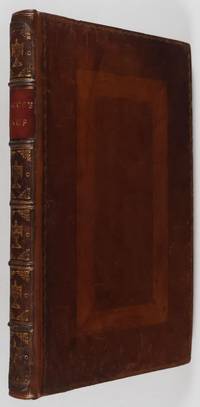
166648718London.: Printed by William Godbid for Francis Barlow and are to be sold by Ann Seile at the Black-Boy against St. Dunstan's Church in Fleetstreet and Edward Powell at the Swan in Little Britain. 1666. Full contemporary calf boards ruled in blind later spine with red morocco label with gilt title and blind rules in seven compartments marbled edges. Folio. 356 x 242 mm. Printed title within double rules engraved title by Barlow with central title within elaborate cartouche and surrounded by an eagle leopard boar fox wolf and lion leaf with large decorative woodcut inhabited ten-line initial and Barlow's dedication to Sir Francis Pruijan or Prujean leaf with Barlow's 'To the Reader' leaf with engraved frontispiece of Aesop with animals and additional engraving with text beneath 20 leaves with 'A Brief Prospect of the Life of Aesop' 16 leaves with 'La Vie d'Esope' 9 leaves with 'Aesopi Philosophice Fabulantis Vita' and Aesop's 110 fables illustrated with 110 engravings final leaves with 'La Table' and 'The Table' decorative woodcut initials and tail-pieces throughout; sheet size: 350 x 228 mm. A very rare large paper copy of the scarce first edition of Francis Barlow's undoubted masterpiece of English book illustration.By the time of the Restoration Francis Barlow had achieved a measure of success with his suites of prints of animals - engraved by the best such as Hollar Griffier and Place - and his decoration of houses and by the mid-1660s had contributed to the Aesop of Ogilby and Hollar. It is not entirely clear why he would wish to issue another edition of the Fables Hofer suggests a competitive nature and a different projected audience but by 1665 he had engraved a superb title it bears that date and by the time of publication in 1666 the date to the letterpress title had engraved a frontispiece of Aesop surrounded by animals and 110 half-page vignettes after his own drawings to illustrate the Fables. Each of the Fable engravings is accompanied by lines of verse by Thomas Philipott; the translations of Aesop's life into French and Latin was by Robert Codrington. Whatever Barlow's motivation the result is one of the most extensive and beautiful English illustrated books of the seventeenth century and one of the scarcest the scarcity often attributed to the loss of the sheets in the Great Fire of London. Large paper copies of this first edition are identifiable see ESTC through various issue points all present here but also as per Philip Hofer the transposition of some of Barlow's engravings. In the present copy the engraving for 'Fab. XLVIII' 'The Ant and Fly' is in fact that for 'Fab. XLXIX' 'The Ant and Grasshopper'. Hofer indicates too that the engravings for 'Fab. LXX' 'The Tortoise and Hare' and 'Fab. LXXI' The Young Man and His Cat' are also transposed however in the present copy they are not the margins headlines etc. conform to the remaining large paper leaves although 'The Young Man and His Cat' features the erroneous title 'The Nurse and Her Child' 'Fab. LXIX' albeit with the correct page number. Large paper copies also feature 'FINIS' beneath the signature Ppp at the foot of the leaf with the final engraving for 'FAB. CX' 'The Tortoise & Eagle'; in addition the spacing of the text in the large paper copy also suggests that the text on this leaf was reset.A second edition was published in 1687 with additional plates to illustrate the life of Aesop and with Philipott's verse replaced with new verse by Aphra Behn. A third edition was issued in 1703 and a posthumous French edition appeared in 1714 published in Amsterdam; Philip Hofer suggests that the third edition was really made up of unused sheets from the two earlier editions but with a new title and that the edition in French - it makes use of some of Barlow's plates - is not a Barlow edition.'This seventeenth-century polyglot English-French-Latin Aesop is handsomely illustrated with engravings after designs by Francis Barlow 1626 - 1702 an English painter renowned for his pictures of country life and field sports. He was perhaps the finest English draughtsman of animal scenes in the seventeenth century. Barlow who published the book at his own expense explains in his preface that he intends the work to contribute to the education of young people. This is the first edition; the relatively few copies known are all survivors of the Great Fire of London which swept over the printer's premises in 1666.' Early Children's Books and Their Illustration.'No artist has responded with more sensitivity and less sentimentality to the gentle grace of deer . The least of creatures the frog the hare the snake and the swallow and the least favoured of them the ass the boar and the wolf -- he draws them all with an intimacy charm and inviolable integrity never surpassed in an English book . '. Edward Hodnett.'Francis Barlow was the first native English book illustrator - indeed the leading interpretative illustrator in England before 1800 . Otto Benesch of the Albertina Museum Vienna has called him 'one of the greatest illustrators of all time'.' Edward Hodnett.This large paper issue of the 1666 Aesop is very scarce: while ESTC lists 17 copies for the small paper issue see ESTC R21542 it notes only two of the large: the copy at the Huntington and that at the Morgan Library and Museum New York; Harvard also holds a copy.ESTC R477463; see 'Francis Barlow' by Edward Hodnett 1978; see #9 in the Morgan Library and Museum's 'Early Children's Books and Their Illustration' 1975; see Philip Hofer's 'Francis Barlow's Aesop' printetd in the Harvard Library Bulletin Autumn 1948. Printed by William Godbid for Francis Barlow, and are to be sold by Ann Seile at the Black-Boy against St. Dunstan's Church in F hardcover
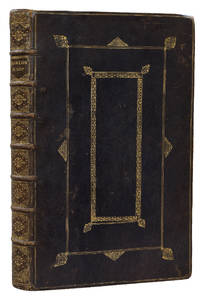
168747459London.: H. Hills jun. for Francis Barlow. 1687. Full contemporary midnight blue morocco by the 'Barlow's Aesop Binder' boards ruled in gilt to surround gilt tooled decorative panels with foliate decorative corner pieces banded spine with elaborate decorative tooling and title 'BARLOWs AESOP' gilt turn ins and board edges with gilt roll tool decoration marbled endpapers a.e.g. black morocco-backed velvet-lined buckram box. Folio. 372 x 242 mm. Engraved title printed title engraving with the Devonshire arms dedication leaf 'to the Right Honourable William of Devonshire' leaf 'to the Reader' engraved frontispiece and 31 engraved plates illustrating the 'Life of Aesop' and 110 half-page vignette engravings to the 'Fables'. A superlative large paper copy in a contemporary English binding by the Barlow's Aesop Binder of Barlow's undoubted masterpiece of English book illustration.This copy - printed on excellent paper - is in a beautiful contemporary binding the binding in a beautiful state of preservation by the ‘Barlow’s Aesop Binder’. Few bindings by the 'Barlow’s Aesop Binder' are known and the present copy identifiable by the lettering to the spine and the comparable decorative tooling is one of only a handful. Active in the 1680s and 1690s the bindery worked certainly for William and Mary although the identified copies of Barlow’s masterpiece from the bindery include too the Devonshire dedication copy from Chatsworth the Cracherode copy both these now at the British Library Pepys’ copy at Magdalene Cambridge the present copy and one other in a private collection in the US.This second edition of Francis Barlow's masterpiece adds 31 plates 32 including the frontispiece to illustrate the life of Aesop including the often mutilated 'obscene' plate here untouched and includes verse by Aphra Behn 1640 - 1689 commissioned especially for each of the 'Fables'. The unsigned plates are engraved by Barlow and the remainder by Thomas Dudley a student of Wenceslaus Hollar. Barlow himself drew and engraved all of the illustrations for the 'Fables' themselves.'The Ingenious Mrs. A. Behn has been so obliging as to perform the English Poetry which in short comprehends the Sense of the Fable and Moral: Whereof to say much were needless since it may sufficiently recommend it self to all Persons of Understanding.' Francis Barlow.'Francis Barlow was the first native English book illustrator - indeed the leading interpretative illustrator in England before 1800 . Otto Benesch of the Albertina Museum Vienna has called him 'one of the greatest illustrators of all time'.' Edward Hodnett.Complete copies of Barlow's work in good condition are scarce the present copy however a large paper example in its original binding by theh Barlow’s Aesop Binder printed on a different thick paper stock and entirely unsophisticated is of the utmost rarity. This is borne out if it is necessary to provide evidence by the fact that this copy featured in two sophisticated collections of illustrated books of the last 50 years: firstly that of Arthur and Charlotte Vershbow secondly that of Robert S. Pirie; the latter collector rarely if ever settled for second best and would certainly have bought another copy if he had found one. That he had to wait for the present copy is telling.Wing 703; see ‘English Restoration Bindings’ by Howard Nixon pg. 40 nos. 98 / 99; see 'Francis Barlow' by Edward Hodnett 1978. H. Hills jun. for Francis Barlow. hardcover
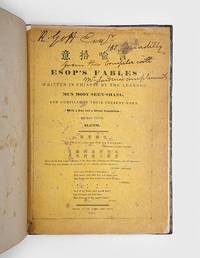
1840173764Canton: Canton Press Office 1840. The first full Chinese translation of Aesop's Fables First edition association copy inscribed by William Jardine one of the three "generous patrons" named in the dedication on the front wrapper "R. Goff Esqr. 105 Piccadilly from the compiler with Mr. Jardine's compliments". Jardine 1784-1843 co-founded the successful trading firm Jardine Matheson & Co. and held significant sway over the course of Anglo-Chinese relations either side of the First Opium War. This Chinese translation was intended as a primer to help the growing number of British students of Chinese working for Jardine Matheson the East India Company and other concerns in Canton. Robert Thom 1807-46 who adopted the pen-name "Sloth" honed his language skills while working for Jardine's and acted as a translator for British forces during the First Opium War 1839-42 and at the 1843 Supplementary Treaty negotiations. He was later British consul at Ningbo. Each page offers three columns of English Chinese characters and romanized Chinese. For each fable Thom dictated the Chinese to his teacher who brushed them in a legible hand. According to the introduction the volume was the first time Chinese wooden blocks and European metal type were used side-by-side during printing. Thom's translation was later reprinted in various modified editions by the Anglo-Chinese College the Shanghai Free Hospital and the Wenyutang Chinese Printing and Publishing Company. This edition is well represented institutionally but is uncommon in commerce - we have traced only five appearances at auction in the past six decades. Of these only one retained both of the original wrappers as here. Provenance: Robert Goff 1801-1866 was an antiquarian who travelled widely in the Middle East and Asia presenting a collection of Egyptian antiquities to the British Museum in 1847. This copy was later in the Bibliotheca Lindesiana one of the most impressive private collections of the 19th century its bookplate is on the front pastedown. Alexander Lindsay 1812-80 later 25th Earl of Crawford and 8th Earl of Balcarres met Goff while the latter was travelling and at the sale of Goff's art collection in 1866 Quaritch acquired a collection of Chinese drawings and sold these to Lindsay. This copy entered the Lindsay library either via Quaritch or via the dispersal of the Goff library in the 1890s. It is recorded in the 1910 Bibliotheca Lindesiana catalogue. Quarto 295 x 202 mm. With engraving of Chinese character styles furnished by Elijah Coleman Bridgman the compiler of the Canton Chrestomathy. Late 19th-century brown hard-grain half morocco by Henry Wood raised bands ruled in gilt spine lettered in gilt Papier Tourniquet-pattern sides marbled endpapers with design of Spanish moiré on Turkish with overprinted gold vein pattern top edge gilt original yellow printed wrappers bound in. Binding a little worn corners and extremities recoloured light foxing neat tissue repairs at foot of wrappers and title page loss at lower corner of p. 103 a few tide marks to fore edges: a very good copy. Bibliotheca Lindesiana 1910 80 this copy; Cordier 1683; Lust 1065. hardcover
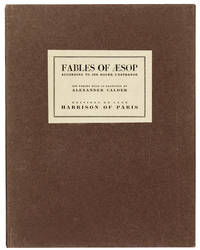
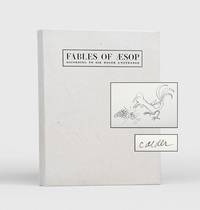
19311709731931. SOUR GRAPES! CALDER Alexander. Fables of Aesop. with an original drawing by Calder. 6 124 10 pp. illustrated with 50 line-block reproductions after pen-and-ink drawings by Calder. 4to 255 x 195 mm. bound in publisher's over boards in the original cardboard slipcase in a new half morocco folding box. Paris: Harrison of Paris 1931. The publisher's copy of the deluxe issue of Calder's most significant book illustrated with figures from Aesop constructed in the same style as his imaginary Circus figures and in his wire portraits and statues that dominated his creative output during the 1930s. This copy has an original signed Calder drawing for "The fox and the grapes" one of the more elaborate images in the book. The deluxe issue is especially sought after being exquisitely printed on Spanish handmade paper incorporating coloured silk-threads. The Calder drawings for Aesop are creative and playful marking this as a major example of modern book illustration. This is the fifth publication of Monroe Wheeler's Harrison of Paris publishing firm. One of 50 copies on Spanish Guarro paper with an original drawing also with the original paper knife laid in. PROVENANCE: This copy belonged to Monroe Wheeler with his book plate. The Artist and the Book 47. Museum of Modern Art 120. hardcover
1931183084Paris & New York: Harrison Minton Balch and Company 1931. With an original signed drawing First edition limited issue number XXVII of 50 copies with a tipped-in original published drawing signed by the artist. The drawing in this copy is from the Cock and Diamond fable. The text of the present edition is based on Roger L'Estrange's translation of Aesop's Fables 1692. Harrison of Paris was founded by publisher and heiress Barbara Harrison Wescott 1904-1977 and art patron and curator Monroe Wheeler 1899-1988 in 1930. The illustrator Alexander Calder came from a long line of sculptors and first took up printmaking after moving to Paris in 1926 where he befriended Marcel Duchamp Fernand Leger Joan Miró and Piet Mondrian. Quarto. Illustrated throughout with line drawings by Alexander Calder on Guarro's Spanish pure rag paper with coloured silk threads. Original paper-covered boards front cover lettered in black edges untrimmed endleaves uncut. With the original glassine dust jacket and the original paper knife loosely inserted. Housed in the original red card chemise and slipcase with printed label to front cover. A few small marks to boards; glassine jacket a little chipped tape repair to rear jacket; slipcase a little toned: a near-fine copy. hardcover
193182103New York:: Harrison of Paris; Minton Balch and Company 1931. First edition; one of twenty copies marked "not for Sale" and including an original signed Calder ink drawing which was not used in the publication hinged in after the front free endpaper as issued. . publisher's boards in lettered dust jacket and glassine wrapper; in the publisher's maroon chemise and slipcase with printed paper labels on front panel and the spine of the chemise. . A very fine copy in a slightly sunned slipcase with a little rubbing / use at extremities and tanning to the paper label on the spine of the chemise. 4to. With Fifth Drawings by Alexander Calder. The unused drawing appears to illustrate the story of "A Dog and a Thief" at p. 116. This copy is printed on Guarros' Spanish pure rag paper with coloured silk threads. Harrison of Paris; Minton, Balch and Company, hardcover
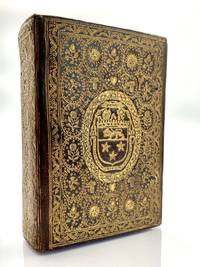
160275949Anvers Antwerp: Jean MoretusEx officina plantiniana apud Ioannem Moretum 1602. Fine. Jean Moretus Ex officina plantiniana apud Ioannem Moretum Anvers Antwerp 1602 8.20 x 12.60 cm relié New Plantin press editions in portable format of these three works. Ruled throughout in red ink. Copy with the arms of Nicolas de Villars clerical councillor at the Parlement of Paris and treasurer of the Sainte-Chapelle later bishop of Agen. Contemporary full soft brown morocco a fanfare binding with the rare Duodo-type decoration: smooth spine gilt with six medallions each containing a flower gilt foliage border covers fully gilt with 24 medallions some emblematic sun heart acorn bouquet sheaf of wheat arms stamped in the centre edges gilt. Discreet restorations to joints corners and headcaps; upper and lower borders with minor wear to leather 0.5 cm; lacking ties; pinhole at head of spine. From the first title-leaf a wormhole in the lower margin extending through to the final leaves of the Fables of Aesop gradually diminishing. A magnificent copy of the utmost rarity. The singular decoration of this style of binding representing one of the pinnacles of the art of French bookbinding is today identified as Duodo after Pierre Duodo Venetian ambassador to Paris from 1594 to 1597. About 150 small volumes were uniformly bound for a portable library only part now known probably towards the end of his stay. It is unlikely he ever enjoyed these treasures which fell into oblivion for nearly two centuries. When they reappeared on the English market at the end of the eighteenth century they were mistakenly attributed to Marguerite de Valois an error that persisted until the 1920s. Although the name Duodo remains attached to this style of decoration another great collector commissioned similar bindings: Nicolas de Villars bishop of Agen. Duodos bindings are now well identified while those of Nicolas de Villars are considerably rarer on the market. While the spine here is very close to the Duodo examples with flowers and foliage borders though in a finer and denser design the covers show 24 medallions compared to only 14 on Duodo bindings and the tools employed are not limited to floral motifs but include a variety of emblems such as the sun and the heart. Jean MoretusEx officina plantiniana, apud Ioannem Moretum hardcover
1668A-110<p>Volume I--Second Edition The Fables of Aesop Paraphras'd in Verse: Adorn'd with Sculpture. London: Printed by Thomas Roycroft for the Author 1668. Second edition with new title page a re-issue of the 1665 edition sheets. This volume contains the frontispiece engraved vignettes and initials missing Ogilby portrait and has all eighty-one full-paged plates in fabulous condition. Light yellowing/browning of initial few pages as regular. Volume II--Second Edition Aesopics or a Second Collection of Fables illustrated with sixty-eight full-paged plates in early issue before captions were added. Pages are remarkably clean without any browning. Large folio volumes both illustrated throughout; Wenceslaus Hollar 1607-1677 engraved eighty-eight of the illustrations for these works the others were executed by Dirck Stoop c. 1610-1686 and Francis Barlow c. 1626-1704. Both volumes are uniformly re-bound with original leather panels inset in full brick morocco bindings with gilt titles.</p> Thomas Roycroft for the Author, 1668 hardcover
1505684L10Venice: Apud Aldum 1505. First edition. Fine Binding. Very Good Indeed. 10" by 7". None. A very scarce early Aldine work regarding Greek allegorical techniques. A highly sought after first edition printing from the famous Aldine Press. Rebound in a lovely morocco binding by C and C McLeish. McLeish started his binding career at the Doves Bindery before starting a partnership with his sons as C & C Mcleish from 1909 to 1949. This book is from the Spencer library at Althorp Northamptonshire. With the bookplate of the Earl of Spencer's arms and pressmark B65. The Aldine Press was the printing office started by Aldus Manutius in 1494 in Venice. The first book appearing under his name was published in 1495. The press was the first to issue printed books in octavo and is also famous for introducing italics. In Greek. Adams A278; Ahmanson-Murphy 93; Renouard 49:6. Early manuscript title to the second blank with original woodcut Aldine printer's device laid down. Marginalia in Greek and Latin by an early hand throughout. This work contains 85 leaves only and therefore is lacking the first sixty-five leaves. Lacking the fables and life of Aesop. Retaining leaves d6-o4. This work retains the accompanying text including the 'editiones principes' of Cornutus/Phurnutus 'De Natura Deorum' by Cicero 'Palaephatus' on disbelieving histories'De Non Credendis Historiis' Heraclitus Ponticus' 'De Allegoriis Apud Homerum and Horapollon' 'Hieroglyphica' as well as a collection of proverbs. Many of the works to this volume appear in their first edition here. A very scarce work beautifully produced by the Aldine Press and with fascinating provenance. In a full morocco binding. Externally very smart with light rubbing to the joints. Internally firmly bound. Front endpaper is chipped to the edges with handling marks and prior owner's notes as well as bookplate. Second blank has a manuscript title with the Aldine Press printer's device pasted. Pages are bright. Occasional ink inscriptions to the margins in Greek and Latin. Very Good Indeed Apud Aldum unknown
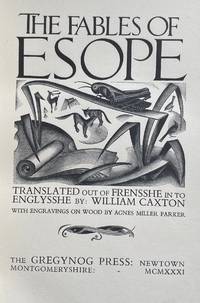
1931122334455668<p>The sole UK printing published by the Gregynog Press Newtown : 1931. Number '125' of only 250 copies issued. Illustrated with thirty-seven wood engravings by Agnes Miller Parker and wood-engraved initials by her husband William McCance typographer and sculptor. This title was Parker's first collaboration with the Press. Bound in the publisher's original tanned sheepskin with the title blocked in black foil on the spine. Printed in Bembo Type on Barcham Green hand-made paper. The BOOK is in Very Good condition with minor rubbing to the spine and the extremities else a fine copy with only a very occasional light spot in places. A book that is seldom encountered in such sharp condition. The book is protected in a removable Mylar archival cover. Together with Gertrude Hermes and Blair Hughes-Stanton Parker helped to usher in a period of masterly illustrated editions at Gregynog with the Esope title considered one of the masterpieces of the Press. The illustrations by Agnes Miller Parker are considered by Colin Franklin to rank this book as 'the most conspicuously decorative volume of that kind' the binding is smooth appropriately naturalistic and exceptionally well preserved and the type hand-set by Richard Jones is generous and exacting. Writing in his The Private Presses Colin Franklin concluded that 'the entire work of Gregynog printing and binding produced a better thing that anyone else had attempted'. Jones pp. 30-1. Housed in the original plain card slipcase which is a little age worn rubbed and marked but tight and complete. With the publisher's prospectus loosely inserted. A great rarity. More images available on request. Ashton Rare Books welcomes direct contact.</p> Gregynog Press, Newtown hardcover
65345London: Printed by H. Hills jun. for Francis Barlow. 1687. FIRST EDITION THUS. Folio. 30 x 19 cm. Engraved title title engraved arms of the dedicatee Earl of Devonshire dedication pp.40 Life plus 40 Vie pp.17 Vita pp.2-2212 Index. Later eighteenth century calf sides with blind-stamped roll-tooled border spine matching with raised bands and gilt lettering gilt decoration to board edges brown endpapers all edges gilt. Comnplete with engraved title dedication plate 31 full page illustrations of the Life and 110 half page illustrations of the Fables. Armorial bookplate of Joseph Tusker Middleton hall Essex. Joints expertly repaired plates to the the Life slightly foxed most noticeably to the versos small hole to plate 25 otherwise contents fresh and clean. An attractive copy. Second edition of Barlowe's illustrations but expanded to include the life and its 31 plates. Frst thus. Many most copies of the first edition were burnt in the Great Fire. The English verses are here for the first time by Aphra Behn. Includes uncensored the often absent or mutilated plate 17 to the Life. The first edition did not include the Life. "One of the very few English productions worthy to stand beside its best foreign contemporaries." Bland See Hodnett "Francis Barlow" and "Aesop in England" for a full discussion of this book. London: Printed by H. Hills jun. for Francis Barlow... 1687. hardcover
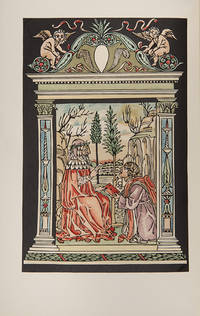
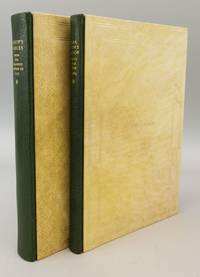
108233Verona Officina Bodoni 1973. . Limited edition number 138 of 160 copies; 2 vols 255 x 170 mm; Latin verses and the Italian version by Accio Zucco including Caxton's translation into English woodcut illustrations by Anna Bramanti after Liberale da Verona all hand-coloured after a copy of the 1479 edition in the British Museum by the Atelier Daniel Jacomet of Paris prospectus loosely inserted; publisher's green morocco-backed vellum with strapwork border and title in gilt top edge gilt other uncut transparent wrappers together in slip-case. some age related mottling to vellum as usual otherwise near-fine.<br /> One of the most beautiful of Mardersteig's productions printer and typographer head of Officina Bodoni with charming hand-coloured illustrations.<br /> Verona, Officina Bodoni, 1973. hardcover
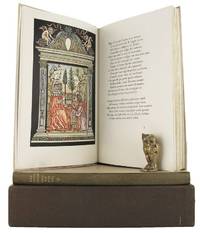
ST14304Verona: Officina Bodoni 1973. No. 131 OF 160 COPIES. 255 x 182 mm. 10 x 6 3/8". Two volumes. With an epilogue by Giovanni Mardersteig. <br/> Publisher's stiff vellum backed with green morocco top edges gilt. WITH 68 FINE HAND-COLORED WOODCUTS by Ann Bramanti 66 of these full-page colored via pochoir by Daniel Jacomet to recreate the illuminated miniature effect of the British Library colored copy of the Veronese Aesop of 1479 upon which the present edition is based. Printed on Magnani mouldmade paper with goose watermark. Volume I: the Latin text of the 1479 edition with Italian translation; volume II: the English text based on Caxton's 1482 translation. Prospectus laid in. Mardersteig/Schmoller 182. ◆Vellum grain showing variation as always otherwise in mint condition.<br/> <br/> This beautiful limited edition of Aesop is generally considered to be the finest book from Officina Bodoni and is thought by many to be among the half dozen greatest private press books ever printed. Probably the most important certainly the longest-lived 20th century Continental private press Officina Bodoni was founded in 1922 by Hans Mardersteig who later changed his first name to Giovanni. Like Sweynheym and Pannartz the first printers in Italy Mardersteig was born in Germany but moved to Italy as an adult and set up his hand press in a small village there. Will Carter has called Mardersteig "probably the finest pressman the world has ever seen or is ever likely to see" and it is difficult to overstate the pleasure derived from the precision of the Officina Bodoni books. Based on a beautiful hand-colored copy of the Aesop of Giovanni Alvise the third printer in Verona the Officina Bodoni Aesop celebrates the golden anniversary of Mardersteig's founding of his press. Officina Bodoni unknown
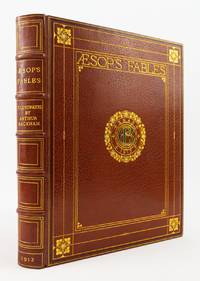
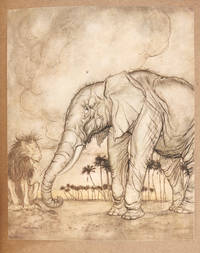
1912ST19901London & New York: William Heinemann & Doubleday Page 1912. No. 863 of 1450 SIGNED by Rackham. With an Introduction by G. K. Chesterton. 290 x 227 mm. 11 1/2 x 9". xxix 1 223 1 pp. <br/> SUPERB HONEY-BROWN CRUSHED MOROCCO GILT AND INLAID BY SANGORSKI & SUTCLIFFE stamp-signed on front turn-in covers with Arts & Crafts-style frame of gilt rules punctuated with inlaid green morocco dots inlaid green morocco Tudor roses at corners with four leafy branches upper cover with gilt titling at head of central panel central gilt-ruled medallion contain the letters "E B" in inlaid blue and green morocco with a collar lettered "XMAS 1912" this surrounded by a wreath of gilt vines and eight inlaid green morocco roses raised bands spine compartments with French fillet frames two panels with gilt lettering turn-ins with multiple gilt rules top edge gilt other edges untrimmed. Housed in a felt-lined buckram clamshell box. With 20 full-page black and white illustrations numerous illustrations in the text and 13 COLOR PLATES as called for each mounted on heavy brown stock and protected by lettered tissue guard. Printed on Large Paper. WITH HAND-ILLUMINATED PRESENTATION LEAF BOUND IN: "TO EDMUND" written in burnished gold surrounded by curling leafy vines in blue orange and green "WITH BEST WISHES FOR A MERRY CHRISTMAS AND A HAPPY NEW YEAR" written in black ink an ornament below it in colors and gold and "FROM THE BINDERY / XMAS. 1912." in black and red ink at foot. Front pastedown with engraved bookplate of "EMB" and "EWB"; front free endpaper with ex-libris of L. W. Jordan Jr. and with pencilled inscription "To Roxy from Edmund." Hudson p. 169; Latimore and Haskell pp. 38-39. The typical offsetting on free endpapers from binder's glue used for turn-ins very small very faint areas of transfer from acidic mounts used for color plates wherever tissue guard doesn't fully cover a facing leaf other trivial imperfections but still QUITE A LOVELY COPY clean and fresh internally and in an unworn handsome binding.<br/> <br/> In a fine binding by an eminent English workshop this is Rackham's take on the famous fables populated with charming animals anthropomorphized to just the right degree along with wistful maidens ancient crones and some seriously sinister trees. Arthur Rackham 1867-1939 studied art at Lambeth School where the work of his fellow student Charles Ricketts influenced his development. As Houfe says soon after Rackham joined the staff of "The Westminster Budget" in 1892 he began concentrating "on the illustration of books and particularly those of a mystical magic or legendary background. He very soon established himself as one of the foremost Edwardian illustrators and was triumphant in the early 1900s when color printing first enabled him to use subtle tints and muted tones to represent age and timelessness. Rackham's imaginative eye saw all forms with the eyes of childhood and created a world that was half reassuring and half frightening. His sources were primarily Victorian and among them are evidently the works of Cruikshank Doyle Houghton and Beardsley but also the prints of Dürer and Altdorfer." After studying under and then working for Douglas Cockerell Francis Sangorski and George Sutcliffe founded their own bindery in 1901 and continued in a successful partnership until 1912. During that year the firm suffered three major blows: their famously splendid jewelled binding dubbed the "Great Omar" was lost on the Titanic; a few weeks after this accident Francis himself drowned; and Francis' brother Alberto who had been a central figure in producing the firm's vellum illuminated manuscripts went over to Riviere. Despite these losses the firm grew and prospered employing a staff of 80 by the mid-1920s and becoming perhaps the most successful English bindery of the 20th century. This special binding was created as a Christmas present and includes a hand-illuminated leaf from the bindery possibly done by Alberto before he moved to Riviere. Such a grand presentation could only have been reserved for a special patron and in this case the "Edmund" would have been Edmund DeWitt Brooks 1866-1919 the substantial bookseller and bibliophile from Minneapolis. The present volume stands as a monument to a very close friendship between Brooks as well as his wife and namesake son on one side of the Atlantic and Sangorski & Sutcliffe on the other. With a special interest in literary works particularly in fine bindings Brooks came to know his supplier through annual book-buying trips abroad see Lee Edmonds Grove's 1945 memoir "Of Brooks & Books" for an account of that relationship. Grove says that the nature of the friendship was so strong that the binders invited Brooks to stay in a specially outfitted room at their premises rather than in a hotel during his London visits. Although our Aesop was inscribed to the father his son Edmund William Brooks 1900-85 so 12 at the time the present volume was signed continued the family connection with Sangorski & Sutcliffe for many years. The "EMB" and "EWB" bookplates belonged to Edmund's wife Edith M. Brooks 1862-1957 and son Edmund who apparently lived together in the family home after the elder Edmund died. Although we don't know the identity of "Roxy" we do know that the "To Roxy from Edmund" inscription is in the same hand as an identical one made--surely by our younger Edmund as printer/publisher--at the front of a copy of "The Book of Ruth" issued in 1934 by the Reed Pale Press that copy being offered for sale in 2022 by Under the Hill Books. William Heinemann & Doubleday, Page unknown
173076Verona: Officina Bodoni 1973. A fine set First Officina Bodoni edition number 86 of 160 copies on handmade Magnani paper. The Officina Bodoni was founded in 1922 by Hans Mardersteig and his press became the most important 20th-century private press on the Continent. This edition was published to mark the fiftieth anniversary of its founding. John Barr notes that this edition was Mardersteig's "reinterpretation of a fine illustrated book printed in Verona in 1479 by Giovanni Alvise. For the Officina Bodoni edition the original woodcuts were. recut by a contemporary engraver and coloured by hand". This copy includes five leaves of prospectuses issued by the press or The Bodley Head who were the sole agent for distribution in the UK. It is recorded that 70 copies each were reserved for The Bodley Head and the Chiswick Book Shop Sandy Hook Connecticut. All other copies were reserved for the Officina Bodoni. 2 vols octavo. With 66 hand-coloured woodcut illustrations by Anna Bramanti after Liberale da Verona. Original green morocco-backed vellum boards spines and front covers lettered in gilt covers with decorative borders in gilt top edges gilt. With acetate dust jackets and brown paper slipcase. List of woodcuts loosely inserted. Acetate slightly toned at spine: a fine set in near-fine jackets and fine slipcase. Barr 91. hardcover
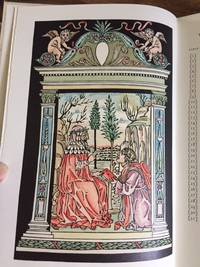
299Verona: Officina Bodoni 1972. Limited Edition. Fine. Octavo 9 7/8 x 6 1/2 in 250 x 165 mm; 2 volume set in slipcase. Vol. 1 pp. 280 with 68 hand-colored woodcuts; Vol. 2 pp. 120. Set in Centaur type and printed on hand-made Magnani paper with goose watermark. Original morocco-backed vellum with strapwork border and title in gilt t.e.g. remaining uncut; number 146 of 160 sets; text in Latin Italian and English. Woodcut illustrations by Anna Bramanti after Liberale da Verona ALL HAND-COLOURED AFTER A COPY OF THE 1479 EDITION IN THE BRITISH MUSEUM BY THE ATELIER DANIEL JACOMET OF PARIS list of woodcuts loosely inserted. <br /> Mardersteig 182. An exquisite and beautifully-executed edition of Aesop's FABLES richly illustrated with newly-cut wood engravings after a copy of the 1479 edition in the collection of the British Museum whose woodcuts are attributed to Liberale da Verona 1441-1526. The illustrations are beautifully carved and hand-colored with a rich scale of colors and shadings that remind us of illuminated miniatures.<br /> <br /> The Latin text comes from the Giovanni Alvise 1479 edition and was translated from the Greek by the Veronese poet Accio Zucco who possibly also used some earlier medieval translations. Each fable is followed by two sonnets by Zucco: the first tells the story Sonetto materiale and the second point the moral of the fable Sonetto morale. For this edition the Latin and Italian texts were revised by the philiologist Giovanni Battista Pighi. <br /> <br /> The second volume contains the William Caxton translation 1484 into English of the first 60 fables. The remaining 6 fables are here translated from Latin by Betty Radice. Prefatory note by Tanya and Hans Schmoller who carried out the revision of the text. <br /> <br /> Vol. 1 frontispiece: "THE FABLES OF AESOP. Printed from the Veronese edition of MCCCCLXXIX in Latin verses and the Italian version by Accio Zucco with the woodcuts newly engraved and coloured after a copy in the British Museum." Vol. 2 frontispiece: "The first three books of CAXTON'S AESOP containing the fables illustrated in the Verona Aesopus of MCCCLXXIX"<br /> <br /> Commenting on the making of this edition Giovanni Madersteig wrote: "At the end of the epilogue I examine the different illustrated editions of the fables printed in Italy during the fifteenth century. This comparison proves that the Verona Aesop was the model for all of them. Even the better-known Aesop from Naples printed by Tuppo contains quite a number of scenes with the same composition but in mirror image. The watermark of the goose which identifies the paper used in the first edition of the Aesop and in other Veronese books as having come from Toscolano was revived for this and other books printed at the Officina Bodoni." Barr John. The Officina Bodoni Montagnola Verona: Books Printed By Giovanni Mardersteig on the Hand Press 1923-1977. London: The British Library 1978. pp. 170-174<br /> <br /> Giovanni Mardersteig Weimar 1892 - Verona 1977 was a printer and typographer who as head of Officina Bodoni created books exemplifying the highest standards in the art of printing. The press began in 1922 in Montagnola Switzerland and moved to Verona in 1927. It printed and published some 200 books and pamphlets including Politian's Favola d'Orfeo; Shelley's Epipsychidion Shakespeare's Tempest and Dante's Vita nuova. There are good collections in many major European and American libraries. The Bodleian Library at Oxford holds a particularly rich collection. Following Mardersteig's death in 1977 his son Martino Mardersteig took over and still occasionally used the Officina Bodoni imprint for works he printed on his father's hand-presses. Officina Bodoni unknown
174319742Paris: Claude-Charles Thiboust 1743. Contemporary mottled sheepskin sewn on 5 cords gold-tooled spine with label in 2nd of 6 compartments gold fillets on board edges red edges green ribbon marker. 4to 25.5 x 20.5 cm. With an etched and engraved frontispiece showing Aesop surrounded by his students and a couple children above and a peaceful group of animals below including a lion elephant monkey mink eagle fox ox and mountain goat; and 139 half-page etched fable illustrations in the text 9 x 11 cm one for each of the 139 numbered fables all 140 copperplates etched and engraved by Aegidius Sadeler the frontispiece signed for Theatrum morum Prague 1608: 124 close copies in mirror image of those by Marcus Gheeraerts 15 added by Sadeler plus the title-plate with title removed. Further with numerous woodcut headpieces tailpieces and decorated initials. The third French Aesop adaptation to use the 140 plates originally etched by Aegidius or Gilles Sadeler ca. 1568/70-1629 for his Theatrum morum Prague 1608 here reordered and with a new prose text probably written by Henri-François d'Aguesseau 1668-1751 Chancellor of France three times between 1717 and 1750. The etching for fable 117 shows an American buffalo bizon the earliest image that really looks like the animal familiar to us today. "These added designs by Sadeler are highlights in the history of book illustration" Hodnett p. 39.With a 20th-century bookplate and ink stamps. The copper plate for fable 90 had lost much of its detail and some others show slight degradation but in general they remained in good condition and are also well printed. The corner of 1 leaf has been torn off and there is an occasional small marginal tear or faint stain but the book remains in good condition and has large margins. The binding is chipped and cracked at top of the spine and shows a few smaller defects but is also in good condition. A late showing of 140 of the best illustrations in the Aesop tradition etched and engraved in 1608.l Hodnett Marcus Gheeraerts pp. 38-41; Hollstein XXI p. 80; Smith Het schouwtoneel der dieren pp. 39-41. Claude-Charles Thiboust, unknown
16687514<p>Engraved frontispiece portrait of Ogilby by P. Lombart after P. Lely engraved plate of Aesop among his animals and eighty-one engraved plates illustrating the fables by Cleyn most of which were cut by Hollar. The work first appeared in folio in 1665 with 82 fables each with its own full-page illustration save one plate representing two fables printed on a separate leaf with accompanying letterpress text. Hollar was responsible for 57 of the illustrations & the print depicting Aesop. Period debossed full calf with handsome recasing in a fine morocco. Engraved frontispiece portrait cut and mounted with small paper repair in the lower right corner of the image. Some browning and occasional foxing; a few short marginal tears or paper flaws. Title in red and black Portrait of Aesop Dedication to Charles II. 211 1 blank 82 engraved plates pages. Large folio 10.5 x 16.125 inches; 410 x 265 mm.<br /><br /><br /><br /><br /><br /><br /><br /><br /></p> Printed by Thomas Roycroft, for the Author hardcover
1722962F34DLondon: J. Tonson and J. Watts 1722 . First edition. Leather. Very Good Indeed. 9.5" by 6.5". Elisha Kirkall; G. van der Gucht. The very scarce first edition of Samuel Croxall's translation of the fables of Aesop illustrated throughout and in a handsome full calf binding. The very scarce first Croxall translation of this work.Illustrated with a frontispiece by G. Van der Gucht and with vignette woodcuts throughout by Elisha Kirkall.Samuel Croxall was an Anglican churchman writer and translator particularly noted for this translation of Aesop's Fables.ESTC T84707With an index to the rear.Rebacked retaining the contemporary calf boards with gilt detailing and with endpapers renewed.Aesop's Fables are a collection of brief moral tales attributed to a storyteller believed to have lived in ancient Greece around the 6th century BCE. These tales typically feature animals as characters who embody human traits and behaviours teaching practical life lessons through their interactions. Classic fables like "The Tortoise and the Hare" "The Boy Who Cried Wolf" and "The Ant and the Grasshopper" use simple narratives to convey enduring wisdom about virtues such as perseverance honesty and hard work.Housed in a cloth clamshell box lined with felt. Rebacked in a contemporary calf binding with gilt detailing and with endpapers renewed. Housed in a felt-lined cloth clamshell box. Externally excellent. Neat repair to front board head. Clamshell in fine condition. Internally firmly bound. Pages lightly age toned with the odd spot most concentrated to the first and last few leaves. Very Good Indeed J. Tonson and J. Watts hardcover
68393Basel Froben 1518. Kl.8° 262 S. 1 Bl. mit Holzschnitt-Titelbordüre u.Druckermarke am Schluss.; 126 S. 1 Bl. mit 4 wiederh.Holzschnitt-Titelbordüren. u. 4 2 verschied.Druckermarken. Unter Verwendung alter blindgeprägter Deckelbezüge sauber restaurierter Lederband mit 4 Schliessbändern. Das erste Titelblatt im Unterrand angestückt etw. gebräunt u. teils mit kl. Feuchträndern die letzten Bl. mit kl. Einrissim Oberrand; flieg. Vorsatz fehlt hinten. VD 16 A 415 - IA. 101.002 - Hieronymus GG 19 - Schweiger I 13. - Erste Froben-Ausgabe des Aesop und einigen kleineren klassischen Texten „vier davon zweisprachig alle für den fortgeschrittenen Griechischunterricht gedacht.“ Hieronymus. - Die beigedruckten Texte jeweils mit eigenem Titelblatt jedochdurchgehend paginiert. „Für den griechischen Text hat Froben eine neue Kursive nach dem Vorbild derjenigen des Aldus Manutius verwendet“ebd. - Provenienz: Exlibris Janet and C. R. Ashbee sowie Exlibris Edmund Mc Clure auf Spiegel. 010 Basel, Froben, 1518 unknown
7198ILLUSTRATED WITH 66 POCHOIR WOODCUTS<br /><br />The Fables of Aesop. Printed from the Veronese Edition of MCCCCLXXIX in Latin Verses and Italian Version by Accio Zucco with the Woodcuts Newly Engraved and Coloured After a Copy in The British Museum. With The First Three Books of Caxton's Aesop containing the Fables Illustrated in the Verona Aesopus of MCCCCLXXIX.<br /><br />Epilogue by Giovanni Mardersteig. Illustrated with 66 full-page woodcuts by Anna Bramanti. Woodcuts are pochoir colored by Daniel Jacomet to recreate the illuminated miniature effect of the British Library copy of the Veronese Aesop of 1479 upon which the present edition is based. The fleurons first adopted in 1479 were engraved by Charles Malin. 8vo. Publisher's ¼-green morocco; decorated boards; top edges gilt; acetate dust wrappers; enclosed in morocco-tipped slipcase.<br /><br />Officina Bodoni Verona 1973. Limited to 160 numbered copies set in Centaur types printed on Magnani mould made paper with goose watermark. 2 volumes. Volume I contains the Latin text of the 1479 edition with Italian translation. The text was revised by Giovanni Battista Pighi. Volume II includes sixty fables in Caxton's English translation followed by 6 missing from Caxton and here translated from the Latin by Betty Radice with a prefatory note by Tanya and Hans Schmoller who revised the text. Mardersteig/Schmoller 182; Barr 91. <br /><br />The Officina Bodoni Aesop is considered to be Mardersteig's finest book and one of the greatest private press books ever printed. It celebrates the golden anniversary of Mardersteig's founding of the press and is based on a beautiful hand-colored copy of the Aesop of Giovanni Alvise the third printer in Verona. A very fine copy of this beautiful edition with the separate index of the woodcuts and an explanatory essay laid in. Officina Bodoni
1931001609<p>Newtown: The Gregynog Press 1931. 8 146pp 2. Publishers sheep title blocked in black to spine. Spine rubbed affecting a couple of the letters to title minor rubbing to extremities with small scuff to lower top corner. Edges of endpapers browned small stain to title just beneath illustrators name a couple of small and very minor marks to margins generally quite bright and clean. Number one hundred and seventy-two of two hundred and twenty-five copies bound thus by the Gregynog Press bindery another twenty-five copies were specially bound with their name to foot of lower endpaper. Actually published in April 1932 in Bembo type on Barcham Green hand-made paper with thirty-seven wood engravings by Agnes Miller Parker and wood engraved initials by William MacCance. For the illustrator see Selborne 'British Wood-Engraved Book Illustration 1904-1940' pages 382-392. Franklin page 282; Harrop 20 noting that "never can living creatures have been more successfully portrayed in so static a medium" Harrop page 96. First Thus. Hardback. Good. Illus. by Parker Agnes Miller. Folio. Private Press.</p> The Gregynog Press hardcover
163103Verona: Officina Bodoni 1973. with the woodcuts newly engraved and coloured after a copy in the British Museum. Epilogue in English by Giovanni Mardersteig. Two volumes. Volume I: Pp. 2782blank colophon 68 pochoir woodcuts attributed to Liberale da Verona recut by Anna Bramanti; Volume II: THE FIRST THREE BOOKS OF CAXTON'S AESOP containing the fables illustrated in the Verona Aesopus of MCCCCLXXIX. Pp. 1202blank colophon; med. 8vo; green morocco spines lettered and decorated in gilt 'cloudy' vellum boards lettered and decorated in gilt the spines uniformly faded; t.e.g. others uncut; together within a brown card slipcase edges slightly worn; bookseller's small stamp at top edge of upper pastedowns; Officina Bodoni Verona 1973. One of 130 sets thus total edition 160. Barr 91. Printed on handmade paper watermarked with a goose like that of the original edition this reinterpretation of an early illustrated book printed in Verona in 1479 by Giovanni Alvise was published to mark the 50th anniversary of the Officina Bodoni. A list of the woodcuts with page numbers is loosely inserted in Volume I together with the publisher's prospectus. Volume I contains the Latin text of the 1479 edition with Accio Zucco's Italian translation. Volume II contains the fables in Caxton's translation with the first fable and the final six of the Veronese edition which Caxton did not include translated from the Latin by Betty Radice. The illustrations were coloured by hand at the Atelier Daniel Jacomet Paris. 'The Aesop cuts show a rich spectrum of colours with delicate hues that recall miniatures. Mardersteig maintained that only a great master could have made the preliminary drawings for the fable illustrations and had in mind at the outset the colouring which would give life to the linear woodcuts. This artist he identified on stylistic grounds with the miniaturist Liberale da Verona whose paintings are to be seen in the large choir-books in the Piccolomini Library in Siena Cathedra and elsewhere' Barr page 90. Officina Bodoni unknown
191389076Paris: Librairie Hachette et Cie 1913. Fine. Rackham illustrates the father of the Western fable Librairie Hachette et Cie Paris 1913 23 x 29.5 cm relié Illustrated edition with compositions by Arthur Rackham 13 in colour tipped in with captioned tissue guards and 52 black-and-white illustrations in the text one of 55 copies on japon signed by Arthur Rackham on the limitation page deluxe issue.  Publisher’s full vellum binding flat spine gilt-lettered with gilt-stamped animals upper cover gilt-stamped with the title and an illustration of animals top edge gilt uncut lower cover silk ties preserved.  A fine copy of the works of the most celebrated fabulist illustrated by Arthur Rackham one of the rare copies on japon.  Provenance: Maurice Feuillet with his manuscript ex-libris on the half-title. A renowned press illustrator notably for major judicial cases but also an art critic and founder of the Figaro artistique Feuillet remains famous for his courtroom sketches at the trials of Émile Zola in 1898 and Alfred Dreyfus in 1899.  Librairie Hachette et Cie hardcover
168730747London: H. Hills jun. for Francis Barlow 1687. Second Barlow Edition. Hardcover. Good . Folio 30.8 by 19.4 cm. 10 40 40 17 2-221 3: table pp; engraved title letterpress title engraved arms of the dedicatee William Cavendish Earl of Devonshire; engraved portrait of Aesop; 30 of 31 numbered full page copperplate engraved plates in the Life; 110 half page engraved plates accompany the fables. 18th-century paneled calf expertly rebacked retaining original backstrip borders and spine tooled in gilt. Light staining and scuffs to covers. Occasional light stains and smudges throughout mostly marginal; a few careful repairs at torn margins; professional repair at margin plate 2 just encroaching on printed surface; 3 cm perforation in plate Fable XII; moderate staining at plate Fable XLVIII; Text block good with otherwise clean plates complete but for the so-called 'indecent' or 'scandalous' plate 17 often defaced or lacking. A good or better copy handsomely bound.<br /> <br /> Second Barlow edition of these superbly illustrated Fables of Aesop first published in 1666. Each of the 110 fables include a half-page engraving text fable and moral in both French and Latin along with new captions in English by Aphra Behn. The English Life of Aesop is likely a reissue of the original sheets from the small-paper copies of the 1666 edition; the French Life is a new version. They are interspersed with thirty full-page plates mostly signed by Thomas Dudley the unsigned plates were engraved by Barlow. <br /> <br /> According to his contemporary the engraver and antiquary George Vertue Francis Barlow d. 1704 came from Lincolnshire and apprenticed in London to the portrait painter William Shepherd. Early and late in his career Barlow designed sets of natural history plates which were etched by Wenceslaus Hollar Richard Gaywood Jan Griffier and Francis Place. These prints proved to be an important source for artists and craftsmen of succeeding generations. Along with his engravings for Edward Benlowes's Theophilia 1652 the present suite of illustrations for Aesop's Fables are considered to be Barlow's finest. The preliminary drawings reside in the British Museum. While Barlow's house at "the Golden Eagle in New-Street near Shoo-lane" was burnt in the great fire the copper plates for the volume survived. ODNB.<br /> <br /> Provenance and annotations: "The Gift of Rich. Wesley Esq to his Son Garret Wesley Year of Christ 1741" entered in black ink at the front endleaf; Garret's entry appears beside the imprint at the title and his "cypher" substitution chart for Greek and English letters appears beneath the gift dediction. A later owner "E.R." has noted in pencil at the pastedown that this book belonged to R. and G. Wesley "ancestors of the Wellesley Family see the autographs for the letter afterwards to the Marquis Wellesley Revnd Dr Wellesley at whose sale I bought it." At the front pastedown is the bookplate of George Aiken Batchelder 1860-1936 who was Vice President E. H. Rollins & Sons Bonds San Francisco California. The bookplate partially obscures another note in pencil which appears to mention the absence of the 'indecent' plate. References: ESTC R22991; S. O'Connell "Barlow Francis" in: ODNB online; Press Reference Library Western Edition Notables of the West vol. I p. 163 International News Service 1913.<br /> <br /> Full title and imprint: AEsop's fables with his life: in English French and Latin. Newly translated. Illustrated with one hundred and twelve sculptures. To this edition are likewise added thirty one New figures representing his life. By Francis Barlow. London: Printed by H. Hills jun. for Francis Barlow and are to be sold by Chr. Wilkinson at the Black-boy against St. Dunstan's Church in Fleet-street Tho. Fox in Westminster-hall and Henry Faitborne at the Rose in St. Paul's Church-yard. M.DC.LXXXVII. 1687. H. Hills jun. for Francis Barlow hardcover