3 692 résultats
1823R240114497F. BAROYER. 1823. In-16. Broché. Etat d'usage, Couv. légèrement pliée, Dos plié, Intérieur frais. 396 pages - frontispice noir et blanc - coiffes déchirées. . . . Classification Dewey : 845-Discours
2002ql516L'esprit du temps Broché 2002 In-8, (21x14 cm), broché, couverture illustrée, 335 pages, histoire contemporaine ; plats légèrement cornés, bon état général. Livraison a domicile (La Poste) ou en Mondial Relay sur simple demande.
000655in-8 broché, Ed. BLOUD, 366 pages, Très bon état, Peu courant
1825R320141206Chez Bredif. 1825. In-12. Relié. Etat d'usage, Plats abîmés, Dos frotté, Quelques rousseurs. XXIV + 454 pages - ouvrage en latin et en français - tampon sur la page de titre - papier jauni - quelques rousseurs à l'intérieur de l'ouvrage sans réelle conséquence sur la lecture - plats jaspés - coins, tranches et plats frottés - titre, roulettes et fleurons dorés sur le dos.. . . . Classification Dewey : 845-Discours
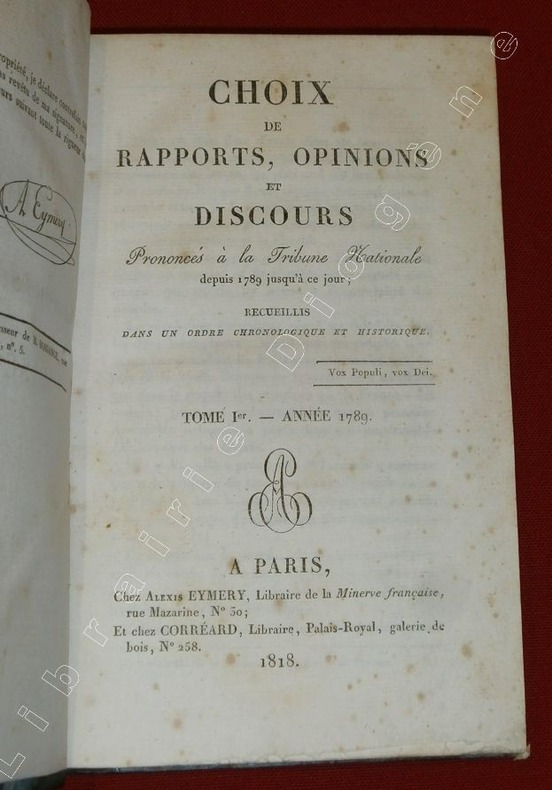
181814815Paris Alexis Eymery, Corréard 1818 In-8 xvi+469+x+428+x+448+482+viij+424+x+418+viij+426+414+viij+422+528+x+424+455+viij+416+vij+431+vij+415+viij+486+x+438+x+494+507+630+501+xvj+119 *+261+746 pp, (.) Recueillis dans un orgre chronologique et historique. 22 frontispices, 112 portraits gravés et 9 tableaux dépliants. Toutes tranches cirées, filets simples sur les plats ; décors, filets triples et roulettes aux dos. Quelques rousseurs et mouillures claires éparses. Légers frottis, quelques trous de vers, peu d'épidermures et faibles manques de cuir. Edités en tre 1818 et 1820. Rare et complet.
1818R320077602EYMERY ALEXIS / CORREARD. 1818. In-8. Broché. Etat d'usage, Livré sans Couverture, Dos satisfaisant, Pliures. 469 pages - Taches brunatres en tete des dernieres pages, sans conséquence réelle sur la lecture - Nombreuses pliures en coins de l'ouvrage - Dos et 2e plat de substitution. 1 signature sur la page de faux-titre.. . . . Classification Dewey : 845-Discours
63588P., Eymery, Corréard, 1818-1822, 20 volumes in 8° reliés demi veau brun de l'époque, dos lisses richement ornés, étiquettes vertes ; quelques rousseurs éparses.
21948Paris, Alexis Eymery, 1822. 13 x 21, 620 pp., broché, non rogné, état moyen (couverture abîmée, rousseurs).
90273A Paris, chez Alexis Eymery, Libraire de la Minerve française, et chez Corréard, Libraire, 1818-1822, 20 volumes +1 supplémentaire, in-8 de 130x210 mm environ, tome 1 : Assemblée Constituante, année 1789, xvi-469 p., - tome 2 : Assemblée Constituante, 1790, - x-428 p., - tome 3 : Assemblée Constituante, années 1790-1791, x-448 p., - tome 4 : Assemblée Constituante, années 1790-1791, 482 p., - tome 5 : Assemblée Constituante, années 1790-1791, viij-424 pages+9 tableaux dépliants, - tome 6 : Assemblée Constituante, années 1789-1790-1791, x-418 p., - tome 7 : Assemblée Constituante, 1790-1791, x-426 p., - tome 8 : Assemblée Législative, années 1791-1792, 414 p., - tome 9 : Assemblée Législative, 1792, viij-422 p., - tome 10 : Convention, 1792-1793, 528 p., - tome 11 : Convention, 1793, x-424, - tome 12 : Convention, 1793, 455 p., - tome 13 : Convention, 1793, 413 p., - tome 14 : Convention, 1794, vij-431 p., - tome 15 : Convention, 1794-1795, vij-415 p., - tome 16 : Directoire, 1795-1799, xvj-486 p., - tome 17 : Consulat (de l'an 8 à l'an 10), 1799-1802, x-438 p. (avec un fac-similé de l'écriture de Napoléon), - tome 18 : Consulat, Empire, années 1802-1804, xiv-494 p., - tome 19 : Empire, années 1804-1808, 507 p., - tome 20 : Empire, (de 1789 à 1815) 630 p., 1 volume supplémentaire, Session de 1819, 10-746 p.(ouvrage annoncé dans le tome 19), demi reliure en veau bleu-marine, dos lisses portant titres et tomaisons dorés, ornés de filets dorés, gardes marbrées, tranches finement mouchetées. Des rousseurs et pages brunies, quelques défauts de marge, frottements et petites épidermures sur le cuir de certains volumes, rares erreurs de pagination (dont une signalée dans le tome 12) sans manque de page. Edition sans portraits.
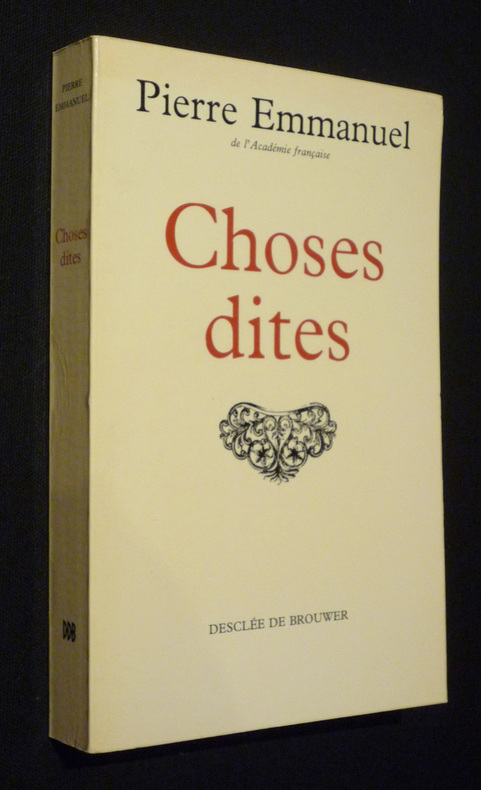
1970gu3538Desclée de Brouwer Dos carré collé 1970 In-8 (12,4 x 19,4 cm), dos carré collé, 289 pages ; couverture jaunie, par ailleurs très bon état. Livraison a domicile (La Poste) ou en Mondial Relay sur simple demande.
185098913Bale: Neukirch 1850. XVIII, C, 489 Seiten. 8° (17,5-22,5 cm). Zeitgenössischer Halbleinenband mit Pfauenpapierbezug. [Hardcover / fest gebunden].
199817763BBHelsinki, Helsingin Juhlaviikot, 1998. 4°, 86 S. mit zahlreichen ganzseitigen s/w-Abbildungen, dreisprachige Ausgabe (Text: finnisch, schwedisch und englisch), original Leineneinband (Hardcover), der Einband stellenweise minimal aufgehellt, sonst ein sehr gutes, sauberes Exemplar.
197856979Königstein/Ts. : Scriptor-Verlag 1978. XII, 448, 469 S. ; 20 cm, Schrift: Fraktur / Altdeutsche Schrift. Lw., gebundene Ausgabe, Blaues Seidenleinen, Schnitt und Einband etwas braunfleckig, sonst Exemplar in gutem Erhaltungszustand
186133202Stuttgart, Verlag von J. F. Steinkopf 1861. 2. Auflage, 850 Seiten, 8° (20,5 x 13 cm), Pappeinband der Zeit mit Rückenschild.
Gift inscription from author to R. E. Fantham on ffep. Else book is fine. ; Cicero in Letters is a guide to the first extensive correspondence that survives from the Greco-Roman world. The more than eight hundred letters of Cicero that are its core provided literary models for subsequent letter writers from Pliny to Petrarch to Samuel Johnson and beyond. The collection also includes some one hundred letters by Cicero's contemporaries. The letters they exchanged provide unique insight into the experience of the Roman political class at the turning point between Republican and imperial rule. The first part of this study analyzes effects of the milieu in which the letters were written. The lack of an organized postal system limited the correspondence that Cicero and his contemporaries could conduct and influenced what they were willing to write about. Their chief motive for exchanging letters was to protect political relationships until they could resume their customary, face-to-face association in Rome. Romans did not normally sign letters, much less write them in their own hand. Their correspondence was handled by agents who drafted, expedited, and interpreted it. Yet every letter advertised the level of intimacy that bound the writer and the addressee. Finally, the published letters were not drawn at random from the archives that Cicero left. An editor selected and arranged them in order to impress on readers a particular view of Cicero as a public personality. The second half of the book explores the significance of leading themes in the letters. It shows how, in a time of deepening crisis, Cicero and his correspondents drew on their knowledge of literature, the habit of consultation, and the rhetoric of government in an effort to improve cooperation and to maintain the political culture which they shared. The result is a revealing look at Cicero's epistolary practices and also the world of elite social intercourse in the late Republic. ; 256 pages; Signed by Author
Former owner's name to ffep. Light creasing to corners of wraps. Minor shelfwear. Pencilling and a few pen markings to a few pages. Else VG. ; Landmarks In Rhetoric And Public Address; 8.1 X 5.5 X 1.3 inches; 440 pages
Very faint bump to 1 corner else fine. ; This is the first book in English to take Cicero's forensic speeches seriously as acts of advocacy, i. E. As designed to ensure that the person he represents is acquitted or that the person he is prosecuting is found guilty. It seeks to set the speeches within the context of the court system of the Late Roman Republic and to explore in detail the strategies available to Roman advocates to win the votes of jurors. The volume comprises a substantial introduction, fourteen chapters by prominent Ciceronian scholars in Britain, North America, and Germany, and a final chapter by a current British Appeal Court judge who comments on Cicero's techniques from the point of view of a modern advocate. The introduction deals with issues concerning the general nature of advocacy, the Roman court system as compared with other ancient and modern systems, the Roman "profession" of advocacy and its etiquette, the place of advocacy in Cicero's career, the ancient theory of rhetoric and argument as applied to courtroom advocacy, and the relationship between the published texts of the speeches as we have them and the speeches actually delivered in court. The first eight chapters discuss general themes: legal procedure in Cicero's time, Cicero's Italian clients, Cicero's methods of setting out or alluding to the facts of a case, his use of legal arguments, arguments from character, invective, self-reference, and emotional appeal, the last of these especially in the concluding sections of his speeches. Chapters 9-14 examine a range of particular speeches as case studies--In Verrem II.1 (from Cicero's only major extant prosecution case) , Pro Archia, De Domo Sua, Pro Caecina, Pro Cluentio, Pro Ligario. These speeches cover the period of the height of Cicero's career, from 70 BC, when Cicero became acknowledged as the leading Roman advocate, to 49 BC when Caesar's dictatorship required Cicero to adapt his well-tried forensic techniques to drastically new circumstances, and they contain arguments on a wide range of subject-matter, including provincial maladministration, usurpation of citizenship rights, violent dispossession, the religious law relating to the consecration of property, poisoning, bribery, and political offences. Other speeches, including all the better-known ones, are used as illustrative examples in the introduction and in the more general chapters. An appendix lists all Cicero's known appearances as an advocate. ; 460 pages
Scholar's name to ffep (Robert Brown). Light shelfwear. ; 360 pages
Wraps are a bit tattered with heavy chipping and tears (crudely repaired with cellotape in places). Internally VG. ; Humanitas I; 311 pages
Some pencilling. Creasing to spine. Corners a bit creased. ; Latin Edition; 8.4 X 5.9 X 0.7 inches; 192 pages
Minor Creasing to wraps with light edgewear. ; 192 pages
Scholar's small bookplate to ffep (R. E. Fantham). Front hinge is cracked and 2 pages have been repaired with tape to their gutters which has now browned. Fraying to head of spine. ; 312 pages
Wraps a bit rubbed with light edgewear. ; Aschendorffs Sammlung Lateinischer Und Griechischer Klassiker; 104 pages
gold coloured boards. Some rubbing. Former owner's name to ffep. Light pencilling. Last page of advertisements torn. ; Includes latin Text with Vocabulary, English Translation, Notes and Introduction. ; The University Tutorial Series
Chipping and tears along joints of backstrip. Spine browned. Some light ink marginalia. Early 1900s? Possible rebind? ; Includes latin Text with Vocabulary, English Translation, Notes and Introduction. ; The University Tutorial Series