28 résultats
19742081502111704231Women's Club of Kanazawa Esperanto Association 1974. Soft Cover. Fine. Number of pages: 230p Size: 18cm Women's Club of Kanazawa Esperanto Association paperback
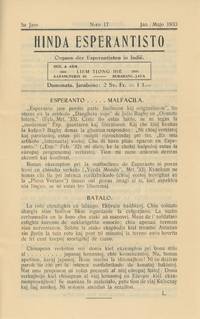
1947List2844Austria; Java Indonesia; London England; and Los Angeles California 1947. Sixteen pieces: two “Friends’ Esperanto Society†bulletins 8 x 12 ½ inch each; two letters 8 ½ x 11 inch each; seven “Hinda Esperantisto†pamphlets 5 ½ x 8 inch four pages each; two “Declaration†forms 4 x 6 inches; one BES pamphlet 4 ½ x 6 inches eight pages; one set of tickets for membership information 2 x 5 inches missing one tear-off ticket and one “Universala Ligo†membership card for 1947 3 x 4 ½ inches. Folded; some chipping and tearing at edges. Overall excellent to near fine. Esperanto is an artificial language created by Polish physician Ludwik Zamenhof 1859–1917 in 1887. Zamenhof intended Esperanto to be a universal second language; his experiences growing up Jewish in the Russian Empire among Russian Polish German and Yiddish speakers—all of whom regarded each other at best with suspicion—led him to believe that an easily-learned neutral second language could by contrast inspire unity between all people. Offered here is a small collection of materials related to various Esperanto societies: the “BES†a Czech group the Universal Esperanto Association the Friends’ Esperanto Society the Esperanto Club of Los Angeles and Hinda Esperantisto – “Indian Esperantist†based in Java Indonesia.<br /> <br /> These materials written largely in Esperanto note that most quotes herein are translated are mostly typical club bulletins advertising events announcing members’ news and reminding the reader of upcoming fees. The BES pamphlet besides advertising its Adresaro member directory solicits donations for a “living monument to Esperantoâ€â€”a headquarters—to be built in PotÅ¡tejn in Czechia<br /> <br /> “in the shape of a five-pointed star which would become a real home for all those who love goodness beauty health truth and progress. The stone-like majestic white building will shine brightly in a beautiful circle from a moderate slope and the fragrant forest behind it will form a charming background.†1932<br /> <br /> This utopian vision was likely prevented at least in part by the Nazi occupation of the country. Esperanto speakers including Zamenhof’s family in particular were among their many targets. The effort to purge the universal language from Europe was clearly not successful; a postwar letter from a language teacher in Austria to a gentleman in California included in this collection notes that the Californian’s address had been printed “in the magazine ‘Die Weltsprache’†– that is “The World Language†February 14 1947.<br /> <br /> Esperanto’s egalitarian and pacifist aims form a large part of its appeal to Quakers. It is unclear whether the Friends’ Esperanto Society which authored two of the items in this collection is the same as the Kvakera Esperanto-Societo which was founded in 1921 and is still active. The March 1935 bulletin announces the F.E.S.’s annual meeting at Friends House in London the headquarters of the Religious Society of Friends in Britain. An obituary for Wilson Henry Sturge the Society’s Vice President remarks on “his desire for international friendship and understanding through Esperanto†March 1935. The January 1936 bulletin calls members to petition their local Registrar of Education for Esperanto to be taught in high schools a request echoed by the Universala Esperanto-Asocio’s declaration form calling on the United Nations to “help to spread the use of this language in every possible way†including supporting its teaching in schools in order “to facilitate communication between the peoples of the world and to promote social progress.â€<br /> <br /> George R. Thompson’s letter to the Los Angeles Esperanto Club as its President strikes a similarly idealistic tone. He gives Club members his “Decalogue†finishing with an exhortation to: “10. Fix our eyes directly on our dear goal the universal brotherhood of humanity and global peace – through linguistic mutual understanding†August 1 1933.<br /> <br /> “Hinda Esperantisto†written by Liem Tjong Hie is somewhat more polemical. Its announcements include news from the Manchurian Federation of Esperantists who proposed to make Esperanto the region’s official language and “to abolish the English language†Jan-May 1933. It criticizes “the European progressive writers†especially the Hungarian Esperantist Kálmán Kalocsay for making the language more difficult for learners. Liem also writes mysteriously:<br /> <br /> “The world does not know that the Belgian Esperanto Institute dir. Frans Schoofs Antwerp is a physically rotting company. The shamelessness of the leaders is shown by the fact that they are so heroic in victimizing distant people knowing that they cannot do anything against them. A black mark to the apparent reputation of the leaders!â€<br /> <br /> These pamphlets also include side-by-side Indonesian and Esperanto blurbs including a review of a new book for Malaysian Esperanto learners – Esperanto caught on quickly in Asia where it still enjoys widespread popularity. <br /> <br /> Of interest to Esperantistoj and historians of Esperanto. unknown
192876663La Habana Cuba: Jorge Lauderman 1928. First edition. Inscribed by the author on the title page. Octavo. Frontispiece portrait 167 1 pp. Publisher's printed green wrappers with a design by Victor Manuel. Spine and all edges taped slight musty smell poor quality paper but nonetheless a very good copy.Johns was a Polish immigrant in Cuba at this was his doctoral thesis on Esperanto presented to the University of Havana in 1928. At the front of this publication is an errata slip and a notice that Dr. Johns had become a professor at the Department of Modern Languages at the University of Florida. Esperanto was created by Dr. Ludwik Lejzer Zamenhof in 1887 for the purpose of international communication. It was an entirely new language and for some time it held out the hope of a unifying language that could reach around the globe. (Jorge Lauderman) unknown
19049La Esperantista Vagabonda Klubo 1 Wilbury Avenue Hove Sussex. Three from '2-a Serio': 'Nro. 8' 'Marto 1912' 'Nro. 10 'Julio-Augusto 1912' and 'Nro. 11' 'Septembro-Oktobro 1912'. One from 'Serio 4': 'Nro. 1' 'Jan.-Februaro 1914'. 'La Vagabondo' The Tramp was the organ of 'La Esperantista Vagabonda Klubo' founded and edited by the artist Caroline Oxenford. Having previously been named 'La Vagabonda Monatajo' January to March 1908 and 'La Vagabondisto' April to July 1908 it became 'La Vagabondo' from September 1908. The First World War put an end to both club and magazine. The four issues are in fair condition on aged and worn paper. Uniform in design and each 12pp. 4to. although the last number is slightly taller in printed wraps carrying advertisements. The three numbers from '2-a Serio' all by 'W. G. Mead & Co. Printers East Putney S.W.' all in cream wraps have the same illustration on the front cover showing the nighttime silhouette of a house against trees; the number from 'Serio 4' by 'William Bishop Printer Market Street Edinburgh' has an illustration of a bearded tramp in a hat with 'Eric Forbes-Robertson E.F.R.' at the foot. The magazines contain work attributed to various individuals including K. M. Thornton Leo Belmont H. Boucon J. Simpson and Ch. Brunet with club reports by M. S. Rutter and M. McNeillie. There are also a number of illustrations including full-page illustrations by Anne Estelle Rici Eric Forbes-Robertson '"Ekamo." Lignogravurajo. Speciale farila por "La Vagabondo." de Sro. Eric Forbes-Robertson.' and Joseph Simpson. From the papers of Eric Forbes-Robertson. La Esperantista Vagabonda Klubo, 1 Wilbury Avenue, Hove, Sussex. Three from '2-a Serio': 'Nro. 8' ('Marto, 1912'), 'Nro. 10 ('Ju paperback
19512090502113700574Not Available 1951. Soft Cover. Fine. The book is in fine condition. Not Available paperback
19552090502113700171Not Available 1955. Soft Cover. Fine. The book is in fine condition. Not Available paperback
19362092902140600174Japan Esperanto Society 1936. Soft Cover. Fine. Number of pages: Book size: A5 Number of books: 47 Japan Esperanto Society paperback
2082702114907062Asake shobo N.A. Soft Cover. Fine. Number of pages: 201p Size: 18cm Asake shobo paperback
1927ZB297727Geneve 1927. 24 pp. original paper wrappers rear cover stained else good. - If you are reading this this item is actually physically in our stock and ready for shipment once ordered. We are not bookjackers. Buyer is responsible for any additional duties taxes or fees required by recipient's country. Geneve unknown
19332092902143900666Japan Esperanto Society 1933. Soft Cover. Fine. Number of books: 1 book Japan Esperanto Society paperback
19332092902143800664Japan Esperanto Society 1933. Soft Cover. Fine. Number of books: 1 book Japan Esperanto Society paperback
1960053317Aydin / Izmir: Cümhuriyet Kütüphanesi / Libristo Mehmet Aydin / Mesrutiyet Matbaasi. c. 1960s 1960. Soft cover. Fine. 8vo - over 7¾ - 9¾" tall. Paperback. Cr. 8vo. 20 x 14 cm. In Esperanto and Turkish. 12 p. A very rare local printing in Aydin city. First and Only Edition. Only one copy in OCLC: 163385249 Bayerische Staatsbibliothek of Germany. <br/> <br/> Cümhuriyet Kütüphanesi / Libristo Mehmet Aydin / Mesrutiyet Matbaasi., [c. 1960s] paperback
19512082402113505555Not Available 1951. Soft Cover. Fine. Number of books: 9 Not Available paperback
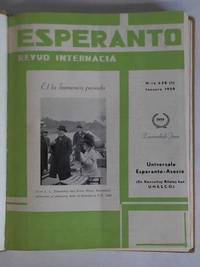
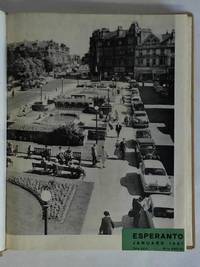
5d3215Esperanto Nederlando 1959/1960. Insgesamt 224 11 220 S. mit vielen Abbildungen broschierte Original-Einbände im Leineneinband quart mit durchgehend geringer Knickspur/Leineneinband und Vorsätze gering fleckig/Rücken leicht ausgeblichen. - Text esperanto - unknown
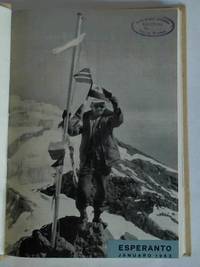
5d3213Esperanto Nederlando 1963/1964. Insgesamt 222 223 S. mit vielen Abbildungen broschierte Original-Einbände im Leineneinband quart teils Original-Einbände mit leichter Knickspur/Leineneinband und Vorsätze leicht fleckig/teils gestempelt/Rücken leicht ausgeblichen. - Text esperanto - unknown
5d3214Esperanto Nederlando 1961/1962. Insgesamt 224 224 S. mit vielen Abbildungen broschierte Original-Einbände im Leineneinband quart mit durchgehend leichter Knickspur/Leineneinband und Vorsätze leicht fleckig/Rücken leicht ausgeblichen. - Text esperanto - unknown
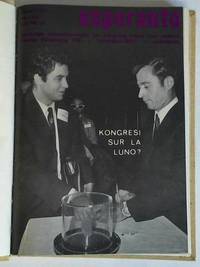
5d3211Esperanto Nederlando 1971/1972. Insgesamt 220 220 S. mit vielen Abbildungen broschierte Original-Einbände im Leineneinband quart Leineneinband und Vorsätze leicht fleckig. - Text esperanto - unknown
5d3210Esperanto Nederlando 1969/1970. Insgesamt 192 197 S. mit vielen Abbildungen broschierte Original-Einbände im Leineneinband quart Original-Einbände mit leichter Knickspur/Leineneinband leicht fleckig. - Text esperanto - unknown
5d3212Esperanto Nederlando 1965/1966. Insgesamt 224 24 204 S. mit vielen Abbildungen broschierte Original-Einbände im Leineneinband quart teils Original-Einbände mit leichter Knickspur/Leineneinband und Vorsätze leicht fleckig/teils gestempelt/Rücken leicht ausgeblichen. - Text esperanto - unknown
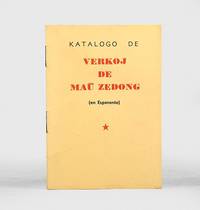
1972150655Beijing: Libroservo de ina Esperanto-Ligo 1972. A rare example of one of the sales catalogues issued by the China Esperanto League for overseas Esperantists wishing to order Mao's works. For catalogues issued in the 1960s and 1970s WorldCat records a total of only nine copies. Shortly after the founding of the People's Republic of China in 1949 the All-China Esperanto Association later renamed the "China Esperanto League" was formed in Shanghai and in the 1950s the League hosted speakers from around the world. While foreign contacts ceased during the Cultural Revolution the League used its network to promote Maoism to Esperanto movements abroad. The present catalogue offers for sale at very cheap prices volumes of Mao's Selected Works as well as pamphlets of his speeches and major essays. At the rear an order form is provided for customers to complete and return to Beijing by post. Though not marked as such the present copy is from the library of Paul Pickowicz b. 1945 a notable scholar of modern Chinese culture and society. In 1971 Pickowicz was one of 15 American scholars invited to visit the mainland the delegation being the first group of American academics to set foot in Mao's China. Duodecimo pp. 18. Stapled as issued original pale orange wrappers front cover lettered in black and red above red five-pointed star. A few marks to wrappers touch of foxing contents else clean and bright. A near-fine copy of this fragile publication. unknown
1925ZB301037Geneve 1925. original paper wrappers good. - If you are reading this this item is actually physically in our stock and ready for shipment once ordered. We are not bookjackers. Buyer is responsible for any additional duties taxes or fees required by recipient's country. Photos available upon request. Geneve unknown
1956N5134Paris: SAT 1956. Original Decorative Wrappers. Very Good. 12mo -. 112pp. Some illustrations A very good copy <br/> <br/> SAT unknown
1977N5133Buenos Aires: AmIgos De Lopez Luna 1977. Original Wrappers. Very Good. 12mo. 47pp. Avery good copy <br/> <br/> AmIgos De Lopez Luna unknown
a76489Moskovo 1968 Komisiono Pri Internaciaj Ligoj. Pro-Communist pamphlet in Esperanto. Small octavo 84pp. illustrations wraps. Good bit of chipping on edge of cover. . paperback
1977N5132Buenos Aires: AmIgos De Lopez Luna 1977. Orig. Wrappers. Very Good. 12mo -. 51pp. A very good copy <br/> <br/> AmIgos De Lopez Luna unknown