Livre Rare Book

3 889 résultats
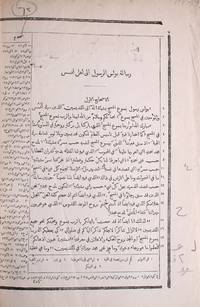
RO30352495. Non daté. In-8. Broché. Bon état, Coins frottés, Dos satisfaisant, Intérieur frais. Environ 110 pages. Nombreux surlignements quelques post-it in texte. Annotation en 1er contre-plat. Lecture dans son sens original (de droite à gauche). Texte en arabe.. . . . Classification Dewey : 492.7-Arabe
1978ABE-1696348169513108 PAGES-GERALD RAFSHOON DEVOILE SES RECETTES EN COMMUNICATION AUPRES DE JIMMY CARTER, 8P-COURONNEMENT DU PAPE JEAN PAUL 1er, 9P-JACQUES MEDECIN ET SON EPOUSE ILENE GRAHAM, 4P-ROBERT SHAW, 2P-MARGARET TRUDEAU SE PREND DEJA POUR MARILYN, 2P-NICARAGUA: LA REVOLUTION DES FOULARDS, 6P-YVES MOUROUSI SUITE A SA TENTATIVE D'ASSASSINAT, 4P-HUA GUOFENG RECU A TEHERAN, 4P-RAMBOUILLET, LE COUP DE COLERE DE GISCARD, 2P-JOHN TRAVOLTA, 4P-LA RIPOSTE DE LARISSA DOUBLET, 6P-ENTRETIEN DE MOUSTAPHA OULD MOHAMED SALECK, 4P-DITES NOUS PIERRE MAUROY, 1P-CARTE BLANCHE A ART BUCHWALD, 1P-DECHIRURE SANS MANQUE EN MARGE INFERIEURE DE QUATRIEME DE COUVERTURE
34968Traduction intégrale sur les manuscrits originaux par René R. Khawam, 1979, 301 pp., broché, traces d'usage, quelques rousseurs sur la tranche supérieure, trace de mouillure sur la partie inférieure de la couverture, pages de garde partiellement brunies, état correct.
1916RO40171470E. J. Brill, Leyden - Luzac & Co., London. 1916. In-8. Relié. Bon état, Couv. convenable, Dos satisfaisant, Intérieur frais. Env. 400 pages. Illustré de quelques reproductions en noir et blanc hors texte. Texte en arabe, avec lecture de droite à gauche.. . . . Classification Dewey : 492.7-Arabe
E. J. Brill, Leyden - Luzac & Co., London. 1916. In-8 Carré. Relié. Bon état. Couv. convenable. Dos satisfaisant. Intérieur frais. Env. 400 pages. Illustré de quelques reproductions en noir et blanc hors texte. Texte en arabe, avec lecture de droite à gauche. Composed in A.H. 658 = A.D. 1260. Edited with an Introduction, Notes and Indices from several Old Mss., by MIRZA MUHAMMAD, Ibn 'Abdu'l-Wahhab-I-Qazwini. And printed for the Trustees of the 'E.J.W. Gibb Memorial', Vol. XVI, II.
Octavo in white color illus wraps; 180p; 22cm, bibliographical references (pages 175-176). In Arabic. Uncommon. Muslim women -- History. Women in literature. Musulmanes -- Histoire. Femmes dans la littÈrature. Muslim women.
Octavo in while wraps illus. in color; 107 pages ; 21 cm In Arabic. Uncommon. Fiction, Novel. Palestine. Gaza. "Ghareeb Asqalani (whose real name is Ibrahim al-Zand) was born in the village al-Majdal Ashkelon in the south of Palestine in 1947. He has been living in the Gaza Strip with his family since 1948. He studied at the college of Agriculture in the University of Alexandria in Egypt, and received a degree in (Higher) Education in Islamic Studies in Cairo. He has worked as an agricultural engineer on the Euphrates Dam in Syria, as well as a teacher in the Gaza Strip. He also worked as a director in the Ministry of Culture and a Media spokesperson for the Palestine International Book Fair. He represented Palestine at the Spring Palestinian Culture Fair in 1997, and since 2010 has been Deputy Secretary General to the Palestinian Writersí Union and Chairman of the Gaza branch. He is the author of nine novels, six short story collections, three collections of essays, as well as three collections of stories online. His articles have been published widely across national print media. He was the winner of the short story prize from New Bethlehem University in 1976, and from the Palestinian Writersí Union in 1991. His short stories have been translated into English, French, Spanish and Russian." ó Publisher.
Very Good English Paperback. Pbo. Roy. 8vo. (24 x 17 cm). In Turkish and facsimile in Ottoman script. [xvi], 25, [14], 48 p. Study on one of important books on 'kâfiye'. Kitâbu'l-Kavâfî. Prep. by Kenan Demirayak.
Fine Turkish Paperback. Pbo. Roy. 8vo. (24 x 17 cm). Reprint in Arabic; large introduction, and annotations in Turkish. [4], [xLvi], 236 p. El-Bark el-Sâmî. [= Kitab al-Barq al-Shami]. Abridged by Al-Bundârî. Published, prepared and introduction by Ramazan Sesen. Muhammad ibn Hamed Isfahan was a Persian historian, scholar, and rhetorician. He left a valuable anthology of Arabic poetry to accompany his many historical works and worked as a man of letters during the Zengid and Ayyubid period. He was born in Isfahan in the year 1125, and studied at the Nizamiyya school in Baghdad. He graduated into the bureaucracy, and held jurisdiction over Basra and Wasit. He then became a deputy of the vizier ibn Hubayra. After the death of ibn Hubayra, he went to Damascus in 1166 CE (562 Islamic Calendar) and entered the service of the qadi of Damascus, Kamal ad-Din. The qadi presented him to the Zengid Nur ad-Din, who appointed him a professor in the school he had established there, which then became known as the Imadiyya school in his honour. Nur ad-Din was later appointed to be his Chancellor. After the death of Nur ad-Din in 1174, Imad ad-Din was removed from all his bureaucratic duties, and was banished from the palace. He went to live in Mosul and later entered the service of Saladin, the Kurdish Sultan of Egypt during that time. When Saladin took control of Damascus, Saladin's vizier, al-Qadi al-Fadil, appointed him chancellor, and he also became al-Fadil's deputy. Saladin had been unsure of his talent because he was only a scribe, Imad ad-Din soon became one of the sultan's favourites. As chancellor he did not have to perform the everyday duties of the chancery scribes, and he had a lot of leisure time in Egypt. From then on he accompanied Saladin on all his campaigns. After a certain raid, he was chosen to kill one of the prisoners, but the prisoner was a child and was instead exchanged for a Muslim prisoner held by the Crusaders. Imad ad-Din was present at the Battle of Marj Uyun, the Battle of Hattin, and the subsequent campaign to expel the Crusaders from the Holy Land. At Acre, he criticized Saladin for giving away the city's treasure instead of spending it on the reconquest. At Beirut, he became ill, but was the only scribe capable of writing the terms of surrender. He had recuperated in time to see the aftermath of the Siege of Jerusalem (1187), where he again criticized Saladin's generosity; he was also disgusted by those in charge of the ransom who took bribes, and the rich Crusader nobles who took their treasures with them rather than ransoming the poor. He was present at Acre again during the Third Crusade when the Christians retook the city of Acre, and was among those who fled after the defeat. After Saladin's death in 1193, he began writing his biographies of the sultan. He wrote the Kitab al-Barq al-Shami, which is lost, but was abridged by al-Bundari. This study contains just 5th volume of manuscript abridged by Al-Bundârî.
509720 in 8 (22x13,5) Un cahier manuscrit de 194 pages renfermant 110 contes de sources diverses, avec le texte en langue arabe finement calligraphié à l'encre noire et la traduction française en regard (fine et très lisible écriture). Les 110 contes sont titrés, et il est aussi donné la précision du nom des auteurs arabes. Attibué au Général Oliva? (roussillonnais), réalisé en Syrie, vers 1930 ??
- Lucien Vogel éditeur, Paris 1922, 18x24cm, relié. - Set of eight original prints in color, drawn on laid paper. The XXXIII and XXXVI sketches are signed lower left and right boards. The boards are introduced by a text Joan Ramon Fernandez. Original prints made ??for the illustration of The Gazette fashionable, one of the finest and most influential twentieth century fashion magazines, celebrating the talent of creators and artists French burgeoning art deco. Famous fashion magazine founded in 1912 by Lucien Vogel, The Gazette fashionable appeared until 1925 with an interruption during the War of 1915 to 1920, due to mobilization of its editor. She is 69 Deliveries from just 2000 copies and is illustrated including 573 color plates and 148 sketches depicting models of fashion designers. Upon publication, these luxury publications "are for bibliophiles and worldly aesthetes" (Françoise Tétart-Vittu "good Gazette of tone" in the fashion dictionary, 2016). Printed on fine laid paper, they use a typeface created specifically for the magazine by Georges Peignot, the Cochin character, taken in 1946 by Christian Dior. The prints are made with the technique of metal stencil, enhanced color and some outlined in gold or palladium. The adventure began in 1912 when Lucien Vogel, man of the world and fashion - it has already participated in Femina magazine - decided to found with his wife Cosette de Brunhoff (John's sister, the father of Babar) Gazette good tone in which the subtitle is then "Art, fashions and frivolities." Georges Charensol quotes the editor: "In 1910, he observed, there was no truly artistic fashion magazine and representative of the spirit of his time. So I thought of making a glossy magazine with truly modern artists [...] I was certain of success because for any fashion country can compete with France. "(" A great art editor. Lucien Vogel "in literary News, No. 133, May 1925). The success of the magazine is immediate, not only in France but also the US and South America. Originally, Vogel therefore brings together a group of seven artists: André-Édouard Marty and Pierre Brissaud, followed by Georges Lepape and Dammicourt; and finally his friends from the School of Fine Arts as are George Barbier, Bernard Boutet de Monvel or Charles Martin. Other talents come quickly reach the equipped Guy Arnoux, Léon Bakst, Benito, Boutet de Monvel, Umberto Brunelleschi, Chas Laborde, Jean-Gabriel Domergue, Raoul Dufy, Edward Halouze Alexander Iacovleff, Jean Emile Laboureur Charles Loupot, Charles Martin, Maggie Salcedo. These artists, mostly unknown when Lucien Vogel appealed to them, will eventually become iconic figures and artistic sought. These are the same illustrators who make the drawings advertisements Gazette. The boards highlight the dresses and sublime seven artists of the time: Lanvin, Doeuillet, Paquin, Poiret, Worth, Vionnet and Doucet. The designers provide for each number of exclusive models. Nevertheless, some of Illustrations contained no real model, but only the idea that the illustrator is done in the fashion of the day. Gazette fashionable is a milestone in the history of fashion. Combining the aesthetic requirement and plastic unit, it brings together for the first time the great talents of the world of arts, literature and fashion and imposed by this alchemy, a new image of women, slender, independent and bold, also driven by the new generation of designers Coco Chanel, Jean Patou, Rochas Marcel ... Recovery in 1920 by Condé Montrose Nast, Gazette fashionable modeled for the new composition and the aesthetic choices of the "little dying newspaper" that Nast had bought a few years ago: the Vogue magazine. [FRENCH VERSION FOLLOWS] Ensemble de huit estampes originales en couleur, tirées sur papier vergé. Les croquis XXXIII et XXXVI sont signés en bas à gauche et à droite des planches. Les planches sont introduites par un texte de Jeanne Ramon-Fernandez. Reliure à la bradel en plein papier à motif décoratif, do
188652630Leiden: E. J. Brill 1886. First Edition. xxii 327 pp. 1 vols. 8vo. Half brown morocco. Bookplate of Max L. Margolis with his signature on title. Somewhat rubbed internally fine. First Edition. xxii 327 pp. 1 vols. 8vo. On Aramaic loan words and phrases in classical Arabic.<br /> With the ownership signature of linguist and scholar of Jewish history Max L. Margolis. E. J. Brill unknown
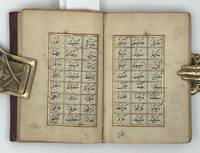
1730369933Ottoman Empire 1730. Polychrome double page ornamental opening text in black ink in a rounded naskh hand 8 lines per page fully vocalized with gold dot aya markers all within gilt rule borders. Attributes within gilt frames 30 per page. Occasional annotations in red. 117 ff. Dated at end A.H. 1143. 1 vols. 12mo. Late nineteenth century Islamic binding of red leather plaque stamped in silver with fore edge guard. Some minor smudging of passages a few paper flaws. Twentieth-century ownership inscriptions on first blank. Very good plus overall. Polychrome double page ornamental opening text in black ink in a rounded naskh hand 8 lines per page fully vocalized with gold dot aya markers all within gilt rule borders. Attributes within gilt frames 30 per page. Occasional annotations in red. 117 ff. Dated at end A.H. 1143. 1 vols. 12mo. Attractive pocket devotional with short surahs tables of the Attributes of Allah and other prayers. unknown
365678Ottoman lands undated early 18th c. C.E. Ink on on aharli paper. Text in black and red ink 23 lines per page. 158 ff. 1 vols. 6 x 8 inches. Later red leather spine cloth boards. Old paper repairs throughout pencil page numbers in a European hand. Two ownership inscriptions dated A.H. 1128-1152 1716-1739 C.E. Very good. Ink on on aharli paper. Text in black and red ink 23 lines per page. 158 ff. 1 vols. 6 x 8 inches. An important compendium of Islamic jurisprudence in the Hanafi school by Ê»Abd AllÄh ibn Aḥmad NasafÄ« d. A.H. 710 / 1310 C.E. <br /> It systematically presents authoritative Hanafi rulings without extended argumentation. The introduction highlights its purpose as a concise yet comprehensive reference. A foundational Hanafi legal text Kanz al-Daqâ'iq is an abridgment of the author's al-Wâfî widely studied in Ottoman madrasas. unknown
1833365677Ottoman lands 1833. Ink on thick burnished paper 21 lines per page in Levantine-style script in black ink with headings and occasional passages in red ink dated A.H. 1249 = C.E. 1833. 448 pp. The first few pages extensively annotated in margins in a later scholarly hand with numerous doodles and pen starts on last leaves. 1 vols. 8vo 8 x 6 inches. Leather wallet binding with fore edge guard boards decorated with a shamsa motif in blind top edge marked in ink "Sharh al-Shatibi". A bit shaken textblock loose in binding very good overall. Ink on thick burnished paper 21 lines per page in Levantine-style script in black ink with headings and occasional passages in red ink dated A.H. 1249 = C.E. 1833. 448 pp. The first few pages extensively annotated in margins in a later scholarly hand with numerous doodles and pen starts on last leaves. 1 vols. 8vo 8 x 6 inches. Ibn al-QÄsıh 1316-1399 C.E. an eminent scholar of Qira'at and Islamic textual transmission was born in Baghdad and studied in Egypt where he mastered the ten canonical recitations 'ashara. He later became a renowned instructor at Madânî Mosque where he taught many scholars. His works particularly Siraj al-QÄriʾal-mubtadî wa Tadhkar al-Muqriʾal-mutahi are critical to the tradition of Qira'at pedagogy.<br /> <br /> This manuscript is an early nineteenth-century copy of a standard work an extensive and detailed commentary on al-Shatıbi's Ḥırz al-Amani a foundational text in the science of Qur'anic recitation. While al-Shatıbi's work is a didactic poem that systematically presents the rules of Qira'at this commentary expands upon its meanings with in-depth linguistic grammatical and recitational analyses providing a comprehensive exegesis that was widely studied by advanced scholars. The presence of extensive marginal annotations suggests active scholarly engagement making this manuscript an invaluable resource for the study of classical Qira'at methodologies and textual transmission.<br /> <br /> A significant scholarly manuscript offering a deeply analytical and authoritative commentary on one of the most important texts in the Qira'at tradition. unknown
1870351950Cairo 1870. Single sheet bifolium a proof of the last page of Galatians and first page of Ephesians marked with corrections in pencil. 1 vols. 8vo. Removed. Some paper flaws along gutter. Good. Single sheet bifolium a proof of the last page of Galatians and first page of Ephesians marked with corrections in pencil. 1 vols. 8vo. Proof sheet from an edition of the Arabic New Testament Galatians 6:7 to end and Ephesians 1:1-19 without full vowel markers with marginal references and notes.<br /> <br /> With a contemporary holograph note in English: "proof sheet corrected . given to me by the American Vice Consul at Cairo". See Darlow & Moule 1688 for Beirut edition 1860: "very many editions with or without the full vowel points have since been priinted unknown
a76262Londini 1824 R. Watts Impensis Societatis Biblicae. Book of Psalms in Arabic. 12mo. 249pp.full leather with later paper spine. Owner bookplate.Good inner hinges cracked. . hardcover
1848ST14540Leipsic Leipzig: Guillaume Vogel fils 1848. FIRST EDITION. 225 x 142 mm. 8 3/4 x 5 1/2". XXV pp. 4 p.l. 231 pp. <br/> VERY ATTRACTIVE AND UNUSUAL CONTEMPORARY BLUE CLOTH BY F. J. CRUSIUS OF LEIPZIG his ticket on verso of front free endpaper WITH ORNATE STAMPED DECORATION IN THE ROMANTIC STYLE in gilt colors and blind covers with rocaille frame and large central arabesque in red and gilt smooth black roan spine with stylized gilt vine brown and tan lattice-work printed endpapers and edges. Text in French and Arabic on facing pages. Front flyleaf with AUTHOR'S INK PRESENTATION INSCRIPTION to Monsieur P. Desmaison see below. ◆One corner slightly bumped leaves lightly and uniformly browned due to paper quality a few other trivial imperfections but A NEARLY FINE AND VERY PLEASING COPY with few signs of wear inside or out.<br/> <br/> This is a beautifully preserved copy of a rare guide to spoken Arabic that features special provenance in an embossed and painted cloth binding that can almost pass as onlaid morocco. Our author Sheikh Mouhammad Ayaad El-Tantavy or al-Tantawi 1810-61 was an instructor of languages and literature at Al Azahr University in Egypt when he came to the attention of Russian diplomats in Cairo whose interpreter had attended his classes. The Russian consul to the Ottoman Empire which then occupied Egypt requested that El-Tantavy be lent to the Institute of Oriental Languages in the Russian foreign ministry and once he arrived in St. Petersburg in 1840 he never left. In addition to teaching languages at the school for Russian diplomats he was a professor of Arabic at St. Petersburg University eventually becoming the Chair of Arabic Studies. The present work is a guide to spoken Arabic for diplomats with the parallel texts in Arabic and French then the international language for diplomacy. France Russia and the Ottoman Empire had been engaged in a series of conflicts for some years so this tool would have had very practical application. It is recommended in the 1855 book "The Languages of the Seat of War in the East" by Friedrich Max Muller. The present copy is inscribed by the author to Jean-Jacques-Pierre Desmaisons 1807-73 the Franco-Russian director of training in Oriental languages in the Asiatic department of the Russian foreign ministry and El-Tantavy's supervisor there. The fact that Desmaisons would not have needed to make practical use of our volume goes some way to account for its fine condition. Binder F. J. Crusius developed machinery to facilitate the lavish decoration of bindings in innovative ways--like using paint to imitate leather as in the present example--achieving aesthetically pleasing results with far less labor and expense than would have been necessitated by hand work. The "Report of the Assessment Commission at the General German Industrial Exhibition in Munich in 1854" notes that Crusius displayed plan drawings of his invention at the fair. Copies of the first edition of this work are rare with OCLC finding just 12 in libraries worldwide and none in North America. We could find no copies recorded at auction. Guillaume Vogel fils unknown
178073849Timbuktu Mali: N.p. ca. 1780. Timbuktu manuscript of northern Mali - handwritten pages written in Arabic - from the same previous collection which is dated of 21/03/1780 24 safar 1194 Hegira. but this one has no date because it is missing a few leaves but I justify that it is from the same collection of the same mosque and same Shaikh masterArabic manuscript in papers former is the 3rd of the same manuscript116 leaves and 36 pages consisting of 36 lines in black and red ink nasghe on strong brown paper written in three different black inks see photos notes in margins.Size: 30 x 26 cmBinding in leather by its former owner written in it: Au nom de Dieu le Miséricordieux Manuscrit de la mosquée de Tombouctou and herffan Mahdi and religious signsThe manuscript has some stains due to passage of time but clearly visible text see pictures purchased from heirs together with other manuscripts N.p. hardcover
- Plon, Paris 1937, 13x20cm, broché. - Edition originale imprimée sur alfa, seul tirage avec 75 pur fil. Iconographie, exemplaire complet de son fac-similé autographe et de sa carte in-fine. Quelques rousseurs affectant essentiellement les toutes premières et toutes dernières pages ainsi que les tranches. Rare. [ENGLISH DESCRIPTION ON DEMAND]
Torino, Giulio Einaudi Editore, 1972. Prima versione integrale dall’arabo diretta da Francesco Gabrieli. A cura di Antonio Cesaro, Costantino Pansera, Umberto Rizzitano, Virginia Vacca. Opera completa in 4 Volumi, appartenente alla Collana: Gli struzzi. Le mille e una notte è una ricca raccolta di novelle orientali, di varia ambientazione storico-geografica e di differenti autori. E’ centrata sul re persiano Shahriyar che essendo stato tradito da una delle sue mogli, ha deciso di uccidere sistematicamente le sue spose al termine della prima notte di nozze. La bella Sharazad, andata in sposa al re, escogita un trucco per salvarsi: ogni sera racconta al re una storia, rimandando il finale al giorno dopo. Va avanti così per mille e una notte; e alla fine il re innamoratosi le rende salva la vita. In 8vo (cm. 20); brossure originali illustrate a colori con titoli al piatto e al dorso più custodia editoriale illustrata; pp. Vol. I: XXXIX, (1), 649, (7); Vol. II: IX, (1), 667, (3); Vol. III: VI, 581, (3); Vol. IV: VI, (2), 690, (8). Buono stato di conservazione. PAx
1974A109390Bagdad: Parti Arabe Socialiste ÒBAASÓ 1974. 1st edition. Near Fine. small octavo. softback with stiff wrappers 392pp. portraits ÔLe Rapport Politique adopte par le Huitieme Congres Regional du Parti Arabe Socialiste ÒBAASÓ- IRAK Janvier 1974. Inc. Portraits of Comrades Hassan Al-Bakr & Saddam Hussein. FRENCH TEXT. Scarce Parti Arabe Socialiste ÒBAASÓ unknown
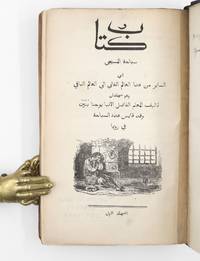
1834372732Malta: press of the Anglican Church Missionary Society 1834. First edition in Arabic. Title vignette of Bunyan in prison 7 plates captioned in Arabic. 6 281 1 imprint 2 blank pp. 1 vols. 8vo in 6s. Original silky cloth over boards twentieth-century binder's cloth spine. Joints crudely rehinged title leaf reinforced at gutter; binding cracked and a few leaves loosened. Contemporary presentation inscription on pastedown. Very good internally fine. First edition in Arabic. Title vignette of Bunyan in prison 7 plates captioned in Arabic. 6 281 1 imprint 2 blank pp. 1 vols. 8vo in 6s. Bunyan's Pilgrim's Progress translated into Arabic with a life of the author by Christoph Friedrich Schlienz. From the title page this is nominally the first volume but press marks are continuous and the text is complete: the end part twentieth sees the Pilgrim reach the Celestial City. Printed at Malta by the Anglican missionaries.<br /> <br /> William R. Whittingham 1805-1879 graduated the General Theological Seminary in 1825 and was named librarian of the newly founded school. He later accepted a position on the faculty in 1836. Whittingham was consecrated the fourth Bishop of Maryland in 1840 and served in that capacity until his death. <br /> <br /> This copy with his contemporary gift inscription to the GTS library "From the Rev. W.R. Whittingham 1834"<br /> <br /> RARE FIRST EDIITION IN ARABIC of a classic of English literature and of Christian devotion. Roper Arabic printing in Malta 1825-1845 56. OCLC: 57188645 Columbia Glasgow Tübingen 643954559 Manchester. Provenance: William R. Whittingham gif tinscription 1834; General Theological Seminary bookplates and inkstamps press of the Anglican Church Missionary Society unknown
190055709Turkey 1900. Contemporary morocco. Very good. Small oblong folio 16 by 30 cm. 28 leaves. Quranic manuscript in Jali Diwani script; gilt text recto and verso 3 lines per page on polished cream paper interleaved with onionskin protective leaves. Contemporary deep brown paneled morocco wallet binding rubbed tooled in gilt and blind; decorative paper pastedowns. Binding skilfully rebacked to style; neat professional repair to tear at front cover panel. Light marginal tidemarks; notable old ink marks continuous line across two leaves; occasional small marginal perforations not affecting text. Very good.<br /> <br /> Rare example of a text from the Qur'an in the Jali Diwani script an elaborate intertwining Arabic cursive developed during the early Ottoman era in the sixteenth century. The text in the present manuscript is entirely in gilt and derives from Juz 29 entitled Tabaraka "Blessed is" after the opening word of the first sura. One of the thirty roughly equal portions into which the Qur'an is divided Juz 29 comprises four complete suras: Al-Mulk "The Dominion"; Nuh "Noah"; Al-Jinn "The Jinn"; Al-Mursalat "The Emissaries. Copies of the Qur'an found in mosques especially in earlier times when manuscripts where very costly were often bound into these thirty portions. According to Islamic tradition during the month of Ramadan the entire Qur'an is recited usually at the rate of one juz each evening. unknown
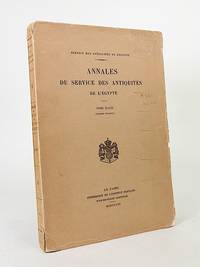
19489999_05036Le Caire Institut Français d'Archéologie Orientale 1948. 1st Edition . Hardcover. . ~ ~ NOTE: THE PRICE OF THIS BOOK IS CURRENTLY REDUCED! ~ ~ . Quarto. Pp. 276. With plates text figures illustrations Original wrappers. In fine condition. Excellent copy practically unused still entirely unopened. ~ FIRST EDITION. First part. For a complete table of contents and a list of contributors consult Wikipedia under series title. _O-7 <br/> <br/> Le Caire, Institut Français d'Archéologie Orientale hardcover