Livre Rare Book
609 résultats
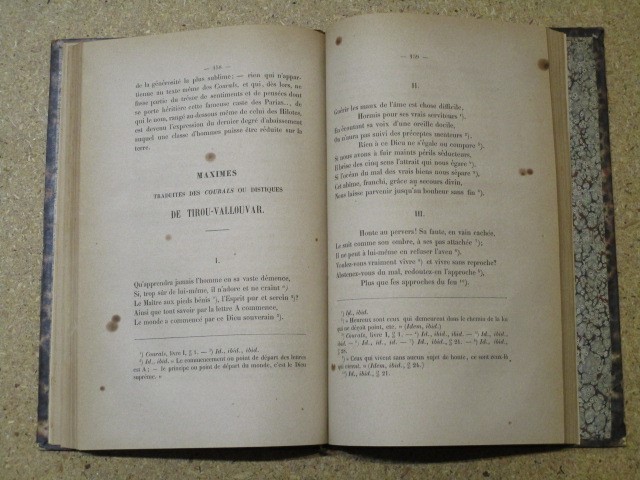
1857105683Vagner Duprat 1857 Nancy, N. Vagner / Paris, B. Duprat, 1857, X-266 p., demi-chagrin, environ 23x16cm, manque sur la coiffe supérieur, un pli prononcé sur le coin inférieur du second plat, des frottements d'usage sur la reliure, un mors fragile, pages jaunies, bon état pour le reste.
188720571Extrait de la Revue des deux mondes | (Paris) 1887 | 15.50 x 25 cm | agrafé
18906086Charles-Lavauzelle | Paris & Limoges 1890 | 14 x 21.50 cm | broché
188652630Leiden: E. J. Brill 1886. First Edition. xxii 327 pp. 1 vols. 8vo. Half brown morocco. Bookplate of Max L. Margolis with his signature on title. Somewhat rubbed internally fine. First Edition. xxii 327 pp. 1 vols. 8vo. On Aramaic loan words and phrases in classical Arabic.<br /> With the ownership signature of linguist and scholar of Jewish history Max L. Margolis. E. J. Brill unknown
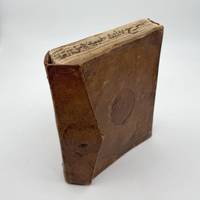
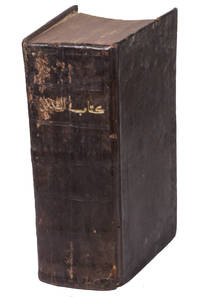
1833365677Ottoman lands 1833. Ink on thick burnished paper 21 lines per page in Levantine-style script in black ink with headings and occasional passages in red ink dated A.H. 1249 = C.E. 1833. 448 pp. The first few pages extensively annotated in margins in a later scholarly hand with numerous doodles and pen starts on last leaves. 1 vols. 8vo 8 x 6 inches. Leather wallet binding with fore edge guard boards decorated with a shamsa motif in blind top edge marked in ink "Sharh al-Shatibi". A bit shaken textblock loose in binding very good overall. Ink on thick burnished paper 21 lines per page in Levantine-style script in black ink with headings and occasional passages in red ink dated A.H. 1249 = C.E. 1833. 448 pp. The first few pages extensively annotated in margins in a later scholarly hand with numerous doodles and pen starts on last leaves. 1 vols. 8vo 8 x 6 inches. Ibn al-QÄsıh 1316-1399 C.E. an eminent scholar of Qira'at and Islamic textual transmission was born in Baghdad and studied in Egypt where he mastered the ten canonical recitations 'ashara. He later became a renowned instructor at Madânî Mosque where he taught many scholars. His works particularly Siraj al-QÄriʾal-mubtadî wa Tadhkar al-Muqriʾal-mutahi are critical to the tradition of Qira'at pedagogy.<br /> <br /> This manuscript is an early nineteenth-century copy of a standard work an extensive and detailed commentary on al-Shatıbi's Ḥırz al-Amani a foundational text in the science of Qur'anic recitation. While al-Shatıbi's work is a didactic poem that systematically presents the rules of Qira'at this commentary expands upon its meanings with in-depth linguistic grammatical and recitational analyses providing a comprehensive exegesis that was widely studied by advanced scholars. The presence of extensive marginal annotations suggests active scholarly engagement making this manuscript an invaluable resource for the study of classical Qira'at methodologies and textual transmission.<br /> <br /> A significant scholarly manuscript offering a deeply analytical and authoritative commentary on one of the most important texts in the Qira'at tradition. unknown
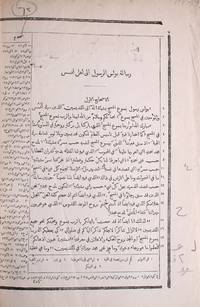
1870351950Cairo 1870. Single sheet bifolium a proof of the last page of Galatians and first page of Ephesians marked with corrections in pencil. 1 vols. 8vo. Removed. Some paper flaws along gutter. Good. Single sheet bifolium a proof of the last page of Galatians and first page of Ephesians marked with corrections in pencil. 1 vols. 8vo. Proof sheet from an edition of the Arabic New Testament Galatians 6:7 to end and Ephesians 1:1-19 without full vowel markers with marginal references and notes.<br /> <br /> With a contemporary holograph note in English: "proof sheet corrected . given to me by the American Vice Consul at Cairo". See Darlow & Moule 1688 for Beirut edition 1860: "very many editions with or without the full vowel points have since been priinted unknown
1848ST14540Leipsic Leipzig: Guillaume Vogel fils 1848. FIRST EDITION. 225 x 142 mm. 8 3/4 x 5 1/2". XXV pp. 4 p.l. 231 pp. <br/> VERY ATTRACTIVE AND UNUSUAL CONTEMPORARY BLUE CLOTH BY F. J. CRUSIUS OF LEIPZIG his ticket on verso of front free endpaper WITH ORNATE STAMPED DECORATION IN THE ROMANTIC STYLE in gilt colors and blind covers with rocaille frame and large central arabesque in red and gilt smooth black roan spine with stylized gilt vine brown and tan lattice-work printed endpapers and edges. Text in French and Arabic on facing pages. Front flyleaf with AUTHOR'S INK PRESENTATION INSCRIPTION to Monsieur P. Desmaison see below. ◆One corner slightly bumped leaves lightly and uniformly browned due to paper quality a few other trivial imperfections but A NEARLY FINE AND VERY PLEASING COPY with few signs of wear inside or out.<br/> <br/> This is a beautifully preserved copy of a rare guide to spoken Arabic that features special provenance in an embossed and painted cloth binding that can almost pass as onlaid morocco. Our author Sheikh Mouhammad Ayaad El-Tantavy or al-Tantawi 1810-61 was an instructor of languages and literature at Al Azahr University in Egypt when he came to the attention of Russian diplomats in Cairo whose interpreter had attended his classes. The Russian consul to the Ottoman Empire which then occupied Egypt requested that El-Tantavy be lent to the Institute of Oriental Languages in the Russian foreign ministry and once he arrived in St. Petersburg in 1840 he never left. In addition to teaching languages at the school for Russian diplomats he was a professor of Arabic at St. Petersburg University eventually becoming the Chair of Arabic Studies. The present work is a guide to spoken Arabic for diplomats with the parallel texts in Arabic and French then the international language for diplomacy. France Russia and the Ottoman Empire had been engaged in a series of conflicts for some years so this tool would have had very practical application. It is recommended in the 1855 book "The Languages of the Seat of War in the East" by Friedrich Max Muller. The present copy is inscribed by the author to Jean-Jacques-Pierre Desmaisons 1807-73 the Franco-Russian director of training in Oriental languages in the Asiatic department of the Russian foreign ministry and El-Tantavy's supervisor there. The fact that Desmaisons would not have needed to make practical use of our volume goes some way to account for its fine condition. Binder F. J. Crusius developed machinery to facilitate the lavish decoration of bindings in innovative ways--like using paint to imitate leather as in the present example--achieving aesthetically pleasing results with far less labor and expense than would have been necessitated by hand work. The "Report of the Assessment Commission at the General German Industrial Exhibition in Munich in 1854" notes that Crusius displayed plan drawings of his invention at the fair. Copies of the first edition of this work are rare with OCLC finding just 12 in libraries worldwide and none in North America. We could find no copies recorded at auction. Guillaume Vogel fils unknown
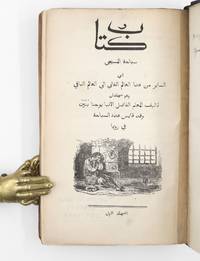
1834372732Malta: press of the Anglican Church Missionary Society 1834. First edition in Arabic. Title vignette of Bunyan in prison 7 plates captioned in Arabic. 6 281 1 imprint 2 blank pp. 1 vols. 8vo in 6s. Original silky cloth over boards twentieth-century binder's cloth spine. Joints crudely rehinged title leaf reinforced at gutter; binding cracked and a few leaves loosened. Contemporary presentation inscription on pastedown. Very good internally fine. First edition in Arabic. Title vignette of Bunyan in prison 7 plates captioned in Arabic. 6 281 1 imprint 2 blank pp. 1 vols. 8vo in 6s. Bunyan's Pilgrim's Progress translated into Arabic with a life of the author by Christoph Friedrich Schlienz. From the title page this is nominally the first volume but press marks are continuous and the text is complete: the end part twentieth sees the Pilgrim reach the Celestial City. Printed at Malta by the Anglican missionaries.<br /> <br /> William R. Whittingham 1805-1879 graduated the General Theological Seminary in 1825 and was named librarian of the newly founded school. He later accepted a position on the faculty in 1836. Whittingham was consecrated the fourth Bishop of Maryland in 1840 and served in that capacity until his death. <br /> <br /> This copy with his contemporary gift inscription to the GTS library "From the Rev. W.R. Whittingham 1834"<br /> <br /> RARE FIRST EDIITION IN ARABIC of a classic of English literature and of Christian devotion. Roper Arabic printing in Malta 1825-1845 56. OCLC: 57188645 Columbia Glasgow Tübingen 643954559 Manchester. Provenance: William R. Whittingham gif tinscription 1834; General Theological Seminary bookplates and inkstamps press of the Anglican Church Missionary Society unknown
190055709Turkey 1900. Contemporary morocco. Very good. Small oblong folio 16 by 30 cm. 28 leaves. Quranic manuscript in Jali Diwani script; gilt text recto and verso 3 lines per page on polished cream paper interleaved with onionskin protective leaves. Contemporary deep brown paneled morocco wallet binding rubbed tooled in gilt and blind; decorative paper pastedowns. Binding skilfully rebacked to style; neat professional repair to tear at front cover panel. Light marginal tidemarks; notable old ink marks continuous line across two leaves; occasional small marginal perforations not affecting text. Very good.<br /> <br /> Rare example of a text from the Qur'an in the Jali Diwani script an elaborate intertwining Arabic cursive developed during the early Ottoman era in the sixteenth century. The text in the present manuscript is entirely in gilt and derives from Juz 29 entitled Tabaraka "Blessed is" after the opening word of the first sura. One of the thirty roughly equal portions into which the Qur'an is divided Juz 29 comprises four complete suras: Al-Mulk "The Dominion"; Nuh "Noah"; Al-Jinn "The Jinn"; Al-Mursalat "The Emissaries. Copies of the Qur'an found in mosques especially in earlier times when manuscripts where very costly were often bound into these thirty portions. According to Islamic tradition during the month of Ramadan the entire Qur'an is recited usually at the rate of one juz each evening. unknown
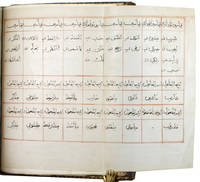
1830ABC_483971830. Contemporary navy blue morocco with the title lettered in gold on spine marbled endpapers. 4to 21.5 x 27 cm. With 2 folding tables 17 lines to the page written in red and black ink. A unique handwritten vocabulary and phrasebook of English and Arabic from the first half of the 19th century. This meticulously prepared manuscript is written in the fashion of a printed book opening with a title page and ending with an index of topics. It is divided into four main sections: nouns adjectives verbs and example sentences. The vocabulary especially in the nouns section is arranged by subjects which include such interesting headings as "Druggist" "Painter" "Merchant" "Cities" "the Bride's Paraphernalia" "Precious Jewels" "War" "The Church" "Clerical Vestments" "Ecclesiastical Degrees & Kinds of Sin" "Festivals" and "Monks their prayers and their dress". Presumably the dictionary was created to help a traveller or merchant who may have had an association with the Church. The final section offers an interesting selection of phrases and sheds some light on the experience of foreign language learning in the early 19th century. The phrases are a mixture of sentences that would be useful in daily life and such as would be included to practice the words from the vocabulary. Examples include: "We roasted a lamb and ate the whole of it and drank wine with it"; "I descended from above with the youth my enemy"; "I shot the bear in the water and he sank"; and "Why dost thou scratch thy head and spit in fire". As a cheat sheet for Arabic grammar the author includes two folding tables of Arabic verb tenses and conjugations. Overall a curious example of a 19th-century Arabic vocabulary and phrasebook.With a presentation note in English indicating it was a Christmas gift in 1881 presented by G. W. Bernard Esq. Binding and spine worn some browning and staining throughout. Otherwise in good condition. unknown
1855ABC_47909London: William Watts 1855. Original elaborately embossed brown calf with the title lettered in gold on the spine red edges. 8vo 22 x 14 cm. Rare edition of one of the best Arabic translations of the Bible. This work is based on the 1671 version from Rome which was the first printed edition of the complete Bible in Arabic. However the version from 1671 was not vocalised written with vowel points but the present edition from London is.The Arabic translation of the Bible from 1671 was done under the direction of Sergius Risi d. 1638 the archbischop of Damascus. It had been requested by the Archbischop of Aleppo and other important figures from the Eastern Church as manuscript copies had become rare and were often found to be incorrect. Risi and his team compared the Arabic manuscripts of the Bible they had access to with Hebrew and Latin versions and then composed their own translation. They first completed the Arabic Pentateuch. The Old and New Testament followed in 1647 and 1650 respectively after Risi's passing. These translations were revised and then finally published in 1671. It was the only Arabic translation of the complete Bible until 1811. Numerous new translations were made in 19th century. The present Catholic edition of the Arabic Bible translation existed alongside the 1860 Protestant translation by Cornelius van Alen van Dyck.According to the title-page this edition of the Old Testament was printed in 1855. However none of the relevant reference works mention an 1855 edition. Since the title-page of the New Testament bears the year 1857 it is possible that the Old Testament was also printed in that year and the date on the title-page is a printing mistake. The 1857 edition is also fairly rare on the market as we have only been able to find it in 1 sales record of the past 100 years.With the label of Watkins' bookbinding factory mounted on the front pastedown and a purple Spanish stamp from the library of someone with a law degree on the final leaf. The edges and corners of the boards are somewhat scuffed the binding is rubbed with some loss of material on the spine. The leaves are somewhat browned mild foxing throughout the back pastedown has a tear in the gutter. Otherwise in good condition.l BM General catalogue vol 2 p. 1276-198/199 other eds.; Darlow & Moule 1684; WorldCat 1402269394 1 copy 1857 ed.; cf. Green Journeymen middlemen: travel transculture and technology in the origins of Muslim printing. In: International journal of Middle East studies vol. 41 2 2009 pp. 203-224. William Watts, unknown
1899_202401103Paris, Éditions de la Revue Blanche, puis Eugène Fasquelle, Éditeur, 1899-1904 ; in-8 (148 x 234 mm), XXIV-[4°]-352 + 372 + [4]-320 + 336 + 304 + 306 + 276 + 356 + 336 + 328 + 348 + 324 + 332 + 336 + 332 + 292 pp., cartonnages d'éditeur, papier simili-toile, coloris vert clair, dos lisses, pièces de titre vert foncé, têtes rognées. Les 16 volumes. Éditions de la Revue Blanche (de 1899 à 1901) – [1902 ?] – Eugène Fasquelle, Éditeur (de 1903 à 1904). Traduction littérale et complète du texte arabe, par le Dr J.-C. MARDRUS.
1835A2420Paris, Beaule & Jubin, 1835 ; in-8, XVI-430 + 444 + 444 + 440 + 447 + 416 pp., brochés. Les 6 volumes. Bonne édition, avec une éloge de Galland. Ce texte est la traduction de Galland, traduit de l'arabe, mais dont la tradition orale vient de Perse et d'Inde. Cette traduction de Galland a été établie au tout début du 18ème siècle. Il l'a rédigé lui-même en s'inspirant du manuscrit. Il a ajouté Sindbad le marin qui ne faisait pas parti du texte original, mais qui était dans le manuscrit. Illustré de 12 gravures. Bon état.
188614790Extrait de La Revue des deux mondes | s. l. [Paris] (1886) | 15.50 x 25 cm | agrafé
188415689Extrait de La Revue des deux mondes | s. l. [Paris] 1884 | 15.50 x 25 cm | agrafé
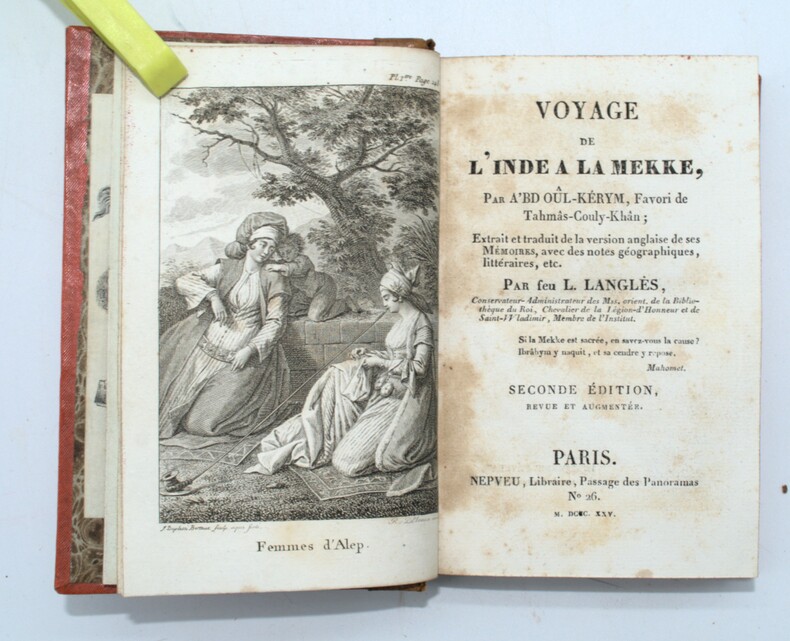
1825PHO-1571Paris, Nepveu,1825.- XXXIV-233 pp., illustré d’une gravure en frontispice, relié demi basane époque, dos lisse orné avec titre, ex-libris, charnières fendues, frottements, rousseurs au titre.
186890434E. Maillet Challamel | Paris 1868 | 14 x 22.5 cm | Relié
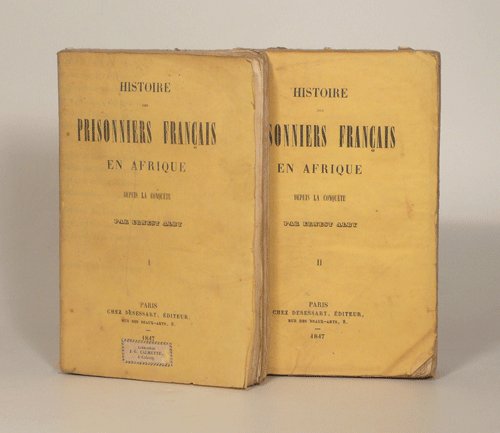
18470015521847 Paris, Chez Desessart, 1847. Deux volumes in-12 (120 X 184 mm) brochés, couverture jaunes imprimées ; Tome I : faux-titre, titre, 335 pages ; Tome II : faux-titre, titre, VIII-384 pages. Cernes de mouillure claire et rousseurs, plus marquées au premier tome, légers défauts aux couvertures. Etiquette de relais de la "Libraire Calmette à Cahors" sur le premier plat du tome I.
187314297Extrait de La Revue des deux mondes | s. l. [Paris] s. d. [1873] | 15.50 x 25 cm | agrafé
183089751Truchy | Paris 1830 | 13.7 x 21.7 cm | Broché
184415604Extrait de La Revue des deux mondes | s. l. [Paris] 1844 | 15.50 x 25 cm | agrafé
188244882A. Lévy | Paris 1882 | 28 x 37 cm | reliure de l'éditeur
188219865Extrait de La Revue des deux mondes | s. l. [Paris] 1882 | 15.50 x 25 cm | agrafé
187618578Extrait de La Revue des deux mondes | s. l. [Paris] 1876 | 15.50 x 25 cm | agrafé
180923384Imprimerie Impériale | Paris 1809-1829 | 71 x 54 cm | une feuille