WAR OF THE SPANISH SUCCESSIONBiblio.com

43 résultats
1703139168London: Printed and sold by John Nutt 1703. Planting colonies in the Spanish Americas First edition preceding the second edition of that year with an added postscript. Published in the third year of the War of the Spanish Succession 1701-1714 the anonymous author proposes that in return for the support of Britain and the Netherlands for the claim of the Emperor of Austria to the Spanish crown Spain's territories in America should be ceded to the two mercantile powers. They propose a confederation which will share the treasure from the Spanish mines keeping it out of the hands of a single monarch and in so doing preserve the balance of power in Europe. They moreover support extending the war to the Spanish West-Indies at that stage untouched by the conflict and offer proposals to plant colonies there. They respond to critics who would argue that such attempts at joint control of the American mines and territories would engender war between Britain and the Netherlands as trade brings peace and also reject the arguments that American wealth flowing into the mercantile nations would weaken the nation as was believed to be the case in Spain. The polemic nonetheless offers a stark realpolitik view of world politics and of the war treating as irrelevant the moral questions of stripping the territories of their nominal ally Habsburg Spain rather than the official war aims of taking French territories and stemming the growth of Bourbon power. A scarce treatise with ESTC locating six copies for this issue and a further two copies of the second edition Library Hub and Worldcat adding several more yet still absent from many prominent institutional collections and untraced in auction records. Small quarto 205 x 162 mm. Disbound pamphlet with remnants of original spine the pages numbered in an 18th-century hand 589-654 from its original place in the sammelband vol. Lightly browned and foxed top two cords mostly gone but bottom two holding light worming at foot not affecting text tiny hole affecting one letter to pp. 25/26. A very good copy without chipping or repairs. Alden 703153; European Americana 703/53; ESTC T193661; Kress S2261. Not in Sabin. unknown
17724365Valencia Por Benito Monfort 1772. Hardcover. . ~ ~ NOTE: THE PRICE OF THIS BOOK IS CURRENTLY REDUCED! ~ ~ . Two volumes. Duodecimo. Pp. xxviii 335; 344. Half-titles present. HARDCOVER uniformly bound in contemporary full mottled calf spines richly decorated in gilt morocco lettering-piece to each spine marbled endpapers all edges red calf bit affected by the mottling few worm holes on endpapers paste-down of one volume partly adhered to board. In a very good condition rather fine interiors. A-2 <br/> <br/> Valencia, Por Benito Monfort hardcover
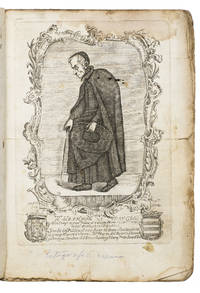
1770ABC_47902Córdoba 1770. 8vo. Contemporary limp parchment. With a large engraving of Juan de Santiago on the second leaf and a pen drawing on page 102. 4 "159" = 162 pp. Manuscript version of the only contemporary source on the life and death of the Córdoban Jesuit Juan de Santiago 1689-1762. It follows a work by the same name by Vincent Morales 1708-1765 which was probably published for the first time in 1763 in Córdoba. The copper engraving in the present manuscript likely comes from this edition. Judging from the ownership annotation the present manuscript was also made in Córdoba probably for a local university or convent. It contains an extra paragraph at the end about a feast held in honour of Juan de Santiago including six epigrams written for him. This part is not present in the printed versions of this work.Juan de Santiago was born in Écija. He became known as the "niño de la razón" because of his love for studying. He entered the Jesuit College at Sevilla at a young age. After he was ordained he moved to Córdoba College where he stayed for 40 years. He was seen as a model of holiness and many miracles were attributed to him. One of these occurred when he put out his hand to a blind woman who tried to enter the church and said to her: "Come in and take a good look." Upon which the woman cried "I see it I have recovered my sight." Throughout his life he was much loved in Córdoba because he helped and advised a great number of inhabitants. When he died there was an enormous grieving crowd in town and the City Council ordered that one of the three keys of his coffin should be kept in the city archive. The work by Morales was written at the request of the grieving Córdobans.With a crossed out ownership annotation on the verso of the title page. The parchment is stained and wrinkled with a few small holes and is somewhat smaller than the paper leaves. The borders of the first two leaves are frayed the manuscript is somewhat stained throughout. Otherwise in good condition.l Cf. De Backer-Sommervogel 1894 V 1284 printed ed. unknown
1787135132Madrid: En la Imprenta Real 1787. First nationwide Spanish census First edition of Spain's first nationwide census the census of 1787. The first census in Spain was undertaken in Castile as early as 1594 and there was a census of the Spanish Empire in 1776 but this was the first which embraced the whole country. It is sometimes known as the Census of Floridablanca after the reformist prime minister Count Floridablanca under whom it was undertaken from 1785 to 1787. The 43 tables list the regions of Spain alphabetically from Andalucia to Valencia but also include the Balearic and Canary Islands. The data accounts for the number of persons their ages religious affiliation and social status. The final population count is 10409879. Although the census did display modern demographic techniques the attempts to classify the population on class and occupation proved too rudimentary - servants were not classified in any consistent way and the scope of the hidalgo class varied considerably from region to region. Even so the census was a considerable demographic achievement and remains studied in modern Spanish demography; it is considered more accurate than the subsequent Spanish census of 1797. Quarto 301 x 225 mm. With 43 printed tables and large printed folding table at rear. Contemporary quarter sheep smooth spine ruled in gilt with green calf label marbled paper sides edges speckled red. Inked number "153" to title page. Scuffing and wear around extremities contents clean leaf a4 creased minor paper faults to tables XVIII and XXVIII 6 cm closed tear to map. A nice unrestored example. Goldsmiths' 13352; Palgrave I 242. unknown
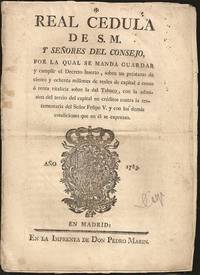
1783CA114212 pages with crest to title page. Quarto 11 1/4" x 8" single folded sheet housed in a custom made enclosure. First edition.<br /><br />Cedula Latin means in general an order or authorization; in earlier times such a document on the authority of the king or a royal decree which for Spain and Spanish America was a decree issued directly by the monarch.<br /><br />During the second half of the eighteenth century the Spanish Crown monopolized the tobacco industry in its American colonies creating vertically integrated organisations which included factories for the production of cigars and cigarettes. Few economic activities were more vital to the development of the Spanish American economies that the cultivation manufacture and commercialization of tobacco. Tobacco was the second most important export industry in Spanish America at the time. The decision of the Bourbon monarchs to monopolize the industry was a critical component of their plan to increase government revenues through a renewed contract with the colonists. This Spanish royal decree issued at the end of the War of American Independence to take effect January 1 1784 alters the basis for the tobacco trade set up as a monopoly under Phillip V and establishing new regulations for the business. This decree mainly affected the American colonies including Louisiana.<br /><br /><b>Condition:</b><br /><br />Some soiling on front and back; last page has columns of numbers and damp-stain along edge one inner page heavily soiled near head else a very good copy in a fine enclosure. En la Imprenta de Don Pedro Marinan
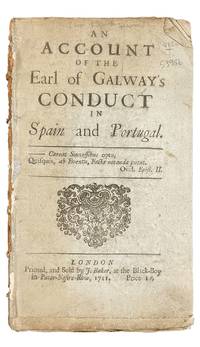
171134984London 1711. 888pp. Some toning. Very good. Disbound.<br/> <br/> An interesting work relating to the actions of French Huguenot soldier and diplomat Henri de Massue Earl of Galway during the War of the Spanish Succession. Galway's failure at the Battle of Almanza led to the defeat of the British and his eventual censure by Parliament.<br/> <br/> ESTC T18844. Goldsmith 4973. unknown
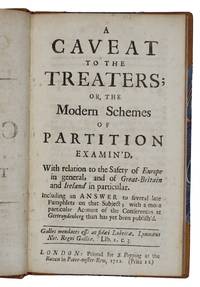
1711AQ26623London: Printed for S. Popping 1711. 8 88pp. Modern half-calf marbled paper boards contrasting red morocco lettering-piece. Minor shelf-wear. Half-title browned. The sole edition of a pamphlet variously attributed to Bishop of Chichester Francis Hare 1671-1740 and physician and satirist William Wagstaff 1683/4-1725 demonstrating 'the Danger of leaving the House of Bourbon in possession of the whole Spanish Monarchy or of any considerable part of it' occasioned by the peace negotiations March-July 1710 held at Geertruidenberg in the United Provinces between representatives of Louis XIV and the Dutch in an attempt to conclude the War of the Spanish Succession and written partly in response to three contemporary pamphlets; The ballance of Europe: or an enquiry into the respective dangers of giving the Spanish monarchy to the Emperour as well as to King Philip; Reasons why this nation ought to put a speedy end to this expensive war; and An essay at a plain exposition of that difficult phrase a good peace - all commonly ascribed to Daniel Defoe 1660-1731. ESTC T56742. First edition. 8vo. Printed for S. Popping hardcover