QUINTILIANUS, Marcus, Fabius (Quintilien).Livre Rare Book

11 résultats
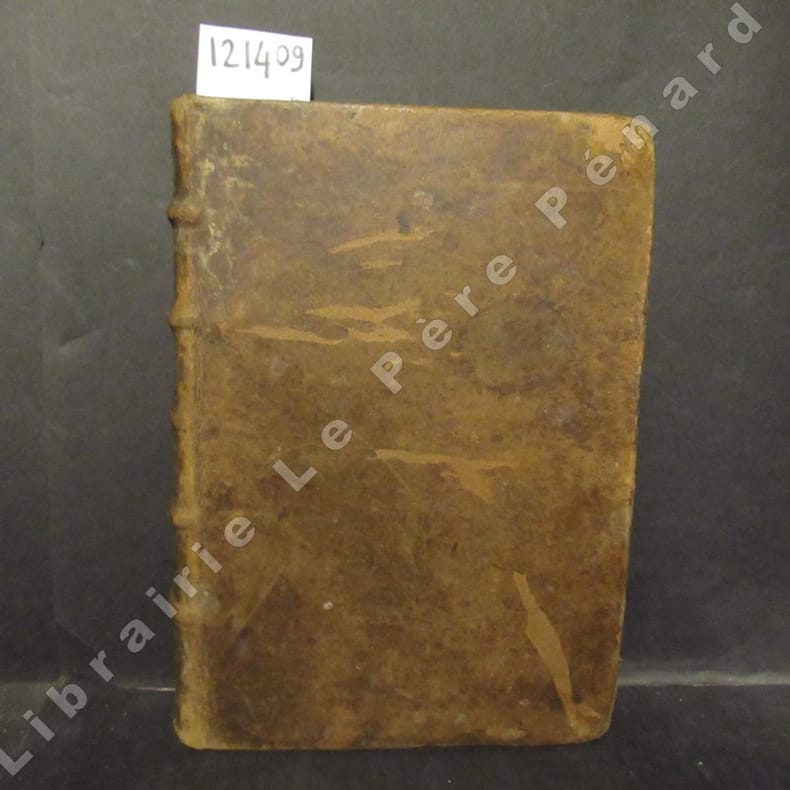
15551073031555 Lugduni (Lyon), Apud Seb. Gryphium (Sébastien Gryphe), 1555, 1 volume in-12 de 168x110 mm environ, 269 pages, avec la marque de l'imprimeur sous la forme d'un griffon, sur la page de titre et sur le dernier feuillet blanc, demi basane brune, titres dorés sur dos lisse, orné de filets dorés, gardes marbrées, tranches finement mouchetées. Quelques rousseurs et pages brunies, mouillures claires sur les tranches, manque de papier sur les coins de 2 feuillets (p. 235 à 238), manque de cuir sur une coiffe, cuir insolé et frotté, petite restauration et un accroc sur le papier marbré. Texte en italique agrémenté de délicates lettrines.
1591GR877Petit in-8o, deux titres relies ensemble. A) Lipsiae, Abr. Lambergi, 1591. xvi et sign. A1-Y8 avec marque d'imprimeurs au colophon. B) Ingolstadii, Dav. Sartirii, 1613, i, 133, i p.Double texte grec-latin, initiales gravees, mouillure legere au texte, insription manuscrite a la page du t., petit manque a une marge de qq feuilles. Reliure contemp. plein velin estampe, un peu sali. Pas dans le Brunet, mention au Hoffmann III, 520
157063191570 Lyon apud antonium gryphium 1570 In16 relié plein parchemin 296 pages plus Ioan Michaelis bruti animadversiones in IIII libros rhetoricorum incetti auctoris ad c herennium non paginé (55 pages) relié dans le même volume : Ciceronis (MT) Fragmenta ab andrea pattricio colecta, in quattuor tomos digesta index rerum verborum cpiosissimus - apud antonium gryphium 1570 - 149 pages plus index non paginé (12 pages).
155948417Venice, Gabriel Giolito de' Ferrari, 1559. Folio. Uncut in later (?) blank limp boards. A tear to middleof spine. Upper margins with brownspots, decreasing towards end. Large printer's woodcut-device at titlepage, 6 woodcut vignettes, 6 large woodcut initials. (12),563 pp. Wide-margined and printed on good paper. Apart from browning to upper margins, a clean copy.
155948417Venice Gabriel Giolito de' Ferrari 1559. Folio. Uncut in later blank limp boards. A tear to middleof spine. Upper margins with brownspots decreasing towards end. Large printer's woodcut-device at titlepage 6 woodcut vignettes 6 large woodcut initials. 12563 pp. Wide-margined and printed on good paper. Apart from browning to upper margins a clean copy. <br/><br/><em>There were printed 2 editions the same year one in Venice the item offered and one in Pesaro.Cavalcanti 1503-62 was a Florentine scholar-diplomat who served the Republic 1527-30 went into exile 1537 and spent his remaining years working for the Este and Farnese families. He died in poverty in Padua . His works reflect his interest in politics and scholarship: an oration to the Florentine militia 1530 political memoranda diplomatic letters translations from Polybius essays on classical political thought 1571 and an amazingly successful Retorica ten editions from 1559 to1585. The last a comprehensive compendium of classical rhetoric written in Italian with Italian examples maintains that the function of rhetoric is civic and practical rather than literary.Adams C 1175 but with the wrong year. </em> hardcover
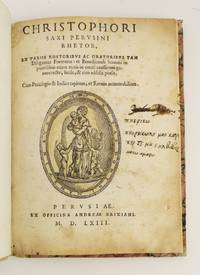
1563ST16379-038Perusiae Perugia: ex officina Andreae Brixiani 1563. SOLE EDITION. 210 x 155 mm. 8 1/4 x 6". 4 p.l. 78 4 leaves. <br/> 19th century vellum-backed pink marbled paper boards smooth spine black morocco label remnants of paper shelf label at foot of spine newer endpapers. Printer's device on title page. With Greek inscription in ink on title page occasional ink marginalia and with a page of inked notes written in Latin in an early hand on blank verso of final leaf. Leaf 3r with an inexpert but endearing pen-and-ink drawing of a rider on a galloping horse below the dedication with some pencilled embellishments around it; A4r with an ink-drawn small face in one margin. EDIT 16 CNCE 23145; Gehl "Advertising or fama: local markets for schoolbooks in sixteenth-century Italy" in Costas ed. "Print Culture and Peripheries in Early Modern Europe" 2012. Corners a little bumped boards lightly chafed title page a bit soiled and browned four leaves affected by the same small burn hole a handful of words partially obscured another leaf with very small damage from ink burn-through occasional faint foxing or minor ink stains but still a pleasing copy the binding perfectly satisfactory and the interior with no major defects the historical charm of the annotations compensating for any blemishes they cause.<br/> <br/> This is the first and only printing of a scarce textbook on rhetoric by a Perugian professor of the subject charmingly decorated and annotated by an early--not very attentive--pupil. In the 16th century the market for textbooks tended to be regional. Schools and teachers wanted works produced by local scholars and printers a preference Gehl relates to their earlier reliance on manuscripts shared and recopied by the teachers who used them. He notes that "Perugia . . . had a particularly lively market for learned books that lasted from the early days of printing right into the 17th century" and local professors were a ready resource for publishers like Andrea Bresciano.<br /> <br /> In the present work Saxus ca. 1499-1574 a pupil of the great Perugian humanist Francesco Maturanzio 1443-1518 outlines the principles of persuasion giving examples of the various rhetorical devices and modes citing classical sources. According to Gehl our author "was an innovator . . . who made a serious attempt to facilitate learning by catering to the limited attention span of students and by including teaching tips to grammar masters." We have evidence of what he was up against in regard to the former in the doodles of a prior owner of this text who was apparently dreaming of galloping away from the classroom on a trusty if seemingly headless steed. On another page the face of a master or fellow student peers critically from a margin. But some attention was paid as shown by the notes at the end of the book. <br /> <br /> Saxus' writings never managed to break into the major markets of Rome and Venice but continued to be printed after his death in Florence and Perugia where Gehl says "he could be considered a regional celebrity" whose former students used his textbooks to teach their own classes. We could trace just one copy of this work in auction records. ex officina Andreae Brixiani unknown
155945366Pesaro, Bartolomeo Cesano, 1559. 4to. Bound in a bit later full vellum with titlelabel in brown leather on spine with gilt lettering. (12),563 pp. Printers woodcut device on titlepage. With 7 large woodcut initials. The first 5 leaves with a few contemporary notes and underlinings. A fine clean copy.
155945366Pesaro Bartolomeo Cesano 1559. 4to. Bound in a bit later full vellum with titlelabel in brown leather on spine with gilt lettering. 12563 pp. Printers woodcut device on titlepage. With 7 large woodcut initials. The first 5 leaves with a few contemporary notes and underlinings. A fine clean copy. <br/><br/><em>There were printed 2 editions the same year one in Pesaro the item offered and one in Venice.Cavalcanti 1503-62 was a Florentine scholar-diplomat who served the Republic 1527-30 went into exile 1537 and spent his remaining years working for the Este and Farnese families. He died in poverty in Padua . His works reflect his interest in politics and scholarship: an oration to the Florentine militia 1530 political memoranda diplomatic letters translations from Polybius essays on classical political thought 1571 and an amazingly successful Retorica ten editions from 1559 to1585. The last a comprehensive compendium of classical rhetoric written in Italian with Italian examples maintains that the function of rhetoric is civic and practical rather than literary.Adams C 1176. </em> hardcover
154611249Venise, Hieronymus Scotas, 1546 ; in-folio ; plein vélin ivoire en partie manuscrit (reliure de l'époque) ; (6) ff., 142 ff. recto-verso, (3) ff. le dernier, blanc, a été découpé.
15531214091553 Lutetia, Cura ac diligentia Caro Stephani, Cum privilegio Regis - M.D.LIII (1553) - Edition princeps - Grand in-octavo, reliure plein veau, dos à cinq nerfs, caissons et fleurons dorés, titre doré - Ex-libris sur l'intérieur du premier plat "Ex-Libris Antoni Marioe Dumas Rectoris de Chauffaille" - 611 pages - Texte sur deux colonnes - Ouvrage en latin
15912981Amsterdam: Herman Jansz. Muller 1591. 8vo 143 x 95 mm. Collation: A-T8 T8 blank. 302 pp. Text in gothic types stage directions and lists of actors in italic. Title woodcut of a family meal six text woodcuts of which 5 half-page and one smaller. Wormtrack in gutter of first few leaves dampstaining to foremargins and lower corners a fewer quires with larger dampstain. 17th-century stiff parchment manuscript spine title. Provenance: "Herman Lamberts Bellaer Anno 1685" signature on front flyleaf Bellaer was a notary in Weesp North Holland from 1656 to 1658; "no. 38" written on title; sheet of 20th-century paper with note tipped in at front.Only Edition of an anonymous vernacular play collection a late survival of a popular medieval performance tradition. These seven plays in Dutch verse dramatize the seven Works of Mercy from Matthew 25:35-46. They were written and performed in the open air on seven consecutive Sundays by the amateur Amsterdam literary and theatrical confraternity or "chamber of rhetoric" known as de Egelantier or Eglantier eglantine or wild rose allegedly in order to encourage the citizens of Amsterdam to participate in a lottery for the benefit of the Amsterdam insane asylum Poll p. 113. The edition was printed by one of the Eglantier members.In each play of the present collection an allegorical figure with a name like "Good Education" or "Brother Love" knocks on the door of the house of a different stock character - a burgher an artisan a farmer etc. - asking to be fed or clothed or given shelter. While these tradesmen comply a selfish character named "Most of the World" invariably rejects the stranger. Each play has a prologue and an epilogue that provides the moral of the story explaining that the stranger the naked the hungry the thirsty etc. are all Christ on the Cross.By the early sixteenth century every town and many villages of the Low Countries possessed their own "college" or chamber of rhetoric; these were literary confraternities whose origin lay in medieval French-speaking theater groups of Flanders and Brabant which performed mystery and miracle plays. Endowed with corporate structures emblematic names often flowers and their own blazons and regalia the chambers of rhetoric became a central cultural institution of Netherlandish life. After the Reformed church came to power in the northern provinces in 1581 it attempted to halt public performances of religious plays and even to suppress the chambers altogether but largely failed the chambers especially of larger towns usually retaining the support of local authorities. Hence one finds such "throwbacks" as the present series of religious plays. A peculiar to the modern reader mixture of traditional farce and didactic allegory it is typical of rhetoricians' plays which were usually "absolutely middle-class in tone and opposed to aristocratic ideas and tendencies in thought" EB 1911 8:721 with simple dramatic plots that were secondary to their educational value.Although founded later than many others at the end of the 15th century Amsterdam's de Eglantier was the most prominent Chamber of Rhetoric in the northern Netherlands. Its prestige was enhanced by the infusion of humanist writers and writers from the southern Netherlands who emigrated to the north during the religious wars. The Zeven Spelen is unique in containing the productions of a single city's Rhetorical Chamber: all other known Renaissance Dutch rhetoricians' collections contain the productions of several different towns performed in elaborate literary competitions known as landjuweelen.Six of the seven simple but charming woodcuts illustrating this edition in a consistent style and apparently by the same wood-engraver possibly the printer represent the first six acts of mercy the seventh play is illustrated with a smaller Last Judgment cut evidently from the printer's stock. Their charm lies in their portrayal of scenes from daily life: a family dining as a servant brings a platter and a mother feeds her baby; a vintner sitting cross-legged on a wine barrel in a medieval square pouring a welcome drink to a pair of wanderers while a neighbor quaffs behind him; naked men being clothed a prisoner in a stockade; a sickbed with a woman stirring gruel. The printer-publisher Harmen or Herman Jansz Muller ca. 1540-1617 was a member of a family of engravers printers and print- and booksellers who operated under the sign of "Den Vergulden Passer." Under his direction from ca. 1566 until his death the bookselling activities of the firm reached their apogee. As in many of his imprints Muller identifies himself here as a figuersnyder and it is possible that the title woodcut and the five larger cuts were his own work cf. Thieme-Becker 25:230 who suggested as much. Muller was also a member of De Egelantier and pubished a number of works for them.OCLC locates 5 copies in American libraries Folger Newberry National Gallery of Art Harvard and U. Michigan. STCN 844000841; The New Hollstein / The Muller Dynasty Part III 1999 75 and pp. 21-22; E. W. Moes De Amsterdamsche boekdrukkers en uitgevers in de zestiende eeuw 1900-1915 I p. 315 no. 223; Univ. of Amsterdam Library Catalogus van oudere werken op het gebied der Nederlandsche letteren 1921 no. 6; Scheepers collection Catalogus van een zeer belangrijke verzameling fraaie en zeldzame boeken der 16e-19e eeuw 1947 I:66. Cf. G. Kalff Geschiedenis der Nederlandsche letterkunde in de 16de eeuw part 2 1889 pp. 25 & 48-55; Klaas Poll Over de tooneelspelen van den Leidschen rederijker Jacob Duym 1898 p. 113-14; A. van Dixhoorn "Chambers of Rhetoric: performative culture and literary sociability in the Early Modern Northern Netherlands" in The Reach of the Republic of Letters: Literary and Learned Societies in Late Medieval and Early Modern Europe 2008 119-148; A-L. Van Braene "Faith on Stage: the Chambers of Rhetoric and Civic Religion in the Low Countries 1400-1700" K. Eisenbichler A Companion to Medieval and Early Modern Confraternities Brill 2019 pp. 365-84. Herman Jansz. Muller hardcover books