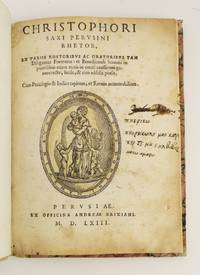
RHETOR EX VARIIS RHETORIBUS AC ORATORIBUS TAN DILIGENTER FORMATUS UT BENEDICENDI SCIENTIA IN PUERILIBUS ETIAM ANNIS IN OMNI CAUSSARUM GENERE RECTE FACILE ET CITO ADDISCI POSSIT
1563ST16379-038Perusiae Perugia: ex officina Andreae Brixiani 1563. SOLE EDITION. 210 x 155 mm. 8 1/4 x 6". 4 p.l. 78 4 leaves. <br/> 19th century vellum-backed pink marbled paper boards smooth spine black morocco label remnants of paper shelf label at foot of spine newer endpapers. Printer's device on title page. With Greek inscription in ink on title page occasional ink marginalia and with a page of inked notes written in Latin in an early hand on blank verso of final leaf. Leaf 3r with an inexpert but endearing pen-and-ink drawing of a rider on a galloping horse below the dedication with some pencilled embellishments around it; A4r with an ink-drawn small face in one margin. EDIT 16 CNCE 23145; Gehl "Advertising or fama: local markets for schoolbooks in sixteenth-century Italy" in Costas ed. "Print Culture and Peripheries in Early Modern Europe" 2012. Corners a little bumped boards lightly chafed title page a bit soiled and browned four leaves affected by the same small burn hole a handful of words partially obscured another leaf with very small damage from ink burn-through occasional faint foxing or minor ink stains but still a pleasing copy the binding perfectly satisfactory and the interior with no major defects the historical charm of the annotations compensating for any blemishes they cause.<br/> <br/> This is the first and only printing of a scarce textbook on rhetoric by a Perugian professor of the subject charmingly decorated and annotated by an early--not very attentive--pupil. In the 16th century the market for textbooks tended to be regional. Schools and teachers wanted works produced by local scholars and printers a preference Gehl relates to their earlier reliance on manuscripts shared and recopied by the teachers who used them. He notes that "Perugia . . . had a particularly lively market for learned books that lasted from the early days of printing right into the 17th century" and local professors were a ready resource for publishers like Andrea Bresciano.<br /> <br /> In the present work Saxus ca. 1499-1574 a pupil of the great Perugian humanist Francesco Maturanzio 1443-1518 outlines the principles of persuasion giving examples of the various rhetorical devices and modes citing classical sources. According to Gehl our author "was an innovator . . . who made a serious attempt to facilitate learning by catering to the limited attention span of students and by including teaching tips to grammar masters." We have evidence of what he was up against in regard to the former in the doodles of a prior owner of this text who was apparently dreaming of galloping away from the classroom on a trusty if seemingly headless steed. On another page the face of a master or fellow student peers critically from a margin. But some attention was paid as shown by the notes at the end of the book. <br /> <br /> Saxus' writings never managed to break into the major markets of Rome and Venice but continued to be printed after his death in Florence and Perugia where Gehl says "he could be considered a regional celebrity" whose former students used his textbooks to teach their own classes. We could trace just one copy of this work in auction records. ex officina Andreae Brixiani unknown