875 résultats
a1053961 Sotheby. 28 April 1975 "Russian and Greek Icons and Russian works of Art"; 2 Christie's July 30 1979 "Russian and Greek Icons"; 3 ditto for 21 September 1979; 4 ditto for 3 Feb 1981. Fully bw illus. All VG to Fine. All sm4to wraps. Group of 4 individual pamphlets: . paperback
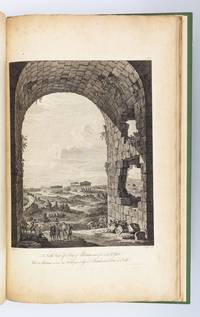
1758ST17496-017Paris: H. L. Guerin & L. F. Delatour Jean-Luc Nyon and Jean Neaulme 1758. FIRST EDITION. 608 x 445 mm. 24 x 17". xiv 56; 2 vi 28 pp. Two parts in one volume. <br/> Later early 20th century quarter sheep over marbled boards raised bands compartments gilt reddish-brown leather label with gilt lettering all edges untrimmed. With large woodcut vignette on title and 60 ENGRAVED PLATES by Le Bas Littret de Montigny Neufforge and Patte after Le Roy. Brunet III 103; Millard French 101. A little rubbing to corners and head and tail of spine leather a bit faded chafed and freckled in places but the binding entirely sound and still quite pleasing; very faint diagonal crease at lower corner of many leaves a handful of plates slightly browned one more noticeably so other minor issues but quite a fine copy internally--the vast majority of the contents clean and bright with deep impressions of the text with the engravings richly impressed and with vast margins.<br/> <br/> With engravings by the some of the most esteemed artists of the day this imposing work contains beautiful depictions of Greek ruins and monuments that proved extremely influential to the development of French Neoclassical architecture. The text is divided into two parts the first covering the history of various monuments and Le Roy's thoughts on the principles of architecture and the second primarily containing a discussion of the orders of columns--particularly the Doric order--as well as several reconstructions of ruined temples. According to Millard this work "breaks new ground in providing a synthesis of archaeological findings with a body of architectural theory developed and expanded from the important controversy of Claude Perrault and Francois Blondel i.e. quarrel of the Ancients and the Moderns. . . . Perhaps most important Le Roy's treatise provides the theoretical framework and many of the actual models for French neoclassical architecture." Although "Les Ruines" came under some criticism especially by British rivals James Stuart and Nicholas Revett it nevertheless "made a strong public impact" in the words of the Dictionary of Art Historians and "greatly influenced the architects of the day particularly Jacques-Denis Antoine Jean-Arnaud Raymond Alexandre-Théodore Brongniart and François-Joseph Bélanger." This was in no small part due to the exquisite plates that included many picturesque views engraved by talented artists such as Louis-Joseph Le Lorrain Pierre-Charles Le Mettay Claude-Antoine Littret de Montigny and Jacques Philippe Le Bas among others. The son of the horologer to Louis XV Julien-David Le Roy 1724-1803 was an architect art historian and archaeologist. He was a protégé of Jacques-François Blondel 1705-74 whom he later succeeded as professor at the Académie Royale d'Architecture. After winning the Prix de Rome in 1754 Le Roy spent time in Greece studying and measuring ancient architecture and developing many of the theories that he would eventually publish in the present work. H. L. Guerin & L. F. Delatour, Jean-Luc Nyon, and Jean Neaulme unknown
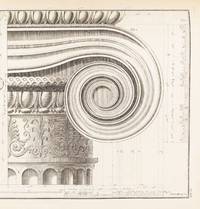
1768ST17496-011London: Chez l'auteur 1768. First Edition in French. 590 x 380 mm. 23 1/4 x 15". 52 2 pp. <br/> Modern brown quarter morocco over green linen boards brown morocco label with gilt lettering on smooth spine edges untrimmed. WITH 25 FULL-PAGE ENGRAVED PLATES OF GRECIAN RUINS and seven smaller engraved plates in text including one on dedication page. A Large Paper Copy. Fowler p. 157; Millard British 41; Blackmer 1065; Brunet III 1329. Head of spine partly torn but with no loss contents with not infrequent light marginal soiling though plates uniformly clean other minor imperfections but an excellent copy with greatly generous margins with deep impressions of the type and with strong impressions of the plates.<br/> <br/> This work is the first significant account of the ancient city of Paestum being in the words of Blackmer "larger and much more complete than any of the previous publications." Located in the Tyrrhenian Sea off the coast of southern Italy Paestum or Poseidonia in Greek was founded by Greek colonists in the sixth century B.C. and still contains beautifully preserved ruins from that period including temples an amphitheater and painted tombs. Abandoned in the Medieval period Paestum wasn't rediscovered by the West until the 18th century with the first modern publication of the site not appearing until 1764 when a suite of plans by G. P. M. Dumont appeared with no text based on the observations of Jacques-Germain Soufflot. As Millard indicates the genesis of the present publication has an extremely complex history we do not even know with certainty who wrote the text but we do know that engraver Thomas Major 1729-99 whom DNB calls "the first great English landscape engraver" was responsible for preparing the plates. Because he had no first-hand knowledge of the site Major relied on images by other artists including Antonio Joli Gaetano Magri Robert Mylne and Jacques-Germain Soufflot. The text was first published in English and then in French the same year. According to Fowler "this work . . . was an important eighteenth-century pioneer contribution to the knowledge of Greek architecture in England"; and Millard tells us that "the book was surprisingly well received by reviewers" in both England and France remaining "the standard reference to Paestum until 'Les Ruines de Paestum ou Posidonia' by C.-M. Delagardette was issued in 1798.". Chez l'auteur unknown
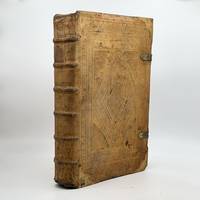
1609371891Geneva: Pierre de la Rouière 1609. In two columns. 28 184 283 1 84 203 1; 8 186 2 134 2pp. Folio 15 x 9-1/2 inches. Contemporary pigskin covers blocked in gilt and blind remnants of paper label on the spine gauffered edges lacks bosses and hinges and clasps worn at extremities and bottom of spine. Provenance: Johann Georg Feuchter of Jura-Weickersroda inscription on pastedown that the bible was purchased at an August 6 1728 auction for 4 florins and 30 groschen; General Theological Seminary blindstamp. In two columns. 28 184 283 1 84 203 1; 8 186 2 134 2pp. Folio 15 x 9-1/2 inches. Edited with introduction by Benito Arias Montanus 1527-1598 Spanish orientalist and editor of the Antwerp Polyglot a reprint of Plantin's similar edition. Darlow & Moole 5113 OT and 4662 NT Pierre de la Rouière unknown
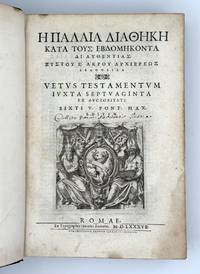
1587371783Rome: Franciscus Zanetti 1587. Text in Greek with short Latin notes at the end of each verse in two columns. Large engraved vignette on title with figures of Moses and Esdras on either side of the arms of Sixtus V. aâ´ A-3Sâ¶ 3Tâ¸. 8 783 1pp. Folio. Eighteenth century red morocco arms of the second Duke of Newcastle on the covers marbled endpapers gilt edges minor darkening to spine and wear to joints. Scattered minor dampstaining at lower outer corner of a few leaves. Provenance: Collegii Paris. Societas Jesu.early inscription on title; Douglass Maxwell Moffat booklabel with original invoice purchasing the volume from Davis & Orioli in 1940; General Theological Seminary bookplates. Text in Greek with short Latin notes at the end of each verse in two columns. Large engraved vignette on title with figures of Moses and Esdras on either side of the arms of Sixtus V. aâ´ A-3Sâ¶ 3Tâ¸. 8 783 1pp. Folio. Commissioned by Pope Sixtus V to assist the revisers who were preparing the Latin Vulgate edition ordered by the Council of Trent the "Sixtine" or "Roman" edition of the Septuagint was edited by Cardinal Antonio Carafa based on the Codex Vaticanus and became the standard for all the later editions of the Septuagint for three centuries after its publication. Darlow & Moule no. 4647; Adams B1246; BM STC Italian 1465-1600 p. 94 Franciscus Zanetti unknown
1653371930London: Roger Daniel 1653. Title in red and black. Engraved printer's device on the title state B. Text in two columns. 8 1279 1 pp. 4to 7-3/8 x 5-3/8 inches. Eighteenth century red morocco panelled in gilt spines gilt with black morocco lettering pieces marbled endpapers gilt edges. Provenance: Viscount Palmerston bookplate; General Theological Seminary bookplate. Title in red and black. Engraved printer's device on the title state B. Text in two columns. 8 1279 1 pp. 4to 7-3/8 x 5-3/8 inches. The rare first printing in England of the Septuagint the earliest translation of the Hebrew Old Testament into Greek the scarce printing in quarto format. The text is derived from the Sixtine text and edited by John Biddle 1615-1662 the Unitarian controversialist who was imprisoned by the Parliamentary Commissioners for his religious views. <br /> <br /> "Roger Daniel's version of the text of the Sixtine edition was prepared for the use of the scholars at Westminster School. This appeared in 1653 and was edited by the Socinian John Biddle. Its publication may have owed something to the interest in the Septuagint generated by Codex Alexandrinus and the frustration produced by the failure of Young's attempts to edit it" S. Mandelbrote "English Scholarship and the Greek Text of the Old Testament" p. 87.<br /> <br /> A rare issue from the same setting as the octavo edition imposed in quarto without rules separaring the columns. Wing 2nd ed. B2718A; ESTC R12599; Darlow & Moule 4692 Roger Daniel unknown
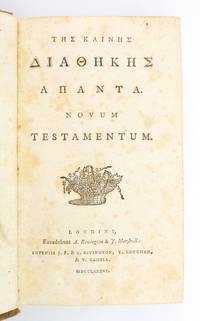
17867475Londini London: Excudebant A. Rivington & J. Marshall 1786. 12mo pp. 368 2 ads. Contemporary sheep spine divided by gilt rolls and rules red morocco label edges sprinkled red. A touch of spotting. Rubbed and a little marked some small sections of leather peeling. A scarce Greek New Testament recorded by ESTC in three North American institutions - Harvard Union Theological Seminary and Tennessee - and one private collection. ESTC N63834. Excudebant A. Rivington & J. Marshall hardcover
17997575Londini London: Apud G.G. & J. Robinson et al 1799. 12mo pp. 347 1. Half-title discarded. Contemporary sheep spine divided by gilt rules red morocco label edges sprinkled blue. Somewhat rubbed some areas of peeling and insect damage to rear board a little wear to extremities. Ownership inscriptions of Charles Kinloch to first few leaves dated 1802. A scarce London printing of the Greek New Testament: ESTC records just 5 copies. ESTC T176685. Apud G.G. & J. Robinson [et al] unknown
17517788Edinburgi Edinburgh: Apud Tho. & Wal. Ruddimannos 1751. 12mo pp. iv 402 frontispiece. Contemporary calf spine divided by raised bands between double gilt rules red morocco label. Somewhat rubbed joints starting some wear to extremities front flyleaf excised. Armorial bookplate of Sibbald to pastedown struck-through inscription of Charles Sibbald dated 1831 and of Donald Bruce to verso of frontispiece pencil notes to rear blanks. A pocket Greek New Testament printed by the Ruddimans. ESTC T94884; Darlow & Moule 4751. Apud Tho. & Wal. Ruddimannos hardcover
17632548Oxonii Oxford: E Typographeo Clarendoniano 1763. 8vo pp. iv 676. Near-contemporary tree calf spine elaborately gilt in compartments red morocco label marbled endpapers edges yellow. Some light toning and spotting. Expertly rebacked by Bernard Middleton with old backstrip laid down hinges relined. An attractive copy. In 1758 Baskerville proposed the casting of a new set of Greek types to the Oxford University Press and they ordered 2000 copies of this octavo New Testament plus 500 in quarto to be printed with the resulting type - which ended up being its only use. Negative critical reception may have contributed to its abandonment but Baskerville’s Greek face has recently been reassessed by Gerry Leonidas as an important predecessor of more modern types if perhaps not quite as elegant as that used by the Foulis press that had fallen afoul of an arbitrary typographic orthodoxy. Gaskell Add. 2; ESTC T94889; D&M 4756. E Typographeo Clarendoniano unknown
1642371830Paris: Ek basilikēs typographias Imprimerie Royale 1642. Engraved title by by Claude Mellan engraved head and tail pieces and initials. 2 453 3 pp. Extra-illustrated with a later English printed "Abbreviations and Connexions" leaf inserted after the title. Folio 15-1/2 x 10-5/8 inches. Late eighteenth or early nineteenth century red morocco gilt marbled endpapers gilt edges. Neatly rebacked. Cloth slipcase and chemise. Engraved title by by Claude Mellan engraved head and tail pieces and initials. 2 453 3 pp. Extra-illustrated with a later English printed "Abbreviations and Connexions" leaf inserted after the title. Folio 15-1/2 x 10-5/8 inches. Known as the Mazarin edition "since it appeared under the auspices of the great Cardinal" D&M it is the first edition of the Greek New Testament from the Imprimerie Royale founded just two years prior.<br /> <br /> Inserted before the engraved title page is a partly-printed certificate of the Collegium Mazarinaeum awarding this volume as a prize in Rhetoric to Philippus Matthaeus Guillot dated MDCC in manuscript i.e. 1700 and signed by the college's master P.-J. Le Chapelier Pierre-Jean le Chapelier de Mauron abbé de Ste Marie de Boquen in Brittany with the trace of a seal below. The College Mazarin or College des Quatre-Nations was established by bequest of Cardinal Mazarin 1602-1661 and opened its doors to students in 1688. Darlow & Moule 4687. Provenance: Philippus Matthaeus Guillot certificate his signature at foot of title engraving; Montagu Barton armorial bookplate; John Horatio Nelson gift inscription dated 1841; General Theological Seminary bookplate perforated stamp Ek basilikēs typographias [Imprimerie Royale] unknown
1698255818Amsterdam: Ex Officina Westeniana 1698. 3rd Leusden edition. Additional engraved title-page and 2 folding engraved maps the Holy Land and the Mediterranean. 337 1. colophon; 142 1 pp. 8vo signatures alternating in 8s and 10s. 18th-century red morocco covers with gilt-rolled bordersgilt-tooled and -lettered spine multi-colored Dutch pastedowns without free endpapeers. a.e.g. Head of spine starting otherwise quite attractive. 3rd Leusden edition. Additional engraved title-page and 2 folding engraved maps the Holy Land and the Mediterranean. 337 1. colophon; 142 1 pp. 8vo signatures alternating in 8s and 10s. D & M doesn't mention the two fine engraved maps found in this copy; nor the separately printed COMPENDIOLUM 1699 with Leusden's useful concordance of all Greek words found in the New Testament. The Dutch Calvinist philologist Johann Leusden 1624 - 1699 was one of the foremost Biblical experts of his time. His edition of the Greek New Testament first appeared in 1675; this 1698 edition is quite scarce in the US and very rare with the Compendiolum. Darlow & Moule 4718a "Apparently the earlies Greek New Testament to bear the name of the publisher Henricus Wetstenius"; OCLC: 64158458 Ex Officina Westeniana unknown
1653255179Londoni: Excudebat Rogerus Daniel: prostat autem venale apud Joannem Martin & Jacobum Allestrye sub signo Campanae in Cometerio D. Pauli 1653. The first edition of the Septuagint printed in England. 8 1279 1; 186 2 pp. plus terminal blank. 1 vols. 4to signed in 8's 195 x 143mm. Old vellum titled and dated in manuscript on the spine. Terminal leaves slightly soiled two ownership inscriptions on front endsheets and small Lincoln's Inn release/sale stamp vellum a bit handsoiled occasional modest foxing and dusting along upper margins but a very good copy. The first edition of the Septuagint printed in England. 8 1279 1; 186 2 pp. plus terminal blank. 1 vols. 4to signed in 8's 195 x 143mm. The first edition of the Septuagint printed in England with the Scholia the scarce printing in quarto format. The text is derived from the Sixtine text and edited by John Biddle 1615-1662 the Unitarian controversialist who was imprisoned by the Parliamentary Commissioners for his religious views. <br /> The SCHOLIA . has a separate title-leaf register and pagination. The same setting was imposed in both quarto and octavo formats the latter with rules separating the columns of text. In regard to institutional representation the edition in quarto is much more uncommon than that in octavo: ESTC locates 4 copies of the quarto printing in North America as opposed to 19 of the octavo printing. Occasionally Daniel's reprint of the New Testament is bound up with the octavo printings to form a complete Bible. Brunet cites that format but notes the sale of a copy on "Gr. Pap." presumably a copy in this format. Over the last 35 years ABPC records sale of one copy in quarto 1999 and four in octavo. ESTC R12599 & R236817; Wing B2718 octavo edition only; Darlow & Moule 4692; Brunet I:863 Excudebat Rogerus Daniel: prostat autem venale apud Joannem Martin & Jacobum Allestrye, sub signo Campanae in Cometerio D. Pauli unknown
196252438Graz: Akademische Druck-u.Verlagsanstalt 1962. Hardcover. Very good. Two volumes large 8vo: pp. 16 966 6; 2 920 42. Publisher’s light blue cloth. A nearly fine clean set with some slight erosion/scuffing at the covers of the second volume. <br /> <br /> Modern photo-reprint of this celebrated work of early modern biblical scholarship. First published in 1752 it was until the twentieth century regarded as "the most elaborate and valuable of all the critical editions of the New Testament" Orme. Edited by the scholar Johann Jakob Wetstein 1693-1754 a scion of the Amsterdam printing family who produced Gerhard von Maestricht's New Testament of 1711 the original edition includes the editio princeps of two pseudepigraphic works ascribed to Saint Clement of Rome which survive in Syriac. At his native city of Basel in 1713 Wetstein defended a thesis on the various readings of the New Testament. "After collating MSS. in various libraries he at length obtained in 1733 a professorship in the Remonstrants’ college at Amsterdam in succession to Le Clerc. In 1730 the Wettstein press published his Prolegomena anonymously and in 1735 he edited for the same firm a revision of G. v. Maestricht’s Testament. At length in 1751-2 he produced the critical edition at which he had been labouring for many years. Perhaps in deference to the opinions of his friends Wettstein did not print in his edition the text of Codex A as he seems at first to have intended or a recension of his own but merely reproduced the Elzevir text with very few variations. Immediately below however he indicated the changes which he considered absolutely necessary from which it is easy to construct ‘Wettsteins’s text.’ Nearly all these proposed changed -- which according to Reuss number 159 -- had appeared in previous editions and are generally accepted do-day. . Below this matter stands the critical apparatus the most elaborate which had yet been published giving innumerable variants and citing as authorities for and against these a vast body of witnesses -- MSS. versions early fathers and printed editions. Wettstein introduced the practice of indicating uncial MSS. by roman letters and cursive MSS. by arabic numerals. In the revised and enlarged Prolegomena preceding the text which give some account of his labours and controversies Wettstein displays a marked antipathy to all the earliest MSS. which he suspected of having been corrupted by the Latin versions. The Animadversiones at the end of vol. 2 are more temperate and possess higher value. A distinctive feature of the book is the commentary printed at the foot of the page. This forms a curious treasury of notes illustrating both the matter and the language of the inspired writers by copious extracts from all kinds of authors -- classical patristic and rabbinicâ€. References for the original edition: Dibdin 4th ed. 1: 156. Le Long/ Masch 1 1778: 243-46. Orme Bibliotheca Biblica 465: “Wetsteins’s merits as a critic’ says Dr. Marsh “undoubtedly surpass the merits of his predecessors: he alone contributed more to advance the criticism of the Greek Testament than all who had gone before him: and this task he performed not only without support either public or private but during a series of severe trials under which a mind of less energy than Wetstein’s would infallibly have sunk.†Full title and imprint: He Kaine Diatheke Novum Testamentum Graecum editionis receptae cum lectionibus variantibus codicum mss. editionum aliarum versionum et patrum nec non commentario pleniore ex scriptoribus veteribus Hebraeis Graecis et Latinis historiam et vim verborum illustrante Joannis Jacobi Wetstenii. Tomus I -II. Continens quatuor Evengelia. . Epistolas Pauli Acta Apostolorum Epistolas canonicas et Apocalypsin. Amstelaedami ex officinia Dommeriana. MDCCLI. Akademische Druck-u.Verlagsanstalt hardcover
1786ST20133London: Excudebant A. Rivington & J. Marshall: Impensis J. F. & C. Rivington T. Longman & T. Cadell 1786. 175 x 105 mm. 7 x 4 1/4". 368 pp. 1 leaf ads. <br/> Contemporary brown "school cloth" rough linen raised bands. Front flyleaf with owner inscription of John Cutler dated Sept 21 1789 four lines of Latin doggerel threatening anyone who steals the book with hanging and two large copperplate trials of Cutler's signature. ESTC N63834. Not in Darlow & Moule. A little fraying at top and bottom of joints light foxing and toning throughout due to paper quality a couple of small ink stains but a surprisingly appealing copy the text extremely clean and the unsophisticated makeshift binding--remarkably--with no significant wear.<br/> <br/> This is an almost startling survival: an 18th century New Testament in Greek in its original utilitarian binding preserved in condition far better than what could be anticipated given the audience of generally uncareful pupils for which it was intended. Considering the usual depredations of school children the rough school cloth should have been worn to shreds long ago but against the odds it has fortuitously escaped hard use and now gives us a glimpse of an important element of the English schoolroom very close to its original condition. One particularly delightful aspect of our copy is the flamboyant declaration of ownership by a pupil called John Cutter who inked his name no fewer than four times in different styles and with calligraphic flourishes across the flyleaf. Cutter's neatly penned book curse threating any would-be thieves with hanging may have helped to preserve the book as it now exists. In fact there are few signs of use by any owner rightful or unlawful. The leaves are free from any markings and the insubstantial binding appears to have rarely left the shelf. Excudebant A. Rivington & J. Marshall: Impensis J. F. & C. Rivington, T. Longman, & T. Cadell unknown
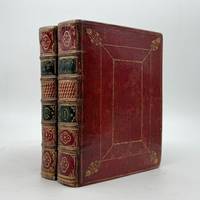
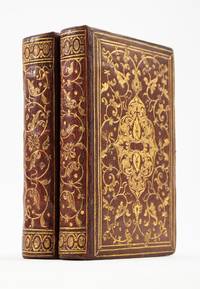
1568ST20921Lutetia Paris: Robert Estienne II 1568. 128 x 87 mm. 5 x 3 1/2". Two volumes. <br/> LOVELY CONTEMPORARY RED MOROCCO GILT covers with large central azured arabesque surrounded by curling vines with azured leaves smooth spines with similar vines head and foot of spines with egg-and-dart roll similar to one used by Claude de Picques second volume with faint blind lettering to spine all edges gilt perhaps with some minor early restorations but if so then done with such care as to preclude certainty. Housed in modern suede-lined calf-backed clamshell boxes with magnetic closures. Printer's device on titles and final page decorative initials and headpieces. Front pastedown of volume I with ex-libris of Georgios Arvanitidis. Renouard 171:1; Schreiber 239; Darlow & Moule 4633; Adams B-1670. See: Verron "Les Reliures de l'Entrée de Charles IX à Paris 1572 . . . réalisées par Claude Picques" in Bulletin du Bibliophile 2014 no. 2 pp. 282-98. Just a touch of rubbing to extremities front hinge of second volume open but everything quite tight text with occasional mild browning small spots trivial smudges or tiny worm trails but A BEAUTIFUL COPY clean and fresh internally and the bindings tight and lustrous with very bright gilt<br/> <br/> With exceptional visual appeal these two precious volumes shining with gilt and containing the Greek New Testament from the renowned Estienne family of printers are of special interest because of their typography their bindings and their provenance. With the expressed goal of printing Greek texts from manuscripts in the royal library at Fontainebleau François I established the post of royal printer in Greek in 1539 appointed Robert Estienne I 1503-59 to the position in 1542 and commissioned the renowned Claude Garamond to cut a new Greek font for this project. To design the type the King called on his own celebrated calligrapher Angelo Vergecio who produced in collaboration with Garamond three different sizes of what came to be called the Royal Types or "grecs du roi." According to Schreiber "These cursive Greek types are universally acknowledged as the finest ever cut." In 1548 and 1549 Robert Estienne issued the press' first Greek Testament known as the "O mirificam" edition for the opening of the dedication to the king in 16mo or "pocket" format using the smaller font of Garamond's "grecs du roi." In 1550 Robert a Protestant moved to Geneva while his son Robert II 1533-70 a Catholic remained in Paris and took over as the royal printer in Greek. Our 1568 Testament--the only one issued by the son--is a reprinting of the "O mirificam" edition but expanded with the critical apparatus from the 1550 folio edition issued by the father. Schreiber notes that our edition is interesting from a typographical point of view as it contains an even more minute version of the already small grecs du roi type for the Table of Chapters. The exceptionally pretty volumes are done in the style of royal binder Claude Picques fl. 1539-78 and employ a decorative roll very similar to one that appears on the spine of the vellum bindings Picques did for "L'Entrée de Charles IX à Paris" 1572. Our volumes once graced the library of Constantinople collector Georgios Arvanitidis 1876-1953 whose library included a number of Estienne Greek editions. They were later in the distinguished library of Frederick B. Adams 1910-2001 director of the Pierpont Morgan Library from 1948-69 and then president of the prestigious Association Internationale de Bibliophilie from 1974-83. And they were featured in the celebrated 1929 Gumuchian catalogue of 398 historically exceptional bindings as item #71. Robert Estienne II unknown
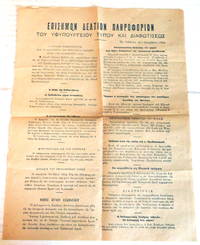
194498904Athens Greece: Deputy Ministry of Press and Information December 5 1944. 1944. Very good. - Folio a 12-3/4 inch high by 9-1/2 inch wide broadside printed on newsprint. A two-line banner title centered at the top is followed by two columns of text with the contents justified left below centered headings. The publication info and the date are printed above the second column. The broadside is toned and folded both vertically and horizontally with minor pinprick holes. Very good. <p>The text is in Greek and our translations may be subject to some corrections.<p>During the late hours of December 4 1944 and the early hours of December 5 Lieut.-General Scobie GOC British Forces in Greece proclaimed martial law in Athens and in Piraeus the port of Athens following violence on December 3rd and the declaration of a general strike. The broadside publishes Winston Churchill's statement supporting his General. "The Prime Minister wishes to make known that the announcement of the 1st December by General Scobie to the Greek people stressing the need for unity and expressing our full support for the current Greek Government was made with the knowledge and full approval of the Government of her Majesty."<p>Following this is a statement concerning order: ".General Scobie has taken all recommended measures to fully reestablish order. .English troops guard Public Facilities and simultaneously the reclamation of Police Departments has begun. The Greek people should be certain that order will be completely enforced."<p>There is a statement that "In yesterday's first court day of the Special Collaborators' Court the S.S. associate and member of the 'BUND' the infamous Giannopoulos was sentenced to death." The BUND organization and its leader Aginor Giannopoulos trained a battalion of Greek volunteers who fought in SS and Brandenburgers units. According to the broadside 200 members of ELAS in the suburb of Nea Ionia were disarmed as were 1200 near Psychiko.<p>There is a brief report on the events leading up to martial law: "In the march on the day before yesterday organized by the Communist Party protesters threw a grenade and shot at the house of the Prime Minister George Papandreou on Kifisias street. The leader of the protesters officer of ELAS and known communist Architect Provellegios was arrested."<p>Finally there is a statement on food shortages. ".due to the three-day labor strike the steamboats full of food meant to be distributed to the Greek People anchored in Piraeus harbor remains unloaded."<p>RARE. Athens, Greece: Deputy Ministry of Press and Information, December 5, 1944. unknown
a77688NY 1910 . Almuth C. Vaniver Attorney for the Defendant. The Amended Answer to the Amended Complaint. Small folio 180 leaves carbon on rectos 332 exhibits in English or in Greek hardcover. A notorious episode in Omaha's history. A Greek immigrant was accused of rape for having sex with the young American woman who was teaching him English. As he was being arrested he pulled out a concealed gun and shot and killed the Irish arresting officer. This occured during a strike in a packing house in South Omaha where a number of Greek immigrants were empoyed as strike breakers inflaming tensions between the Irish and Greek communities. A riot ultimately ensued resulting in the destruction of the Greek community in Omaha.The Greek minister to the U.S. became involved an article on the affair was printed in Atlantis and a lawsuit was commenced protesting that the article was libelous against the Greeks. Owner stamp and a few signatures on front free blank. Good plus very little wear. . hardcover
a66202Oxonii 1763 Typographeo Clarendoniano. Printed by John Baskerville. In Greek. Octavo 676pp. full leather with mounted leather spine label. Fairly Good front cover held on by binding string rear board cracked along outer hinge spine label chipped. Text bright and clean. Scarce Greek Bible in usable condition. . hardcover
1633005521Amsterdami: Guiljelmun Blaeu Willem Janszoon BLAEU 1571-1638 1633. Hardcover. Very Good. 32mo - over 4 - 5" tall. VG 1633. In full contemporary black boxed calf corners repaired. Rebacked retaining original spine raised bands no title. Internally engraved t.p. with allegorical figures of apostles and evangelists 2 3-454 pp 6 marbled endpapers ink names to ffep tp & versos Mau Vaughan. Ch Williams Wynne. Robert Grey. 10559 cms. signatures: A-2F6. Bibles Paris 3719; Bibelsammlung Stuttgart C245; Darlow & Moule 4681. A Greek Testament without preface or notes. "The editor according to Reuss must have taken as the basis of this text Beza's third major edition emending it in places by the help of other editions especially R. Stephanus' second edition" D. & M. Text not divided into verses but with verse numbers in the margin. <br/> <br/> Guiljelmun Blaeu (Willem Janszoon BLAEU 1571-1638) hardcover
1675ZB1345141Utrecht: Antonii Smytegelt 1675. Price HAS BEEN REDUCED by 10% until Monday June 29 SALE item 12mo 1 decorated title page 14 703 1 pp. rebound in modern maroon buckram a.e.g. lacking any/all of the original prelims or rear endpapers the final “xv” in the date at the foot of the title page has been scratched away old inked named to the top margin of the title page short closed tear to the fore edge of the title page text age-toned but supple. - If you are reading this this item is actually physically in our stock and ready for shipment once ordered. We are not bookjackers. Buyer is responsible for any additional duties taxes or fees required by recipient's country. Photos available upon request. Utrecht: Antonii Smytegelt hardcover
1665310448Cambridge: John Field 1665. Second edition of the Septuagint printed in England; variant B with misprint in Greek title and sun and cup transposed in motto on title. 2 19 1 755 i.e. 767 1 516 273 pp. Text in Greek type in two columns. 12mo. Full morocco gilt to style by John Gardner Borough Green marbled edges and endpapers. One gathering sprung. Second edition of the Septuagint printed in England; variant B with misprint in Greek title and sun and cup transposed in motto on title. 2 19 1 755 i.e. 767 1 516 273 pp. Text in Greek type in two columns. 12mo. A handsome copy of the second edition of the Septuagint printed in England following the first of 1653 and the first edition to include the oft reprinted preface by John Pearson. John Field was printer to Cambridge University. "Possibly a reissue by Hayes who was University Printer from 1669 to 1680" Darlow & Moule. Darlow & Moule 4702 John Field unknown
1475168896.Gpaperback. Good. Access codes and supplements are not guaranteed with used items. May be an ex-library book. paperback
1475169051.Gpaperback. Good. Access codes and supplements are not guaranteed with used items. May be an ex-library book. paperback
18257811Edinburgh: Printed for Archibald Constable and Co. 1825. 12mo pp. ii 86. Contemporary sheep spine divided by double gilt rules. Some offsetting to endpapers. Somewhat rubbed particularly to spine front joint cracked but cords holding rear joint starting. A scarce Edinburgh-printed Greek primer - Library Hub records just 2 copies at Aberdeen and Dundee; Worldcat adds none further. Printed for Archibald Constable and Co. unknown