BIBLE IN GREEKBiblio.com
30 résultats
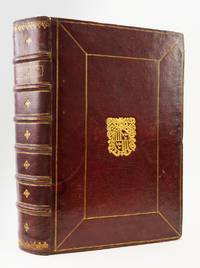
1597ST19351Frankfurt: heirs of Andreas Wechel Claude de Marne & Johann Aubry 1597. Fourth Complete Greek Bible printed in Germany. 388 x 258 mm. 15 1/8 x 10 1/8". 4 p.l. 1 blank leaf attached to backing of folio :4 1098 2 pp. <br/> VERY STATELY 17TH CENTURY RED MOROCCO covers with mitered gilt frame gilt supralibros of Baderon de Maussac Olivier 745 at center raised bands spine panels with gilt flower gilt lettering all edges gilt. Printer's Pegasus device on title and final page. Front flyleaf with ink inscription recording the purchase on 24 February 1680 at Toulouse for 24 livres. Darlow & Moule 4653; VD16 B 2578; Adams B-979. ◆Three minute dents to front board a hint of wear to bands and corners isolated faint foxing blank recto of frontispiece leaf and blank verso of final leaf with faint blue shadow from endpapers but all of these quite trivial and otherwise A BEAUTIFUL COPY--fresh clean and bright internally with very wide margins and strong impressions of the plates and in a lustrous binding showing few signs of use.<br/> <br/> This handsome and remarkably well-preserved tall folio Greek Bible from a distinguished German printing firm comes in a shiny armorial binding with aristocratic French provenance. Darlow & Moule assigns the editing of this issue to Franciscus Junius François du Jon or Friedrich Sylburg noting that the Old Testament "is based on the Basel edition of 1545 . . . with correction from the Complutensian text and useful notes." The New Testament follows the text of Robert Estienne's 1568-69 edition. The Wechel family had a long tradition of humanist printing with an emphasis on Greek texts beginning with the press of Christian Wechel fl. 1520-54 in Paris and continuing after his son Andreas d. 1581 fled to Frankfurt to escape the persecution of Protestants in France. Andreas' descendants carried on the business through the first quarter of the 17th century. Olivier's "Reliures Armoriées Françaises" 1926 pl. 745 offers three possible attributions for the supralibros here all from the Languedoc region during the first half of the 17th century: Jean de Baderson; Jacques de Baderon seigneur de Maussac a member of the Parlement of Toulouse; and Jacques de Baderon de Maussac seigneur de Montagnac et de Corneillan and commandant of the city of Collioure. The inscription on the flyleaf here indicating that the book was purchased in Toulouse perhaps supports the case for the member of the Parlement in that city. The 24 livres paid for our imposing volume in 1680 would have represented as much as two months' wages for a worker in the region of its purchase. heirs of Andreas Wechel, Claude de Marne & Johann Aubry unknown
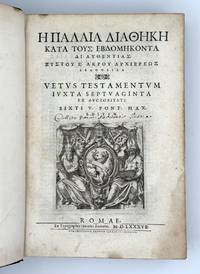
1587371783Rome: Franciscus Zanetti 1587. Text in Greek with short Latin notes at the end of each verse in two columns. Large engraved vignette on title with figures of Moses and Esdras on either side of the arms of Sixtus V. aâ´ A-3Sⶠ3Tâ¸. 8 783 1pp. Folio. Eighteenth century red morocco arms of the second Duke of Newcastle on the covers marbled endpapers gilt edges minor darkening to spine and wear to joints. Scattered minor dampstaining at lower outer corner of a few leaves. Provenance: Collegii Paris. Societas Jesu.early inscription on title; Douglass Maxwell Moffat booklabel with original invoice purchasing the volume from Davis & Orioli in 1940; General Theological Seminary bookplates. Text in Greek with short Latin notes at the end of each verse in two columns. Large engraved vignette on title with figures of Moses and Esdras on either side of the arms of Sixtus V. aâ´ A-3Sⶠ3Tâ¸. 8 783 1pp. Folio. Commissioned by Pope Sixtus V to assist the revisers who were preparing the Latin Vulgate edition ordered by the Council of Trent the "Sixtine" or "Roman" edition of the Septuagint was edited by Cardinal Antonio Carafa based on the Codex Vaticanus and became the standard for all the later editions of the Septuagint for three centuries after its publication. Darlow & Moule no. 4647; Adams B1246; BM STC Italian 1465-1600 p. 94 Franciscus Zanetti unknown
153326505Basel: Hieronymus Froben e Nikolaus Episcopius 1533. The Editio Princeps the first printing of the work in the original Greek. Greek and roman type. Woodcut printer’s device of Johann Froben by Hans Holbein der Jünger The Younger on the title-page and on fol. CC4v Heitz-Bernoulli 50. Woodcut decorated headpieces decorated and animated initials on black ground from different alphabets designed by Holbein; on fol. a1r 8-line initial showing Heraclitus and Democritus from the capital Latin alphabet of May 1520 drawn by Holbein and by Jacob Faber cfr. Hollstein’s German xivB n. 119. 4to 210x146 mm. In a very rarely encountered contemporary binding of Dutch blind-tooled leather over wooden boards. The covers are framed by two borders of blind tooled fillets a floral tool at each corner; the central panel is divided into diamond designs with rosettes on the upper cover and fleur-de-lys on the rear. Turn–ins and cords fixed at the inner boards. Antique spine and clasps renewed at a somewhat later date and accomplished with the greatest skill. The guard leaves are composed of two bifolia from a 14th-century manuscript breviary. Collation: 1 2 3 4 a-z4 A-Z4 aa-zz4 AA-CC4 fols. 1v CC4r blank. 8 573 3 pp A beautiful and fine broad-margined copy in a wonderful contemporary binding faint water staining to the inner corner of the first quires a minor repair to the gutter of the first leaves two tiny wormholes in the last three quires. Provenance: John Alfred Spranger 1889-1968; book-plate on front pastedown and stamp on title-page. EXTREMELY RARE FIRST PRINTING OF THE EDITIO PRINCEPS OF THIS REMARKABLY IMPORTANT BOOK AND A COPY WHICH IS OF THE VERY FINEST STATE AND CONDITION. The editio princeps of Diogenes Laertius’ Lives of the Famous Philosophers is the most important source of our knowledge in the history of Greek philosophy from Thales to Pyrrho. <br> The text was known only in the Latin translation by Ambrogio Traversari 1386-1439 which made its first appearance in print in Rome around 1472 and which was widely reprinted during the fourteenth and the first decades of the sixteenth century. This is the first printing of the book in its original language.<br> The edition is dedicated by the typographers Froben and Episcopius to the scholars and in their epistle they declare their publishing plan: to print at least a work per year able to combine usefulness and pleasure. <br> The text follows a manuscript provided by the professor of Greek and Hebrew at the University of Wittenberg Matthaeus Goldhahn 1480-1553 called Aurigallus probably a copy of the codex Raudnitzianus Lobkowicensis vi.F.c.38 at the time preserved in Komotau Bohemie in the house of the politician Bohuslav Lobkowitz von Hassenstein c. 1460-1510 and presently in the Library Národní Knihovna of Prague. Hieronymus Froben e Nikolaus Episcopius hardcover
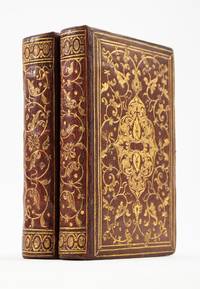
1568ST20921Lutetia Paris: Robert Estienne II 1568. 128 x 87 mm. 5 x 3 1/2". Two volumes. <br/> LOVELY CONTEMPORARY RED MOROCCO GILT covers with large central azured arabesque surrounded by curling vines with azured leaves smooth spines with similar vines head and foot of spines with egg-and-dart roll similar to one used by Claude de Picques second volume with faint blind lettering to spine all edges gilt perhaps with some minor early restorations but if so then done with such care as to preclude certainty. Housed in modern suede-lined calf-backed clamshell boxes with magnetic closures. Printer's device on titles and final page decorative initials and headpieces. Front pastedown of volume I with ex-libris of Georgios Arvanitidis. Renouard 171:1; Schreiber 239; Darlow & Moule 4633; Adams B-1670. See: Verron "Les Reliures de l'Entrée de Charles IX à Paris 1572 . . . réalisées par Claude Picques" in Bulletin du Bibliophile 2014 no. 2 pp. 282-98. Just a touch of rubbing to extremities front hinge of second volume open but everything quite tight text with occasional mild browning small spots trivial smudges or tiny worm trails but A BEAUTIFUL COPY clean and fresh internally and the bindings tight and lustrous with very bright gilt<br/> <br/> With exceptional visual appeal these two precious volumes shining with gilt and containing the Greek New Testament from the renowned Estienne family of printers are of special interest because of their typography their bindings and their provenance. With the expressed goal of printing Greek texts from manuscripts in the royal library at Fontainebleau François I established the post of royal printer in Greek in 1539 appointed Robert Estienne I 1503-59 to the position in 1542 and commissioned the renowned Claude Garamond to cut a new Greek font for this project. To design the type the King called on his own celebrated calligrapher Angelo Vergecio who produced in collaboration with Garamond three different sizes of what came to be called the Royal Types or "grecs du roi." According to Schreiber "These cursive Greek types are universally acknowledged as the finest ever cut." In 1548 and 1549 Robert Estienne issued the press' first Greek Testament known as the "O mirificam" edition for the opening of the dedication to the king in 16mo or "pocket" format using the smaller font of Garamond's "grecs du roi." In 1550 Robert a Protestant moved to Geneva while his son Robert II 1533-70 a Catholic remained in Paris and took over as the royal printer in Greek. Our 1568 Testament--the only one issued by the son--is a reprinting of the "O mirificam" edition but expanded with the critical apparatus from the 1550 folio edition issued by the father. Schreiber notes that our edition is interesting from a typographical point of view as it contains an even more minute version of the already small grecs du roi type for the Table of Chapters. The exceptionally pretty volumes are done in the style of royal binder Claude Picques fl. 1539-78 and employ a decorative roll very similar to one that appears on the spine of the vellum bindings Picques did for "L'Entrée de Charles IX à Paris" 1572. Our volumes once graced the library of Constantinople collector Georgios Arvanitidis 1876-1953 whose library included a number of Estienne Greek editions. They were later in the distinguished library of Frederick B. Adams 1910-2001 director of the Pierpont Morgan Library from 1948-69 and then president of the prestigious Association Internationale de Bibliophilie from 1974-83. And they were featured in the celebrated 1929 Gumuchian catalogue of 398 historically exceptional bindings as item #71. Robert Estienne II unknown
1514372265Alcala de Henares: Arnao Guilem de Brocar 1514. First edition of the New Testament in Greek published as volume 5 of the Complutensian Polyglot. Woodcut arms of Cardinal Jiménez on title page with woodcut borderswoodcut initials. Text in Greek and Latin in two columns Collation: a4 A-Q6 a6 R-Z6 AA-LL6 MM8 2a11 3a6 b-f6 g4 -g4. 271 of 272 leaves lacking final blank. 1 vols. Folio. Recent full black morocco spine gilt gilt turn-ins red morocco doublures gilt marbled flyleaves. Minor toning or soiling to a few leaves. A clean fresh copy. First edition of the New Testament in Greek published as volume 5 of the Complutensian Polyglot. Woodcut arms of Cardinal Jiménez on title page with woodcut borderswoodcut initials. Text in Greek and Latin in two columns Collation: a4 A-Q6 a6 R-Z6 AA-LL6 MM8 2a11 3a6 b-f6 g4 -g4. 271 of 272 leaves lacking final blank. 1 vols. Folio. Produced under the patronage of Cardinal Ximenes archbishop of Toledo and founder of the university of Alcala. As part of the Complutensian Polyglot Bible the New Testament was printed first dated 10 January 1514; the Old Testament was completed only in 1517 and publication was delayed until 1522.<br /> <br /> "Undoubtedly the finest Greek fount ever cut and the only one of which it can be affirmed with certainty that it is based on the writing of a particular manuscript" Proctor. Pope Leo X lent the Codex Vaticanus to Ximenes and it was upon this manuscript that Brocar modelled his type. Proctor used it as the model for the type in his edition of the Oresteia of 1904. This volume complete with the six leaves of the travels of St. Paul printed only in Greek and often lacking as it was printed later.<br /> <br /> This is the first Greek New Testament ever printed 1514 but as it was not published until 1522 this text was unknown to Erasmus when he published his Greek New Testament in 1516.<br /> <br /> Douglas Maxwell Moffat 1881-1956 Yale class of 1903 was a Grolier Club member from 1929 until his death; the libraries at Yale University and the General Theological Seminary were beneficiaries of gifts from his widow. "As a collector he was interested in three fields primarily: editions of Vergil; Greek and Latin lyric poetry; and fine printing. Almost all his books were in superb condition and often of very interesting provenance" Yale University Library Gazette 35:2 p. 122.<br /> <br /> THE MOST FAMOUS PIECE OF PRINTING EXECUTED IN SPAIN. Darlow & Moule 1412/4593; PMM 52; Adams B968 Vol. 5; Norton Printing in Spain 1501-1520 27; Proctor Printing of Greek p. 144. Provenance: Douglas Maxwell Moffat bought from E.P. Goldschmidt; General Theological Seminary gift of Mrs. Douglas M. Moffat Arnao Guilem de Brocar unknown