THEODOSE DE TRIPOLILivre Rare Book
31 résultats
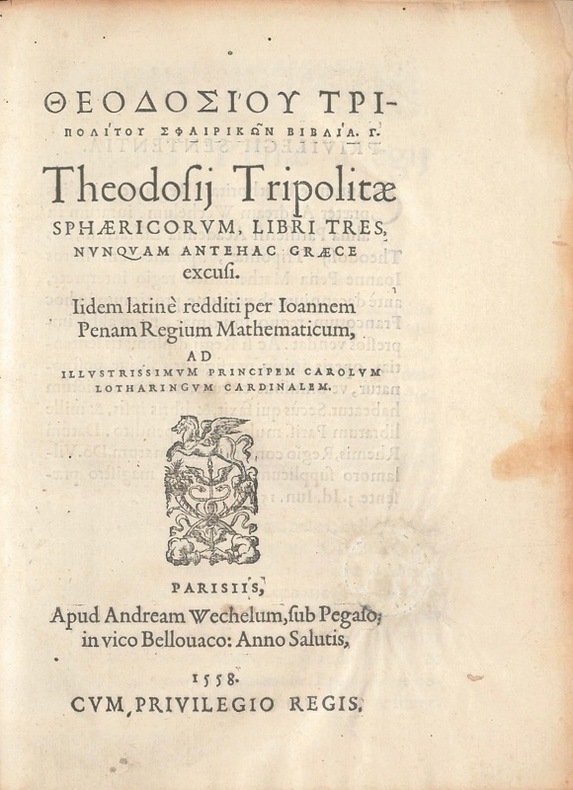
155811535Paris Andréas Wechel 1558 in-4 demi-veau marron, dos à faux nerfs, orné, pièce de titre rouge [Rel. mod. à l'imitation], légères mouillures et restaurations intérieures, accroc au titre
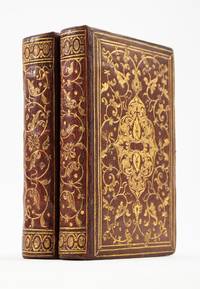
1568ST20921Lutetia Paris: Robert Estienne II 1568. 128 x 87 mm. 5 x 3 1/2". Two volumes. <br/> LOVELY CONTEMPORARY RED MOROCCO GILT covers with large central azured arabesque surrounded by curling vines with azured leaves smooth spines with similar vines head and foot of spines with egg-and-dart roll similar to one used by Claude de Picques second volume with faint blind lettering to spine all edges gilt perhaps with some minor early restorations but if so then done with such care as to preclude certainty. Housed in modern suede-lined calf-backed clamshell boxes with magnetic closures. Printer's device on titles and final page decorative initials and headpieces. Front pastedown of volume I with ex-libris of Georgios Arvanitidis. Renouard 171:1; Schreiber 239; Darlow & Moule 4633; Adams B-1670. See: Verron "Les Reliures de l'Entrée de Charles IX à Paris 1572 . . . réalisées par Claude Picques" in Bulletin du Bibliophile 2014 no. 2 pp. 282-98. Just a touch of rubbing to extremities front hinge of second volume open but everything quite tight text with occasional mild browning small spots trivial smudges or tiny worm trails but A BEAUTIFUL COPY clean and fresh internally and the bindings tight and lustrous with very bright gilt<br/> <br/> With exceptional visual appeal these two precious volumes shining with gilt and containing the Greek New Testament from the renowned Estienne family of printers are of special interest because of their typography their bindings and their provenance. With the expressed goal of printing Greek texts from manuscripts in the royal library at Fontainebleau François I established the post of royal printer in Greek in 1539 appointed Robert Estienne I 1503-59 to the position in 1542 and commissioned the renowned Claude Garamond to cut a new Greek font for this project. To design the type the King called on his own celebrated calligrapher Angelo Vergecio who produced in collaboration with Garamond three different sizes of what came to be called the Royal Types or "grecs du roi." According to Schreiber "These cursive Greek types are universally acknowledged as the finest ever cut." In 1548 and 1549 Robert Estienne issued the press' first Greek Testament known as the "O mirificam" edition for the opening of the dedication to the king in 16mo or "pocket" format using the smaller font of Garamond's "grecs du roi." In 1550 Robert a Protestant moved to Geneva while his son Robert II 1533-70 a Catholic remained in Paris and took over as the royal printer in Greek. Our 1568 Testament--the only one issued by the son--is a reprinting of the "O mirificam" edition but expanded with the critical apparatus from the 1550 folio edition issued by the father. Schreiber notes that our edition is interesting from a typographical point of view as it contains an even more minute version of the already small grecs du roi type for the Table of Chapters. The exceptionally pretty volumes are done in the style of royal binder Claude Picques fl. 1539-78 and employ a decorative roll very similar to one that appears on the spine of the vellum bindings Picques did for "L'Entrée de Charles IX à Paris" 1572. Our volumes once graced the library of Constantinople collector Georgios Arvanitidis 1876-1953 whose library included a number of Estienne Greek editions. They were later in the distinguished library of Frederick B. Adams 1910-2001 director of the Pierpont Morgan Library from 1948-69 and then president of the prestigious Association Internationale de Bibliophilie from 1974-83. And they were featured in the celebrated 1929 Gumuchian catalogue of 398 historically exceptional bindings as item #71. Robert Estienne II unknown
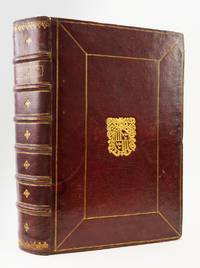
1597ST19351Frankfurt: heirs of Andreas Wechel Claude de Marne & Johann Aubry 1597. Fourth Complete Greek Bible printed in Germany. 388 x 258 mm. 15 1/8 x 10 1/8". 4 p.l. 1 blank leaf attached to backing of folio :4 1098 2 pp. <br/> VERY STATELY 17TH CENTURY RED MOROCCO covers with mitered gilt frame gilt supralibros of Baderon de Maussac Olivier 745 at center raised bands spine panels with gilt flower gilt lettering all edges gilt. Printer's Pegasus device on title and final page. Front flyleaf with ink inscription recording the purchase on 24 February 1680 at Toulouse for 24 livres. Darlow & Moule 4653; VD16 B 2578; Adams B-979. ◆Three minute dents to front board a hint of wear to bands and corners isolated faint foxing blank recto of frontispiece leaf and blank verso of final leaf with faint blue shadow from endpapers but all of these quite trivial and otherwise A BEAUTIFUL COPY--fresh clean and bright internally with very wide margins and strong impressions of the plates and in a lustrous binding showing few signs of use.<br/> <br/> This handsome and remarkably well-preserved tall folio Greek Bible from a distinguished German printing firm comes in a shiny armorial binding with aristocratic French provenance. Darlow & Moule assigns the editing of this issue to Franciscus Junius François du Jon or Friedrich Sylburg noting that the Old Testament "is based on the Basel edition of 1545 . . . with correction from the Complutensian text and useful notes." The New Testament follows the text of Robert Estienne's 1568-69 edition. The Wechel family had a long tradition of humanist printing with an emphasis on Greek texts beginning with the press of Christian Wechel fl. 1520-54 in Paris and continuing after his son Andreas d. 1581 fled to Frankfurt to escape the persecution of Protestants in France. Andreas' descendants carried on the business through the first quarter of the 17th century. Olivier's "Reliures Armoriées Françaises" 1926 pl. 745 offers three possible attributions for the supralibros here all from the Languedoc region during the first half of the 17th century: Jean de Baderson; Jacques de Baderon seigneur de Maussac a member of the Parlement of Toulouse; and Jacques de Baderon de Maussac seigneur de Montagnac et de Corneillan and commandant of the city of Collioure. The inscription on the flyleaf here indicating that the book was purchased in Toulouse perhaps supports the case for the member of the Parlement in that city. The 24 livres paid for our imposing volume in 1680 would have represented as much as two months' wages for a worker in the region of its purchase. heirs of Andreas Wechel, Claude de Marne & Johann Aubry unknown
155539566Basileae: per Ioannem Oporinum colophon: 1555. 8vo 15.9 cm 6.25". 16 341 7 pp. <br><br>Sole edition of these Greek paraphrased psalms done by Paul Dolscius while he was serving as a rector in Halle. Melanchthon was a great supporter of Dolscius 152689 whose translation work was so proficient that at one point his authorial byline on the Greek translation of the Augsburg Confession was assumed to be merely a pseudonym for the great reformer himself.<br>Â Â Â Â The text here is simply printed with the Latin preface in roman and the main text in Greek using single columns; a 5-line decorative initial and a 7-line inhabited one showing two kings in profile complete the work. This is now an uncommon edition with searches of Worldcat COPAC USTC and NUC Pre-1956 revealing only three U.S. institutions reporting ownership.<br>Â Â Â Â Provenance: An inked ownership stamp of notable 19th-century English bibliomaniac Richard Heber 17741833 reading "Bibliotheca Heberiana" appears on the front free endpaper; Thomas Frognall Dibdin added this stamp to select rare books in Heber's collection following the collector's death. Most recently in the library of American collector Albert A. Howard small booklabel "AHA" at rear. <br>Â Â Â Â <br>Â Â Â Â Bibliotheca Palatina F5048/F5049; VD16 B3122; USTC 626665. Not in Adams; not in Darlow & Moule. On Dolscius see: Allgemeine Deutsche Biographie online. 19th-century half calf and paste papercovered boards spine with gilt rolls and green leather gilt title-label all edges stained blue; rubbed slight loss of leather on front joint outside and corners a few small spots and leather repairs isolated glue action to endpapers. Light age-toning with occasional slivers of marginal staining possibly thanks to the blue edge stain one interior tear touching letters and two marginal spots. Provenance indicia as above small round paper shelflabel on spine a few bibliographical notes pencilled on endpapers. => A skillfully produced work with a pleasing provenance. per Ioannem Oporinum hardcover books
1530HI172Basileae. (Valder ca. 1530). In-32o, 1 bl.,i+443+2 bl. p. Quelques notes manuscrites anciennes sur la p. de titre et aux marges du texte. Rel. 1/2 veau fin XVIIIe, la coiffe sup. legerement abimee, charnieres frottees, bon etat du texte (grec). Brunet III, p. 119, Adams H-379, Hoffmann II, 223.
1559GR925Tiguri (Zurich) apud Froschoverum, 1559. Small in-8o, [1] Bl., 748, [2] pp., illustrated woodcut initials, water stains especially at the end, ancient notes on the blank leaves, lower parts of 2 leaves 497, 499 torn without missing text. Contemporary full calf binding, blind stamped covers, the lower one with small holes, 2 copper clasps, the upper one missing a part, back with 3 raised bands. Greek text. Rare edition not in Brunet or Legrand, no copy sold in public auctions the last years.