30 résultats
1787045076Davis and Johnson 1787. 3rd Edition . Hardcover. Fair. 8vo - over 7¾ - 9¾" tall. ' A New Edition revised corrected and Improved by William Radcliffe'.Full leather well worn/handled.Front board almost adrift. Cracked at spine. Front endpaper almost loose. xxv Contents 354 pages plus advert leaf. <br/> <br/> Davis, and Johnson hardcover
1752049793London Uk: T. Cox 1752. First English Language Edition 2nd Printing. Hardcover. Good. I Xiv 222 Pp. 2 Page Catalog At End. Original Poloshed Calf. Second Edition Stated Actually The Second Printing Of The First English Language Edition. Binding Worn And Frayed Front Board Detached But Present Can Be Reattached With New Cords Without Re-Backing. <br/> <br/> T. Cox hardcover
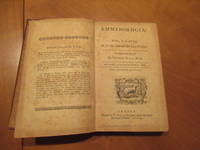
17526278Glasguae Glasgow: In aedibus Academicis excudebant Robertus et Andreas Foulis 1752. 8vo pp. iv 151 1. Contemporary polished sprinkled calf boards bordered with a double gilt rule enclosing a blind roll spine divided by raised bands between double gilt rules orange morocco label. Just a touch of light spotting. Extremities rubbed front joint cracking at head. The sole Foulis edition of this collection of shorter Latin poetry. This is the pot 8vo issue. Gaskell 237. In aedibus Academicis excudebant Robertus et Andreas Foulis hardcover
17134037Londini: Apud R. J. Bonwicke and five others 1713. 1713 12mo in 6s. 36 184 150 p. Collates unsigned2 A6 a - b6 B - Q6 R2 unsigned1 Aa - Mm6 Nn2. Engraved frontispiece as Griffiths 87/16. The Psalms are in the 1716 reprint with Atkins name removed from the imprint of the part title. The substitution of the 1716 sheets means that the catchword on R2v is incorrect. Griffiths describes this edition as 16mo but it is in 6s with horizontal chainlines. Bound in contemporary black morocco rubbed but sound. Sides tooled in triple panels with corner tools. Spine gilt in panels between raised bands. All edges gilt. Name torn from blank endpaper and an inscription deleted . A few old shorthand notes. A sound copy. Londini: Apud R. J. Bonwicke, [and five others], hardcover
176263526Prague: Reimpressa Pragæ in Aula Regia apud Jacobum Schweiger Archi-Episcopalem Typographum 1762. Edition with new index. Leather bound. Very good. 234pp. Small quarto 24 cm Full brown mottled leather. Spine in 6 compartments with a red leather title label and decorative gilt floral tooling. Red page edges. Marbled endpapers. Head- and tailpieces. Includes index. The boards are a bit warped. There are a handful of brief contemporary notations on the preliminary pages including the title page. There is also a numerical notation in red on the front pastedown and an ink stamp foreign bookseller on the front flyleaf. A well preserved copy. Reimpressa Pragæ in Aula Regia apud Jacobum Schweiger Archi-Episcopalem Typographum unknown
176263531Prague: Reimpressa Pragæ in Aula Regia apud Jacobum Schweiger Archi-Episcopalem Typographum 1762. Edition with new index. Leather bound. Very good. 234pp. Small quarto 24 cm Full brown mottled leather. Spine in 6 compartments with a red leather title label and decorative gilt floral tooling. Red page edges. Marbled endpapers. Head- and tailpieces. Includes index. The leather at the spine ends is chipped with loss. The larger loss is from the foot of the spine measuring 1 inch wide by just over 1/4" deep. There are several areas of insect nibbling to the covers exposing the underlying boards. There is a contemporary gift inscription on the front flyleaf and there is a contemporary owner's name at the head of the title page. Reimpressa Pragæ in Aula Regia apud Jacobum Schweiger Archi-Episcopalem Typographum unknown
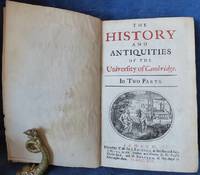
1721V66452London: Bateman Nicks & Boreham 1721. Hardcover. Very Good. Copperplate engraved view of Cambridge on additional engraved TP. . Octavo 195x125mm contemporary panelled and blind tooled calf with darkened central panel hinges & tips worn 4x265pp5pp of index. Engraved TP printed in red & black newer end papers which are damp stained & with name Eliza Robertson on pastedown. Some damp staining to the last pages from about p230 else neat and tight in a handsome binding. Nicholas Cantalupe wrote "Of its Original and Pregress sic" in the 15th century. The second half writen by Rev Richard Parker contains some excellent contemporary descriptions of Cambridge`s Colleges including their halls and inns. It also contains lists of College Provosts Wardens and Masters as well as Bishops who graduated from the university from 1500-1602. Also an account of the University's sacking during the peasants' revolt of 1381. Bateman, Nicks & Boreham hardcover
1709FGN11-D-17London: Bowyer 1709. Leather. Good. 7.5" by 5". None. A first London edition of this collection of Latin works Intended for the tuition of children in Latin. Scarce. Printed in Latin. In a full calf binding. Externally sound with rubbing and bumping. Front joint cracked. Hinges strained. Ink inscription to front free-endpaper. Internally firmly bound. Pages cockled but bright with occasional scattered spots Good Bowyer hardcover
1729123875London: Printed for Bernard Lintot. Fine in Fine dust jacket. 1729. Third Edition. Hardcover. A Third Edition that is corrected with additions in Very Good condition with the slightest of rubbing to the edges and corners and some age toning throughout the volume itself. A very nice copy of a charming book; This poem by Claudius Quilletus revolves around the raising of children choosing a wife and other concerns of marriage and family life. It is divided into four books: "The First treats of the Nature and Variety of Beauty and of the Choice of a Wife. The Second of Marriage and Enjoyment with Laws and Rules relating to both from Nature and Astrology. The Third of Conception and Imagination. The Fourth and Last of the Beauty of the Mind of Education and Virtue and of the Variety of Climes Customs and Manners." ; 12mo; xviii 96 97-102 pages . Printed for Bernard Lintot hardcover
1713AQ15276Londini i.e. London: Apud R. & J. Bonwicke et al. 1713. 38 184pp 148. With an engraved frontispiece. Handsomely bound in contemporary richly gilt-tooled black morocco A.E.G. Lightly rubbed. Marbled endpapers Recent bookplate of Robert J. Hayhurst to FEP loss to upper corner of front blank fly-leaf early inked inscription of 'John Murray / April 1726' to recto. An early eighteenth-century Latin edition of the 1662 Book of Common Prayer. The translation was completed by Jersey-born Anglican clergyman Jean Durel 1625-1683 who had been appointed Chaplain of the Stuart Court's French congregation at the Savoy and also held the monopoly for printing the French translation of the new authorised Liturgy. Considered eminently superior to the latter this translation mined the Sarum Missal and Breviary as a source for amongst others the canticles and psalms included here. The delay of seven years between the passing of the Act of the Uniformity which made use of the Book of Common Prayer compulsory in Anglican church services and the first publication of this translation in 1669 suggests that the demand for Latin editions had waned since Tudor days. ESTC T140407. 12mo. Apud R. & J. Bonwicke et al. unknown
171050858Hauniae København H.C. Paulli 1710. 4to. Contemp. full calf. Raised bands. Richly gilt spine. Title stamped in blind. Engraved frontispiece. 16548 pp. Index. Internally clean and fine. <br/><br/><em>First latin edition of King Christian V's famous "Danish Law" of 1683. </em> hardcover
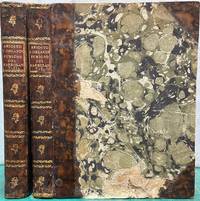
175616169Arezzo: Michele Bellotti Stampatore. Good with no dust jacket. 1756. Hardcover. Edgewear chipping to front board of volume two front paste-down of volume two detaching at bottom edge from board some text stains not affecting legibility some minor worming not affecting text in volume two otherwise light wear. Spine labels reverse volume numbers. Solid oversize hardcovers. ; Bilingual Italian and Latin languages in parallel columns. Two of two volumes complete set. Engraved portraits of Ariosto and Barbolani by Andrea Bolzoni. Signatures: v. 1: a4 A-3G4 3H6 -- v. 2: A-3G4. Title-page of t. 1 in red and black; title vignettes; decorative initials head and tail pieces. Period half leather binding with marbled boards and endpapers red spine labels with gilt lettering gilt spine rolls and decoration and black and red edge decor. Custom bookplate of Vera Kossovski on both paste-downs. Attractive 18th-century printing of the classic Italian epic poem of Lodovico Ariosto with the First Edition of the Latin translation of Torquato Barbolani. ; vii 435; 421 3 in 2v pages . Michele Bellotti Stampatore hardcover
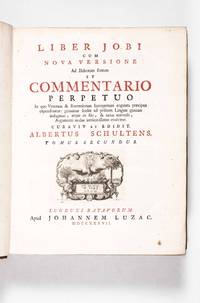
173749261Leiden: Jean Luzac 1737. First edition. Two volumes large quarto. 52 544; 2 545-1232 63 indices 1 corrigendapp. Text in two columns with Hebrew text and facing Latin translation interspersed with commentary. Titles in red and black with engraved vignettes. Contemporary speckled calf; gilt-tooled spine with raised bands and morocco lettering pieces; gilt dentelles; edges daubed in red and green. Light scuffing to boards and fading to spines. A very good set with crisp clean text throughout.<br /> <br /> First edition of this comprehensive commentary to the biblical Book of Job by the Dutch scholar of Semitic languages Albert Schultens 1686-1750 who maintained "that the true nature of the Hebrew language and the meaning of many of its words and idioms are to be found chiefly in the Arabic" Orme. Fifty-five pages of the indices constitute a brief lexicon and provide Latin as well as Arabic equivalents for more than 1000 Hebrew words. Schultens studied theology and eastern languages at Groningen where he received his degree in theology in 1709. After a brief career as a preacher in Wassenaar he was nominated professor of Hebrew and Jewish antiquities at Franeker in 1713. In 1729 he decamped for Leiden were he was first appointed reader in eastern languages and finally full professor in 1732.<br /> <br /> At this time a chief concern of Calvinist theologians was to liberate Old Testament exegesis from the Jewish Rabbinic as well as Catholic traditions. Schultens' influential and controversial solution was revealed as early as 1706 in his first public thesis Disputatio theologico philologica de utilitate linguae Arabicae in interpretanda S. Scriptura A Theologico-Philosophical Dissertation on the Utility of the Arabic Language for the Interpretation of the Holy Scriptures "a forceful attack" Brugman & Schröder on the Protestant sola scriptura methodology of Biblical exegesis. "With the help of Jacobus Golius' Arabic dictionary he perused with zeal and fervour the Old Testament and wrote prolifically. The lexical superiority of Arabic had led him to a reconsideration of the position of Hebrew: at first he had called Arabic 'the most splendid daughter of mother Hebrew' but in his oration of 1729 he proclaimed Hebrew and Arabic cognate twin sisters. This shocked conservative theologians as an outright profanation of God's Word" Brugman & Schröder. "In 1737 he applied his theories in his bilingual edition of the book of the prophet Job whom he regarded as an Arab. The Hebrew text and the Latin translation are all but totally submerged by the extensive commentary in which Schultens draws abundantly on Arabic texts such as the Hamasa an anthology of early Arabic poetry by the ninth-century poet Abu Tammam" Vrolijk & van Leeuwen. Schultens was not without his critics and by 1824 William Orme notes a turning of the tide: "Different opinions are entertained of the correctness of his views and also of his success in applying them; but it is now generally admitted that he carries his notions of the advantage of Arabic learning to the interpretation of the Scriptures too far." <br /> <br /> Jean Luzac 1728-1777 was a member of a well-known Huguenot family of printers; he published many works for the University of Leiden including three Hebrew books of Albert Schultens. Isaac van der Mijn is noted as the printer at the colophon of the second volume.<br /> <br /> Provenance: printed label of the Bibliotheca Seminarii Warmondani at the front endleaf of the first volume. Full title: Liber Jobi cum nova versione ad Hebraeum fontem et commentario perpetuo in quo Veterum et Recentiorum Interpretum cogitata præcipua expenduntur: genuinus sensus ad priscum Linguae genium indagatur atque ex filo et nexu universo Argumenti nodus intricatissimus evolvitur. Curavit et editit. Albertus Schultens. Tomus Primus. -Tomus Secundus<br /> <br /> References: J. Brugman & F. Schröder Arabic Studies in the Netherlands Leiden: E.J. Brill 1979 p.26f. Fuks/Fuks-Mansfeld 78. Orme Bibl. Biblica p. 390. A. Vrolijk & R. van Leeuwen Arabic Studies in the Netherlands a Short History in Portraits 1580-1950 Leiden: E.J. Brill 2014 pp. 73-79. Jean Luzac unknown
171050853Hauniae København H.C. Paulli 1710. 4to. Contemp. full vellum. handwritten title on spine. Engraved frontispiece. 16548 pp. Index. Internally clean and fine. <br/><br/><em>First latin edition of King Christian V's famous "Danish Law" of 1683. </em> hardcover
171055541Hauniae København H.C. Paulli 1710. 4to. Pragtfuldt samtidigt helpergamentsbind med overdådig rygforgyldning og forgyldt skindtitel. Permer indfarvet i marmormønster. Rødt snit. Kobberstukket frontispiece. 16548 pp. Index. Frisk velbevaret. <br/><br/><em>First latin edition of King Christian V's famous "Danish Law" of 1683. </em> unknown
171048537Hauniae København H.C. Paulli 1710. 4to. Contemp. full calf. Blindtooled lettering to spine. Raised bands. Spine a little rubbed.Engraved frontispiece. 16548 pp. Index. A few scattered brownspots. The copy has belonged to the former Danish Minister of Foreign Affairs Holger Christian Reedtz 1800-1857. <br/><br/><em>First latin edition of King Christian V's famous "Danish Law" of 1683. </em> hardcover
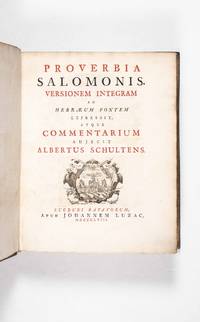
174849255Leiden: Jean Luzac 1748. First edition. Hardcover. Very Good. Quarto. 8 cviii 522 60 indices & corrigendapp. Text in two columns with Hebrew text and facing Latin translation interspersed with commentary. Title in red and black with engraved vignette; woodcut ornaments. Contemporary Dutch paneled vellum with blind-stamped vignettes and ruled borders; manuscript title at spine. Covers lightly soiled. Occasional touches of soiling and some leaves with mild embrowning. A very good copy generally crisp and clean.<br /> <br /> First edition of this comprehensive commentary to the biblical Book of Proverbs by the Dutch semitic language scholar Albert Schultens 1686-1750 who maintained "that the true nature of the Hebrew language and the meaning of many of its words and idioms are to be found chiefly in the Arabic" Orme. Forty-one pages of the indices constitute a brief lexicon and provide Latin as well as Arabic equivalents for more than 1000 Hebrew words. Schultens studied theology and eastern languages at Groningen where he received his degree in theology in 1709. After a brief career as a preacher in Wassenaar he was nominated professor of Hebrew and Jewish antiquities at Franeker in 1713. In 1729 he decamped for Leiden were he was first appointed reader in eastern languages and finally full professor in 1732.<br /> <br /> At this time a chief concern of Calvinist theologians was to liberate Old Testament exegesis from Jewish Rabbinic as well as Catholic traditions. Schultens' influential and controversial solution was revealed as early as 1706 in his first public thesis Disputatio theologico philologica de utilitate linguae Arabicae in interpretanda S. Scriptura A Theologico-Philosophical Dissertation on the Utility of the Arabic Language for the Interpretation of the Holy Scriptures "a forceful attack" Brugman & Schröder on the Protestant sola scriptura methodology of Biblical exegesis. "With the help of Jacobus Golius' Arabic dictionary he perused with zeal and fervour the Old Testament and wrote prolifically. The lexical superiority of Arabic had led him to a reconsideration of the position of Hebrew: at first he had called Arabic 'the most splendid daughter of mother Hebrew' but in his oration of 1729 he proclaimed Hebrew and Arabic cognate twin sisters. This shocked conservative theologians as an outright profanation of God's Word" Brugman & Schröder. <br /> <br /> Like his earlier commentary on the Biblical Book of Job one here finds that the "Hebrew text and the Latin translation are all but totally submerged by the extensive commentary in which Schultens draws abundantly on Arabic texts such as the Hamasa an anthology of early Arabic poetry by the ninth-century poet Abu Tammam" Vrolijk & van Leeuwen. Schultens was not without his critics and by 1824 William Orme notes a turning of the tide: "Different opinions are entertained of the correctness of his views and also of his success in applying them; but it is now generally admitted that he carries his notions of the advantage of Arabic learning to the interpretation of the Scriptures too far." <br /> <br /> Jean Luzac 1728-1777 was a member of a well-known Huguenot family of printers; he published many works for the University of Leiden including three Hebrew books of Albert Schultens. Isaac van der Mijn is noted as the printer at the colophon of the second volume.<br /> <br /> Provenance: bookplate of the Crozer Theological Seminary - Bucknell Library; bookseller's ticket of Librairie Ancienne et Moderne de Frederik Muller Amsterdam at the front paste-down. References: J. Brugman & F. Schröder Arabic Studies in the Netherlands Leiden: E.J. Brill 1979 p.26f. Fuks/Fuks-Mansfeld 78. Orme Bibl. Biblica p. 390. A. Vrolijk & R. van Leeuwen Arabic Studies in the Netherlands a Short History in Portraits 1580-1950 Leiden: E.J. Brill 2014 pp. 73-79. Jean Luzac hardcover
17651247745Venice: Typographia Balleoniana 1765. Leather bound. 18th century printing of the Catholic Vulgate Bible in the original Latin. Bound in full leather worn and chipped with large peices missing from the spine. 904p lacking the final four pages of the index but otherwise complete. Pages show some scattered browing and minor wear. Overall this book is in more than presentable condition. A very scarce example of a Vulgate Bible of the 18th century. Typographia Balleoniana unknown
1800E0068viii514 pages with frontispiece map. Quarto 10 1/2" x 8 3/4" housed in a custom slipcase. Translated by Maurice Keatinge. First English edition.<br /><br /> Bernal Dïaz del Castillo was a conquistador who wrote an eyewitness account of the conquest of Mexico by the Spaniards under Hernan Cortes himself serving as a rodelero under Cortes. Born in Medina del Campo Spain he came from a family of little wealth and he himself had received only a minimal education. He sailed to Cuba in 1514 to make his fortune but after two years found few opportunities there. Much of the native population of the island had already been killed by epidemics and forced labor and in 1517 an expedition was sent to the smaller Caribbean islands to find alternative sources of labor. Dïaz joined this group under the command of Francisco Hernandez de Cordoba. It was a difficult venture and although they discovered the Yucatan coast by the time the expedition returned to Cuba they were in disastrous shape. Nevertheless Dïaz returned to the coast of Yucatan the following year on an expedition led by Juan de Grijalva with the intent of exploring the newly discovered lands. Upon returning to Cuba he enlisted in a new expedition this one led by Hernan Cortes. In this third effort Dïaz took part in one of the legendary military campaigns of history bringing an end to the Aztec empire in Mesoamerica. During this campaign Dïaz spoke frequently with his companions in arms about their experiences collecting them into a coherent narration. The book that resulted from this was Historia verdadera de la conquista de la Nueva Espana English: The True History of the Conquest of New Spain. In it he describes many of the 119 battles in which he claims to have participated culminating in the fall of the Aztec Empire in 1521.As a reward for his service Dïaz was appointed governor of Santiago de los Caballeros present-day Antigua Guatemala. He began writing his history in 1568 almost fifty years after the events described in response to an alternative history written by Cortes's chaplain who had not actually participated in the campaign. He called his book the Verdadera Historia True History in response to the claims made in the earlier work. Dïaz died in 1585 without seeing his book published. A manuscript was found in a Madrid library in 1632 and finally published providing an eye-witness account of the events often told from the perspective of a common soldier. Today it is one of the most important sources in understanding the campaign that led to the collapse of the Aztec Empire and the Spanish conquest of Mexico.<br /><br /><b>Condition:</b>Spine renewed with new period spine label and original boards which the corners and edges are heavily rubbed some foxing to early pages. Frontispiece map repaired. Custom made red slipcase with Japanese toggles and leather spine label in gilt lettering else about a very good copy in a near fine case. Printed for J Wright by John Dean hardcover
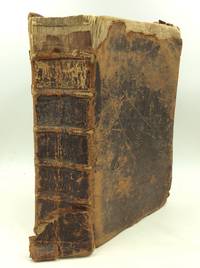
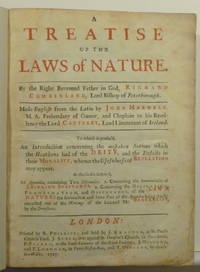
172727439London: Printed by R. Phillips; and Sold by J. Knapton 1727. .May Appear. At the End is subjoin'd An Appendix containing two Discourses. I. Concerning the Immateriality of Thinking Substance. 2. Concerning the Obligation Promulgation and Observance of the Law of Nature." Thick quarto in four parts with separate title pages. A very good copy newly rebound in handsome three-quarter calf with hand marbled paper covered boards. Raised spine bands with gilt decorated compartments and red morocco labels titled in gilt. Title page printed in red and black. Illustrated with copper plate engravings including an armorial headpiece and two fold-out plates depicting the nervous system and the solar system. A very handsome copy of this scarce book. . Hard Cover. Very Good. 4to - over 9¾" - 12" tall. Printed by R. Phillips; and Sold by J. Knapton Hardcover
1755CA0114<p>24531 pages with engraved allegorical frontispiece and index. Small folio 11 1/2" x 8 1/2" bound in original full leather with raised spine bands and decorative gilt lettering. Palau 266572. Sabin 70785 First edition.<br /><br />Full of original documents respecting the establishment of the Church in the Indies and the protection of the Indians together with all the bulls referred to from that of Alexander VI to the time of publication. With the additional 24 preliminary leaves not in all printings.<br /><br />The ancestors of Rivadeneira on both sides had served the Crown for centuries in the Reconquista in high positions of Church and State and in the conquests of Mexico and the Darién. Among his relatives is the Marquis de Moncada lieutenant colonel of the Puebla Regiment. Rivadeneira received a bachelor's degree in Philosophy and Law from the University of Mexico. He obtained a scholarship at the Colegio Mayor de Todos Santos on November 11 1731 served in various positions competed for the Chair of Institutes and remained in residence until 1746. The Audiencia de México approved him to practice as a lawyer in 1733. While still in Todos Santos Rivadeneira began serving in various positions. He was an advisor to the mayors of the city and town of Carrión in Valle Atrisco. The interim viceroy-archbishop Juan de Bizarrón appointed him a lawyer for the poor of the Courtroom of the Audiencia in 1739 with similar capacity in the Tribunal del Santo Oficio the city of Puebla and the Agustino Convent of Mexico. In 1744 Rivadeneira became fiscal agent of the room of the Crime. He served as an advisor to the viceroy Duke of the Conquest and was commissioned to settle a dispute over land by his successor the Count of Fuenclara. In 1746 Rivadeneira decided to go to Spain for family businesses and to secure a position. For a payment of 13000 pesos he obtained the appointment as supernumerary judge of the Audiencia de Guadalajara by decree of January 30 and title of February 20 1748. Without occupying this position he obtained the criminal prosecution of the Audiencia de Mexico on December 22 of 1753. He obtained a license to sail to New Spain with the servants José Ostos of Écija; Diego Ibiricu from Cádiz; Antonio de la Cruz from Zacatecas and Manuel Tagle a "free black". Rivadeneira returned to New Spain in 1755 in the same vessel in which the new viceroy Marquis de las Amarillas went and assumed his post on October 30 1755. As a prosecutor he opposed the activities of the Tribunal de Acordada. Assigned to the civil prosecutor's office to replace Luis de Mosquera and Aranda by consultation of April 28 and title of June 21 1760 the following year by consultation of May 14 and title of August 15 was appointed to replace the deceased Francisco López Adán as judge of the Audiencia. He served until his death. While he was an oidor he was denounced for possessing forbidden books. While in Spain in 1752 Rivadeneira published <em>El Pasatiempo for the use of Ex.mo Señor Carvajal and Lancaster a history of the world from creation to Fernando VI</em> in three volumes. This long didactic and religious poem was an effort to obtain a position and Beristain perhaps not knowing of the payment of 13000 pesos by Rivadeneira considered his first appointment of audience due to the sponsorship of José de Carvajal. As a prosecutor in 1755 Rivadeneira wrote the <em>Handbook compendium of the Indian Board of Trustees</em> which traced the royal patronage to the Book of Genesis an achievement for which the Crown gave him 4000 pesos. He also wrote the <em>Defense of Royal Jurisdiction</em> in 1763 <em>the remarkable newspaper of His Excellency Marquise de las Amarillas</em> and the draft of the protest sent to Spain by the City Council of Mexico City in 1771 on a claim of appointments for Americans.<br /><br /><strong>Condition:</strong><br /><br />Missing some of spine label small crack along the heal font hinge spine ends chipped light rubbing to extremities with the corners rubbed through internally very nice over all a very good copy.</p> Antonio Marín hardcover
1720TTUocLIT5Paris: Dominican Convent & College of St. James c1720. 1720. 2 Parts in 1. 4to. pp. 1 p.l. 132 34; 1 p.l. 128. numerous manuscript additions incl. paste-overs 2 full-page additon in first part & 14 full-page addition in second part. engraved thoughout with vignette headpieces & decorative initials. music on 4-line staves. contemporary mottled calf gilt back spine damaged. ms. note: 'ce livre est a l'usage to ma soeur marie de sainte agnes'. Hardcover. Good. Paris: Dominican Convent & College of St. James, [c1720]. Hardcover
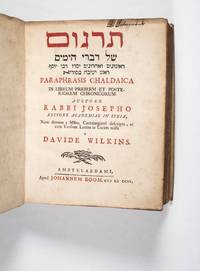
171549239Amsterdam: Jan Boom 1715. First edition. Hardcover. Very Good. Small quarto. asterisk4 a-f4 -blank f4 A-3F4 = 235 leaves. 54 415 1 blankpp. Contemporary vellum with exposed thongs boards somewhat bowed spine darkened early manuscript title in Hebrew and Latin at spine. Old owner entry at top margin title memorial label at front paste-down. A very good copy amply-margined with fine crisp text throughout.<br /> <br /> Important edition of this Aramaic version of the biblical books of Chronicles attributed to Joseph ben Hiyya d. 333 a Babylonian amora and head of the Pumbedita academy near present-day Falluja Iraq. "Ben Hiyya was also distinguished in biblical exegesis and left an Aramaic translation of parts of the Bible which is often quoted. It is not to be assumed however that Joseph translated the whole Bible though the Aramaic translation of the Books of Chronicles is ascribed to him. Enc. Jud. The editio princeps edited from an Erfurt manuscript by Matthias Frederick Beck and accompanied by substantial annotations was published at Augsburg in 1680. "After this David Wilkins gave the public an edition from a Cambridge manuscript of which the text was more pure and more complete. The critic should unite both these editions the former for the value of its learned notes and the latter for its full and accurate text†The Biblical Repertory. <br /> <br /> The Coptic scholar David Wilkens 1685–1745 was born of Prussian parentage in Memel Lithuania. Little is known about his education in Germany probably in Berlin or how he acquired his knowledge of ancient and Semitic languages which was extensive rather than profound. He referred to the antiquarian Ezechiel Spanheim the elector of Brandenburg's ambassador in England from 1701 to 1710 as his former teacher. By 1707 Wilkins was studying at the Bodleian Library in Oxford and had encountered a group of clerical protectors in London. In 1709 engaged in preparing a history of the patriarchs of Alexandria which remained in manuscript and the editio princeps of the Coptic Bohairic New Testament the Novum Testamentum Aegyptium 1716 he left for the continent. He called on scholars examined manuscripts in Vienna Rome and Paris and stopped in Amsterdam in 1714 to see to the publication of his first works -- an edition of the Aramaic paraphrasis of the books of Chronicles and an Armenian version of the apocryphal third epistle to the Corinthians 1715 -- and of John Chamberlayne's polyglot edition of the Lord's prayer to which he contributed. Wilkins was an industrious scholar. In the three years he spent as librarian at Lambeth he made important contributions to the cataloguing of manuscripts. In 1721 he edited the Anglo-Saxon laws in 1725–6 the complete works of John Selden and in 1731 the Coptic Pentateuch. His main work was his Concilia Magnae Britanniae et Hiberniae an account of British church councils from 446 to 1717. Wilkins had many detractors -- John Gagnier the professor of Arabic at Oxford who deplored his incompetence in Arabic and Hebrew Edward Harley who described him as ‘a very great scoundrel’ and the cantankerous Thomas Hearne who as librarian at the Bodleian had watched him turn from a young man ‘of a civil Courteous and modest behaviour’ into ‘a vain ambitious man of little judgement tho' great industry’ ready to ‘do anything in the World for a little Money’ Alastair Hamilton: "Wilkens David" -- ODNB online.<br /> <br /> Provenance: From the library of G.H.A. Juynboll 1935-2010 the celebrated scholar of Islamic Hadith literature with his printed memorial label at front paste-down. Hebrew title: ×ª×¨×’×•× ×©×œ דברי ×”×™×ž×™× ×¨××©×•× ×™× ×•××—×¨×•× ×™× ×™×¡×“×• ר×ש ישיבה בסורי×<br /> <br /> References: The Biblical Repertory 1834 6:248-249. Brunet 3:574 - "Livre recherché et peu commun". Enc. Jud. 10:229. Le Long Bibliotheca sacra 1723 1:92B. Le Long-Masch 2.1 p. 48: “Multo correctior est editio ac praecedens Beckiana.†long note in which the relation with the never published version by Clarke is discussed. Cf. D&M 2416: The editio princeps of the Targum on Chronicles printed from an Erfurt MS. and edited with a Latin translation by M. F. Beck Augsburg 1680-3 2 vols 4to. The present edition is “a more complete form of the text from a Cambridge MS. . edited with a Latin translation by D. Wilkins. Jan Boom hardcover
17671232331767. Paris: Boudet Desaint et Avignon Merande 1767-1773. <br /> <br /> 17 vols 4to 33 engraved plates some folding 6 letterpress tables some folding. Contemporary/original mottled calf spines gilt and gilt-lettered. A bit dry and worn but quite sound.<br /> <br /> § A lovely quarto edition of the Bible in Latin and French also issued in 8vo -- this is much the more preferable version. The plates and maps are outstanding and the physical feat of printing all seventeen volumes in six years is astonishing. Complete sets in commerce are surprisingly scarce though widely held by institutions. Brunet I 888: "Ce livre connu sous le nom de Bible de Vence mais qui devrait plutôt porter celui de Rondet son éditeur est fort estimé." Not in Darlow and Moule under Latin or French. unknown
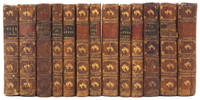
17445955Londini London: Typis J. Brindley 1744. 13 vols 12mo. Title-pages engraved ruled in red throughout. Contemporary red morocco by Brindley’s workshop boards bordered with gilt rules and gilt corner-pieces spines divided by raised bands gilt black morocco labels other compartments tooled centrally in gilt with ‘Golden fleece’ tool marbled endpapers a different pattern in each volume. A little toning in places first gathering of Caesar vol. 2 loose. Bindings rubbed spines dulled some spine ends worn or defective a number of labels lost or chipped several joints cracked but none detached some creasing or cracking to a few spines. Armorial bookplate of Cosmo Gordon Duke of Gordon and more modern Gordon Castle library shelf-labels to pastedowns early shelfmark numbering in ink to head of title-pages. An unusual surviving example of a substantial portion of Brindley’s Latin classics in Brindley’s original trade bindings. This is the first thirteen volumes in the series which was intended to rival the Elzevirs for small format and fine typography and which ultimately reached 24 volumes. Many of them - and all the ones here - were edited by Usher Gahagan d.1749 an Irish scholar of some talent but either poor morals or poor choice of friends; he was arrested with a compatriot in 1748/9 for a plan to file coins and hanged a month later. The series may have gone on longer in his absence had Brindley himself not died in 1759; the last publication in it was a 1760 reissue of the Tacitus of 1754 with Brindley’s successor’s name added to the imprint. Brindley was bookseller and binder to Frederick Prince of Wales entitling him to use the ‘Feathers’ engraving on the title-pages of these volumes. As a binder Brindley also specialised in royal work and used a distinctive dolphin tool in a number of bindings but the ‘Golden fleece’ present on the spines here is another tool regularly used by Brindley especially for copies of his little Latin classics. These were available ready-bound in his shop on New Bond Street and special small shelves to hold them remained in the premises into the 20th century. The elegant variation in endpapers on a set otherwise exactly matchingly bound is an attractive touch. This set represents the complete series as of the end of 1745. A Quintus Curtius followed in 1746 but there was then a pause until after Gahagan’s death with the next volume being the Catullus of 1749. They were probably originally purchased by Cosmo George Gordon 3rd Duke of Gordon 1720-1752 who entered the House of Lords in 1748 and may therefore have been too occupied elsewhere to complete the ongoing series. The full list present is: Horace 1744 ESTC T46227; Virgil 1744 ESTC T139210; Cornelius Nepos 1744 ESTC T83013; Juvenal and Persius 1744 ESTC T123550; Terence 1744 ESTC T137486 - the rarer variant; Julius Caesar 1744 2 vols. ESTC T136731 this the variant state; Sallust 1744 ESTC T133040; Ovid 1745 5 vols. ESTC T99863. Typis J. Brindley hardcover