543 résultats
190666057CBParis, Plon-Nourrit & Cie, 1906. 4°. 35 x 24 cm. 65 (4) Seiten auf ungebundenen, gefalteten Bögen. Original-Broschur mit Original-Schutzumschlag mit goldgeprägtem Deckeltitel in Original-Faltmappe mit goldgeprägtem Deckeltitel. [9 Warenabbildungen]
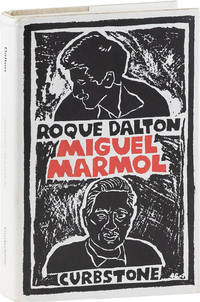
198759799New York: Curbstone Press 1987. First English Language Edition. First printing. Octavo. Tan cloth hardcover; dustjacket; xviii19-503pp. Inscribed on front flyleaf: "Para la camarada Kendra Alexander y adelante con la lucha solidaria con el pueblo Salvadoreño y Centroamerica" signed by Miguel Mármol dated 1988. Mild bumps to board corners a bit of rippling to cloth on spine still Near Fine a slightly faded but still Near Fine dustwrapper. <br /> <br /> A terrific association copy inscribed by Miguel Mármol to American communist and civil rights activist Kendra Alexander. Mármol 1905-1993 founding father of the Salvadoran Communist Party in 1930 and a leading figure of the Salvadoran worker-revolutionary movement for over five decades told his story over the course of several weeks in 1966 to the Salvadoran communist poet Roque Dalton. In his introduction Dalton who was assassinated in 1973 describes the experience as "one of the greatest satisfactions of my life" and the result was indeed one of the most popular and important works of Latin American revolutionary literature of the decade - Mármol's tumultuous life most of it spent in exile came both to exemplify and inspire the revolutionary movement in El Salvador and Central America.<br /> <br /> Though Miguel Mármol was first published in 1972 and went into numerous subsequent printings in Cuba and the Soviet Union there was no English-language translation until this 1987 edition from the small Latin-American publisher Curbstone. The cloth issue is hard to find and inscribed copies are rare; this a compelling association copy inscribed to the American civil rights leader and Communist Party leader Kendra Alexander 1945-1993 perhaps best-remembered as a close associate of Angela Davis whose Defense Committee she co-chaired during Davis's 1971 conspiracy trial. 59799. Curbstone Press unknown
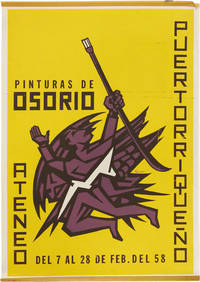
195855418San Juan: Ateneo Puertorriqueño 1958. Original illustrated poster silkscreened in three colors on white stock measuring 47.25cm x 67.25cm 18.5" x 26.5". Light wear and handling some faint creases short tear to upper left margin with masking tape along upper and lower margins on recto and some faint adhesive streaking; unbacked; Very Good / B. Striking poster announcing a 1958 exhibition of paintings by Puerto Rican painter and printmaker Carlos Osorio 1927-1984 at the Ateneo Puertorriqueño the country's oldest private cultural institution. The exhibition featured 41 works including oil paintings watercolor and drawings. The poster designed by Puerto Rican artist Carlos Rivera 1923-1999 features a powerful central image of a winged man holding aloft a staff which is both his paintbrush and his machete. Not separately listed in OCLC though we note an example held by the University of Puerto Rico. Ateneo Puertorriqueño] unknown
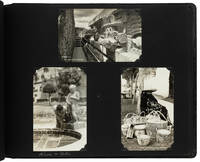
1930205481930. Early twentieth century travel photo album compiled by "Jake"documents the working life and global mobility of a merchant ship crewman during the 1930s and 1940s with sustained visual attention to port cities across Africa the Americas and the United States. The album supports research into maritime labor informal American commercial presence abroad and everyday interactions between traveling workers and local populations under late colonial conditions. Photographs taken in Beira and Dondo in Mozambique and Angola Durban and Cape Town in South Africa and Accra in the Gold Coast record encounters shaped by European colonial infrastructures and tourist economies including images captioned "Typical Ricksha Boy" depicting South African rickshaw pullers in elaborate headdress and dress and scenes of women in Accra balancing baskets and trays of food. Additional captions such as "Sam and his 'girls'" showing uniformed workers marked "Sea View Hotel" and "me and my gals" portraying informal social contact provide direct evidence of how American maritime workers framed and recorded relationships with local communities. The album further situates this mobility within a broader circuit including the Panama Canal Mexico City and Vera Cruz and U.S. port cities such as Galveston New York and Boston.<br /> <br /> Travel photo album compiled circa 1930s to 1940s likely by an American merchant marine crewman identified as Jake. String-bound black cloth album containing 44 leaves with 218 silver gelatin photographs and postcards mounted or cornered in along with one original sketch of an African man. Images span multiple global locations including Beira Dondo Durban Cape Town Accra Vera Cruz Mexico City the Panama Canal Powell River Vancouver Galveston New York and Boston. Several photographs depict shipboard life and crew activity aboard the S.S. Nemiskam Park with additional images of small craft landings including African men canoeing crew members ashore. A sequence of photographs taken in Boston shows the compiler in maritime work gear wearing thigh-high boot wraps rubber gloves and an oxygen mask captioned "At last -- working for a change." Nineteen photographs document Mexico including rancheros and rancheras in embroidered dress scenes of bullfighting and crew members wearing sombreros and sarapes.<br /> <br /> This album provides a concentrated record of interwar and wartime-era maritime circulation linking North American labor to colonial and postcolonial port environments offering primary visual evidence of how working-class American travelers documented race labor and leisure across imperial geographies. The inclusion of commercial signage hotel uniforms and transport labor such as rickshaw pulling situates the photographs within local economies shaped by tourism and global trade while the Panama Canal images anchor the album within a critical artery of twentieth-century shipping and U.S. strategic infrastructure. The juxtaposition of African Mexican and U.S. scenes underscores the continuity of maritime networks that connected these regions and the album's captions provide insight into informal language humor and perception among traveling crewmen. Minor edge wear to album corners with some mounts loosening; leaves and photographs remain clean and stable. Overall very good condition. unknown
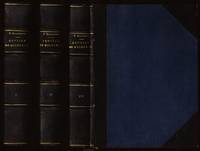
1932CA02463 volumes. xxix-574 pages with 4 folding maps; 466 pages with folding coats of arms 6 folding native illustrations and map; 469 pages with 2 coats of arms one folding and 6 folding native illustrations. Royal octavo 9 1/2" x 7" bound in three quarter blue leather with raised spine bands and gilt lettering to spine. Introduction by Rafael Lopez. From the library of George Foster. Publicaciones del Archivo General de la Nacion volume XVII XVIII and XIX.<br /><br />There are only meager biographical data about Pablo de la Purísima Concepción Beaumont whose work is a major source on Michoacán. Despite its title "Chronicle of the Holy Apostles St Peter and St Paul of Michoacán" Beaumont's work in fact spans a much greater area including much of western Mexico northward to New Mexico and tending toward a general history. It provides details to 1565. Beaumont divided his total work into tow major parts the firs or Aparato intended to be introductory to the second or the Crónica proper. the first seems complete but the second was never finished. The Aparato takes up fully a third of the extant Beaumont work although nominally introductory. It deals with the discovery of America and the conquest of Mexico to the year 1521. It was twice published before appearance of the total work. Far more valuable is the Crónica. It consists of two books and one chapter of book 3. Beaumont drew on a wide variety of sources. He tell us us that he gathered a large quantity of manuscripts from various Franciscan archives as well as listing 30 standard writers in printed sources. He gives full copies of some of his documents of which several have since disappeared. He speaks of obtaining a native painting possibly from which his illustrations came. These paintings show incidents of the first visits of Spaniards to Michoacán there reception by Tarascans labors of the Franciscans coats of arms of principal cities of Michoacán. It is usually through that Beaumont composed his work around 1777. That is the last date in the later copies of the original manuscript. Unfortunately his original manuscript is lost. It was copied in Mexico City around 1792 to for volumes 7-11 of a 32 volume Collection of Memories on New Spain ordered by Viceroy Conde de Revilla Gigedo and compiled by Manuel de la Vega. Three partially complete sets of these Vega Memorias are known; from one or another of them come other recopied manuscript copies as well as the printed versions. Editions of the work have a somewhat unfortunate publishing history. In 1826 Bustamante published an incomplete and useless edition of the Aparato attributing it to Vega who had owned the manuscript Bustamante used. In 1873-74 a five volume edition of both Aparato and Crónica appeared in Mexico; it lacks the Indian drawings and was based on a secondary manuscript copy made b y J F Ramirez that then belonged to Alfredo Chavero. A three volume version was published by the National Archives of Mexico in 1932 based on their copy of the 1792 collection of Memorias; it contains the Indian drawings and an introduction by Rafael Lopez. The text seems slightly corrupt but it may be near the original as Beaumont said his Spanish was defective owing to his Parisian rearing.<br /><br />George McClelland Foster Jr born in Sioux Falls South Dakota on October 9 1913 died on May 18 2006 at his home in the hills above the campus of the University of California Berkeley where he served as a professor from 1953 to his retirement in 1979 when he became professor emeritus. His contributions to anthropological theory and practice still challenge us; in more than 300 publications his writings encompass a wide diversity of topics including acculturation long-term fieldwork peasant economies pottery making public health social structure symbolic systems technological change theories of illness and wellness humoral medicine in Latin America and worldview. The quantity quality and long-term value of his scholarly work led to his election to the National Academy of Sciences in 1976. Virtually all of his major publications have been reprinted and/or translated. Provenance from the executor of Foster's library laid in.<br /><br />Condition:<br /><br />Some underlining in pencil through out by Foster. Foster's date of acquire on front paste down early owner's name on front end paper. some light soiling and rubbing to extremities else a very good set.<br /><br /> Talleres Graficos de la Nacion hardcover
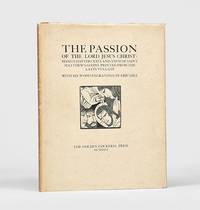
19269150Waltham St Lawrence: The Golden Cockerel Press 1926. Limited edition number 180 of 250 copies of a beautifully achieved piece of Biblical private press printing from the 1920s illustrated by Eric Gill. Cream buckram clean and fresh; pages unopened along top fold; gutter visible between pages 8 and 9; limitation statement numbered in black ink with cockerel emblem. A very good copy. Gill contributes two full page and four vignette illustrations. Initial letters printed in red. The jacket is chipped and worn fair only but has done an excellent job protecting the book itself. Please contact Christian White Rare Books Ltd for more information or images of this item 1926 The Golden Cockerel Press hardcover
1976ZB393682Athens 1976-1984. numbers 1-17 an uninterrupted run in original paper wrappers minor ownership markings overall very good; sold as a lot only. - If you are reading this this item is actually physically in our stock and ready for shipment once ordered. We are not bookjackers. Buyer is responsible for any additional duties taxes or fees required by recipient's country. Photos available upon request. Athens unknown
1969TBLrnBIB63Geneva: Éditions De l'Institut D'Histoire De L'Art Du Moyen Age 1969. 1969. 2 Volumes. 8vo. pp. 2 p.l. ix-xiv 1 leaf 316 1 leaf. numerous text illus. after the woodcuts by Bernard Salomon. the porfolio volume containing 40 woodcuts on china paper loose in paper folder with list of illus. loose in binding. full antique-style blind-stamped vellum over heavy bds. small nick on one cover otherwise fine. in slightly damaged slipcase. Limited to 390 numbered copies plus 10 'hors-commerce' on 'Ingres d'Arches'. The French and Latin texts are taken from the Bibles publlished by Jean de Tournes at Lyon in 1554. René Loche wrote the introduction and compiled the tables relatiing to the occurrence of the Salomon cuts in the various De Tournes editions pp. 249-316 which are adapted from Cartier's bibliography of that printer's works. The photographs of the Salomon woodcuts were executed by Yves Siza from 'The true and lyvely historyke purtreatures of the woll Bible' 1553 'Quadrins historiques de la Bible' 1560 and 'Quadrins historiques de la Bible' 1583. The text was printed in Garamond types by Étienne Braillard and the binding was executed by Henri Donzel in Geneva. The woodcuts on china paper in the separate portfolio were pulled from the original Salomon blocks belonging to the Musée d'Art et d'Histoire de Genève. [Geneva: Éditions De l'Institut D'Histoire De L'Art Du Moyen Age, 1969]. hardcover
1967ZB642996University of Kansas. Center of Latin American Studies 1967. Volumes 1-18 partly bound minor library markings else text clean & bindings tight. - If you are reading this this item is actually physically in our stock and ready for shipment once ordered. We are not bookjackers. Buyer is responsible for any additional duties taxes or fees required by recipient's country. Photos available upon request. University of Kansas. Center of Latin American Studies unknown
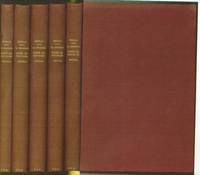
1910CA01065 volumes: volume 1 Texto: xx607 pages with frontispiece portraits illustrations facsimiles maps and plates; volume 2 Documentos: 552 pages; volume 3 Vida de Ercilla: 337 pages with portraits illustrations and index; volumes 4-5 Illustrations: 512 pages with facsimile titles to the first publications; 559 pages with facsimile signatures plates and index. Folio 15" x 10 3/4" with original wrappers bound in to cloth binding. Compiled and arranged by Jose Toribio Medina. First edition.<br /><br />La Araucana is an epic poem in Spanish about the Spanish conquest of Chile by Alonso de Ercilla; it is also known in English as The Araucaniad. It was considered the national epic of the Kingdom of Chile and one of the most important works of the Spanish Golden Age Siglo de Oro. The poem consists of 37 cantos that are distributed across the poem's three parts. The first part was published in 1569; the second part appeared in 1578 when it was published with the first part; the third part was published with the first and second parts in 1589. The poem shows Ercilla to be a master of the octava real the complicated stanza in which many other Renaissance epics in Castilian were written. A difficult eight-line unit of 11-syllable verses that are linked by a tight rhyme scheme the octava real was a challenge few poets met. It had been adapted from Italian only in the 16th century and it produces resonant serious-sounding verse that is appropriate to epic themes. The work describes the initial phase of the Arauco War which was born as a Spanish conquests attempt not at all comparable in importance to those of Hernán Cortés who helped conquer the Aztec empire and Francisco Pizarro who initiated the overthrow the Inca empire. Contrary to the epic conventions of the time however Ercilla placed the lesser conquests of the Spanish in Chile at the core of his poem because the author was a participant in the conquest and the story is based on his experiences there. On scraps of paper in the lulls of fighting Ercilla jotted down versified octaves about the events of the war and his own part in it. These stanzas he later gathered together and augmented in number to form his epic. It was the first poem of its kind written by a participant in the course of the events narrated and the first to immortalize the beginnings of a modern country. In the minds of the Chilean people La Araucana is a kind of Iliad that exalts the heroism pride and contempt of pain and death of the legendary Araucanian leaders and makes them national heroes today. Thus we see Ercilla appealing to the concept of the "noble savage" which has its origins in classical authors and took on a new lease of life in the renaissance - c.f. Montaigne's essay Des Canibales and was destined to have wide literary currency in European literature two centuries later. He had in fact created a historical poem of the war in Chile which immediately inspired many imitations.<br /><br />La Araucana is deliberately literary and includes fantastical elements reminiscent of medieval stories of chivalry. The narrator is a participant in the story at the time a new development for Spanish literature. Influences include Orlando furioso by Ludovico Ariosto. Also features extended description of the natural landscape. La Araucana's successes—and weaknesses—as a poem stem from the uneasy coexistence of characters and situations drawn from Classical sources primarily Virgil and Lucan both translated into Spanish in the 16th century and Italian Renaissance poets Ludovico Ariosto and Torquato Tasso with material derived from the actions of contemporary Spaniards and Araucanians. The mixture of Classical and Araucanian motifs in La Araucana often strikes the modern reader as unusual but Ercilla's turning native peoples into ancient Greeks Romans or Carthaginians was a common practice of his time. For Ercilla the Araucanians were noble and brave—only lacking as their Classical counterparts did the Christian faith. Caupolicán the Indian warrior and chieftain who is the protagonist of Ercilla's poem has a panoply of Classical heroes behind him. His valour and nobility give La Araucana grandeur as does the poem's exaltation of the vanquished: the defeated Araucanians are the champions in this poem which was written by one of the victors a Spaniard. Ercilla's depiction of Caupolicán elevates La Araucana above the poem's structural defects and prosaic moments which occur toward the end when Ercilla follows Tasso too closely and the narrative strays from the author's lived experience. Ercilla the poet-soldier eventually emerges as the true hero of his own poem and he is the figure that gives the poem unity and strength. The story is considered to be the first or one of the first works of literature in the New World cf. Cabeza de Vaca's Naufragios—Shipwrecked or Castaways for its fantastical/religious elements it is arguable whether that is a "traveler's account" or actual literature; and Bernal Díaz del Castillo's Historia verdadera de la conquista de Nueva España The Conquest of New Spain. La Araucana's more dramatic moments also became a source of plays. But the Renaissance epic is not a genre that has as a whole endured well and today Ercilla is little known and La Araucana is rarely read except by specialists and students of Spanish and Latin American literatures and of course in Chile where it is subject of special attention in the elementary schools education both in language and history. La Araucana makes Chile the only American country that was founded under the lights of an epic poem. <br /><br />Condition:<br /><br />Bound in red cloth with original wrappers bound in. Volume one first 15 pages closed tear at heal repaired back page fore edge repaired. A very good set. Imprenta elzeviriana hardcover
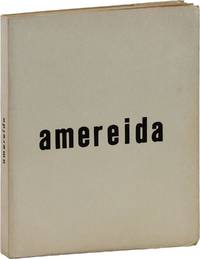
196787336Santiago: Editorial Cooperativa Lambda 1967. First Edition. Octavo 24cm. Coated card wrappers with French flaps; unpaginated 193pp; illus. Very light wear to covers; internally complete and clean but for a few faint pencil marginal markings by the previous owner the noted poet and translator Nathaniel Tarn. Near Fine. Text entirely in Spanish.<br /> <br /> A collaborative book-length work combining poetry and conceptual imagery; published anonymously but compiled and edited primarily by Chilean avant-garde poet Godofredo Iommi. "Amereida" a composite neologism for "American Aeneid" is a conceptual chronicle of a literal cross-country trek from Tierra del Fuego to Southern Bolivia undertaken in 1965 by a group of like-minded poets architects designers philosophers and artists including Iommi 1925-2001 the architect Alberto Cruz 1917-2013 sculptor Claudio Girola 1923-1994 French philosopher François Fédier 1935-2021 and numerous others. Many of the participants in this first "Travesia Amereida" had originally coalesced around the surrealist group in post-war Paris and were later responsible for modernizing the faculty and curriculum of the College of Architecture at the Universidad Católico de Valparaíso. In 1971 the group founded an intentional community the "Ciudad Abierta" "Open City" in Ritoque Chile some kilometers southwest of Valparaíso; the community is still in existence and the tradition of the "Travesias" continues with annual journeys through the South American wilderness that become stages for performance poetry readings and art installations. La Ciudad Abierta quoting the editorial introduction to the poem in the Oxford Book of Latin American Poetry ".is probably the only site in the world where architecture is conceived as an outgrowth of poetry" OBLAP p.362ff. The current volume nominally the community's founding document is notoriously scarce almost never encountered in commerce; OCLC locates only about a dozen holdings worldwide 8 in North America. Editorial Cooperativa Lambda unknown
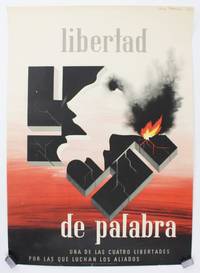
19424754Washington DC: El Coordinador de Asuntos Interamericanos 1942. Very good. Pictorial lithograph 20 x 14.25 inches printed in red gray yellow and black. Minor surface wear mild creasing light dust-soiling a few pinholes. A rare poster issued by the Office of the Coordinator of Inter-American Affairs CIAA during World War II attempting to sway public opinion in Latin America to the Allied side. The CIAA was established by executive order in July 1941 in order to distribute news advertising film reels and more to and from Latin America to counter Italian and German propaganda campaigns in the region. The text of the present poster translates from the Spanish as "Freedom of Speech. One of the four freedoms for which the Allies are fighting." The central image features an open-mouthed face breaking open a large swastika which is itself on fire. A mildly subtle message that free speech destroys fascism. The poster was designed by noted Russian-American graphic designer and photographer Alexey Brodovitch whose printed credit appears at top right; Brodovitch is most well-known for his art direction of Harper's Bazaar from 1934 to 1958. A powerful visual display with only one copy reported in OCLC at MOMA though we also find two other institutional holdings at the United States Holocaust Museum and the Hoover Institute. El Coordinador de Asuntos Interamericanos unknown
1922List2026N.P. 1922. Oblong 8vo wraps 9 x 6 inches. Rear wrap detached tears and chips to front wrap fine contents very good overall. Very Good. An uncommon first edition copy of Manuel Gomez Miralles’ photographic survey of Costa Rica. Miralles was one of Costa Rica’s most prolific photographers operating for many decades and this book is an early collection of his work. Miralles work is compositionally advanced and his large format images are reproduced effectively in the volume. This book was the only survey of Miralles’ work to appear in his lifetime and after his death his negatives were sold to a foreign photographer. We find no records of this book in the trade or auction records at the time of this listing. unknown
1926149674Waltham St Lawrence: The Golden Cockerel Press 1926. The Passion of the Lord Jesus Christ with six wood-engravings by Eric Gill rare with dust jacket Limited edition number 31 of 250 copies only. Reviewed by the Times Literary Supplement on 29 July 1926 the reviewer noted "this is a production for which we have nothing but praise. The first requirements a harmony of form and balance of weight between illustrations and type are perfectly fulfilled. In spirit Mr Gill's illustrations could hardly be bettered; they are both religious and decorative." Quarto. 2 full-page and 4 other illustrations by Gill. Original white buckram spine lettered in gilt. Text printed in red and black. With dust jacket. Minimal soiling to covers with corners slightly bumped else an attractive near-fine copy. Dust jacket toned at spine with extremities frayed still a very good copy of a scarce dust jacket. Gill 276. hardcover