26 128 résultats
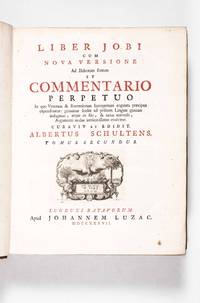
173749261Leiden: Jean Luzac 1737. First edition. Two volumes large quarto. 52 544; 2 545-1232 63 indices 1 corrigendapp. Text in two columns with Hebrew text and facing Latin translation interspersed with commentary. Titles in red and black with engraved vignettes. Contemporary speckled calf; gilt-tooled spine with raised bands and morocco lettering pieces; gilt dentelles; edges daubed in red and green. Light scuffing to boards and fading to spines. A very good set with crisp clean text throughout.<br /> <br /> First edition of this comprehensive commentary to the biblical Book of Job by the Dutch scholar of Semitic languages Albert Schultens 1686-1750 who maintained "that the true nature of the Hebrew language and the meaning of many of its words and idioms are to be found chiefly in the Arabic" Orme. Fifty-five pages of the indices constitute a brief lexicon and provide Latin as well as Arabic equivalents for more than 1000 Hebrew words. Schultens studied theology and eastern languages at Groningen where he received his degree in theology in 1709. After a brief career as a preacher in Wassenaar he was nominated professor of Hebrew and Jewish antiquities at Franeker in 1713. In 1729 he decamped for Leiden were he was first appointed reader in eastern languages and finally full professor in 1732.<br /> <br /> At this time a chief concern of Calvinist theologians was to liberate Old Testament exegesis from the Jewish Rabbinic as well as Catholic traditions. Schultens' influential and controversial solution was revealed as early as 1706 in his first public thesis Disputatio theologico philologica de utilitate linguae Arabicae in interpretanda S. Scriptura A Theologico-Philosophical Dissertation on the Utility of the Arabic Language for the Interpretation of the Holy Scriptures "a forceful attack" Brugman & Schröder on the Protestant sola scriptura methodology of Biblical exegesis. "With the help of Jacobus Golius' Arabic dictionary he perused with zeal and fervour the Old Testament and wrote prolifically. The lexical superiority of Arabic had led him to a reconsideration of the position of Hebrew: at first he had called Arabic 'the most splendid daughter of mother Hebrew' but in his oration of 1729 he proclaimed Hebrew and Arabic cognate twin sisters. This shocked conservative theologians as an outright profanation of God's Word" Brugman & Schröder. "In 1737 he applied his theories in his bilingual edition of the book of the prophet Job whom he regarded as an Arab. The Hebrew text and the Latin translation are all but totally submerged by the extensive commentary in which Schultens draws abundantly on Arabic texts such as the Hamasa an anthology of early Arabic poetry by the ninth-century poet Abu Tammam" Vrolijk & van Leeuwen. Schultens was not without his critics and by 1824 William Orme notes a turning of the tide: "Different opinions are entertained of the correctness of his views and also of his success in applying them; but it is now generally admitted that he carries his notions of the advantage of Arabic learning to the interpretation of the Scriptures too far." <br /> <br /> Jean Luzac 1728-1777 was a member of a well-known Huguenot family of printers; he published many works for the University of Leiden including three Hebrew books of Albert Schultens. Isaac van der Mijn is noted as the printer at the colophon of the second volume.<br /> <br /> Provenance: printed label of the Bibliotheca Seminarii Warmondani at the front endleaf of the first volume. Full title: Liber Jobi cum nova versione ad Hebraeum fontem et commentario perpetuo in quo Veterum et Recentiorum Interpretum cogitata præcipua expenduntur: genuinus sensus ad priscum Linguae genium indagatur atque ex filo et nexu universo Argumenti nodus intricatissimus evolvitur. Curavit et editit. Albertus Schultens. Tomus Primus. -Tomus Secundus<br /> <br /> References: J. Brugman & F. Schröder Arabic Studies in the Netherlands Leiden: E.J. Brill 1979 p.26f. Fuks/Fuks-Mansfeld 78. Orme Bibl. Biblica p. 390. A. Vrolijk & R. van Leeuwen Arabic Studies in the Netherlands a Short History in Portraits 1580-1950 Leiden: E.J. Brill 2014 pp. 73-79. Jean Luzac unknown
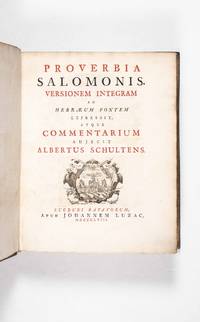
174849255Leiden: Jean Luzac 1748. First edition. Hardcover. Very Good. Quarto. 8 cviii 522 60 indices & corrigendapp. Text in two columns with Hebrew text and facing Latin translation interspersed with commentary. Title in red and black with engraved vignette; woodcut ornaments. Contemporary Dutch paneled vellum with blind-stamped vignettes and ruled borders; manuscript title at spine. Covers lightly soiled. Occasional touches of soiling and some leaves with mild embrowning. A very good copy generally crisp and clean.<br /> <br /> First edition of this comprehensive commentary to the biblical Book of Proverbs by the Dutch semitic language scholar Albert Schultens 1686-1750 who maintained "that the true nature of the Hebrew language and the meaning of many of its words and idioms are to be found chiefly in the Arabic" Orme. Forty-one pages of the indices constitute a brief lexicon and provide Latin as well as Arabic equivalents for more than 1000 Hebrew words. Schultens studied theology and eastern languages at Groningen where he received his degree in theology in 1709. After a brief career as a preacher in Wassenaar he was nominated professor of Hebrew and Jewish antiquities at Franeker in 1713. In 1729 he decamped for Leiden were he was first appointed reader in eastern languages and finally full professor in 1732.<br /> <br /> At this time a chief concern of Calvinist theologians was to liberate Old Testament exegesis from Jewish Rabbinic as well as Catholic traditions. Schultens' influential and controversial solution was revealed as early as 1706 in his first public thesis Disputatio theologico philologica de utilitate linguae Arabicae in interpretanda S. Scriptura A Theologico-Philosophical Dissertation on the Utility of the Arabic Language for the Interpretation of the Holy Scriptures "a forceful attack" Brugman & Schröder on the Protestant sola scriptura methodology of Biblical exegesis. "With the help of Jacobus Golius' Arabic dictionary he perused with zeal and fervour the Old Testament and wrote prolifically. The lexical superiority of Arabic had led him to a reconsideration of the position of Hebrew: at first he had called Arabic 'the most splendid daughter of mother Hebrew' but in his oration of 1729 he proclaimed Hebrew and Arabic cognate twin sisters. This shocked conservative theologians as an outright profanation of God's Word" Brugman & Schröder. <br /> <br /> Like his earlier commentary on the Biblical Book of Job one here finds that the "Hebrew text and the Latin translation are all but totally submerged by the extensive commentary in which Schultens draws abundantly on Arabic texts such as the Hamasa an anthology of early Arabic poetry by the ninth-century poet Abu Tammam" Vrolijk & van Leeuwen. Schultens was not without his critics and by 1824 William Orme notes a turning of the tide: "Different opinions are entertained of the correctness of his views and also of his success in applying them; but it is now generally admitted that he carries his notions of the advantage of Arabic learning to the interpretation of the Scriptures too far." <br /> <br /> Jean Luzac 1728-1777 was a member of a well-known Huguenot family of printers; he published many works for the University of Leiden including three Hebrew books of Albert Schultens. Isaac van der Mijn is noted as the printer at the colophon of the second volume.<br /> <br /> Provenance: bookplate of the Crozer Theological Seminary - Bucknell Library; bookseller's ticket of Librairie Ancienne et Moderne de Frederik Muller Amsterdam at the front paste-down. References: J. Brugman & F. Schröder Arabic Studies in the Netherlands Leiden: E.J. Brill 1979 p.26f. Fuks/Fuks-Mansfeld 78. Orme Bibl. Biblica p. 390. A. Vrolijk & R. van Leeuwen Arabic Studies in the Netherlands a Short History in Portraits 1580-1950 Leiden: E.J. Brill 2014 pp. 73-79. Jean Luzac hardcover
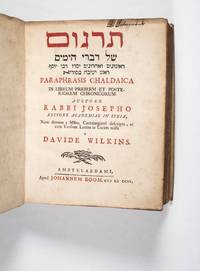
171549239Amsterdam: Jan Boom 1715. First edition. Hardcover. Very Good. Small quarto. asterisk4 a-f4 -blank f4 A-3F4 = 235 leaves. 54 415 1 blankpp. Contemporary vellum with exposed thongs boards somewhat bowed spine darkened early manuscript title in Hebrew and Latin at spine. Old owner entry at top margin title memorial label at front paste-down. A very good copy amply-margined with fine crisp text throughout.<br /> <br /> Important edition of this Aramaic version of the biblical books of Chronicles attributed to Joseph ben Hiyya d. 333 a Babylonian amora and head of the Pumbedita academy near present-day Falluja Iraq. "Ben Hiyya was also distinguished in biblical exegesis and left an Aramaic translation of parts of the Bible which is often quoted. It is not to be assumed however that Joseph translated the whole Bible though the Aramaic translation of the Books of Chronicles is ascribed to him. Enc. Jud. The editio princeps edited from an Erfurt manuscript by Matthias Frederick Beck and accompanied by substantial annotations was published at Augsburg in 1680. "After this David Wilkins gave the public an edition from a Cambridge manuscript of which the text was more pure and more complete. The critic should unite both these editions the former for the value of its learned notes and the latter for its full and accurate text†The Biblical Repertory. <br /> <br /> The Coptic scholar David Wilkens 1685–1745 was born of Prussian parentage in Memel Lithuania. Little is known about his education in Germany probably in Berlin or how he acquired his knowledge of ancient and Semitic languages which was extensive rather than profound. He referred to the antiquarian Ezechiel Spanheim the elector of Brandenburg's ambassador in England from 1701 to 1710 as his former teacher. By 1707 Wilkins was studying at the Bodleian Library in Oxford and had encountered a group of clerical protectors in London. In 1709 engaged in preparing a history of the patriarchs of Alexandria which remained in manuscript and the editio princeps of the Coptic Bohairic New Testament the Novum Testamentum Aegyptium 1716 he left for the continent. He called on scholars examined manuscripts in Vienna Rome and Paris and stopped in Amsterdam in 1714 to see to the publication of his first works -- an edition of the Aramaic paraphrasis of the books of Chronicles and an Armenian version of the apocryphal third epistle to the Corinthians 1715 -- and of John Chamberlayne's polyglot edition of the Lord's prayer to which he contributed. Wilkins was an industrious scholar. In the three years he spent as librarian at Lambeth he made important contributions to the cataloguing of manuscripts. In 1721 he edited the Anglo-Saxon laws in 1725–6 the complete works of John Selden and in 1731 the Coptic Pentateuch. His main work was his Concilia Magnae Britanniae et Hiberniae an account of British church councils from 446 to 1717. Wilkins had many detractors -- John Gagnier the professor of Arabic at Oxford who deplored his incompetence in Arabic and Hebrew Edward Harley who described him as ‘a very great scoundrel’ and the cantankerous Thomas Hearne who as librarian at the Bodleian had watched him turn from a young man ‘of a civil Courteous and modest behaviour’ into ‘a vain ambitious man of little judgement tho' great industry’ ready to ‘do anything in the World for a little Money’ Alastair Hamilton: "Wilkens David" -- ODNB online.<br /> <br /> Provenance: From the library of G.H.A. Juynboll 1935-2010 the celebrated scholar of Islamic Hadith literature with his printed memorial label at front paste-down. Hebrew title: ×ª×¨×’×•× ×©×œ דברי ×”×™×ž×™× ×¨××©×•× ×™× ×•××—×¨×•× ×™× ×™×¡×“×• ר×ש ישיבה בסורי×<br /> <br /> References: The Biblical Repertory 1834 6:248-249. Brunet 3:574 - "Livre recherché et peu commun". Enc. Jud. 10:229. Le Long Bibliotheca sacra 1723 1:92B. Le Long-Masch 2.1 p. 48: “Multo correctior est editio ac praecedens Beckiana.†long note in which the relation with the never published version by Clarke is discussed. Cf. D&M 2416: The editio princeps of the Targum on Chronicles printed from an Erfurt MS. and edited with a Latin translation by M. F. Beck Augsburg 1680-3 2 vols 4to. The present edition is “a more complete form of the text from a Cambridge MS. . edited with a Latin translation by D. Wilkins. Jan Boom hardcover
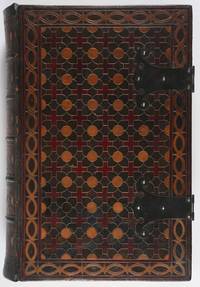
170153475Liege: Jean-François Broncart 1701. First edition thus. Hardcover. Very good. Two tomes each in two parts bound in one volume folio: 6 lxxix 1 blank 544; 1 title 1 blank 545-957 1 blank xx Cantique des cantiques 96 La sagesse; Ecclesiastique de Jesus fils de Sirach; 1 title 1 blank 468; 1 title 1 blank 430 16 Oratio Manassae; Liber Esdrae - tertius et quartus pp. Main titles for each tome in red and black; secondary titles in black only all four titles with engraved printer's device; each dated 1701. Text in two columns Latin and French. Illustrated with 6 engraved plates: frontispiece Johann Friederich Karg von Bebenburg; folding plate with 16 vignettes 4x4 depicting well-known biblical scenes; 4 folding maps The Holy Land; The Promised Land Apportioned by Tribe; Jerusalem in the Second Temple Era - after Lamy; The World Known to the Evangelists. Quarter-page engraved vignettes at the head of each of the 30 biblical books; historiated initials; printed marginalia. Exquisitely bound in the 19th century in levant morocco extra over wooden boards with mosaic compartments in crimson ochre; and dark brown bordered in fine gilt line; spine with raised bands lightly rubbed; pair of brass mounts finished in black with steel rivets at both covers clasps and catched perished. All edges gilt and elaborately gauffered in textured floral motif; gilt inner dentelles; decorative endleaves renewed in orange and black; crimson silk ribbon marker. The work of a master binder. Expertly repaired at spine caps. Occasional faint embrowning; marginal dampstains beginning in second half mostly at outer corners; expanding to fore-edge and darkening considerably in final 20 leaves. Overall a very good copy with crisp text throughout though incomplete: lacks Antoine Arnould's "Concorde des quatre Evangélistes" along with its accompanying Latin version and the concluding index.<br /> <br /> Amply margined copy of this sumptuous edition of the Bible comprising the Latin Sixto-clementine Vulgate and the Port-Royal French translation printed in parallel columns. Isaac-Louis Lemaistre de Sacy 1613-1684 was the principal translator of the French version which was edited and completed after his death by Pierre Thomas du Fossé 1634-1698 and Henri-Charles de Beaubrun 1655-1723 who also provide annotations throughout. According to Barbier the French controversialist Thierry de Viaixnes 1659-1735 who found himself often at odds with his superiors was the principal editor of the work; at the time of its preparation he was serving as director of an academy at Hautvilliers in the diocese of Rheims McClintock & Strong.<br /> <br /> Dedicated to Johann Friederich Karg von Bebenburg 1648-1719 whose signed portrait was drawn and engraved by C. Gustav of Amling. An advocate of maximal papal power Karg served as Privy Councilor of the Prince-Bishop of Bamberg and Würzburg Peter Philipp von Dernbach then of Elector Max Emanuel of Bavaria. He served as Dean of Our Lady in Munich and was entrusted by Emperor Leopold I with a legation to Pope Innocence XI. By these efforts he secured in 1688 the election of Prince Joseph Clemens of Bavaria as Archbishop of Cologne as a result of which he was made Chancellor and Minister of State here noted on the frontispiece.<br /> <br /> Provenance and annotations: Bookplate of Herman Blum Blumhaven Library & Gallery with his ticket below; two gilt-stamped ex-libris morocco labels: Henry W. Poor oval; Adolph Lewisohn octogonal. References: Darlow & Moule 3779; Deleveau & Hillard Bibles imprimées du XVe au XVIIe siècles conservées è Paris 605; ADB 15 1882 "Karg: Johann Friedrich; Jean-François Broncart hardcover
179518760paris Barbou 1795 in-12 plein-veau un volume, reliure plein veau blond marbré in-douze (binding full calfskin duodecimo)(10 x 17 cm), dos long (spine with raised bands), décorations or à filet or, filet perlé or et roulette or, entre-nerfs à fleurons divers (pot de fleur, vase et soleil) au fer plein (floweret with hollowed out blocking stamp), pièce de titre sur fond rouge avec filet et filet perlé or, roulette or avec de part et d'autre unfilet or et un filet perlé or en place des nerfs et en tête et en pied, 1er plat trés légèrement épidermé sur 1 cm2 (cover lightly rubbed), roulette or sur coupes (fillets on the cuts), toutes tranches rouges (all red edges), EX-LIBRIS imprimé en noir sur une étiquette blanche : Hervé Denis : " Morbihanha mor bras é mor er vretoned", Texte en Latin avec sa traduction française en regard, sans illustrations (no illustration) excepté une vignette gravée sur bois en noir en bas de la page de titre + bandeaux (illuminated of headpieces), 440 pages, AN IV (1795) à Paris Barbou Editeur,
20006Villeneuve d'Ascq, Presses Universitaires du Septentrion, collection "Travaux et Recherches", 1995, 1 broché. in-8 de 391-(4) pages ;
1937LFA-126713132Un ouvrage de 173 pages, format 110 x 170 mm, relié cartonnage, publié en 1937, Editions de la Scola Cantorum (Paris) et Librairie Saint Grégoire (Grenoble)
1750LFA-126719378Un ouvrage de 763 pages, format 220 x 290 mm, relié plein cuir dos à nerfs orné, publié en 1750, Jacobus Rollin Filium (Paris), état d'usage
LFA-126719763Une plaquette de 64 pages, format 135 x 190 mm, illustrée, brochée, s.d. (milieu du XXe siècle), Vizzavona Editeur, bon état
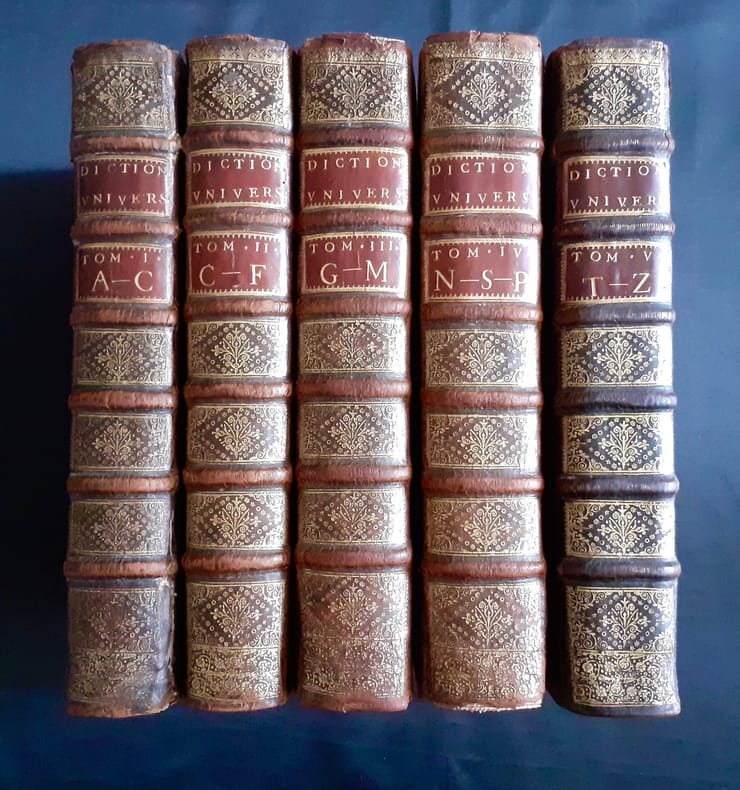
45332Imprimé à Trévoux et se vend à Paris chez Florentin Delaulne, Hilaire Foucault, Michel Clousier, Jean-Geoffroy Nyon, Estienne Ganeau, Nicolas Gosselin, 1721. 5 vol. in-folio plein veau, dos à nerfs ornés de fleurons dorés, roulette en coupes et à l’intérieur (reliure de l’époque).Texte à double colonnes. Cinq mors lègèrement fendus, sans gravité et deux coiffes frottées, sinon belle et solide reliure de l’époque et intérieur d’une grande fraîcheur.
26935A Cologne, & se trouve à Paris, Chez Nyon, 1772. With engraved frontispiece. xliv, 436 pp. 8vo. Contemporary marbled calf, spine gilt withr aised bands, label with gilt lettering, slightly rubbed, some discolouring, marbled edges. Sabin 20201; Leclerc 453; Muller 975 (all listing the first edition). Second edition, first published in 1767. This work is largely based on a manuscript by P. Champion, Jesuit, who had started having a life of Palafox printed, but the impression was stopped. Dinouart says in his preface he was happy in being able to procure the entire mansucript of Champion which enabled him to complete the life of the celebrated bishop (Sabin).Juan de Palafox y Mendoza (June 26, 1600 - October 1, 1659), a Spanish politician, administrator, and Catholic clergyman in 17th century Spain and viceregal Mexico. Palafox was the Bishop of Puebla (1640-1655), and the interim Archbishop of Mexico (1640-1642). He also held political office, from June 10, 1642 to November 23, 1642 as the Viceroy of New Spain. He lost a high-profile struggle with the Jesuits in New Spain, resulting in a recall to Spain, to the minor Diocese of Osma in Old Castile. In 1639 Philip IV nominated him, and Pope Urban VIII appointed him, as Bishop of Puebla de los Ángeles in viceroyal Mexico. Puebla de los Ángeles was the second largest city in the Viceroyalty of New Spain (viceroyal México) then, and is the present day City of Puebla. He was consecrated at Madrid on December 27, 1639. As bishop, Palafox arrived in Veracruz on June 24, 1640. He was in the company of the new Viceroy of New Spain, Diego López Pacheco, 7th Duke of Escalona, whom he had gotten to know during the voyage. That same ship brought an Irishman, William Lamport, known in New Spain as Don Guillén de Lombardo y Guzmán, who played a role in political turmoil during the 1640s. Palafox was also named Visitador (royal inspector, representative of the king), to investigate the two previous viceroys.Palafox founded the Biblioteca Palafoxiana on September 5, 1646, stocking it with five thousand books of science and philosophy. He also founded the Dominican Convent of Santa Inés, the Colleges of San Pedro and San Pablo, and the girls school Purísima Concepción. He amended the by-laws of the seminary of San Juan, and worked diligently on completing the cathedral, which was dedicated April 18, 1649. As bishop, Palafox y Mendoza distinguished himself by his efforts to protect the Native Americans, forbidding any methods of conversion other than persuasion. - Small stamp on page v: Toulouse 1777, and a scribbled name . A good copy.
27078A Paris, Chez Jean-Baptiste Coignard, 1720. With 6 engraved plates, four of which are folding and including a plan of Lima. Two parts in one volume. xxxv, [1, blank], 282, 244, [2] pp. 12mo. Nineteenth-century half morocco, spine with raised bands and gilt lettering, marbled boards. European Americana 720/78; Sabin 21437; James Ford Bell Library D354; Gove, The Imaginary Voyage in Prose Fiction, p. 233; Conlon 20:394; not in Echeverria & Wilkie; Goldsmiths' 5610; not in Kress or Einaudi. First edition of this scarce book which, although suggesting to be an account of a voyage to South America, is actually a work of fiction. Durret himself claims that it was based on an account by the "Sieur Bachelier" to which he only added notes and of which improved the style. This however is not correct, the work is by Durret. "Chapter 17 of the first part and chapter 19 contain descriptions of Santa Catharina and Brazil in general. The letter is signed "Durret," but the account is by Bachelier, a surgeon. Father Labat believes this was an imaginary voyage" (Borba de Moreas, i, p. 281)."Récit, selon Barbier, plein de bévues et de contradictions, car D. l'aurait fait sans sortir de chez lui. Détails sur les moeurs, et sur les coutumes nuptiales de Malte, du Maroc, des Canaries, du Brézil, du Chili, du Pérou, de Madagascar, etc." (INED 1678.)"Contains useful information on the products of the South American coast" (James Ford Bell Library). - Title page cut short at foot and outer margin.
1770101671770 Paris, Babuty, 1770; 4 volumes in-12°, pleinveau marbré de l'époque, dos lisse orné de petits fleurons et filets dorés, titre doré sur étiquette de maroquin vuex-rouge, tomaison dorée, tranches mouchetées de bleu; (4),LXVIII,436pp.; (4), 418pp.;(4), 434pp.; (4), 486, (2)pp. Ex-libris manuscrit ancien sur la garde blanche du Tome 1: “H. D'espagnac“.
18650Amsterdam, Daniel Elzévir, 1678, 1 pleine basane, dos à nerfs, orné, coiffes manquantes, petit manque au dos, mors frottés, coins émoussés. in-16, de 1 feuillet blanc, 624 pages + 12 feuillets d'index, titre frontispice gravé ;
In-8°, 27pp, testo su due colonne in latino e italiano, legatura in brossura editoriale
192 p. Damp stain. Age stain. 12mo. 190 mm. Original cloth spine over paper covered boards. Boards damp stained with loss. Paper spine label perished. Hardbound. Fair. Haliburton was a Nova Scotian politician, judge, and author. Politically, he played a significant role in the history of Nova Scotia prior to its entry into Confederation. While Haliburton gained a reputation as a local businessman and as a judge, his greatest fame came from writing. He wrote a number of books on history, politics, and farm improvement. He rose to international fame with his Clockmaker serial, which first appeared in the Novascotian and later published as a book throughout the British Empire, becoming popular light reading. The work recounted the humorous adventures of the character Sam Slick. He was the first international best-selling author from what is now Canada. S&S/AI 56101. First edition of the second series. PAIMP 23
504Carpentras, Dominique-Gaspard Quenin, s.d. (entre 1755 et 1791), 1 Pleine basane d'époque, ex-libris manuscrit sur le premier contreplat: "Auguste Gouteron..." (avocat à Montélimar), plats et dos frottés, un mors fendu sur 2 centimètres, tranche bleu. in-16 de 443-(10) pp. , annotations manuscrites sur la page de titre, travail de vers dans la marge de quelques feuillets, petit manque sur le dernier feuillet, sans perte de texte ;
(FT) 1st edition. Later Cloth, 8vo, 137 pages. Includes portrait and well over 40 photo plates of life in the Colony. 25 cm. In Yiddish. SUBJECT(S): Jews -- Argentina -- Colonia Lucienville -- History. Jews -- Colonization -- Argentina -- Colonia Lucienville -- History. Agricultural colonies -- Argentina -- Colonia Lucienville -- History. Jewish farmers -- Argentina -- Colonia Lucienville -- History. OCLC lists 8 copies worldwide (JTS, NYPL, LOC, FAU, U of Chicago, Harvard, Toronto, McGill), none west of chicago nor outside North America. Reprinted in 1986, this is the original edition from 1932. Bound in later boards, some internal binding repairs, ex-library with minimal markings. Good Condition. (LATAM1-46)
a711341965 U. S. Department of State. Hardcover. 4to. 640pp. heavy blue buckram. Depository Library stamps on fore-edges and on a few interior pages label at heel of spine. o/w Near Fine. . hardcover
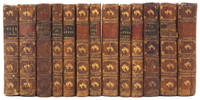
17445955Londini London: Typis J. Brindley 1744. 13 vols 12mo. Title-pages engraved ruled in red throughout. Contemporary red morocco by Brindley’s workshop boards bordered with gilt rules and gilt corner-pieces spines divided by raised bands gilt black morocco labels other compartments tooled centrally in gilt with ‘Golden fleece’ tool marbled endpapers a different pattern in each volume. A little toning in places first gathering of Caesar vol. 2 loose. Bindings rubbed spines dulled some spine ends worn or defective a number of labels lost or chipped several joints cracked but none detached some creasing or cracking to a few spines. Armorial bookplate of Cosmo Gordon Duke of Gordon and more modern Gordon Castle library shelf-labels to pastedowns early shelfmark numbering in ink to head of title-pages. An unusual surviving example of a substantial portion of Brindley’s Latin classics in Brindley’s original trade bindings. This is the first thirteen volumes in the series which was intended to rival the Elzevirs for small format and fine typography and which ultimately reached 24 volumes. Many of them - and all the ones here - were edited by Usher Gahagan d.1749 an Irish scholar of some talent but either poor morals or poor choice of friends; he was arrested with a compatriot in 1748/9 for a plan to file coins and hanged a month later. The series may have gone on longer in his absence had Brindley himself not died in 1759; the last publication in it was a 1760 reissue of the Tacitus of 1754 with Brindley’s successor’s name added to the imprint. Brindley was bookseller and binder to Frederick Prince of Wales entitling him to use the ‘Feathers’ engraving on the title-pages of these volumes. As a binder Brindley also specialised in royal work and used a distinctive dolphin tool in a number of bindings but the ‘Golden fleece’ present on the spines here is another tool regularly used by Brindley especially for copies of his little Latin classics. These were available ready-bound in his shop on New Bond Street and special small shelves to hold them remained in the premises into the 20th century. The elegant variation in endpapers on a set otherwise exactly matchingly bound is an attractive touch. This set represents the complete series as of the end of 1745. A Quintus Curtius followed in 1746 but there was then a pause until after Gahagan’s death with the next volume being the Catullus of 1749. They were probably originally purchased by Cosmo George Gordon 3rd Duke of Gordon 1720-1752 who entered the House of Lords in 1748 and may therefore have been too occupied elsewhere to complete the ongoing series. The full list present is: Horace 1744 ESTC T46227; Virgil 1744 ESTC T139210; Cornelius Nepos 1744 ESTC T83013; Juvenal and Persius 1744 ESTC T123550; Terence 1744 ESTC T137486 - the rarer variant; Julius Caesar 1744 2 vols. ESTC T136731 this the variant state; Sallust 1744 ESTC T133040; Ovid 1745 5 vols. ESTC T99863. Typis J. Brindley hardcover
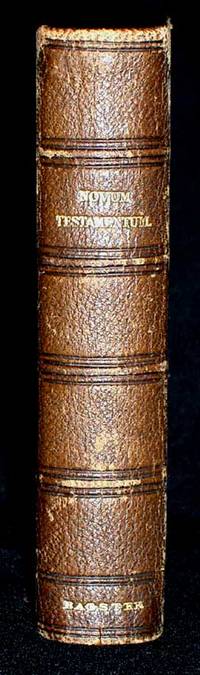
18528235London. Samuel Bagster. 1852. Bound in full blind ruled morocco. Blind ruled spine compartments with raised bands. Gilt titles. a.e.g. 32mo 2" x 3.5". A bit of rubbing to extremities. A Near Fine crisp sweet little copy. Samuel Bagster. hardcover
17526278Glasguae Glasgow: In aedibus Academicis excudebant Robertus et Andreas Foulis 1752. 8vo pp. iv 151 1. Contemporary polished sprinkled calf boards bordered with a double gilt rule enclosing a blind roll spine divided by raised bands between double gilt rules orange morocco label. Just a touch of light spotting. Extremities rubbed front joint cracking at head. The sole Foulis edition of this collection of shorter Latin poetry. This is the pot 8vo issue. Gaskell 237. In aedibus Academicis excudebant Robertus et Andreas Foulis hardcover
1607119421607 Lutetiæ, Ex Typographia Roberti Stephani, 1607; in-12 de (12) ff. (dont le titre, une étude en latin sur Scaliger et Casaubon, la table, l'extrait du privilège) - 70 ff. ch. Plein veau granité brun, fine roulettte à froid encadrant les plats, dos à nerfs orné de filets pointillés et petits fers dorés, coupes guillochées, tranches rouges ( reliure postérieure). Petit arrachage de cuir à l'angle supérieur du1er plat, sinon très bon exemplaire.
in-12, broche, couverture illustree, 189 pp. Iconographie en noir in-texte. Chronologie, bibliographie, index. Bel exemplaire [FL-11*]
1st edition. Original green printed paper wrappers, 8vo, 208 pages. In Yiddish. mit a hakdome fun H. D. Nomberg. Many black and white photos throughout. Includes contents page. Alpersohn was an " Argentine farmer and Jewish writer. Alpersohn was born in Kamenets-Podolski, Russia. His father, Israel, was a shohet and melamed. In his youth Alpersohn was a maskil, writing Hebrew articles in the Jewish press. In 1891 he emigrated to Argentina and settled in Colonia Mauricio, the first agricultural colony founded by the Jewish Colonization Association (ICA) . From the very outset he wrote pamphlets in Yiddish under a pseudonym criticizing the ICA administration. After 43 years in Mauricio, he began to spend winters in Buenos Aires but remained on his farm during the summer. Alpersohn was a prolific writer. In his three volumes of memoirs (The ICA and Its 30 Years of Colonization in Argentina) , novels, plays, stories, and newspaper articles, he described with much color the life of the Jewish farmers in the ICA colonies. He is considered one of the outstanding Yiddish writers of Argentina" (Zadoff, EJ, 2007) . SUBJECT(S) : Jews -- Argentina -- Colonia Mauricio. Farmers. Jewish Colonization Association. Ex-library with usual marks, otherwise Very Good condition with beautiful paper and binding. (YID-11-1A)