Antiquariat.de

52 résultats
1870130469London : Samuel Bagster & Sons [1870]. 598, 48, 48 Seiten. 21,5*13,5 cm. OLederband mit Goldschnitt.
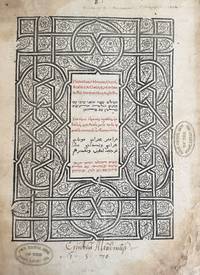
1516371021Genoa: Petrus Paulus Porrus 1516. Title printed in red and black within woodcut arabesque border printer's device on final leaf. Parallel text in Hebrew Latin Greek Arabic and Chaldaean Aramaic 4 columns to a page 41 lines. 13 woodcut floriated initials. A10 B-Z8 &8 con6; 200 leaves complete. Folio 13-1/8 x 9-3/8 inches. Contemporary blind tooled pigskin over bevelled wooden boards boards with repeated roll of hound hunter and stag spine with floral tools. Clasps perished early repairs with vellum at lower corners; spine darkened with chip at foot joint starting wormholes to the covers. Toning throughout worm holes throughout but heavier to the preliminary and terminal leaves paper loss not affecting text at the lower outer corners of the first 3 leaves minor dampstaining at the lower corners of most leaves and extending from the top inner margin. Scattered early marginalia. Title printed in red and black within woodcut arabesque border printer's device on final leaf. Parallel text in Hebrew Latin Greek Arabic and Chaldaean Aramaic 4 columns to a page 41 lines. 13 woodcut floriated initials. A10 B-Z8 &8 con6; 200 leaves complete. Folio 13-1/8 x 9-3/8 inches. The Genoa Psalter also known as the Octaplum or Quadruplex Psalter was the first polyglot psalter to be published and the first polyglot edition of any part of the Bible. Financed by the Oriental language scholar Bishop Agostino Giustiniani and printed in Genoa in 1516 it presents the psalms laid out in eight columns i.e. four per page on double-page spreads: in Hebrew a Latin paraphrase the Vulgate Latin the Septuagint Greek Arabic Chaldean Aramaic a Latin paraphrase and the editor's notes. "A monument of Renaissance typography this Psalter was linguistically the most ambitious work attempted to date and the first Polyglot work ever published. It provides the Psalms in five languages as well as a marginal scholarship based largely on rabbinic sources. The Arabic text is one of the first two texts and the first biblical text ever printed in this language. The Hebrew types used in this book were apparently never used again" B. Sabin Hill Hebraica from the Valmadonna Trust The Piermont Morgan Library 1989 no. 18.<br /> <br /> Notably within a lengthy editor's note to Psalm XIX is what is considered the first printed biography of Christopher Columbus along with a very early description of his voyage. A native son of Genoa Giustiniani presents the discovery of the new world as a fulfilment of Biblical prophecy appropriately glossing verse four of Psalm XIX to include his biography of Columbus: "Their sound is gone out through all the earth and their words to the end of the world." <br /> <br /> The text of the biography of Columbus written a decade after his death includes a brief account of his childhood and continues at length on his discovery of America. Translated from the Latin it begins: "And so their words have reached unto the ends of the earth at least in our own times in which by the marvelous daring of Christopher Columbus of Genoa almost another world was discovered and joined to the community of Christians. And since Columbus often declared that he was chosen by God so that through him this prophecy would be fulfilled I did not consider it unsuitable to include his life here. Therefore Christopher surnamed Columbus a Genoese by birth . lived in our age and through his own efforts explored more lands and seas in a few months than almost all other mortals had done throughout all previous ages . More swiftly than the Portuguese had done he approached new lands and new peoples and at last penetrated regions unknown before now. The news of this matter quickly reached the King who - both out of rivalry with the Portuguese kings and a desire for such new marvels and glory that might accrue to him and his descendants - after long discussions with Columbus finally ordered two ships to be outfitted. With these Columbus set sail from the Fortunate Islands directing his course slightly off the western line . After many days of sailing they had covered great distances. While the others having lost all hope urged a change in course Columbus persisted asserting by reason and conjecture that continuing but a little longer might lead them to discover continents or islands. Nor was he wrong. On the following dawn they sighted land. From this event immense confidence arose in human minds. Later it was learned that these were islands and observations were made of certain peoples there uncultivated and prone to raids on their neighbors even devouring human flesh like wolves. There were violent encounters yet eventually some of these islanders were brought safely to Spain astonishing and delighting all who saw them because they were at first timid unfamiliar with approach easy to persuade and marveling at everything as new."<br /> <br /> An important and desirable work from a liturgical linguistic and historical perspective. Adams B1370; BM STC Italian p. 97; Darlow & Moule 1411; Sabin 66468; European Americana 516/4; Harrisse BAV 88; JCB 3 I:64; Smitskamp 236; Roper Early Arabic Printing in Europe in Sprachen des Nahen Ostens und die Druckrevolution p. 132; Vinograd Genoa 1. Provenance: Cenobii Alois 1570 inscription below title; Bibliotheca Regia Monacensi pencil inscription on the inside front board identifying it as a duplicate; General Theological Seminary ink and blindstamps and other markings Petrus Paulus Porrus unknown
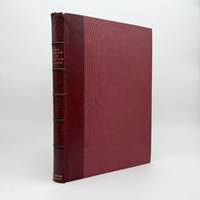
1518371799Cologne: Johann Soter 1518. Title within woodcut borders. Text in double columns in Latin Amharic not Chaldaean Greek and Hebrew types across double page spreads. Collation: a-y6 ç6 &6 ¶4 -&6 blank. 147 ff. 1 vols. 4to. Twentieth century red morocco and cloth. Some traces of rubbing to joints. GTS bookplate stamps on first and last leaves. Very good plus. Title within woodcut borders. Text in double columns in Latin Amharic not Chaldaean Greek and Hebrew types across double page spreads. Collation: a-y6 ç6 &6 ¶4 -&6 blank. 147 ff. 1 vols. 4to. The third polyglot Psalter edited by Johannes Potken who had edited an Ethiopic Psalter in 1513. The work is preceded only by the Genoa Psalter 1516 and the Complutensian Bible printed 1514-1517 but not published until 1522. The Introductiunculae in tres linguas externas: Hebraeam Graecam Chaldaeam sic introduction to three languages Greek Hebrew and Chaldaean i.e. Ethiopic is bound after the main text.<br /> <br /> Preserving an early binder's blank marked Duplum Bibliothecae Regiae Monacensis with ink inscription beneath The General Seminary of the Protestant Episcopal Church in the U States new York 10 December 1826 gift of John Pintard. This marks it as one of the earliest books donated to the newly established library.<br /> <br /> Pintard 1759-1844 was a prominent New Yorker of Huguenot origin patron of education and one of the earliest and staunchest advocates for the preservation and study of the history of New York and the United States. Pintard began to work towards the establishment of a historical society in the city in early 1804 and he was the leader in the organization of the New-York Historical Society in November 1804. He was also a patron of the old French Huguenot Church of St. Esprit and the General Theological Seminary.<br /> <br /> Important and early work. Darlow & Moule 1413; VD16 B 3101; Adams B-1371; Vinograd Cologne 1; D.S. Berkowitz In Remembrance of Creation 1968 no. 175; Fumagalli G. Bibliografia etiopica 1243 [Johann Soter] unknown
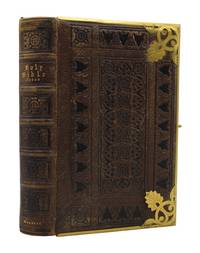
AQ32799London: Samuel Bagster and Sons s.d. c. 1860 Finely bound in publisher's luxurious blind-decorated gilt- titled brown morocco gilt-metal corner bosses to beveled boards gauffered edges marbled endpapers gilt dentelles morocco label to FEP lettered in gilt 'FROM INTERNATIONAL EXHIBITION - 1862'. Lightly rubbed gilt-metal clasp broken away and absent. An exhibition quality Victorian Neo-Gothic binding executed by Bagster and Sons for display at the Great London Exposition of 1862. The International Exhibition of 1862: The Illustrated Catalogue of the Industrial Department p.87 issued to accompany the event states: 'The publishers of London show together in a collective case where may be seen some of the most luxurious volumes produced by the leading houses. The reprint of the first edition of Shakespeare; the Bibles of Bagster and Spottiswoode are also in this collection.' Founded by Samuel Bagster the elder 1772-1851 who was succeeded in the by his sons Samuel Bagster the Younger 1800-1835 and Jonathan Bagster 1813-1872 Bagster and Sons was renowned in the early nineteenth-century for bringing a wealth of rare scholarly Bibles and Liturgical texts to the mass market most notably Polyglot Bibles and reprints of early protestant translations by Tyndall Wycliff and Cranmer. Their efforts in producing affordable yet finely printed versions of Biblical texts allowed the Bagsters to pioneer the avoidance of the monopoly printing of the Authorized version. . 8vo. Samuel Bagster and Sons, [s.d., c. 1860] paperback
ORD-14050Nombreux renvois aux passages les plus remarquables, arrangés d'une manière toute nouvelle; pour servir à établir et expliquer les rapports qui existent entre eux. Londres. Samuel Bagster. Sans date (ex-donno d'une grand-mère à sa petite fille, daté de 1884). Petit in-12 (94 x 143mm) plein chagrin noir à grains fins, reliure signée par l'éditeur, dos à 5 nerfs, orné de caissons décorés à froid, plats également ornés à froid d'un motif central d'inspiration végétale, gardes couleur chocolat, tranches dorées, signet. VI, (2), 586, (2), 168 pages. Deux pages de titre, l'une pour l'Ancien testament, l'autre pour le nouveau, contenant chacune une carte géographique. Impression en caractères minuscules sur 2 colonnes. Très bel exemplaire.
18377301837 Venetiis, in insula S. Lazari, 1837. 23,5 x 15,5 cm (R), grand in-8, 4 ff. n. ch. + 431 pp., portrait de Nersès IV en frontispice, reliure romantique de l'époque en demi-maroquin à grains longs rouge à coins, dos lisse orné, tranches dorées. // Large 8vo, contemporary romantic red half straight grained red morocco, smooth spine gilt, gilt edges.
10242MANOMÈTRE. N° 2. (Octobre 1922). Jean Arp, Jorge Luis Borges, Emile Didier, René Faure, Emile Malespine, Adrien Rambaud, Philippe Soupault, Guillermo de Torre, Tristan Tzara, etc. Très bon état.
10244MANOMÈTRE. N° 5. (Février 1924). Julio J. Casal, Emile Didier, Emile Malespine, Roberto A. Ortelli, Josezf Peeters, Benjamin Péret, Michel Seuphor, Kurt Schwitters, Tristan Tzara, etc. Très bon état.
10245MANOMÈTRE. N° 6. (Août 1924). Tilly Brugman, Julio J. Casal, Serge Charchoune, César Geoffray, Vicente Huidobro, Pierre Laurent, Emile Malespine, Moholy Nagy, Piet Mondrian, Gonzalez del Valle, etc. Très bon état.
xv + 644 + 468 pp., with 1711 illustrations, 21cm., publisher's hardcover in black cloth with gilt lettering, text and interior are clean and bright, good condition, weight: 1.5kg., [N.B. Though it is mentioned nowhere in this volume, it could well be that this copy is a more recent facsimile reprint of the original 1936-edition], W111605
1936W111605Cairo, Argus & Papazian Presses [1936?] xv + 644 + 468 pp., with 1711 illustrations, 21cm., publisher's hardcover in black cloth with gilt lettering, text and interior are clean and bright, good condition, weight: 1.5kg., [N.B. Though it is mentioned nowhere in this volume, it could well be that this copy is a more recent facsimile reprint of the original 1936-edition], W111605
8vo., on India paper, with 9 coloured engraved maps on 6 and a double-page chronological chart; attractively bound in publisher's black roan portfolio with drop sides all round, covers framed and blocked in blind and blocked and lettered in gilt, back with five raised bands ruled in blind, second compartment lettered in gilt 'Bagster's Teacher's Bible', gilt edges, black endpapers, portfolio mildly scuffed and rubbed at extremities else a remarkably well-preserved, bright, clean copy. Bagster's Teacher's Bible is a facsimile reprint, with larger types, of the English Version of Bagster's Polyglot Bible first published in 1817 and which made Bagster's name. It corresponds page for page, and line for line, with the two well-known Pocket Editions. The text is that of the Authorized Version, printed in double column with the references in a third central column in Bagster style. In addition to the Old and New Testaments, this edition contains Cruden's Concordance, Chronology, Tables of Weights & Measures, Tabular Harmony, Comparative View of Quotations, and a set of maps engraved and coloured expressly for this edition. A particular feature is the set of Four Thousand Short Scripture Question with Answers, designed expressly for the use of teachers. The Teacher's Bible is an edition uncommon at best, and scarce indeed in this condition with wholly unrestored portfolio in unusually sound state. See Darlow & Moule 1081.
1831ALEX210Stereotyped by L. Johnson for Key & Meilke Philadelphia: . 1831 Old and New Testaments bound in one: pp. viii 3-587; 190 Engraved frontis and title. Irregular pagination. Text beginning to brown but not brittle. Double column. Early manuscript ownership of Julia A. Lumbard on first fly leaf. Front fly leaves loose. 16mo. 145 mm. Original leather binding. Original leather spine label lettered in Gothic type. Spine worn with small loss at rear joint. Title continues: 'With The Marginal Readings: Together With A Copious And Original Selection Of References To Parallel And Illustrative Passages. Exhibited In A Manner Hitherto Unattemped'. Hardbound. Good. FIRST AMERICAN EDITION. This is the English text from Samuel Baxter's eight language Polyglot printed in London in 1822. The little book became an immediate success and later editions are not uncommon but this first edition is quite SCARCE. Hills 753; D/M 1785. PAIMP 21. 1st Edition. Hardcover. Stereotyped by L. Johnson for Key & Meilke, Philadelphia: . hardcover
3 works in 1 vol., 8vo., neat and lengthy contemporary ownership insctiptions on blank preliminary; handsomely bound in full burgundy roan, boards elaborately framed in gilt and blind enclosing large arabesque in blind, back with flat bands, second compartment framed and lettered in gilt, all other compartments richly framed and tooled in gilt, gilt doublures, gilt dentelles, all edges gilt, blue endpapers, a remarkably well-preserved, crisp, clean copy. With the early nineteenth century trade ticket of Rees of Bristol on front paste-down. The works comprise (in order) Book of Common Prayer (Bagster, 1829); New Version of the Psalms of David (Clarendon Press, 1829); English Version of the Polyglot Bible (Bagster, 1828). A SPLENDID EARLY NINETEENTH CENTURY THEOLOGICAL COMPANION WITH CONTEMPORARY BRISTOL ASSOCIATION.
Complete in 2 volumes, iv,959 + 855 pp., large woodcut mark on title with Borde's device ('Semina fortunae geminat cum tempore virtus'), "Editio novissima", folio (39x25cm.), text printed in two columns, text in Latin, title in red and black, in two uniform cart. hardcover bindings (ca. 19th century, spines in leather, some use at ends, corners bumped and some slightly damaged), foxing throughout though text is always well readable, vague stain in margin of first pages of vol.1, small stamp on first blanco endpaper and on title page, nervertheless a good copy, [Monumental Latin dictionary with equivalents in 7 languages. The first edition was published in 1502, and since then it has been expanded and revised continuously. This edition is based on the revised edition by the French humanist Jean Passerat (1534-1602)], weight: 6.6kg., T107174
1663T107174Lugduni [Lyon], Sumptib. Philippi Borde & Laurentii Arnaud 1663 Complete in 2 volumes, iv,959 + 855 pp., large woodcut mark on title with Borde's device ('Semina fortunae geminat cum tempore virtus'), "Editio novissima", folio (39x25cm.), text printed in two columns, text in Latin, title in red and black, in two uniform cart. hardcover bindings (ca. 19th century, spines in leather, some use at ends, corners bumped and some slightly damaged), foxing throughout though text is always well readable, vague stain in margin of first pages of vol.1, small stamp on first blanco endpaper and on title page, nervertheless a good copy, [Monumental Latin dictionary with equivalents in 7 languages. The first edition was published in 1502, and since then it has been expanded and revised continuously. This edition is based on the revised edition by the French humanist Jean Passerat (1534-1602)], weight: 6.6kg., T107174
An outstanding collection, with many rare French and Spanish books, as well as a host of rare editions of the bible, including all the important polyglots. VIII, 315 pp. 3055 lots. Large 8vo. Original printed wraps. Light wear to covers. Former owner's stamp (?) neatly obliterated by a round spot. Otherwise uncut, fine and bright.
3384334639.Ghardcover. Good. Access codes and supplements are not guaranteed with used items. May be an ex-library book. hardcover
3384340361.Ghardcover. Good. Access codes and supplements are not guaranteed with used items. May be an ex-library book. hardcover
3384366867.Ghardcover. Good. Access codes and supplements are not guaranteed with used items. May be an ex-library book. hardcover
338429906X.Ghardcover. Good. Access codes and supplements are not guaranteed with used items. May be an ex-library book. hardcover
3384366808.Ghardcover. Good. Access codes and supplements are not guaranteed with used items. May be an ex-library book. hardcover
3384331508.Ghardcover. Good. Access codes and supplements are not guaranteed with used items. May be an ex-library book. hardcover
3384319133.Ghardcover. Good. Access codes and supplements are not guaranteed with used items. May be an ex-library book. hardcover
1879100148487Williams & Norgate 1879 in4. 1879. Broché. Le Psalterium Tetraglottum est une édition académique du Livre des Psaumes publiée en 1879 pour commémorer le 400e anniversaire de la première édition imprimée du psautier hébreu (1477-1877). Éditée par Eberhard Nestle avec l'aide de S.G.F. Perry elle présente le texte en quatre langues (grec syriaque chaldéen et latin) à partir des meilleurs manuscrits et éditions accompagnée d'un commentaire savant