Antiquariat.de

5 résultats
149715821Augsburg, Johann Schönsperger, 1497. Ca. 8,5 cm x 33,5 cm (Bildfläche); ca. 27 cm x 36 cm (doppelte Buchseite). [2 Warenabbildungen]
149715822Augsburg, Johann Schönsperger, 1497. Ca. 8,5 cm x 33,5 cm (Bildfläche); ca. 27 cm x 36 cm (doppelte Buchseite). [2 Warenabbildungen]
145034789Probably Milan Circa 1450. Written in Latin 19 lines in a fine hand the calligraphy in black and red augmented with a multi-line "B" in blue and decorative accents in red. Single sheet 20 x 13.8 cm double-sided on vellum and tipped into a cream and black mounting. 2 pp. A fine specimen visually very attractive. A FINE VELLUM MANUSCRIPT LEAF. The breviary of Rites in the Catholic Church is a liturgical book it contains public or canonical prayers hymns the Psalms readings and notations for everyday use especially by bishops priests and deacons in the Divine Office.<br> The canonical hours of the Breviary owe their remote origin to the Old Covenant when God commanded the Aaronic priests to offer morning and evening sacrifices. Other inspiration may have come from David's words in the Psalms "Seven times a day I praise you" Ps. 119:164 as well as "the just man meditates on the law day and night" Ps. 1:2. <br> In the early days of Christian worship the Sacred Scriptures furnished all that was thought necessary containing as it did the books from which the lessons were read and the psalms that were recited. hardcover
145034790Probably Milan Circa 1450. Written in Latin citing one of the Psalms. 19 lines in a fine hand the calligraphy in black and red and gold augmented with a multi-line "B" in blue and decorative accents in red and gold. Single sheet 19.8 x 13.5 cm double-sided on vellum and tipped into a cream and black mounting. 2 pp. A fine specimen visually very attractive. A FINE VELLUM MANUSCRIPT LEAF. The breviary of Rites in the Catholic Church is a liturgical book it contains public or canonical prayers hymns the Psalms readings and notations for everyday use especially by bishops priests and deacons in the Divine Office.<br> The canonical hours of the Breviary owe their remote origin to the Old Covenant when God commanded the Aaronic priests to offer morning and evening sacrifices. Other inspiration may have come from David's words in the Psalms "Seven times a day I praise you" Ps. 119:164 as well as "the just man meditates on the law day and night" Ps. 1:2. <br> In the early days of Christian worship the Sacred Scriptures furnished all that was thought necessary containing as it did the books from which the lessons were read and the psalms that were recited. hardcover
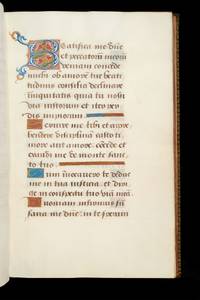
150012054Tours 1500. 19th-century blind-ruled crushed green morocco Niédrée; hinges slightly cracked at top and bottom gilt-lettered spine title all edges gilt green silk marker. <p> THIS ELEGANT TRILINGUAL PRIVATE DEVOTIONAL WAS PREPARED FOR A HIGH-RANKING FRENCH MILITARY OFFICIAL likely a participant in the Italian Wars of 1494-1512. An identical suite of prayers appears in a manuscript Morgan M.292 made for maréchal de France Pierre de Rohan-Gié 1450-1513 who campaigned in Italy with Charles VIII and Louis XII.<br /> Our anthology is centered on the faithful's plea for military success and protection against the dangers of war. The opening prayers in French are rich in chivalric imagery. Next is an uncommon extended version of the Latin Abbreviated Psalter a series of extracts from the Psalms compiled for soldiers and others unable to recite the full daily Office. The texts that follow include a Latin prayer for victory in battle the placeholder n stands in for the name of the supplicant and unusually the long pseudo-Augustinian Prayer for the Troubled in its Italian version.<br /> This last concludes the work of the first scribe who in line with the contemporary trends of luxury manuscript production at Tours adopted a peculiar rounded bâtarde. His hand's nod to the shapes of humanistic Antiqua doesn't mitigate the striking mismatch of language and script in the italian prayer.<br /> In Latin the Gospel readings on the Passion occupy the second half of the manuscript executed in a more traditional hand by a second scribe. attractive uniform decoration unifies our intriguing manuscript. In very good condition.<br /> ¶Salmon "Psautiers abrégés du moyen âge" in Analecta liturgica 1974 80; Cottier "Psautiers abrégés et prières privées durant le haut Moyen Âge" in Recherches Augustiniennes 33 2003 215-30; Avril & Reynaud Les Manuscrits à peintures en France 165 173 & 177.<br /> <br /> </p> <br /> <p>Prayer Book in French Latin and Italian. <br /> TEXTS & ILLUSTRATIONS </p> <br /> <p>I. French prayers to the Virgin: pp. 1-8<br /> p. 1 Inc. O glorieuse pure vierge pucelle Sinclair 6243; four-line illuminated initial in blue and white on red and gold ground infilled with flowers.<br /> p. 6 Inc. Je te salve tres chaste espouse Sonet 897; two-line boxed initial in gold ink on blue ground.<br /> p. 8 blank.</p> <br /> <p>II. Confession formula and Psalterium Abbreviatum: pp. 9-58<br /> p. 9 Inc. Confitebor tibi domine deus omnipotens; four-line illuminated initial in grey and and white on gold ground infilled with flowers.<br /> p. 14 blank.<br /> p. 15 Inc. Beatifica me domine et peccatorum meorum; three-line illuminated initial in blue and white on red and gold ground infilled with flowers.<br /> p. 25 Inc. Miserere mei deus secundum magnam misericordiam; two-line boxed initial in gold ink on red ground.<br /> pp. 35-36 blank.<br /> p. 37 Inc. Domine exhaudi orationem meam; two-line boxed initial in gold ink on red ground.<br /> p. 48 blank.<br /> p. 49 Inc. Domine quid multiplicati sunt; two-line boxed initial in gold ink on red ground.<br /> p. 58 blank.</p> <br /> <p>III. Latin Prayers to Jesus and the Trinity: pp. 59-70<br /> p. 59 Inc. Deus omnipotens pater filius et spiritus sanctus; two-line boxed initial in gold ink on red ground.<br /> p. 62 Inc. Iesu Nazarene respice ad meas miserias; two-line boxed initial in gold ink on red ground.<br /> p. 64 blank<br /> p. 65 Inc. Domine iesu christe qui septem verba; four-line illuminated initial in grey and white on gold ground infilled with flowers.<br /> p. 70 blank.</p> <br /> <p>IV. Pseudo-Augustine's Orazione per i Tribolati in Italian: pp. 71-84<br /> p. 71 Inc. O dulcissime signore iesu cristo vero dio; four-line illuminated initial in blue and white on red and gold ground infilled with flowers. </p> <br /> <p>V. Psalm 117: pp. 85-90<br /> p. 85 Confitemini domine quoniam bonus; three-line illuminated initial in blue and white on red and gold ground infilled with flowers and strawberries.<br /> p. 90 blank.</p> <br /> <p>VI. Gospel readings on the Passion: pp. 91-172<br /> p. 91 rubric: Dominica in ramis palmarum. Text of Matthew 26-27 begins; four-line initial in blue and white on red and gold ground infilled with flowers.<br /> p. 116 rubric: Feria tercia post ramos palmarum. Text of Mark 14-15 begins; two-line boxed initial in gold ink on red ground.<br /> p. 136 rubric: Feria quarta post ramos palmarum. Text of Luke 22-23 begins; two-line boxed initial in gold ink on red ground.<br /> p. 156 rubric: Die veneris sancta. Text of John 18-19 begins; three-line illuminated initial in blue and white on red and gold ground infilled with flowers.<br /> p. 172 blank.</p> unknown