580 résultats
161567051615. 14; 13 folding leaves. Two parts in one vol. Large 8vo cont. or later dark wrappers dyed with persimmon juice shibubiki new stitching. Japan probably Kyoto: printed with moveable types ca. 1615-40.<br/> <br/> A very rare edition printed with moveable types apparently unrecorded in the standard bibliographies of the story — or legend — of the creation of the first statue of Siddhartha Gautama or Gautama Buddha the founder of Buddhism. The statue executed while Buddha was still alive was commissioned by King Udayana of Kaushambi a contemporary of Buddha. It was the very first image of Buddha and is especially important as it was carved from life. Copies of this statue made their way to China with the spread of Buddhism and later as we shall see to Japan.<br/> <br/> The text provides a history of the creation of the first statue of Buddha which is perhaps the most famous of all Buddha images. King Udayana commissioned the statue “so that he could gaze upon the sacred form of the Buddha while the latter was off preaching to his mother in the heaven of Indra. Buddha’s disciple Maudgalyayana transported thirty-two craftsmen up to the heavenly realm so that they could observe the special marks of the Buddha firsthand thereby insuring the representational accuracy of the image they created. When the Buddha eventually returned to the earth King Udayana’s statue rose into the air to greet him of its own accord and the Buddha proclaimed that it would one day help to transmit his teachings.â€â€“Brown ed. The Oxford Handbook of Religion and the Arts p. 371. We learn that the statue was carved out of sandalwood and that later copies were made of gold silver bronze lead tin or iron as well as of wood.<br/> <br/> This text was translated by the Khotanese monk Tiyunbanruo d. 691 or 692 whose original Sanskrit name was Devendraprajna. Khotan was an ancient Iranian Saka Buddhist kingdom on the branch of the Silk Road that ran along the southern edge of the Taklamakan Desert near modern-day Xinjiang. Tiyunbanruo came to Luoyang the “Eastern Capital†of the Tang dynasty of China in about 688 with a considerable reputation as a Buddhist missionary and set up a bureau to translate Buddhist texts into Chinese. An earlier edition of this text was published in Beijing in 1593 and only one copy is known at the BnF.<br/> <br/> This book was probably printed and issued as a way to reinforce the legitimacy of the famous Buddha statue of the temple of Seiryoji in the Saga fields of Kyoto. It is one of the chief objects of religious veneration in Kyoto. A copy of the original statue also commissioned by King Udayana was brought from the castle at Kaushambi in north-central India to China by Hsuan-tsang in 645. The statue moved many times and ultimately arrived at Kaifeng the Sung capital. The Japanese monk Chonen 938-1016 who spent the years 983-86 in China studying and collecting texts had worshiped the statue in Kaifeng and commissioned men in 984 to carve a copy to bring back to Japan. The copy was ultimately installed at Seiryoji and according to Japanese tradition the Chinese “original†and Chonen’s copy had miraculously changed places — the Seiryoji Buddha was actually the authentic example commissioned by Udayana.<br/> <br/> The Seiryoji Buddha is “probably the most important best-documented and best-preserved sculpture now existing which represents the school and tradition of Buddhist sculpture connected with the sacred Udayana image of the living Buddha of which Hsuan-tsang brought a copy to the court at Ch’ang-an.â€â€“Henderson & Hurvitz “The Buddha of Seiryoji: New Finds and New Theory†Artibus Asiae Vol. 19 No. 1 1956 p. 43–and see the whole fascinating article.<br/> <br/> As mentioned above this rare work is printed with moveable types. It was at one time owned by the great Japanese dealer Shigeo Sorimachi. The chitsu has the characteristic handwriting on the label of Sorimachi’s assistant Mr. Mori who has written: “Zozo kudoku kyo. Genna kan’ei chu kan. Kokatsu ban†“Creation of the Statue a Pious Act. From Genna to mid-Kan’ei edition ca. 1615-40. Moveable typeâ€. It is not cited by Kazuma Kawase Kokatsuji-ban no kenkyu Study of the Early Typographic Editions of Japan 1967 the definitive bibliography of Japanese moveable type books. There is no copy in WorldCat nor the Union Catalogue of Early Japanese Books.<br/> <br/> In very good condition. The first ten folding leaves which are a little stained have some repaired worming and strengthening. The following leaves have some worming some carefully repaired and others as the worming lessens not repaired. Several characters affected by the worming. As mentioned above the wrappers have been dyed with persimmon juice which serves a dual purpose: to strengthen the paper and act as an insect repellent.<br/> <br/> ⧠Wang Zhenping “Chonen’s Pilgrimage to China 983-986†Asia Major Third Series Vol. 7 No. 2 1994 pp. 63-97. Martha L. Carter The Mystery of the Udayana Buddha Naples: 1990. unknown
670514; 13 folding leaves. Two parts in one vol. Large 8vo cont. or later dark wrappers dyed with persimmon juice shibubiki new stitching. Japan probably Kyoto: printed with moveable types ca. 1615-40. A very rare edition printed with moveable types apparently unrecorded in the standard bibliographies of the story - or legend - of the creation of the first statue of Siddhartha Gautama or Gautama Buddha the founder of Buddhism. The statue executed while Buddha was still alive was commissioned by King Udayana of Kaushambi a contemporary of Buddha. It was the very first image of Buddha and is especially important as it was carved from life. Copies of this statue made their way to China with the spread of Buddhism and later as we shall see to Japan. The text provides a history of the creation of the first statue of Buddha which is perhaps the most famous of all Buddha images. King Udayana commissioned the statue "so that he could gaze upon the sacred form of the Buddha while the latter was off preaching to his mother in the heaven of Indra. Buddha's disciple Maudgalyayana transported thirty-two craftsmen up to the heavenly realm so that they could observe the special marks of the Buddha firsthand thereby insuring the representational accuracy of the image they created. When the Buddha eventually returned to the earth King Udayana's statue rose into the air to greet him of its own accord and the Buddha proclaimed that it would one day help to transmit his teachings."-Brown ed. The Oxford Handbook of Religion and the Arts p. 371. We learn that the statue was carved out of sandalwood and that later copies were made of gold silver bronze lead tin or iron as well as of wood. This text was translated by the Khotanese monk Tiyunbanruo d. 691 or 692 whose original Sanskrit name was Devendraprajna. Khotan was an ancient Iranian Saka Buddhist kingdom on the branch of the Silk Road that ran along the southern edge of the Taklamakan Desert near modern-day Xinjiang. Tiyunbanruo came to Luoyang the "Eastern Capital" of the Tang dynasty of China in about 688 with a considerable reputation as a Buddhist missionary and set up a bureau to translate Buddhist texts into Chinese. An earlier edition of this text was published in Beijing in 1593 and only one copy is known at the BnF. This book was probably printed and issued as a way to reinforce the legitimacy of the famous Buddha statue of the temple of Seiryoji in the Saga fields of Kyoto. It is one of the chief objects of religious veneration in Kyoto. A copy of the original statue also commissioned by King Udayana was brought from the castle at Kaushambi in north-central India to China by Hsuan-tsang in 645. The statue moved many times and ultimately arrived at Kaifeng the Sung capital. The Japanese monk Chonen 938-1016 who spent the years 983-86 in China studying and collecting texts had worshiped the statue in Kaifeng and commissioned men in 984 to carve a copy to bring back to Japan. The copy was ultimately installed at Seiryoji and according to Japanese tradition the Chinese "original" and Chonen's copy had miraculously changed places - the Seiryoji Buddha was actually the authentic example commissioned by Udayana. The Seiryoji Buddha is "probably the most important best-documented and best-preserved sculpture now existing which represents the school and tradition of Buddhist sculpture connected with the sacred Udayana image of the living Buddha of which Hsuan-tsang brought a copy to the court at Ch'ang-an."-Henderson & Hurvitz "The Buddha of Seiryoji: New Finds and New Theory" Artibus Asiae Vol. 19 No. 1 1956 p. 43-and see the whole fascinating article. As mentioned above this rare work is printed with moveable types. It was at one time owned by the great Japanese dealer Shigeo Sorimachi. The chitsu has the characteristic handwriting on the label of Sorimachi's assistant Mr. Mori who has written: "Zozo kudoku kyo. Genna kan'ei chu kan. Kokatsu ban" "Creation of the Statue a Pious Act. From Genna to mid-Kan'ei edition ca. 1615-40. Moveable type". It is not cited by Kazuma Kawase Kokatsuji-ban no kenkyu Study of the Early Typographic Editions of Japan 1967 the definitive bibliography of Japanese moveable type books. There is no copy in WorldCat nor the Union Catalogue of Early Japanese Books. In very good condition. The first ten folding leaves which are a little stained have some repaired worming and strengthening. The following leaves have some worming some carefully repaired and others as the worming lessens not repaired. Several characters affected by the worming. As mentioned above the wrappers have been dyed with persimmon juice which serves a dual purpose: to strengthen the paper and act as an insect repellent. ❧ Wang Zhenping "Chonen's Pilgrimage to China 983-986" Asia Major Third Series Vol. 7 No. 2 1994 pp. 63-97. Martha L. Carter The Mystery of the Udayana Buddha Naples: 1990. unknown books
In-4°, 4 voll. (XVI, pp. 585, (1); pp.526, (1); pp.492,(1); pp.544 (1)), legatura in mezza pelle, con nervi e titolo al dorso. Langlois, orientalista e traduttore francese venne conosciuto per le sue traduzioni dal sanscrito, particolarmente per la traduzione in francese del Rig-Veda. Le sue traduzioni furono apprezzate più per la loro qualità letteraria che per il rigore scientifico. In-4°, 4 voll. (XVI, pp. 585, (1); pp.526, (1); pp.492,(1); pp.544 (1)), half calf binding, bands and title at the spine. Langlois, a French orientalist and translator, was known for his translations from Sanskrit, particularly for the French translation of the Rig-Veda. His translations were appreciated more for their literary quality than for scientific accuracy.
5 voll. in 4, pp. 102; 113; 88; 192; 25. M. tl. coeva. Manoscritti originali redatti in bella grafia. Prime versioni autografe di queste traduzioni che rappresentano il primo tentivo in Italia di traduzioni dal sanscrito di queste opere teatrali, delle quali la Sacuntala di Calidasa e' la piu' nota. I vari volumi portano diverse date di redazione: il primo pone come data di revisione il 1869. Il secondo, indica una revisione nel 1867. Il terzo porta come data al f. 1 novembre 1863 e 12 gennaio 1864 in fine. Il quarto non indica nulla. Il quinto in fine porta l'indicazione: Malgrate 14 agosto 1866. Al f. del primo volume e' applicato un biglietto da visita di P. I. Maggi (indologo milanese dell'800) con su scritto: P. I. Maggi prega il Sig. Marazzi di non invidiare piu' a lungo alla repubblica delle lettere La Sacuntala. Quattro di questi manoscritti furono pubblicati (a spese dell'autore) nel 1871 e '74 con molte varianti nella resa in lingua italiana (accludiamo i due volumi portanti la dedica dell'a. al noto maestro Michele Saladino, palermitano ma insegnante di contrappunto al Conservatorio di Milano a partire dal 1870).
182150911Kolombo (Colombo), 1821. With orig. blank blue backwrapper (frontwrapper lacks). (2),16 pp. Titlepage brownspotted.
182150911Kolombo Colombo 1821. With orig. blank blue backwrapper frontwrapper lacks. 216 pp. Titlepage brownspotted. <br/><br/><em>First edition. In this importent work Rask "identified Sinhalese as a speech belonging to the same class as Sanskrit and added that Tamil belonged to quite a different class. Since then the subject has been studied and discusses by various scholars and it is established beyond doubt that Sinhalese is an Indo-Aryan language." </em> unknown
8 vols., 4to, orig. green cloth, lettered in gilt, a very nice set.
1993239105DICTIONARY UNIT CENTRAL INSTITUTE OF HIGHER TIBETAN STUDIES SARNATH, VARANASI ab, 1993.
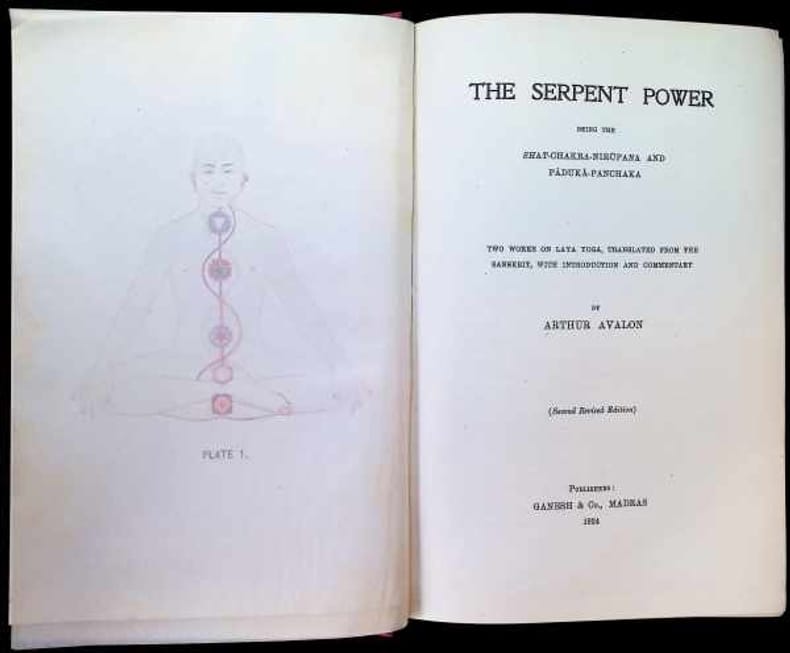
1924027485Madras 1924 Ganesh & Co Hardcover Poor
FIRST AND ONLY EDITION of this extremely early catalogue of Sanskrit manuscripts on palm leaves and on paper. 80 pp. Lengthy scholarly introduction. Dozens of manuscripts described. Wesdin (1748-1806), a Carmelite, was sent to Malabar as a missionary in 1774. After returning to Europe in 1789, he wrote many important works introducing India to the West. Printed on fine laid paper. Sanscrit types appear sporadically throughout. 4to. Attractively bound in recent marbled boards. ENTIRELY UNCUT. FINE AND BRIGHT. An important and very rare book.
198419611984 Thèse ronéotée, Paris, 1984. Format in-4. (xxxvi), 463 feuillets. Grande carte dépliante avec interventions manuscrites en couleurs (carte des migrations depuis l'Inde), documents rajoutés (Français, Espagnol, Anglais, Allemand, Conseil de l'Europe). Rédigé de 1959 à 1984
1778952307Paris: Imprimerie de Stoupe. 1778. Quarto. 248 x 191 mm. (Einband etwas verzogen, etwas bestoßen und berieben, innen frisch, gutes Exemplar) [9 Warenabbildungen] [1] (Vortitel), [1 weiße], [1] (Titel), [1 weiße], lx, 341, [2], [1 weiße] Seiten,. Ganzleder der Zeit mit Rückenvergoldung und rotgefärbtem Schnitt,
In-8 gr. (mm. 264x170), 5 volumi, cartonato editoriale (2 dorsi restaurati per piccole manc.; bruniti e con lievi tracce d’uso), pp. (10),XVI,(2),469,(3); (6),LXXV,364,(2); (2),XV,364,(2); (4),XXIV,382,(2); (4),XXXV,371. Voll. VI-X della serie dell’opera pubblicata in 10 voll. (i primi 5 contengono il poema in sanscrito). "Prima edizione della traduzione italiana". “Ramayana è il secondo poema epico dell’India. Si presenta come un poema di circa 24.000 strofe, diviso in sette parti, di cui la prima e l’ultima sono state aggiunte più tardi. Altre aggiunte ha scoperto la critica europea, ma l’unità del poema emerge dalll’uniformità dello stile epico, dal metro costante, dalla lingua, così da avvalorare la tradizione indigena che fa autore del Ramayana un solo poeta, Valmiki.. Oggi, dopo più di due millenni, il Ramayana è celebrato da tutto il popolo indiano; è pubblicamente letto in occasione delle più solenni feste religiose, episodi e scene ne sono rappresentati.. Come dice il titolo del poema, “le gesta di Rama” ne sono l’argomento.. L’Italia ha dato la prima e, per un pezzo, l’unica traduzione completa del "Ramayana", e, inoltre, l’”editio princeps”, opera insigne dell’abate Gaspare Gorresio (Parigi, voll. I-X, 1843-1858)”. Così Diz. Opere Bompiani,VI, pp. 98-99. “Gaspare Gorresio (1808-1891), indianista, glottologo e politico italiano. Visse per molti anni a Parigi studiando il sanscrito con E. Burnouf. E tra il 1843 e il 1870 pubblicò la prima edizione completa (in 12 voll.) del Ramayana accompagnata dalla traduzione italiana”. Così Diz. Treccani,V, p. 515. Edizione non comune, rara e ricercata. Esemplare fiorito, con una macchia pesante alla pag. 280 del VII vol., ma complessivamente buon esemplare.
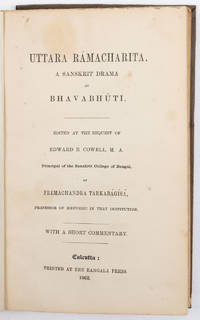
1862213321Calcutta.: Bangala Press. 1862. Title pages in English and Sanskrit iv 277 pages occasional spotting and toning; original saddle-stitched stiff plain yellow card wrappers dusty and spine chipped with an added stiff dark grey wrapper-- title and author attractively hand-lettered in black ink label of the London and Edinburgh booksllers Williams and Norgate fl. 1842-1928 previous owner's neat inscription to the front free endpaper in good condition.<P> Scarce printing of a Sanskrit drama based on the Ramayana by the 8th Century scholar and poet BhavabhÅ«ti telling the story of Rama's later life his coronation the abandonment of Sita and their reunion. Edited by Premachandra TarkabaÌgiÌsaÌ then Professor of Rhetoric at the Sanskrit College of Bengal under the direction of the Principal Edward Byles Cowell 1826 –1903 a noted translator of Persian poetry who was to become the first professor of Sanskrit at Cambridge University. Whilst he was at the Sanskrit College he famously discovered a manuscript of Omar Khayyám's quatrains in the Asiatic Society's library and sent a copy to London for his friend and student Edward Fitzgerald. <br> <br>We can trace only handul of copies held worldwide.<P> <b>When referring to this item please quote stockid 213321</b> . Bangala Press. unknown
Edizione originale. In -4°. Legatura in tela verde, lievemente usurata.
1778YRG-128Traduit du Samscretan par un Brame. Yverdon, M. de Felice, 1778. 2 vol. in-12 veau marbré, dos à nerfs ornés, p. de titre et de tom., tr. rouges (reliure de l'époque). Galeries de vers et rongés sur les plats sinon bon ex. Édition originale de ce pastiche religieux composé par des missionnaires jésuites en Inde. Attribué au missionnaire Roberto de Nobili Imprimée sur les presses de Fortuné-Barthélemy de Felice à Yverdon, elle a été publiée par le baron de Sainte-Croix.
3 voll. in 8 (cm 16 x 23 circa), pp. 379 con ritratto all'antiporta; 270 con tavola in fototipia all'antiporta; 352 con 1 tavola fuori testo all'antiporta. Tutta tela editoriale con scritte oro al piatto anteriore (per il volume II e III). Il I volume presenta una legatura difforme in mezza tela con angoli. Dedica manoscritta alla prima carta bianca del II volume. Il I volume presenta una gora non estesa al margine esterno bianco delle pagine. Usuali bruniture della carta. Edizione originale di questa relazione di viaggio in India. De Gubernatis attraverso' l'India Centrale, Meridionale, Ceylon. Fu nel Bengala, Punjab e Cashmir. De Gubernatis, inizialmente latinista, compi' studi in sanscrito a Berlino. Fu in seguito docente di sanscrito e glottologia comparata a Firenze. Edizione molto rara a trovarsi completa dei tre volumi.
63711, Brepols, 2017 hardcover, Pages: 738 pages,Size:155 x 245 mm, Illustrations:2 b/w, 3 tables b/w. Language(s):Armenian, Italian. ISBN 9782503569864.
1849180768Calcutta.: Baptist Mission Press. First Edition. 1849. Title pages for the two parts in English the first loose text 1096 pages in Sanskrit 21.3 x 13.5 cm; original calf backstrip and marbled boards worn and detached but the text clean sound and complete previous owner's inked name to the front free endpaper loose.<P> Unusual printing from the Brihadaranyaka Upanishad one of the first volumes published in the Bibliotheca Indica perhaps the earliest Indological series begun in 1849 by the Royal Asiatic Society Bengal. This series consisted of a collection of rare and previously unpublished works of Asian literature and contains original text-editions as well as translations into English and grammars dictionaries bibliographies and studies.<P> <b>When referring to this item please quote stockid 180768</b> . Baptist Mission Press. hardcover
1894AUB-5949London Luzac&CO 1894. Bel exemplaire relié, reliure pleine toile ornée d'éd., in-4 non coupé, XVI + 364 pages.
1920239328Sugat Book House Familie Lalitpur, Nepal um, 1920.
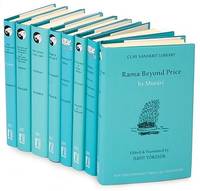
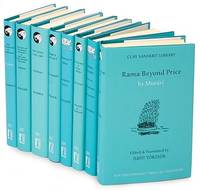
2009SONG0814717497Clay Sanskrit 2009-11-09. hardcover. Used: Good. 9.25x4.75x11.50. Buy with confidence. Excellent Customer Service & Return policy. Clay Sanskrit hardcover
2009SONG0814717462Clay Sanskrit 2009-11-09. Bilingual. hardcover. Used: Good. 9.25x4.75x11.50. Buy with confidence. Excellent Customer Service & Return policy. Clay Sanskrit hardcover
Introdution nouvelle de J.Filliozat 4 (5 tomi) 24,7x17,5 cm.,pagg.A-L,CLXXVII,331;XV,383;CVIII,310,VII,248, legatura in brossura, lingua francese con citazioni in arabo, pagine intonse, bellissimo frontespizio figurato nei quattro volumi, copertura protettiva con carta velina. Il traduttore ? membro dell'Institut e prof. de Sanscrit al Vollege Royal De France. Opera interessante.