Giacomini Tebalducci Malespini, LorenzoBiblio.com
16 résultats
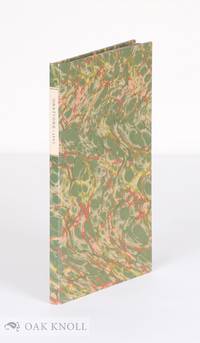
1587138044Fiorenza: Ne le case de' Sermartelli 1587. Rebound in marbled boards. 8vo. Rebound in marbled boards. 4 36 pages. Fatta per ordine de l'Academia Fiorentina nel Tempio di S. Lorenzo nel Consolato di B. Valori. Coat of arms of the Medici family on the title page. A near fine copy. Giacomini was a well-respected academic from Florence. The book is dedicated to Ferdinando Grand Duke and is praised by G. B. Strozzi and L. Salviati. Moreni Bibliography of Tuscany vol. I. Rare original edition missing from Adams; B. M. C. p. 299. Ne le case de' Sermartelli unknown
15767393Genoa: Appresso Marc' Antonio Bellone 1576. First edition. Vellum. Very Good. 4to. 819224pp. Index of names. Armorial woodcut device on title. Publisher's woodcut device on colophon. Cont. limp vellum a bit soiled ties lacking some gnawing at lower fore-edge of front cover remains of an old hand-lettered paper label on spine. A few gatherings a bit browned M-S and V-X. A valuable and entertaining book which Borromeo placed in his collection of "Novellieri" but which contains in reality narrative stories of people and events occurring between the mid-15th century and 1566; their names are listed in the index at the end. The events factual and anecdotal take place in Liguria Lombardy Campania and Aragon and several of them mention Turkey and the Turks. At the beginning in his preface the author narrates the history of Novi Ligure where he was born circa 1510. Not in adams; BL Italian STC p. 145. Appresso Marc' Antonio Bellone hardcover books
1588322821Florence: Bartolommeo Sermartelli 1588. hardcover. very good. 8vo older brown calf-backed marbled boards. One folding plate small library stamp of title page. Intaglio vignette on the title page with a turtle bearing a sail with a Florentine lily on its shell and the motto "Festina lente". Florence: Bartolommeo Sermartelli 1588. Very good in a lightly rubbed but attractive binding.<br/> <br/> History of the house of the Ubaldini and of the affairs of some of that family. Book one. Described by Giovambattista by Lorenzo Ubaldini 134 pages - And the life of Niccola Acciaioli Grand Seniscalco of the Kingdoms of Sicily and of Gierusalemme 46 pages described by Matteo Palmieri.<br/> <br/> Bartolommeo Sermartelli unknown
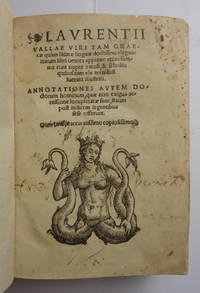
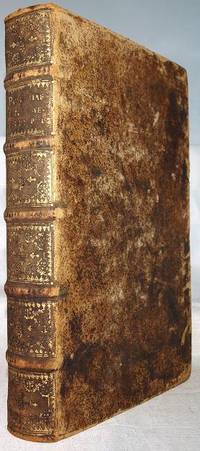
1535WB15731Lyon: Seb. Gryphium 1535. Hardcover. Very Good. MDXXXV 1535. 8vo 170 x 120mm. 493pp. 42. Signatures: a-z8 A-K8 L4. Colophon on leaf 3r. Woodcut engraved printers device of griffin on pedestal and winged orb with motto VIRTUTE DVCE COMITE FORTVNA Under the guidance of valor accompanied by good fortune. 5-line chapter decorative initials throughout. Printed catchwords and marginalia. 19th century half cloth over marbled boards spine with three raised bands and lettered in gilt LAURENTIUS VALLA endpapers renewed; title browned with small lower right marginal tear some marginal dampstaining marginal worming in center of text block only affecting a few quires few stains outer edgewear; altogether a good French imprint from the Gryphius press. Title page with 19th century ownership inscriptions "Gabriele Tasinari 1865 and early 20th century ink ownership stamp of Jaime Azancot. Lyon edition of Lorenzo Vallas linguistic work on the Latin language. This same year an edition appeared with Jodus Badius Ascensius and was printed in Paris with Simonem Colinaeum. The next year 1536 saw editions from the printers Giunta in Lyon and Fabricius in Cologne. Immensely popular as a textbook this was Vallas widely reprinted and influential work on Latin linguistics which went through at least 60 editions between 1471 and 1536. Lorenzo or Laurentius Valla from Piacenza was a scholar humanist and philosopher not unfamiliar with controversy. In his tumultuous career he was chosen by Pope Nicholas V to translate the classical texts of Herodotus and Thucydides into Latin. His masterwork is De lingvae latinae elegantia 1444 called a brilliant philological defense of classical Latin in which he contrasted the elegance of the ancient Romans works - especially those of Cicero and Quintilian - with the clumsiness of medieval and Church Latin Columbia Electronic Encyclopedia 6th ed. 2006. Vallas treatise was novel in it subjected the forms of Latin grammar and the rules of Latin style and rhetoric to a critical examination. His work was the basis for the Humanist movement to reform the style of Latin prose to a more classical and Ciceronian direction and on a scientific basis and away from the Christian Latin of the European Middle Ages. This was thought to be a major improvement in style and elegance in Latin usage. Sebastian Gryphius was a German bookseller-printer and humanist. Around 1520 he came to Lyon and settled there on behalf of a Venetian firm of booksellers. Initially Gryphius largely published works on law but was later known for classic works in humanism produced in elegant format. For an often reprinted title this particular edition is not common. <br/><br/> Seb. Gryphium hardcover books
1535WB15731Lyon: Seb. Gryphium 1535. Hardcover. Very Good. MDXXXV 1535. 8vo 170 x 120mm. 493pp. 42. Signatures: a-z8 A-K8 L4. Colophon on leaf 3r. Woodcut engraved printers device of griffin on pedestal and winged orb with motto VIRTUTE DVCE COMITE FORTVNA Under the guidance of valor accompanied by good fortune. 5-line chapter decorative initials throughout. Printed catchwords and marginalia. 19th century half cloth over marbled boards spine with three raised bands and lettered in gilt LAURENTIUS VALLA endpapers renewed; title browned with small lower right marginal tear some marginal dampstaining marginal worming in center of text block only affecting a few quires few stains outer edgewear; altogether a good French imprint from the Gryphius press. Title page with 19th century ownership inscriptions "Gabriele Tasinari 1865 and early 20th century ink ownership stamp of Jaime Azancot. Lyon edition of Lorenzo Vallas linguistic work on the Latin language. This same year an edition appeared with Jodus Badius Ascensius and was printed in Paris with Simonem Colinaeum. The next year 1536 saw editions from the printers Giunta in Lyon and Fabricius in Cologne. Immensely popular as a textbook this was Vallas widely reprinted and influential work on Latin linguistics which went through at least 60 editions between 1471 and 1536. Lorenzo or Laurentius Valla from Piacenza was a scholar humanist and philosopher not unfamiliar with controversy. In his tumultuous career he was chosen by Pope Nicholas V to translate the classical texts of Herodotus and Thucydides into Latin. His masterwork is De lingvae latinae elegantia 1444 called a brilliant philological defense of classical Latin in which he contrasted the elegance of the ancient Romans works - especially those of Cicero and Quintilian - with the clumsiness of medieval and Church Latin Columbia Electronic Encyclopedia 6th ed. 2006. Vallas treatise was novel in it subjected the forms of Latin grammar and the rules of Latin style and rhetoric to a critical examination. His work was the basis for the Humanist movement to reform the style of Latin prose to a more classical and Ciceronian direction and on a scientific basis and away from the Christian Latin of the European Middle Ages. This was thought to be a major improvement in style and elegance in Latin usage. Sebastian Gryphius was a German bookseller-printer and humanist. Around 1520 he came to Lyon and settled there on behalf of a Venetian firm of booksellers. Initially Gryphius largely published works on law but was later known for classic works in humanism produced in elegant format. For an often reprinted title this particular edition is not common. <br/><br/> Seb. Gryphium hardcover
1536026538Cologne: Ioannes Gymnecus 1536. Book. Very Good. Vellum. 56 prelims 608 pp. 127 pp misnumbered: begins 5 4 5 to 127. Contemporary embossed vellum with intact brass clasps. Three works included in one volume. Title page missing but otherwise complete as collated against BSB 1133964 OCLC 220615439. A photocopy of the title page is laid in. Title and author written on fore-edge. Spine has title author and library number probably 17th C and remnant of later library label. Binding is very secure. Handwritten notations on front pastedown. Text block is square and remarkably clean toned but not foxed. Very good or better copy of Valla's important work on the elegance of the Latin language 1471. This analysis was the basis for Humanists to reform Latin prose to a more classical style very different from the ecclesiastical style that had evolved. His knowledge and analysis of the language allowed him to establish that the Donation of Constantine was a forgery perhaps his most famous work. Three works are included in this volume: 1 Laurentii Vallae viri tam Graece quam Latinae linguae doctissimi Elegantiarum Libri omnes apprime útiles scholiis quibusdam ubi hactenus mendosi fuere illustrati per Gybertum Longolium. Hac Postrema Editione Annotationes doctorum hominum non exigua accessione locuple tauimus quod post indicis finem cognoscere perfacile est. Cum índice copiosissimo.; 2 Laurentii Vallae ad Ioannem Tortellium Aretinum cubicularium apostolicum de Reciprocatione Sui & Suus libellus plurimum utilis.; and 3 Laurentii Vallae ad Ioannem Tortellium Aretinum cubicularium apostolicum de Reciprocatione Sui & Suus libellus plurimum utilis. Size: 12mo. Ioannes Gymnecus Hardcover
1538007094<p>Venezia: Rabani 1538. "Elegantiarum libri omnes apprime vtiles summa cura nuper excusi & scholiis quibusdam vbi mendosi fuerant illustrati. Annotationes autem doctorum hominum quae non exigua accessione locupletatae sunt statim post indicem legentibus sese offerunt". Rilegato insieme a: "In errores Antonii Raudensis annotationes nuper accuratius emendatae. Item ex Alexandri ab Alexandro genialibus libris in eundem Laurentium annotationes". Due opere in un volume 10x155 cm di 48-551 pagine e 12-115 pagine. Bella marca tipografica alle pagine di titolo Sirena incoronata con code divaricate attorcigliate sulle braccia mentre le indicazioni di stampa sono al colophon: "Venetiis: Victor à Rabanis & socii excudebant 1538. Mense Iunio". Piccole macchioline marginali e una gora chiara all'angolo delle prime 10 pp. Margine superiore corto soprattutto in fine ma senza mai toccare la stampa. Piena pergamena antica con autore titolo e data manoscritti al dorso. Bell'esemplare fresco e genuino di una delle opere più famose di Lorenzo Valla il trattato sulle lingue greca e latina che influenzò in maniera massiccia l'Umanesimo italiano ed europeo. Importante e non comune anche la refutazione dello scritto di Antonio da Rho 1398-1455 ca professore di eloquenza a Milano.</p> Rabani
1594395572In Genoua: Appresso gli Heredi di Gier. Bartoli 1594. Softcover. Good. First Italian edition. Translated by Lorenzo Conti. Quarto. 40 803 1pp. woodcut title vignette and illustrated woodcut initials. Contemporary pastepaper boards with original sewing along the joints edges sprinkled red. Signed manuscript note dated from: "Malta 2 December 1839" laid-down on the front pastedown identifying this copy as belonging to: "the Library of the Knights of Malta of the Order of St. John of Jerusalem." Two small laid-paper strips are pasted over an early ownership signature on the title page to the left and right of the woodcut vignette. The pastepaper binding is frayed at the edges and torn along the front joint both free endpapers are nearly detached modest intermittent old dampstaining and some worming to the top margin good. The scarce first Italian edition of Commynes celebrated Mémoires in a contemporary binding and with a compelling provenance. Appresso gli Heredi di Gier. Bartoli unknown
1577JC14677Antwerp: Christophe Plantin 1577. First Edition. Hardcover. Very Good. 4to 240 x 175mm. Pagination: 2 3-194pp. 2 colophon leaf. Signatures: A-Z4; a6. Engraved architectural frame on title signed Bernardinus Passarus with coat of arms of Pope Gregory XIII two cardinals Alessandro Farnese escutcheon of six fleur-de-lis and Antonio Perenotto escutcheon of double-headed eagle and seven bends and classicizing boughs of fruit. All 55 copperplate engravings 54 in cartouche illustrated by Bernandino Passeri c.1577-1585 and engraved by Hieronymus Jerome Wierix c.1553-1619 with the exception of the Raising of Lazarus on p. 88 which is signed PB i.e. Pieter van der Borcht as designer and IHW i.e. Jan Wierix which belonged to the Plantin stock. Edited by Jacobus Pactus. Text in roman and italic. Contemporary limp vellum lacking ties manuscript title to spine GAMBARAE CARININA SACRA; title and edges lightly browned hinges starting ink stains on p. 71 but otherwise a good copy. Old library stamp of the Biblitoeca de Oscar e Carbone. Modern armorial bookplate of Bibliotheque I.G. Schorsch on the front pastedown. <br/><br/>Scarce first edition of Lorenzo Gambaras devotional treatise the Rerum sacrarum liber published by Plantin in Antwerp in 1577. Plentiful in sacred iconography Gambaras book was known for its beautiful art history images depicting classic Christological scenes visions saints and parables all after the drawings of Bernadino Passeri. Lorenzo Gambara born in Brescia studied arts and letters at the University of Padua. While he was still young he moved to Rome where he was linked to the papal court and was in service to Cardinal Alessandro Farnese and later Pope Gregory XIII. Virtually Gambaras entire life had been encompassed by the culture of the papal court a place where he also made his name as a poet. One of Gambaras major driving beliefs was that the popular myths in ancient poetry had pagan roots. Wanting to write something to counteract the celebration of depraved literature in his time Gambara wrote this treatise to discourage Christian poets from using pagan symbols in their work. He dedicated this work to some of the greatest themes in Christian liturgy such as the Annunciation Epiphany Pentecost and Christmas. Adams G-186; Brunet II 1474; Graesse III 22. Christophe Plantin hardcover books
1577JC14677Antwerp: Christophe Plantin 1577. First Edition. Hardcover. Very Good. 4to 240 x 175mm. Pagination: 2 3-194pp. 2 colophon leaf. Signatures: A-Z4; a6. Engraved architectural frame on title signed Bernardinus Passarus with coat of arms of Pope Gregory XIII two cardinals Alessandro Farnese escutcheon of six fleur-de-lis and Antonio Perenotto escutcheon of double-headed eagle and seven bends and classicizing boughs of fruit. All 55 copperplate engravings 54 in cartouche illustrated by Bernandino Passeri c.1577-1585 and engraved by Hieronymus Jerome Wierix c.1553-1619 with the exception of the Raising of Lazarus on p. 88 which is signed PB i.e. Pieter van der Borcht as designer and IHW i.e. Jan Wierix which belonged to the Plantin stock. Edited by Jacobus Pactus. Text in roman and italic. Contemporary limp vellum lacking ties manuscript title to spine GAMBARAE CARININA SACRA; title and edges lightly browned hinges starting ink stains on p. 71 but otherwise a good copy. Old library stamp of the Biblitoeca de Oscar e Carbone. Modern armorial bookplate of Bibliotheque I.G. Schorsch on the front pastedown. <br/><br/>Scarce first edition of Lorenzo Gambaras devotional treatise the Rerum sacrarum liber published by Plantin in Antwerp in 1577. Plentiful in sacred iconography Gambaras book was known for its beautiful art history images depicting classic Christological scenes visions saints and parables all after the drawings of Bernadino Passeri. Lorenzo Gambara born in Brescia studied arts and letters at the University of Padua. While he was still young he moved to Rome where he was linked to the papal court and was in service to Cardinal Alessandro Farnese and later Pope Gregory XIII. Virtually Gambaras entire life had been encompassed by the culture of the papal court a place where he also made his name as a poet. One of Gambaras major driving beliefs was that the popular myths in ancient poetry had pagan roots. Wanting to write something to counteract the celebration of depraved literature in his time Gambara wrote this treatise to discourage Christian poets from using pagan symbols in their work. He dedicated this work to some of the greatest themes in Christian liturgy such as the Annunciation Epiphany Pentecost and Christmas. Adams G-186; Brunet II 1474; Graesse III 22. Christophe Plantin hardcover
15511411030034Florentiae. : L. Torrentinus ducalis typographus excudebat 1551-01-01. Hardcover. Very Good. 0x0x0. Folio. 7 1 432 80 p. final leaf blank ; 36 cm. Bound in contemporary full calf leather. Gilt spine. 5 raised bands. Blue speckled page ends. Good binding. Wear and rubbing to boards. Slight staining to title page and front prelims. Negligible marginal worming to first few pages. Lacking terminal blank. Ex-library ink stamps on title page. Sparse contemporary marginal notation. Clean unmarked pages few pages with scattered foxing. The Latin of Amaseo was used in the 1583 Frankfurt edition of Pausanius by Friedrich Sylburg. Brunet IV 454; Graesse V 178; Br. Libr. p. 49; Adams P524 Florentiae. : L. Torrentinus ducalis typographus excudebat hardcover
15897795Venetiis. Apud Aldum. 1589. 1589 12 211 1 p. Later 18th centurycontinental half vellum with marbled boards. The spine with four raised bands and two labels. A large armorial bookplate c. 1900 on the front pastedown of Harry Bertram McCaskie M.A.M.D. The title page is a little dusty with two pinholes of worm one penetrating only the title the other through the prelims to A1. Otherwise a clean crisp copy with good margins. "Anania believed in the existence of both arial and subterranean demons. He held that demons only pretend to shun certain constellations and regarded both astrological and necromantic images as operative only by demon aid. He believed that demons are terrified by relics of the saints but that they are cast out now less than formerly" Thorndike. Venetiis. Apud Aldum. hardcover
1577LD6849Antwerp: Christoph Plantin 1577. Hardcover. Very Good. 4to 205 x 155mm. 194pp. 1. Engraved title after Bernadino Passeri with coats of arms of Alessandro Farnese cardinals hat surmounting escutcheon bearing six fleurs-de-lis and Antonio Perenotto cardinals hat over double headed eagle and seven bends emblems of Pope Gregory XIII papal tiara and crossed keys of Rome over medallion enclosing head of dragon two putti and heads of putti amid boughs of fruit hanging from architectural frame. All 55 copperplate engravings 54 in cartouche representing religious scenes mainly scenes of Christs life the Presentation Transfiguration Entry into Jerusalem Crucifixion Resurrection Ascension Pentecost various judgments visionary and moralistic scenes mainly for saints and a fight against the Turks all from drawings of Bernardino Passeri one repeated on p. 160 p. 191 and one The Raising of Lazarus p. 88 of a different style and signed I. H. W.-P. B. i. e. Hieronymus Wierix after Pierre van der Borcht of the Plantin stock. Early 19th-century half morocco over marbled boards marbled endpapers and edges; margins trimmed close title browned some toning throughout lightly worn otherwise complete and sound. Armorial bookplate of T. Graham three escallops joined with chevron charged with three crescents with motto Omne meum nihil meum tis all mine and none mine on front pastedown. Few annotations in margins mainly on poem for St. Anthony of Padua beginning p. 183. <br/><br/>Gambaras rare neo-Latin treatise discouraging Christian poets from using pagan symbols the Liber Rerum Sacrarum finely illustrated by Passeri and from the Plantin press in 1577. Rare original edition of Lorenzo Gambaras Liber Rerum Sacrarum a collection of Latin religious poems in which he dissuades Christian poets from using pagan mythology in their work. Gambara was born in Brescia in 1506 but spent most of his life in Rome in service to Cardinal Alessandro Farnese and Pope Gregory XIII where he had regular contact with many writers of the day. He himself was a prolific poet and translator of Greek lyric poetry perhaps better known for his work on the Navigation of Christopher Columbus 1581. Gambara died in 1596 at the age of 90. Each of Gambaras poems in the Liber Rerum Sacrarum feature saints or religious feasts which were dedicated to a prominent prelate starting with a brief argumentum or appeal and with an illustration adapted to the text. As pointed out in letters by Plantin the plates were made in Italy by an unknown engraver probably after the designs of the Roman painter Bernardino Passeri whose name figures on the title page and shipped to Antwerp. Rare copies located at Stanford Duke Newberry Library Brigham Young and the National Art Library in London and another on market. Christoph Plantin hardcover books
1577LD6849Antwerp: Christoph Plantin 1577. Hardcover. Very Good. 4to 205 x 155mm. 194pp. 1. Engraved title after Bernadino Passeri with coats of arms of Alessandro Farnese cardinals hat surmounting escutcheon bearing six fleurs-de-lis and Antonio Perenotto cardinals hat over double headed eagle and seven bends emblems of Pope Gregory XIII papal tiara and crossed keys of Rome over medallion enclosing head of dragon two putti and heads of putti amid boughs of fruit hanging from architectural frame. All 55 copperplate engravings 54 in cartouche representing religious scenes mainly scenes of Christs life the Presentation Transfiguration Entry into Jerusalem Crucifixion Resurrection Ascension Pentecost various judgments visionary and moralistic scenes mainly for saints and a fight against the Turks all from drawings of Bernardino Passeri one repeated on p. 160 p. 191 and one The Raising of Lazarus p. 88 of a different style and signed I. H. W.-P. B. i. e. Hieronymus Wierix after Pierre van der Borcht of the Plantin stock. Early 19th-century half morocco over marbled boards marbled endpapers and edges; margins trimmed close title browned some toning throughout lightly worn otherwise complete and sound. Armorial bookplate of T. Graham three escallops joined with chevron charged with three crescents with motto Omne meum nihil meum tis all mine and none mine on front pastedown. Few annotations in margins mainly on poem for St. Anthony of Padua beginning p. 183. <br/><br/>Gambaras rare neo-Latin treatise discouraging Christian poets from using pagan symbols the Liber Rerum Sacrarum finely illustrated by Passeri and from the Plantin press in 1577. Rare original edition of Lorenzo Gambaras Liber Rerum Sacrarum a collection of Latin religious poems in which he dissuades Christian poets from using pagan mythology in their work. Gambara was born in Brescia in 1506 but spent most of his life in Rome in service to Cardinal Alessandro Farnese and Pope Gregory XIII where he had regular contact with many writers of the day. He himself was a prolific poet and translator of Greek lyric poetry perhaps better known for his work on the Navigation of Christopher Columbus 1581. Gambara died in 1596 at the age of 90. Each of Gambaras poems in the Liber Rerum Sacrarum feature saints or religious feasts which were dedicated to a prominent prelate starting with a brief argumentum or appeal and with an illustration adapted to the text. As pointed out in letters by Plantin the plates were made in Italy by an unknown engraver probably after the designs of the Roman painter Bernardino Passeri whose name figures on the title page and shipped to Antwerp. Rare copies located at Stanford Duke Newberry Library Brigham Young and the National Art Library in London and another on market. Christoph Plantin hardcover
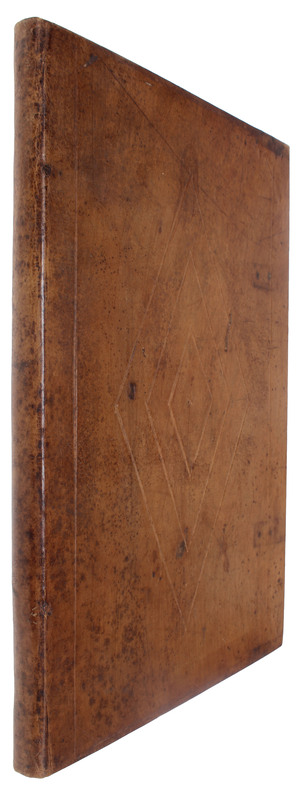
159652658Venice Girolamo Franceschi 1596. Folio 400x260 mm. Two parts bound in one later presumably 19th century sprinkled full calf with blindstamped geometrical ornamentations to boards. Leather on back board renewed. Engraved title-page neatly restored at inner margin far from affecting imprint; old owner's inscription ""Ex libris Ludovici A. la." crossed-out previous owner's name and traces after a stamp to title-page. With Medici arms at the top and those of Sirigatti at foot of title-page repeated on title-page of part two. As with all other copies we have been able to locate the title-page is trimmed affecting approximately 1 cm of the allegorical depictions in margin. Large woodcut printer's device at the end of the volume. Light occassional discolouring but overall in very fine condition. 1 f. allegorical frontispiece 3 ff. of dedication and index 43 plates numbered with parallel text 1 f. large woodcut printer's device 22 copper engraved plates including the title-page of the second part numbered 44-65. I.e. 65 plates in total - fully complete. <br/><br/><em>The rare first edition of this most important work on the art of perspective: "Questa e la più elegante delle edizioni di libri prospettici per i tipi pei caratteri per la carta" Cicognara 860. Sirigatti's work is famous for being one of the very earliest thorough works solely dedicated to the art of perspective. Combining the visual language of the German book tradition of Lencker and Jamnitzer with the Italian tradition of linear perspective treated previously by Serlio and Barbaro and earlier that of Leon Battista Alberti unillustrated as applied to stage design and architectural theory this is one of the seminal Italian works on the subject of perspective. Presumably this work functioned as basis for Galileo’s drawing technique. The book quickly became very popular and several Italian editions were reprinted in the 17th century; its reputation was so long-lived that an English translation was published no less than 160 years after the original. The work is divided in two parts: The first part is dedicated to the elementary rules of perspective to plane and solid geometric figures which also contain musical instruments like the lute plate 41 and 42. The second part depicts architectural elements facades of palaces and churches in polyhedrons of various forms and regular Platonic solids with several references to Luca Pacioli's "divina proportione". Furthermore Sirigatti famously contributed to the study of theatrical perspective: "He is the first to mention that the full effect of the perspective frame for instance in a stage set can be enjoyed only by those sitting along the main axis. This is a fundamental aspect of absolutist theater that no doubt had been noticed by designers of princely entertainments earlier but is first commented on in print by Sirigatti whose observations were taken up more extansively by Pietro Accolti." Millard.Two problems were endemic in perspective designs. First because perspective scenery exploits the difficulty of the eyes in judging the sizes and distances of objects it works best by assigning the spectator to a single point of vision and manipulating relative magnitudes to make small images represent objects that are larger and farther away. Second the apparent magnitude and distance of painted objects tended to clash with the fixed size of live actors when applied to the theater threatening to produce absurd combinations of scale when performers wandered upstage. Sirigatti was first to "acknowledge the problem of spectator position. Sirigatti proposed a way to combine a painted perspective backdrop with fixed three-dimensional scenery that diminished in size as it neared an upstage vanishing point". Camp The First Frame. Sirigatti was not only influential in the theory of architecture and stage design. "Galileo "most certainly studied" La pratica di prospettiva which was published in Venice while Galileo was teaching nearbyby in Padova and that when Galileo and Thomas Harriot simultaneously pioneered the use of the telescope to study the moon's surface it was Galileo's training in chiaroscuro that led him to see mountains and craters where Harriot only saw "strange spottedness"." The Partnership of Art and Science: The Moon of Cigoli and Galileo.Sirigatti was a member of the Academy of Drawing Accademia del Disegno a school for artists and engineers where Galileo studied as a young man. Any young artist or mathematician working his way through Sirigatti and learning to create the spikes on a ring diagram such as this would master perspective and the handling of light and shadow chiaroscuro. Each spike must cast an appropriate shadow not unlike the patches Galileo would later discern through his "perspective tube" and interpret as the shadows of mountains protruding up from the surface of the Moon.Adams S-1224Cicognara 860Fowler 336Graesse VI417 Macclesfield 1896Mortimer 479Millard 129 the 1625-edition </em> hardcover
159652658Venice, Girolamo Franceschi, 1596. Folio (400x260 mm). Two parts bound in one later (presumably 19th century) sprinkled full calf with blindstamped geometrical ornamentations to boards. Leather on back board renewed. Engraved title-page neatly restored at inner margin, far from affecting imprint" old owner's inscription (""""Ex libris Ludovici A. la...""), crossed-out previous owner's name, and traces after a stamp to title-page. With Medici arms at the top and those of Sirigatti at foot of title-page, repeated on title-page of part two. As with all other copies we have been able to locate, the title-page is trimmed, affecting approximately 1 cm of the allegorical depictions in margin. Large woodcut printer's device at the end of the volume. Light occassional discolouring, but overall in very fine condition. 1 f. (allegorical frontispiece), 3 ff. (of dedication and index), 43 plates numbered with parallel text, 1 f. (large woodcut printer's device), 22 copper engraved plates (including the title-page of the second part) numbered 44-65. I.e. 65 plates in total - fully complete.