1 013 résultats
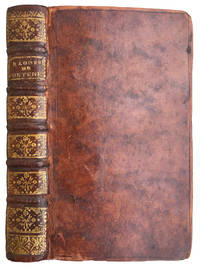
1715160304London: Printed for A. Bettesworth 1715. 12mo pp. 1-12 1-192; collates A 6 B-I 12 frontispiece eighteenth-century brown leather front and rear panels ruled and tooled in blind four raised bands on spine panel no title label. The first printing of the Gardiner edition. Fontenelle's ENTRETIENS SUR LA PLURALITE DES MONDES his most famous and frequently reprinted and translated book was first published in 1686. It is "the first example in French of a learned work placed within the reach of an educated but non specialized public." - DSB V 59. A popular account of the systems of Ptolemy Copernicus and Tycho Brahe in dialogue form the treatise "awakened general interest in astronomy and popularized the scientific system of inquiry; it also emphasized the small space occupied by man and this planet relatively to the rest of the universe. The work was ridiculed by Voltaire though it suggested his MICROMEGAS." - The Oxford Companion to French Literature 1959 p. 278. The first of the three seventeenth-century English translations was A DISCOURSE OF THE PLURALITY OF WORLDS . Translated into English by Sir W. D. Knight. Dublin: Printed by Andr. Crook and Sam. Helsham for William Norman 1687. The first edition of the Glanvill translation containing five dialogues was published in 1688 the same year Aphra Behn's translation of Fontenelle's book A DISCOVERY OF NEW WORLDS was published in London by William Canning. This Gardiner translation first published in 1715 is the first edition to include a translation of Fontenelle's sixth dialogue. "In all the literature of the cosmic voyage there was no book more popular than Fontenelle's CONVERSATIONS OF THE PLURALITY OF WORLDS. Translated again and again it seemed to the British peculiarly their own book read for at least a century both by men and by those 'ladies' of whom we have many a description one of whom would read it aloud to others who were busily engaged in making strawberry jam. This was a book indeed that warranted a subtitle I once discovered in an eighteenth-century popularization of astronomy: 'Science made clear to the Meanest Capacities even those of Women and Children.'" - Nicolson Voyages to the Moon pp. 58-9. Fontenelle's book "became a seminal influence on proto science fiction . This is one of the earliest works ever written popularizing science notably astronomy for the layman which it does by wittily presenting its speculations -- many about the possibility of life on other worlds -- in the form of conversations after dinner between the author and a marquise." - Clute and Nicholls eds The Encyclopedia of Science Fiction 1993 p. 437. "A great stimulant to utopian speculations and science fiction." - Gibson and Patrick "Utopias and Dystopias 1500-1750" in Gibson St. Thomas More: A Preliminary Bibliography 1961 683. See Ley Rockets Missiles and Space Travel 1951 pp. 22-4 and Ley Rockets Missiles and Men in Space 1968 pp. 21-2 for a good summary of the book. Bleiler Science-Fiction: The Early Years p. 853. Howgego Encyclopedia of Exploration: Invented and Apocryphal Narratives of Travel F16. Negley Utopian Literature: A Bibliography 371. Versins Encyclopédie de l'Utopie des Voyages Extraordinaires et de la Science Fiction pp. 341-42. NCBEL II 1513. An early important and scarce edition of this classic work. A lovely copy. Enclosed in a custom quarter leather rounded back clamshell box. #160304 Printed for A. Bettesworth unknown books
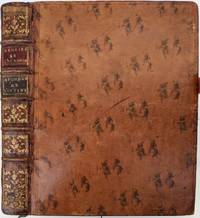
1727D11894Paris: De LImprimerie Royale 1727. First Edition. Hardcover. Good. 4to 249 x 187mm. 26 548 pages. Title with woodcut royal printers device fleur-de-lis three under crown. Folding engraved plate of figures of planes. Contemporary mottled calf gilt marbled endpapers spine gilt in compartments with morocco lettering label ELEMENTS DE LA GEOMETRIE; occasional toning light soiling and minor stains on title light marginal dampstaining mostly in middle of volume wormtrail and dampstaining in blank upper margins toward end few stains in upper margin of plate nothing severe a good book in contemporary binding. Near contemporary ink inscription French surname Baudoin on end-leaf another instance cancelled and No. 17 on title. 1727 first edition of Fontenelles published theories on inifinitesimal calculus plenty in philosophical dialogue. <br/><br/>While Éléments de la Géometrie de lInfini was praised by Alexis Fontaine des Bertins as an inspiration Fontenelles contemporary mathematicians did not consider his book to be a mathematical work. Fontenelles main desire in line with early-Enlightenment ideals was to make science accessible to the layman. His work laid the foundations for such discussion by taking a philosophical approach to the calculus of infinity writing in a novelistic style. For infinity Fontenelle studied the curvatures of the plane curves using the sines of angles of contingence although in practice Fontenelles theories contained many paradoxes. The result was that Fontenelles work was increased and expanded on by his supporters famously by the Jesuit mathematician Louis-Betrand Castel. In addition Fontenelles work was the basis on Fontaines 1731 work on the curvature of plane curves which presented new formulas on infinity and was a highly praised work in the Paris Academy. OCLC locates several institutional copies in the US additionally held in microform. Fontenelles is a classic and fundamental textbook work on geometry from the French Enlightenment-era still containing valuable points. De LImprimerie Royale hardcover books
1811RW1078Paris:: Bossange et Masson 1811. 1811. Sm. 8vo. xiv 392 pp. Fold-out engraved frontis. with a decorative design of the solar system including the planet "Herschell" a.k.a. Uranus half-title; light foxing. Original quarter tan calf marbled boards burgundy gilt-stamped spine label; spine head worn corners showing. Else very good. Bossange et Masson, 1811. hardcover books
1708RW1077London:: Jacob Tonson 1708. 1708. Sm. 8vo. ii l 2 209 1 pp. Original blind- and gilt-stamped calf later gilt-stamped black leather spine label raised bands; rebacked preserving original spine inner joints reinforced with brown cloth tape covers splitting at pp. 62-63 upper cover scratched. Embossed ownership stamps of S. G. Morten heraldic bearing: crowned eagle wings raised. Good. Early edition in English of the author's Nouveaux dialogues des morts. Fontenelle was one of the earliest authors of "popular science" texts. While not much of a researcher himself he found great success expounding the discoveries of his contemporaries in such a way that a broad audience could make sense of them. In his own time his popularity as an author among educated French society was second only to Voltaire and he was in fact "described by Voltaire as having the most universal mind produced by the era of Louis XIV" – Britannica. Fontenelle's Dialogues of the Dead was very popular at the time of its publication and the basic conceit of the book is still employed by authors today. In the work Fontenelle imagines dialogues between great minds of various eras such as the philosophers Socrates and Montaigne or the physicians Erasistratus and William Harvey. This allows the imagined speakers to present their views in a naturalistic way making them much more palatable to lay readers who might have difficulty sloughing through more scholarly works like On the Motion of the Heart and Blood in Animals. ESTC T139460. Jacob Tonson, 1708. hardcover books
1733RW1080Paris:: Chez la Veuve Brunet fils. . . et Marc Bordelet 1733. 1733. 12mo. viii 422 misnumbered "322" 2 pp. Frontis. engraved portrait. of Fontenelle – is trimmed folded at the upper and lower edges by "Crepy rue St. Jacques au lion d'Argent" title woodcut vignette. Original gilt-stamped calf gilt-stamped spine label raised bands. Inscription on title: "O.R. lousin aet coner". Very good copy with a handsome binding. "Extra-illustrated" with an added engraved bound-in folding frontispiece. This edition of the author's eulogies includes fourteen members of the Academie des Sciences who died between 1725 and 1730. There were two issues of this work printed in 1733: one showing "Brunet fils and Marc Bordelet the other issue showing only Marc Bordelet's name as publisher. They also feature a resetting of the type at least for the title-page and a different title woodcut vignette. There was an earlier 1731 Dutch edition of the Eloges printed by Isaac van der Kloot but I have been unable to determine if the biographies contained therein are the same. A note indicates this was also re-issued as miscellany works Oeuvres diverses of Fontenelle in 1736 see pt. 4. Fontenelle was a prolific biographer of notable persons publishing also a series of Dialogues with famous past historical figures. His Eloges commenced with a 1699 work on Claude Bourdelin. He also issued collective editions starting in 1708. This is the first 'separate' edition of the "Suite" containing biographies of 14 scientific notables. "It was Bernard Bovier de Fontenelle 1657-1757 who by his eulogies of scientists first bridged the gap between the scientific communities and the world at large . the eloges of the old Academy of Sciences acquainted laymen with a discipline that was at once esoteric by its novelty and forbidding by its terminology and methodology. Hence the eloges aside from the other functions they performed in the service of science also served as a public relations organ in the same manner as journals textbooks public lectures literary dialogues scientific expositions and cabinets de physique and d'histoire naturelle" - Charles Bennett Paul Science and immortality: the Eloges of the Paris Academy of Sciences 1699-1791 Berkeley: University of California Press 1980. pages 1-2. Contents: eloges du Czar Pierre I - Alexis Littre 1658-1726 – Nicolas Hartsoeker 1656-1725- Guillaume Delisle 1675-1726 - Nicolas de Malezieu 1650-1727 – Isaac Newton published 1727 1728 - Charles-Rene Reyneau 1656-1728 - Marechal de Tallard 1652-1728 - Sebastien Truchet 1656-1729 – Francois Bianchini 1662-1720 – Jacques-Philippe also known as: Giacomo Filippo. . . Maraldi 1665-1729 - Jean-Baptiste-Henri de Valincourt 1653-1730 – Count Luigi Ferdinando Marsigli 1658-1730 – Du Verney 1648-1730 - et le discours de Fontenelle a l'Academie francaise recevant l'eveque de Lucon. See: Suzanne Delorme "Contribution a la bibliographie de Fontenelle." p. 305. Revue d'histoire des sciences Annee 1957 vol. 10-4 pp. 300-309. Chez la Veuve Brunet fils,. . . et Marc Bordelet 1733. hardcover books
1955006272Oxford: Clarendon Press 1955. Edited by Robert Shackleton. 218p. original blue cloth. Clarendon Press unknown books
197067817New York and London: Johnson Reprint Corporation 1970. Hardcover. Fine. The Sources of Science No. 76. Small octavo. Original blue cloth binding with gilt titles. Issued without a dust jacket. A fine copy. <br/><br/> Johnson Reprint Corporation hardcover books
1959Z1245Philadelphia:: American Philosophical Society 1959. 1959. Series: Transactions of the APS New Series Vol. 49 Part 7 1959. 4to. 64 2 pp. Printed wrappers; bottom corner slightly bumped else near fine. American Philosophical Society, 1959. unknown books
1929RW1079London:: Nonesuch Press 1929. 1929. 8vo. ix 1 138 2 pp. Title vignette in red and black decorative blue and gilt headpieces. Original gilt-stamped vellum decorative slip-case; case rubbed. Fine. Limited edition of 1200 copies printed for U.K. distribution an additional 400 distributed by Random House in the US. Nonesuch Press, 1929. hardcover books
1727SW1717Paris:: L'Imprimerie Royale 1727. 1727. 4to. xxvi 548 pp. Title-page vignette tailpieces headpieces 1 engraved chapter vignette 1 engraved initial 1 engraved folding plate; occasional light foxing or browning. Full contemporary mottled calf blind-ruled covers raised bands red and brown leather spine labels gilt decorated spine all edges red marbled end-papers; leather separation at top of spine all edges red marbled end-papers; leather separation at top of spine hint of worming but strong lightly rubbed. A very clean and tight copy. Fine. FIRST EDITION of an extensive treatise on the principles of calculus by Bernard Fontenelle the distinguished French philosopher and scientist who is famous for his book on the plurality of worlds. Through his friend Varignon Fontenelle made the acquaintance of the Parisian scientific circle and became friends with Nicolas de Malezieu and l'Hopital. Fontenelle wrote the preface to l'Hopital's Analyse des infiniment petits pour l'intelligence des lignes courbes 11690. "In it he displayed his interest in the notion of infinity and his talent as a historian; in a few pages he retraces the history of the mathematical study of curved lines from Archimedes to Newton and Leibniz. . . In 1727 he published his Elements de la geometrie de l'infini which he had worked on for a long time probably since the period of his preface to the Analyse des infiniment petits. . . . According to Fontenelle none of the geometers who had invented or employed the calculus of infinity had given a general theory to it; that is what he proposed to do. The work is divided into a preface relating to the history of this branch of calculus and into two main part. . . 'the infinite series or in progression of numbers' and then examines 'the infinite in straight and curved lines. . . .'" DSB. / Bernard Fontenelle was born at Rouen and pursued a literary career. Fontenelle dabbled in poetry and writing for the stage but it is better known for his work as secretary to the Academy of Sciences. Among his published works are Entretiens sur la pluralite des mondes 1686 the Histoire du renouvellement de l'Academie des Sciences 1708-1722 and a number of eloges of the members. DSB V pp. 57-63; Poggendorf I col. 770; Zeitlinger 1360. L'Imprimerie Royale, 1727. hardcover books
182525056Paris: Salmon et Peytieux 1825. 5 volumes 8vo engraved frontispiece portrait; a few small cracks in the joints of vol. 3 all else good and sound in full contemporary polished calf gilt decorated spines black morocco label. Volume I: Eloges; vol. II : Eloges; vol. III: Les mondes Dialogues des morts etc.; vol. IV: Mélanges; vol. V: Poésies. <br/><br/> Salmon [et] Peytieux unknown books
1972194333Crémille 1972 1110 pages in4. 1972. Relié. 1110 pages.
200727716Des Idées & des Hommes 2007 252 pages 20x14x2cm. 2007. Broché. 252 pages.
1820W83353Paris, chez Janet et Cotelle 1820 408pp.+ 2 planches hors-texte gravées par Ambroise Tardieu, 21cm., reliure plein-cuir (encadrements dorés aux plats, titre et faux-nerfs et fleurons dorés au dos, charnières peu fragiles, coins touchés), tranches et feuilles de garde marbrées, rousseurs occasionnelles (texte toujours très bien lisible), bon exemplaire, W83353
1929RO40049009La Renaissance du Livre. 1929. In-12. Broché. Bon état, Couv. défraîchie, Dos satisfaisant, Intérieur frais. 233 pages.. . . . Classification Dewey : 840.091-XX ème siècle
1929100121084La renaissance du livre 1929 in12. 1929. Cartonné.
177772121777 A Genève, 1777 ; 2 volumes in-32°, plein veau de l'époque, triple filet doré encadrant les plats, dos lisse orné de filets et petits fers dorés, titre et tomaison dorés sur étiquette de maroquin vieux-rouge, tranches dorées; ( 4), 216pp.; ( 4), 196pp.
14803Marseille - Jean Mossy 1780. Hardcover viii-362pp. In-8, rel. pleine basane epoque, dos plat orne, coiffe superiere frotte et abimée,, illustr. grande planche depliante h.t.,
521112P., Fayard, 1992. Fort in-8 cartonnage éditeur, 375 pp. (Corpus des oeuvres de philosophie de langue française).
20572Paris, Plon-Nourrit et Cie, "Bibliothèque française - XVIIIe siècle", 1912 1 volume In-8° (12 x 19,1cm) Reliure d'époque demi-toile rouge; pièce d'auteur et titre noire au dos soulignée de doubles filets dorés; papier de couvrure des plats et gardes marbrés à dominante rouge; plats de couverture conservés. 3 feuillets dont 1 frontispice, II + 334p., 1 feuillet. Bon état sauf petits manques à la pièce de titre du dos (auteur et titre intacts) et plats de la couverture d'origine (papier) salis; très rares rousseurs.
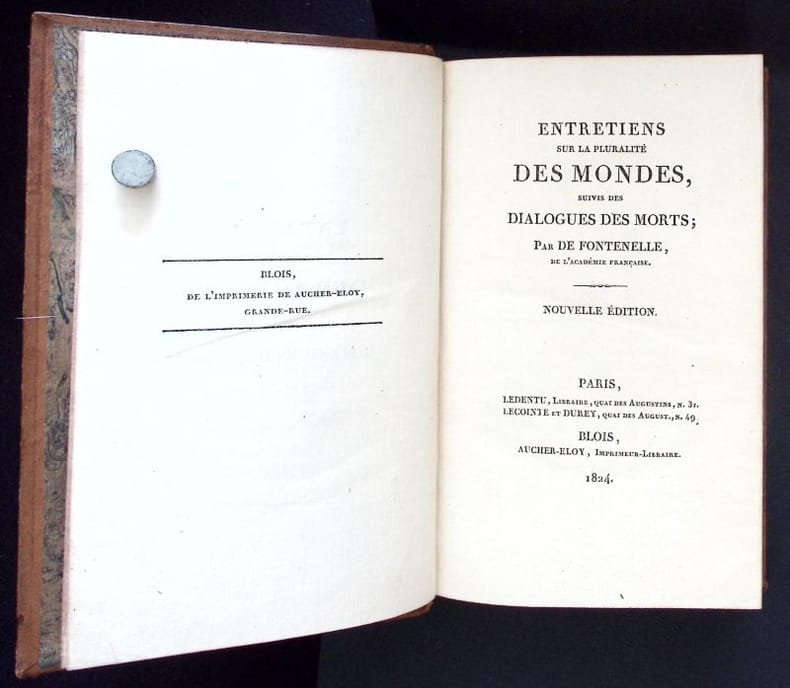
21491Ledentu / Lecointe et Duret, 1824, nouvelle édition.Blois, Aucher-Leroy, imp. éditeur. In-16, reliure plein veau blond raciné, dos lisse orné à la grotesque, encadrement en chaînons floraux des plats, tranches marbrées. XV- frontispice gravé sur deux vollets., 428 p., (1) garde. Accident sans altération réelle de la coiffe, cepdt fragilisée. Bel ex. par ailleurs.
6646P., Brunet, 1742; 2 VOLUMES in 8 reliés en plein veau, dos ornés de caissons dorés (reliure de l'époque), (épidermure à un mors, 1 coiffe usée, 1 mors légèrement fendu, tache vert pâle sur le frontispice du tome 2, cachets de bibliothèque), T.1 : 1 frontispice, 570pp., T.2 : 1 frontispice, (1), 674pp., (1)
21420P., Imprimerie Royale, 1727, un volume grand in 4 (26 cm x 19,5 cm) relié en plein veau marbré, dos orné de fers dorés, tranches rouges (reliure de l'époque), (13), 548pp., 1 PLANCHE DEPLIANTE
1703176171703 un volume, reliure plein veau brun in-douze (binding full calfskin duodecimo) (10 x 16,3 cm), dos à nerfs (spine with raised bands), décoration or (gilt decoration) à filets or (gilt lines) et à froid (blind-stamping decoration), entre-nerfs à compartiments à fleurons (compartment with floweret) au fer plein ( full blocking stamp), titre frappé or (gilt title), pièce de titre sur fond bordeaux foncé (label of title) avec filet or (label of title with gilt line), rinceaux or en pied (foot of spine with foliages carried out with the curved line), compartiments à fleurons (compartment with floweret), plats trés légèrement frottés (lightly rubbed cover), coins écornés (corners dog-eared), roulettes sur les coupes (fillets on the cuts) avec manque de dorure (blurred gilding), sans illustrations, pièces liminaires +.296 pages + 1 ff privilège du Roi, 1703 à Paris Michel Brunet Editeur,