145 résultats
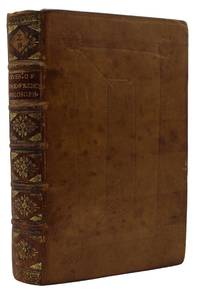
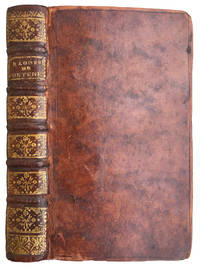
1727D11894Paris: De LImprimerie Royale 1727. First Edition. Hardcover. Good. 4to 249 x 187mm. 26 548 pages. Title with woodcut royal printers device fleur-de-lis three under crown. Folding engraved plate of figures of planes. Contemporary mottled calf gilt marbled endpapers spine gilt in compartments with morocco lettering label ELEMENTS DE LA GEOMETRIE; occasional toning light soiling and minor stains on title light marginal dampstaining mostly in middle of volume wormtrail and dampstaining in blank upper margins toward end few stains in upper margin of plate nothing severe a good book in contemporary binding. Near contemporary ink inscription French surname Baudoin on end-leaf another instance cancelled and No. 17 on title. 1727 first edition of Fontenelles published theories on inifinitesimal calculus plenty in philosophical dialogue. <br/><br/>While Éléments de la Géometrie de lInfini was praised by Alexis Fontaine des Bertins as an inspiration Fontenelles contemporary mathematicians did not consider his book to be a mathematical work. Fontenelles main desire in line with early-Enlightenment ideals was to make science accessible to the layman. His work laid the foundations for such discussion by taking a philosophical approach to the calculus of infinity writing in a novelistic style. For infinity Fontenelle studied the curvatures of the plane curves using the sines of angles of contingence although in practice Fontenelles theories contained many paradoxes. The result was that Fontenelles work was increased and expanded on by his supporters famously by the Jesuit mathematician Louis-Betrand Castel. In addition Fontenelles work was the basis on Fontaines 1731 work on the curvature of plane curves which presented new formulas on infinity and was a highly praised work in the Paris Academy. OCLC locates several institutional copies in the US additionally held in microform. Fontenelles is a classic and fundamental textbook work on geometry from the French Enlightenment-era still containing valuable points. De LImprimerie Royale hardcover books
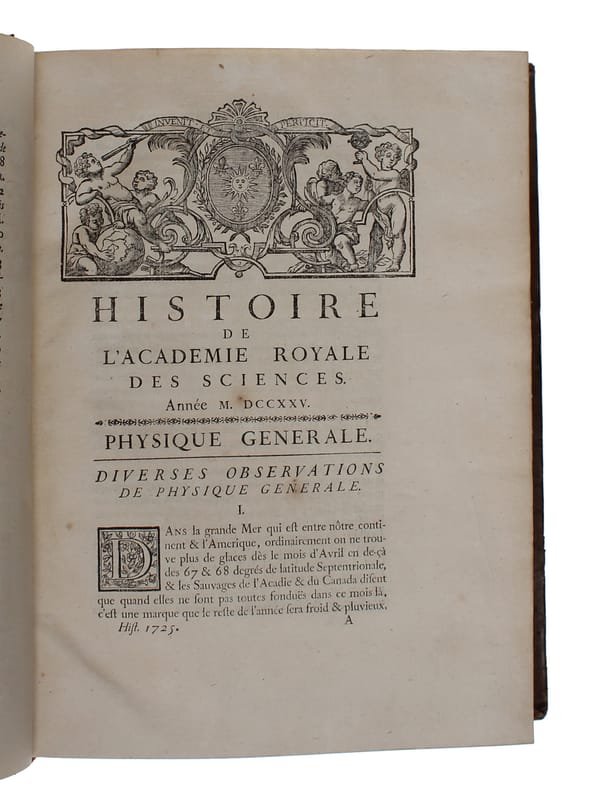
1727D11894Paris: De LImprimerie Royale 1727. First Edition. Hardcover. Good. 4to 249 x 187mm. 26 548 pages. Title with woodcut royal printers device fleur-de-lis three under crown. Folding engraved plate of figures of planes. Contemporary mottled calf gilt marbled endpapers spine gilt in compartments with morocco lettering label ELEMENTS DE LA GEOMETRIE; occasional toning light soiling and minor stains on title light marginal dampstaining mostly in middle of volume wormtrail and dampstaining in blank upper margins toward end few stains in upper margin of plate nothing severe a good book in contemporary binding. Near contemporary ink inscription French surname Baudoin on end-leaf another instance cancelled and No. 17 on title. 1727 first edition of Fontenelles published theories on inifinitesimal calculus plenty in philosophical dialogue. <br/><br/>While Éléments de la Géometrie de lInfini was praised by Alexis Fontaine des Bertins as an inspiration Fontenelles contemporary mathematicians did not consider his book to be a mathematical work. Fontenelles main desire in line with early-Enlightenment ideals was to make science accessible to the layman. His work laid the foundations for such discussion by taking a philosophical approach to the calculus of infinity writing in a novelistic style. For infinity Fontenelle studied the curvatures of the plane curves using the sines of angles of contingence although in practice Fontenelles theories contained many paradoxes. The result was that Fontenelles work was increased and expanded on by his supporters famously by the Jesuit mathematician Louis-Betrand Castel. In addition Fontenelles work was the basis on Fontaines 1731 work on the curvature of plane curves which presented new formulas on infinity and was a highly praised work in the Paris Academy. OCLC locates several institutional copies in the US additionally held in microform. Fontenelles is a classic and fundamental textbook work on geometry from the French Enlightenment-era still containing valuable points. De LImprimerie Royale hardcover
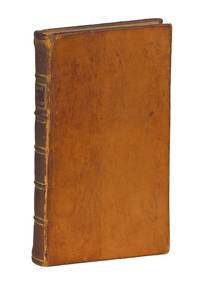
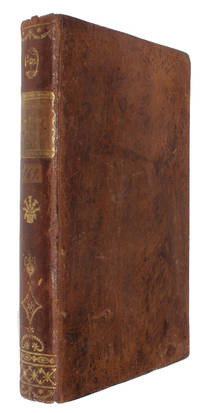
1727171224to. Cont. full calf. 5 raised bands and richly gilt compartments. Faint scratches on covers. Corners and edges a little rubbed. 2 small holes in leather at sides of upper compartment. (26),548 pp. and 1 folded engraved plate. Engraved vignette. On good paper.
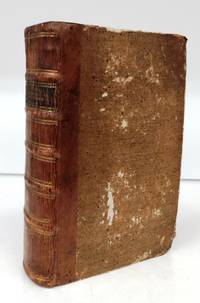
172759036Paris, L'Imprimerie Royale, 1727. 4to. Fine contemp. full calf. Raised bands. Richly gilt spine. Tome- and titlelabels with gilt lettering. Gilt borders on covers. A small nick in leather at upper compartmen. Light wear to foot of spine. (26),548, pp., 1 folded engraved plate. Clean and fine. The offered item includes the entire volume of ""Histoire de L'Academie Royale des Sciences. Années MDCCXXV. Paris, L'Imprimerie Royale, 1727"", of which the memoir of Fontenelle is printed as a ""suite"". With the engraved frontispiece. (6),154,354,(2) pp., 14 partly folded engraved plates. (Original papers by: Maraldi, Petit, Nicole, Winslow, du Fay, Pitot, Delisle d'Aine, Geoffroy le Cadet, Reaumur, Nicole, Cassini, de Mairan, Saurin, de Lagny, Fizes).
172759036Paris L'Imprimerie Royale 1727. 4to. Fine contemp. full calf. Raised bands. Richly gilt spine. Tome- and titlelabels with gilt lettering. Gilt borders on covers. A small nick in leather at upper compartmen. Light wear to foot of spine. 26548 pp. 1 folded engraved plate. Clean and fine. The offered item includes the entire volume of "Histoire de L'Academie Royale des Sciences. Années MDCCXXV. Paris L'Imprimerie Royale 1727" of which the memoir of Fontenelle is printed as a "suite". With the engraved frontispiece. 61543542 pp. 14 partly folded engraved plates. Original papers by: Maraldi Petit Nicole Winslow du Fay Pitot Delisle d'Aine Geoffroy le Cadet Reaumur Nicole Cassini de Mairan Saurin de Lagny Fizes. <br/><br/><em>First edition. "In 1727 as a "Suite des mémoires de l’Académie royale des sciences" he published the Élémens de la géométrie de l’infini. Some doubted whether it was really the work of a mathematician but the author believed it was and attached great value to it. He had worked on it for a long time probably since the period of his preface to the Analyse des infiniment petits. The term élémens is to be understood in the sense of "first principles." According to Fontenelle none of the geometers who had invented or employed the calculus of infinity had given a general theory of it; that is what he proposed to do. The work is divided into a preface relating the history of this branch of calculus and into two main parts: "Système général de l’infini" and "Différentes applications ou remarques." The author discusses "the infinite in series or in progressions of numbers" and then examines "the infinite in straight and curved lines" in the words of the Abbé Terrasson who reviewed the work in the Journal des sçavans July-October 1728." There was a great deal of discussion in the scientific community about this work in which mathematicians found numerous paradoxes. Johann I Bernoulli for example in his correspondence with Fontenelle allowed his criticisms to show through his praise: he did not understand what was meant by finis indéterminables. Fontenelle attempted to defend his theory and above all his distinction between metaphysical infinity and geometric infinity: one must ignore the metaphysical difficulties in order to further geometry and the finis indéterminables ought to be considered "as a type of hypothesis necessary until now in order to explain several phenomena of the calculus" letter to Johann I Bernoulli 29 June 1729. "The orders of infinite and indeterminable quantities like the magnitudes that they represent are only purely relative entities hypothetical and auxiliary. The subject matter of mathematics is only ideal" according to the terms of a "Projet de rapport" of Dortous de Mairan to the Academy on this work." DSB. </em> hardcover
1727171224to. Cont. full calf. 5 raised bands and richly gilt compartments. Faint scratches on covers. Corners and edges a little rubbed. 2 small holes in leather at sides of upper compartment. 26548 pp. and 1 folded engraved plate. Engraved vignette. On good paper. <br/><br/><em>First edition of the well-known French philosopher and mathematician's main mathematical work. Fontenelle author of "The Plurality of Worlds" claims here that Geometry is entirely intellectual and independent of the actual decription and existence of figures following more the conceptions of Descartes than those of Newton. </em> hardcover
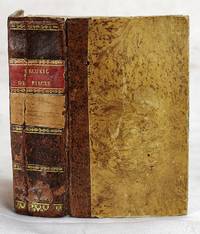
17972105270019Paris Impr. de Hautbout l'aine an v 1797. First French edition. Hardcover. Good. The French and Indian War: Cherokee Indians 3 works bound as one. 12mo 15 cm. Bound in contemporary 1/4 calf. 2 viii 187 1 pages. Lacking frontispiece. Early ink doodle on verso of title page lion but clean besides. French translation by Billecocq of the 1765 London edition of "The memoirs of Lieut. Henry Timberlake." Timberlake was a Virginian from Hanover county who fought for the English against the Cherokees in the French and Indian War. Tensions had been raised by the execution of 22 Cherokee in South Carolina in 1760 at Fort Prince George. As a result Overhill Cherokee attempted to expel British settlers. Timberlake was part of Colonel William Byrd / Adam Stephen's forces sent to suppress the Americas Indians in the Virginia / Tennessee region. Timberlake served as a lieutenant and a hostage to the Cherokees in 1761-1762 and visited many of their settlements. Later he was accompanied by three Cherokee leaders including the Chief Ostenaco on a diplomatic mission to England. The mission met with King George III and attempted to halt westward expansion by British colonists. One a second mission to England in 1765 Timberlake was imprisoned for debts owed for the lodging in London. He presumably wrote this journal while in debtor's jail and died in prison in 1765. His journal was published posthumously. His accounts of the Cherokee provide an early and fairly accurate depiction of the people before their displacement. Sabin 95837. <br> Also includes two other works bound with this one: M. de Fontenelle "Histoire des Oracles" "Poesies Pastorales." 2 212 142 pages. London 1785; "Confessions de Clement Marot." 6 197 pages. Paris 1798. Paris, Impr. de Hautbout l'aine, an v hardcover
178997584BB1789 . Paris: Le Directeur de la Bibliothèque rue d'Anjou ca. 1789. 16°. CXI 168 S. Leder. Vorsätze farbiges Leimpapier. Umlaufender Goldschnitt. Rückentitel in Goldschrift auf dunklerem Grund mit Dekor auf Rücken und Kanten und Filletten. altersmässig gebräunt; einige Stockflecken; Vorsätze angestaubt und etwas fleckig; Reihentitelseite Scharnier leicht gelöst; Kapital oben Läsur mit kleiner Fehlstelle; Rücken etwas beschabt =Bibliothèque universelle des Dames. Quatrième classe: Théatre. Second Volume Bernard le Bovier de Fontenelle 1657-1757 französischer Schriftsteller Neffe der Dramatiker Pierre und Thomas Corneille. unknown
175239695Paris, Guerin, 1752. In-12 de XXXI-(1)-215-(5) pp., cartonnage souple de papier marbré, pièce de titre en maroquin vert (reliure postérieure).
17528548Chez Hippolyte-Louis Guérin 10 x 16,5 Paris 1752 In-12, reliure plein veau raciné de l'époque, dos à cinq nerfs orné de cinq grenades dorées encadrées de filets dorés, pièce de titre de maroquin lavallière, titre doré, tranches rouges, roulette dorée sur les coupes, XXXI-[1]-215-[5] pp. Edition originale sans nom d'auteur. Fontenelle a 95 ans lorsqu'il commet sa "Théorie des tourbillons cartésiens." Il apparait en 1752 comme un des derniers défenseurs de la thèse que Descartes avait exposée près d'un siècle plus tôt dans "Les principes de la philosophie", parus en 1644-1647, à savoir que "la matière du ciel est liquide" et que "Les planètes tournent sans cesse en rond ainsi qu'un tourbillon qui aurait le soleil en son centre". Fontenelle avait participé dès 1686 à la diffusion du cartésianisme. Le frontispice de ses "Entretiens sur la pluralité des mondes" présentait un système solaire environné de multiples tourbillons. Or au même moment (1687) paraissaient à Londres les "Principia" de Newton (1643-1727) qui démontraient de manière rigoureuse l'attractivité universelle des corps et l'incompatibilité de la théorie des tourbillons avec les lois de Kepler. Dans les années 1720-1740, le cartésianisme fait toujours la loi en France, malgré la lente diffusion des théories de Newton, à laquelle participa Voltaire par ses "Eléments de la philosophie de Neuton" parus en 1738. Pour mémoire la première traduction française à partir du texte latin des "Principia" par Emilie du Chatelet date de 1759. Fontenelle en 1752, sous couverture de l'anonymat, descend à nouveau dans l'arène, qui oppose à l'époque "cartésiens" et "newtoniens", "impulsionnistes" et "attractionnistes." Le petit volume se présente comme une synthèse. Son angle d'attaque, en s'appuyant sur Kepler et la force centrifuge de Huguens [Huygens], est contenu en fait dans la deuxième partie du titre "avec des réflexions sur l'attractivité", qui occupent le dernier chapitre (p. 185). Newton a expliqué les phénomènes célestes par la force de la gravitation, mais il est accusé (cf. la préface de l'éditeur écrite par un des proches de Fontenelle, Camille Falconet) de revenir aux "qualités occultes" de la scholastique pour expliquer la cause de cette gravitation. Coiffe supérieure abimée, coins légèrement émoussés, dos agréable, intérieur frais, bon exemplaire. Peu fréquent.(Bbis6) PHOTOS NUMERIQUES DISPONIBLES PAR EMAIL SUR SIMPLE DEMANDE-DIGITAL PHOTOGRAPS MAY BE AVAILABLE ON REQUEST
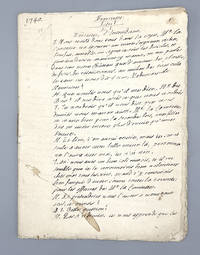
1740cmd20<p><strong> XVIIIth c. THEATRE – FEMINISM</strong></p><p><strong> AN <em>AVANT-GARDE</em> PLAY ON <em>"WOMEN'S CONSENT" </em></strong></p><p><strong> EXTREMELY RARE MANUSCRIPT BY FONTENELLE WITH CORRECTIONS </strong></p><p><strong> MANUSCRIPT</strong></p><p><strong> FONTENELLE Bernard le Bovier de</strong></p><p><strong> <em>Henriette</em> Paris 1740 </strong>32 pp.</p><p><strong> A precious autograph manuscript with corrections and variants of this innovative comedy written by Fontenelle in his eighties. It is the penultimate play he ever wrote. </strong></p><p>This comedy belongs to the theatre of the 18th century: a world of gallantry and sentiment centered on amorous sparring. <strong>But Fontenelle takes it further—although rooted in 18th-century conventions <em>Henriette</em> proves avant-garde in its critical perspective on women's roles in society and marriages of convenience</strong>. Far from being a mere comedy of manners it anticipates some Enlightenment ideas especially regarding female emancipation.</p><p><strong>It even contains an unusually forward-thinking development on women's consent Act I Scene 1: <em>"All that's missing is a trifle a word of consent."</em></strong></p><p>Our manuscript—which ends at Act IV Scene 4— shows traces of edits and revisions by Fontenelle ; some phrases have been crossed out or rewritten.</p><p><strong>A rare and invaluable glimpse into the making of an 18th-century play. </strong></p>
1717AQ19580London: Printed for W. Innys 1717. 16 xxxv 1 123 122-441 552 455- 464pp 4. With two terminal advertisement leaves. Contemporary gilt-tooled blind-panelled polished calf contrasting red morocco lettering-piece small shelf-label to head of spine. A trifle rubbed slightly chipped at head else a fine copy. The Macclesfield copy with the armorial 'North Library' bookplate shelf-mark 45.C.29 and typical armorial blind- stamps to title page and first two leaves of text pencilled shelf-marks to front endpapers. A choice copy of John Chamberlayne's significant translation of short biographies or 'Elogy as Mons. Fontenelle calls it' of eminent European scientists and mathematicians members of the French Academy of Sciences with excellent provenance: from the library of the dedicatee Thomas Parker 1st Earl of Macclesfield 1666-1732. Whilst the biographies within are translations of the work of Bernard le Bovier de Fontenelle 1657-1757 celebrated French author and secretary for forty-two years of the Academy of Sciences in the second half of the work English writer John Chamberlayne c.1668-1772 has added brief English abstracts of 'some of the Choicest Pieces Memoirs Dissertations &c' taken from the Academy's Transactions including work on flora fauna entomology 'Upon Bees' geological and meteorological phenomena. Chamberlayne's gushing dedication of this work to Lord Parker - then Lord Chief Justice - references the latter's patronage of the sciences was apparently presented 'without.consent or knowledge' and indeed is referenced in his later works also dedicated with similar gusto to the Earl of Macclesfield. This taken with the presence in the Macclesfield library of several copies of works presented to Chamberlayne including Miscellanea Berolinensia ad incrementum scientiarum Berlin 1710 inscribed by Dr. Daniel Ernst Jablonski likely acquired by Parker after the 1724 sale of the library of Chamberlayne pere et fils further suggests a close connection between the two. A printed postscript to the dedication of this work also directed by Chamberlayne at 'My Lord' Parker discusses the disagreement over 'the Differential Calculation as the Invention thereof which I think is every where ascribed to the late Mons. Liebnitz' and 'no where attributed as it ought to our own Countryman Sir Isaac Newton the First Mathematician in the World' and shares with his readership that 'Dr. Keill.has done our British Philosopher justice; and fully proved that which Mr. L did in some manner acknowledge to me when I attempted to reconcile these two Great Men that Sir I.N. might be the first inventor'. Although not a presentation copy per se given the connection between the translator and early owner this is surely one of the most interesting copies available of this significant work documenting the work of the French academicians. . First edition. 8vo. Printed for W. Innys unknown
1753000010568Glasgow: R. Urie 1753. Later edition. Hardcover. Very Good. 12mo. 3 iv-x 1 2-144 2 pp. Contemporary smooth calf with the spine in six compartments a maroon morocco label lettered in gilt on the spine; all edges decoratively sprinkled. Completing the title page: Wherein are Proved I. That the Oracles were not given out by Daemons; but were invented and supported by the Craft of the Pagan Priests. II. That the Oracles did not cease at the coming of Jesus Christ; but subsisted four hundred Years after it till the entire Abolition of Paganism. Oxford DNB Janet Todd "Behn Aphra Aphara 1640–1689". Translated from the French into English by Aphra Behn. Originally published in English in 1688. This work helped to popularize Copernican science and was also a comparative study of pagan religions especially in late antiquity. The publication of this book was dangerous as it questioned the Anglican and Catholic Church's authority. Moderate rubbing to the joints with two tiny holes exposed; an early owner's name on the first page of the preface. R. Urie hardcover
1733344951733 Paris - Brunet - Bordelet - 1733 - 1 volume in12 de 8 - 422 - 2 pages - Reliure pleine basane d'époque - dos cinq nerfs orné - tranches rouges - coiffes arasées - mors partiellement fendus -
1733ROD0107606BRUNET FILS & BORDEL M.. 1733. In-12. Broché. Bon état, Couv. convenable, Dos à nerfs, Intérieur frais. 422 pages. Dos à 5 nerfs. Etiquette collée sur la coiffe en tête. Tampon sur la page de titre et la page 25.. . . . Classification Dewey : 809-Histoire, littérature
1733RW1080Paris:: Chez la Veuve Brunet fils. . . et Marc Bordelet 1733. 1733. 12mo. viii 422 misnumbered "322" 2 pp. Frontis. engraved portrait. of Fontenelle – is trimmed folded at the upper and lower edges by "Crepy rue St. Jacques au lion d'Argent" title woodcut vignette. Original gilt-stamped calf gilt-stamped spine label raised bands. Inscription on title: "O.R. lousin aet coner". Very good copy with a handsome binding. "Extra-illustrated" with an added engraved bound-in folding frontispiece. This edition of the author's eulogies includes fourteen members of the Academie des Sciences who died between 1725 and 1730. There were two issues of this work printed in 1733: one showing "Brunet fils and Marc Bordelet the other issue showing only Marc Bordelet's name as publisher. They also feature a resetting of the type at least for the title-page and a different title woodcut vignette. There was an earlier 1731 Dutch edition of the Eloges printed by Isaac van der Kloot but I have been unable to determine if the biographies contained therein are the same. A note indicates this was also re-issued as miscellany works Oeuvres diverses of Fontenelle in 1736 see pt. 4. Fontenelle was a prolific biographer of notable persons publishing also a series of Dialogues with famous past historical figures. His Eloges commenced with a 1699 work on Claude Bourdelin. He also issued collective editions starting in 1708. This is the first 'separate' edition of the "Suite" containing biographies of 14 scientific notables. "It was Bernard Bovier de Fontenelle 1657-1757 who by his eulogies of scientists first bridged the gap between the scientific communities and the world at large . the eloges of the old Academy of Sciences acquainted laymen with a discipline that was at once esoteric by its novelty and forbidding by its terminology and methodology. Hence the eloges aside from the other functions they performed in the service of science also served as a public relations organ in the same manner as journals textbooks public lectures literary dialogues scientific expositions and cabinets de physique and d'histoire naturelle" - Charles Bennett Paul Science and immortality: the Eloges of the Paris Academy of Sciences 1699-1791 Berkeley: University of California Press 1980. pages 1-2. Contents: eloges du Czar Pierre I - Alexis Littre 1658-1726 – Nicolas Hartsoeker 1656-1725- Guillaume Delisle 1675-1726 - Nicolas de Malezieu 1650-1727 – Isaac Newton published 1727 1728 - Charles-Rene Reyneau 1656-1728 - Marechal de Tallard 1652-1728 - Sebastien Truchet 1656-1729 – Francois Bianchini 1662-1720 – Jacques-Philippe also known as: Giacomo Filippo. . . Maraldi 1665-1729 - Jean-Baptiste-Henri de Valincourt 1653-1730 – Count Luigi Ferdinando Marsigli 1658-1730 – Du Verney 1648-1730 - et le discours de Fontenelle a l'Academie francaise recevant l'eveque de Lucon. See: Suzanne Delorme "Contribution a la bibliographie de Fontenelle." p. 305. Revue d'histoire des sciences Annee 1957 vol. 10-4 pp. 300-309. Chez la Veuve Brunet fils,. . . et Marc Bordelet 1733. hardcover books
1733310011733. A Paris chez Osmont / Hourdel / Huart l'A”nÂŽ / Gissey / David le Jeune / Chaubert / Clousier 1733. Un vol. au format in-12 172 x 98 mm de 1 f. bl. 4 ff. n.fol. 322 pp. 1 f. n.fol. de catalogue ÂŽditeur in fine et 1 f. bl. Reliure de l'ÂŽpoque de plein veau glacÂŽ blond filet ˆ froid encadrant les plats dos ˆ nerfs ornÂŽ de filets gras ˆ froid caissons d'encadrement dorÂŽs fleurons dorÂŽs jeu de petits filets verticaux dorÂŽs sur les nerfs piÂce de titre de maroquin acajou titre dorÂŽ palette dorÂŽe en tÂte et queue jeu de petits filets dorÂŽs sur les coupes tranches mouchetÂŽes. Edition originale. ''Ce recueil d'ÂŽloges est l'ouvrage de Fontenelle qui lui a fait le plus d'honneur''. in Brunet. Le prÂŽsent volume recÂle les biographies du Tsar Pierre Ier de LittrÂŽ Hartso‘ker Delisle MalÂŽzieu Newton Reyneau de Tallard Bianchini Maraldi de Valincourt Marsigli du Verney et Truchet Carme. Brunet II Manuel du libraire et de l'amateur de livres 1333 - Cioranescu I Bibliographie de la littÂŽrature franÂaise 30735. TrÂs lÂŽgÂres altÂŽrations superficielles affectant la reliure. Quelques claires rousseurs et petite irisation angulaire dans le corps d'ouvrage. Du reste bonne condition. b42961 unknown
1733RW1080Paris:: Chez la Veuve Brunet fils. . . et Marc Bordelet 1733. 1733. 12mo. viii 422 misnumbered "322" 2 pp. Frontis. engraved portrait. of Fontenelle – is trimmed folded at the upper and lower edges by "Crepy rue St. Jacques au lion d'Argent" title woodcut vignette. Original gilt-stamped calf gilt-stamped spine label raised bands. Inscription on title: "O.R. lousin aet coner". Very good copy with a handsome binding. "Extra-illustrated" with an added engraved bound-in folding frontispiece. This edition of the author's eulogies includes fourteen members of the Academie des Sciences who died between 1725 and 1730. There were two issues of this work printed in 1733: one showing "Brunet fils and Marc Bordelet the other issue showing only Marc Bordelet's name as publisher. They also feature a resetting of the type at least for the title-page and a different title woodcut vignette. There was an earlier 1731 Dutch edition of the Eloges printed by Isaac van der Kloot but I have been unable to determine if the biographies contained therein are the same. A note indicates this was also re-issued as miscellany works Oeuvres diverses of Fontenelle in 1736 see pt. 4. Fontenelle was a prolific biographer of notable persons publishing also a series of Dialogues with famous past historical figures. His Eloges commenced with a 1699 work on Claude Bourdelin. He also issued collective editions starting in 1708. This is the first 'separate' edition of the "Suite" containing biographies of 14 scientific notables. "It was Bernard Bovier de Fontenelle 1657-1757 who by his eulogies of scientists first bridged the gap between the scientific communities and the world at large . the eloges of the old Academy of Sciences acquainted laymen with a discipline that was at once esoteric by its novelty and forbidding by its terminology and methodology. Hence the eloges aside from the other functions they performed in the service of science also served as a public relations organ in the same manner as journals textbooks public lectures literary dialogues scientific expositions and cabinets de physique and d'histoire naturelle" - Charles Bennett Paul Science and immortality: the Eloges of the Paris Academy of Sciences 1699-1791 Berkeley: University of California Press 1980. pages 1-2. Contents: eloges du Czar Pierre I - Alexis Littre 1658-1726 – Nicolas Hartsoeker 1656-1725- Guillaume Delisle 1675-1726 - Nicolas de Malezieu 1650-1727 – Isaac Newton published 1727 1728 - Charles-Rene Reyneau 1656-1728 - Marechal de Tallard 1652-1728 - Sebastien Truchet 1656-1729 – Francois Bianchini 1662-1720 – Jacques-Philippe also known as: Giacomo Filippo. . . Maraldi 1665-1729 - Jean-Baptiste-Henri de Valincourt 1653-1730 – Count Luigi Ferdinando Marsigli 1658-1730 – Du Verney 1648-1730 - et le discours de Fontenelle a l'Academie francaise recevant l'eveque de Lucon. See: Suzanne Delorme "Contribution a la bibliographie de Fontenelle." p. 305. Revue d'histoire des sciences Annee 1957 vol. 10-4 pp. 300-309. Chez la Veuve Brunet fils,. . . et Marc Bordelet 1733. hardcover
176457289Kiøbenhavn Trykt hos N. Møller 1764. 8vo. I samtidigt hellæderbind med forgyldt titel og ornamentik på ryg og blågrønt snit. Lille papirmerkat påklistret ryggen. Udvendig med en smule slitage ellers pænt eksemplar. 1-335 pp. med 14 træsnit af planetbaner månefaser og andre astrologiske fænomener i teksten. <br/><br/><em>Andet oplag af den danske oversættelse af Fontenelle's "Entretiens sur la pluralité des Mondes" </em> unknown
1728151186Dordregt; Amsterdam: Hendrik Walpot; Isaak Tirion 1728; 1732. First book is a second edition; Ninth edition. Hardcover. Good. 2 vols. in one book: 26 189 498 18 p. 18 cm. Engraved frontispiece and three other plates two of which fold out. Second title in black and red. Leather spine and corners with brown paper boards. Lilt trim on spine. Spine leather cracked corners and edges worn paper scuffed. Ink signature on first title page. First folding plate has hole and is cut off at bottom. Small tear in p. 1. Small ink notation on second folding plate. Ink blots pp. 125-131 in first section. Dutch text. <br/><br/>Two books bound together. Bernard Le Bovier de Fontenelle 1657 1757 was noted for his accessible treatment of scientific topics during the unfolding of the Age of Enlightenment. Remarkably for his time he died only one month before his 100th birthday. A noted gourmand he attributed his longevity to eating strawberries. Book I in this volume is the second edition of the first Dutch translation of "Entretiens sur la pluralité des mondes." First edition was in 1702. The author engages in a philosophical discussion with laymen in this book about Copernican astronomy and Cartesian physics with the aim of education readers about science. Includes fold-out engraving of the solar system and anoter one showing the surface of the moon. There are also two title poems by Joh. vanden Brouke and A. de Zoete. <br /> <br />John Ray 1627 1705 author of the second book was an English parson-naturalist who published several important works on botany zoology and natural theology. The John Ray Initiative formed in 1997 takes its name from this theologian; the organization exists to promote a Christian understanding of environmental issues. Hendrik Walpot; Isaak Tirion hardcover
170244534Paris, Jean Boudot, 1702. 4to. Without wrappers. Extracted from ""Mémoires de l'Academie des Sciences"". Année 1699. With the fine engraved frontispiece and the titlepage to the volume. (22) pp.. Stamped in blind on the 2 first leaves, in margins.
170244534Paris Jean Boudot 1702. 4to. Without wrappers. Extracted from "Mémoires de l'Academie des Sciences". Année 1699. With the fine engraved frontispiece and the titlepage to the volume. 22 pp. Stamped in blind on the 2 first leaves in margins. <br/><br/><em>First appearance of Fontenelle's famous program for the philosophy of science of the Enlightment stipulating the nature of scientific research in terms of the analytical geometry."From 1699 to 1740 Fontenelle devoted himself almost exclusively to his task of editing the Histoire de l’Académie royale des sciences . . . avec les mémoires de mathématique et de physique pour la même année tirés des registres de cette Académie. The volume for the year 1699 which appeared in 1702 opens with an untitled preface usually called "Préface sometimes "Discours préliminaire" sur l’utilitë des mathématiques et de la physique et sur les travaux de l’Académie the paper offered which contains essential material on the philosophy of science and is a sort of bridge between Descartes’s Discours de la méthode and Claude Bernard’s Introduction à l’étude de la médecine expérimentale. Here one finds the first literary expression of the idea of the interdependence of the sciences and of the constancy of the laws of nature." </em> unknown
171329911713 Londres, aux dépens de Paul & Isaak Vaillant, 1713, volume in-12 relié plein veau brun raciné de l'époque, VI-193-8(non paginées, table) pages, dos à 5 nerfs orné de caissons dorés, pièce de titre bordeaux, très bon état
171381221713 Londres, aux dépens de Paul & Isaak Vaillant, 1713, in 12 de (3) ff. dont le titre, 193 pp.,(9) pp. de table, rel. d'ép., plein veau brun, dos à nerfs, pièce de titre de mar. rouge sombre, usure et manque à la coiffe sup., bon ex.