MachiavelBiblio.com

869 résultats
174792<p><b>Rare and precious edition of the Opere by Machiavelli missing in Gamba.</b></p><p>Bertelli-Innocenti 155 n. 60 ; Brunet III 1275.</p><p>First edition mentioned by Brunet of <i>"the principal editions of Machiavelli's Opere printed in the 18th century and worthy of being mentioned". </i>Brunet</p><p>Machiavelli's importance is proportional to the interest the 18th century had of politics: as interest in political science increases so do the references to the <i>Prince</i>. </p><p>A real political movement was created. The question of liberty is fundamental to Machiavelli who associates the law to the desire for freedom which is what the quest of the Enlightenment was. If the <i>Prince</i> is considered by the Church to be an impious text many philosophers manifested a keen interest for the "republican" maxims found in this treaty reputed to be odious.</p><p>In his own way Montesquieu continued Machiavelli's work.</p><p>Nicollo Machiavelli 1469-1527 wrote in one session the 26 chapters of the <i>Prince</i> his masterpiece in 1513. His last text <i>The History of Florence</i> was started in 1520 and finished in 1526 the account ending with the death of Lorenzo di Medici and the alteration of the political balance of Italy. </p><p>"<i>His genius principally lied in the way he brilliantly treated modern history. He seized through his superior genius the real principles of the constitution of the States unthreaded their motives with finesse explained the causes of their revolution; basically he carved a new road and examined all of the depths of politics." </i>Diderot</p><p><b>A beautiful and precious copy on large paper with wide margins preserved in its attractive contemporary calf binding with the arms of la Pompadour.</b></p><p><i>From an artistic point of view she had great influence on her era : "She inspired good taste and the arts during the period she called her "reign" says the baron Roger Portalis in his nice book on the Dessinateurs d'illustrations au dix-huitième siècle. It is under her influence and inspiration that Carle Vanloo and Boucher painted that Bouchardon Coustou Falconnet and Pigalle sculpted their marbles ; that Cochin and Eisen drew that Guay engraved his stones and each of these artists' work bears the Pompadour seal</i>."</p> hardcover
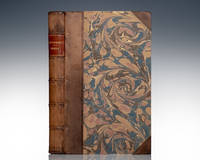
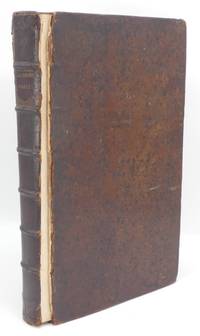
1675148533London: John Starkey at the Miter in Fleetstreet near Temple-Bar 1675. First edition in English of the most important writings of Niccolo Machiavelli widely considered the foundation of the modern study of politics. Includes The History of Florence The Prince Discourses on Livy and The Art of War. Folio bound in three quarter modern calf over marbled boards with gilt-lettered morocco spine label modern endpapers but retaining early binder's flyleaves engraved ornamental initials headpieces. Without the general title frontispiece or ads sometimes encountered. Included is “Nicholas Machiavel’s Letter to Zanobius Buondelmontius in Vindication of Himself and His Writings†which was in fact authored by Henry Neville the translator of this edition. There are two issues of this work in 1675: one with the general title page imprint “Printed for John Starkey†this copy and another “Printed for J.S.†Separate title pages for The History of Florence The Prince The Discourses and The Art of War as issued. French inscription to the front binder's flyleaf marginal toning and spotting throughout toning to the spine. In very good condition. A very sharp example. “Machiavelli founded the science of modern politics on the study of mankind… Politics was a science to be divorced entirely from ethics and nothing must stand in the way of its machinery†PMM 63. “Machiavelli is a popular symbol for the… completely unprincipled and unscrupulous politician whose whole philosophy is that the end justifies the means. The highest law to Machiavelli it is universally believed was political expediency… From a comparative reading of Discourses and The Prince one must come to the startling conclusion that Machiavelli was a convinced republican. He had no liking for despotism and considered a combination of popular and monarchical government best. No ruler was safe without the favor of his people. The most stable states are those ruled by princes checked by constitutional limitations… His ideal government was the old Roman republic and he constantly harked back to it in the Discourses… It is hardly disputable that no man previous to Karl Marx has had as revolutionary an impact on political thought as Machiavelli†Downs 12. “He more than any other political thinker created the meaning that has been attached to the state in modern political usage†Sabine 351. John Starkey at the Miter in Fleetstreet, near Temple-Bar hardcover
albf2e7c792c898b099Machiavelli N. Sovereign (Il principe) and reflections on the first three books of Titus Livia. In Russian (ask us if in doubt)/Makiavelli N. Gosudar' (Il principe) i rassuzhdeniya na pervye tri knigi Tita Liviya. Short description: In Russian (ask us if in doubt).Translation from Italian edited by N. Kurochkin. St. Petersburg: Tiblen Printing House 1869. 4 X 502 p. We have thousands of titles and often several copies of each title may be available. Please feel free to contact us for a detailed description of the copies available. SKUalbf2e7c792c898b099
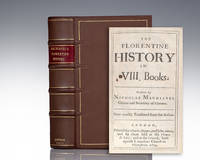
1674149757London: Charles Harper and John Amery 1674. Rare second English edition of Machiavelli s Florentine History the first edition to appear after Thomas Bedingfield s translation in 1595 of this political and historical account of Florence. Sextodecimo bound in full leather morocco spine label gilt titles to the spine in five compartments within raised bands gilt ruling to the panels all edges marbled marbled endpapers frontispiece. In very good condition. Florentine Histories is a historical account by Italian Renaissance political philosopher and writer Niccolò Machiavelli. After the crisis of 1513 with arrests for conspiracy torture and after being sentenced to house arrest Machiavelli's relationship with the Medici family passively began to mend itself. If the dedication of Il Principe 1513 to Lorenzo II de' Medici had not any effect part of the then dominant faction of the Florence was not against him and instead granted him an appointment. In his letter he deplores of his idle state offering his precious political experience to the new lord. To sustain that timid request Machiavelli with a considerably courtier-like spirit set his Mandragola for the wedding of Lorenzino de' Medici. In 1520 he was invited to Lucca for a mission of a semiprivate character indicating that the ostracism was to be raised up. At the end of that year Giulio Cardinal de Medici commissioned him to write a History of Florence. Although this was not exactly the charge he desired Machiavelli accepted it as the only possible way to come back into the graces of the Medici. The intent of the work although semi-officially was to recover the city's charge of historic officiality. The wage for the appointment was not large 57 florins per year later increased to 100. The finished work was presented officially to Giulio de' Medici now Pope Clement VII in the May 1526. The Pope liked the work and rewarded him albeit moderately and asked him support in the creation of a national army on the wake of his theorical work The Art of War in the preparations for the War of the League of Cognac. However after the Sack of Rome 1527 and the fall of the Medici government in Florence Machiavelli's hopes were dashed. Machiavelli would die soon afterwards. Charles Harper and John Amery hardcover
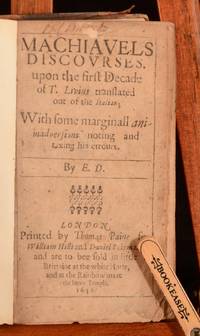
1636EXP3-A-6London: Tho Paine for W Hills and D Pakeman 1636. First edition. Leather. Good Only. 6" by 3.5". None. Niccolo Machiavelli's political history work Discourses on Livy. This is the first English translation of this work. Translated by Edward Dacres a prominent translator of Machiavelli's works. Collated complete. A very scarce copy of this work. Would make a good copy once rebound rarely seen at all and usually in very poor state. Discourses on Livy is a philosophical political history. It was written in the early 16th century and was first published posthumously in 1531. The work discusses Livy's Ab Urbe Condita which discuss the expansion of Rome through the end of the Third Samnite War. Niccolo Machiavelli was a Florentine Renaissance historian politician humanist philosopher and author. In a contemporary calf binding. Externally worn. Severe loss to the backstrip and to the boards. Patches of rubbing to what remains of boards. Evidence of some previous repair to the joints and boards. Front joint and hinge are extremely weak and held by one cord only. Highly likely board with detach with further handling. Rear hinge is also weak and held by two cords. May detach with further handling. Internally binding is tender in place and strained throughout. Pages are slightly age toned. Light tidemarks to the top of the outer margin to pages 135-195 then again to pages 245-288pp and 389-434pp not affecting text. Occasional scattered spots throughout. Overall: GOOD ONLY due to binding. Good Only Tho Paine for W Hills and D Pakeman hardcover
157760444Paris Guillaume de la Noue 1577. 8vo. In recent full limp vellum with yapp edges. Woodcut printer's device on title woodcut headpieces and initials. Small closed tear to upper inner margin of title-page. First 33 ff. with small worm tract in inner margin with minor loss of text. Light dampstaining to first and last leaves. A good copy. 36 294 6 pp. <br/><br/><em>The exceedingly rare first French and presumably very first overall translation of Machiavelli's Florentine Histories; his famous account of the political events and power struggles in Florence during the Renaissance. Essentially being a panegyric to the house of Medici Machiavelli's work offers valuable insights into the rise and fall of political factions the challenges faced by republican governments and the dynamics of power in a city-state. Although often overshadowed by his more famous 'The Prince' the present work is important in understanding Machiavelli's broader political philosophy and is an indispensable document in understanding renaissance politics in general. The Histories constitute an essential work for understanding the political development of the late Machiavelli and is “also an important item in modern historiography because for the first time the issue of conflict and more precisely of urban conflict finds itself at the heart of historical narrative ….Infact the Histories constitute the first attempt in modern historiography to analyze the totality of individual and collective agents and factors that allow a community to sustain itself or to founder. This analytical quality was certainly at the basis of the interest in the work outside Florence and the fact of its being translated. As Yves de Brinon explains in dedicating his ‘Histoire Florentine the present work to Cathrine de Medici the case of Florence is a model for the dangers that threaten the integrity of every state and the Kingdom of France in Particular.†Landi A re-reading of Machiavelli. Machiavelli visited France representing the Republic of Florence where he - and later his writings - exercised great influence. The Huguenot Innocent Gentillet whose work commonly referred to as 'Discourse against Machiavelli' or 'Anti Machiavel' accused Machiavelli of being an atheist and accused politicians of his time by saying that his works were the "Koran of the courtiers" that "he is of no reputation in the court of France which hath not Machiavel's writings at the fingers ends" Birely The Counter Reformation 1990. “Although Machiavelli became the embodiment of a real "devil theory of history" there was nothing supernatural or even suspicious about his journey across the Alps. As the French translator remarked to his customers in 1544 "This Florentine merchant has voluntarily left his own country to be received into yours. Do not be so ungracious as to refuse him citizenship. From all appearances he was welcomed with open arms or at least open minds. Within a few years one of his admirers declared that he was a prophet honored more in France than in his own country." Kelley Murd'rous Machiavel in France: A Post Mortem. Following the crisis of 1513 which involved arrests for conspiracy and torture Machiavelli's relationship with the Medici family gradually improved. Despite the dedication of his book "Il Principe" to Lorenzo II de' Medici having little effect Machiavelli found favor with a faction in Florence that was not opposed to him and was granted an appointment. In a letter Machiavelli expressed his dissatisfaction with his idle state and offered his valuable political experience to the new ruler. To further solidify his position Machiavelli adopting a somewhat courtier-like attitude arranged for the staging of his play "Mandragola" at the wedding of Lorenzino de' Medici in 1518. In 1520 he received an invitation to Lucca for a semi-private mission indicating that his ostracism was coming to an end. Later that year Giulio Cardinal de Medici commissioned him to write a history of Florence. Although this was not exactly the role he desired Machiavelli accepted it as the only way to regain the favor of the Medicis. The purpose of the work although unofficial was to restore the city's official historical standing. The salary for this appointment was not substantial starting at 57 florins per year and later increased to 100. In May 1526 Machiavelli formally presented the finished work to Giulio de' Medici who had become Pope Clement VII. The Pope appreciated the work and rewarded Machiavelli though only moderately and sought his support in creating a national army based on his theoretical work "The Art of War" in preparation for the War of the League of Cognac. However Machiavelli's hopes were shattered following the Sack of Rome in 1527 and the fall of the Medici government in Florence. Soon after Machiavelli passed away. This exceedingly scarce first French edition was issued with two variant title-pages the present referred to as variant-b. see Gerber Niccolo Machiavelli. Bibliopgraphia Machiavelliana p. 60 no. 160. Gerber dritter teil p. 37 D-b. Brunet 1279. </em> hardcover
163086791550 (1630). In-4 (215 x 168 mm), 2 ff.n.ch.; 8 pp., 351 pp.; 2 ff .n.ch., 116 pp.; 14 pp., 1 f. blanc n. ch., 304 pp.; 168 pp. mal chiffrées 158; 170 pp. Maroquin vert à grain long, roulette dorée encadrant les plats, dos lisse orné de filets dorés, titre, auteur et chiffre en pied dorés, petit défaut en haut du dos, des rousseurs (reliure du début du XIXe siècle).
alb40a31a83aa2a3bccMachiavelli N. Sovereign (IL PRINCIPE). In Russian /Makiavelli N. Gosudar ( IL PRINCIPE). Writing by Nikolai Machiavel. St. Petersburg The printing house of the Society of Public Usefulness. 1869. 38 p. We have thousands of titles and often several copies of each title may be available. Please feel free to contact us for a detailed description of the copies available. SKUalb40a31a83aa2a3bcc.
alb67f92963ad6cd9bbMachiavelli N. Sovereign. In Russian (ask us if in doubt)/Makiavelli N. Gosudar'. Short description: In Russian (ask us if in doubt).Ill. A. Durrer H. Burgmayer. Moscow Leather Mosaic Publishing House. 2018. 330s. We have thousands of titles and often several copies of each title may be available. Please feel free to contact us for a detailed description of the copies available. SKUalb67f92963ad6cd9bb
179922911Paris Potey et Pichard 1799 -in-8 plein-veau 9 volumes, reliure plein veau glacé vert olive marbré in-octavo (binding full calfskin in-8)(20,2 x 13 cm), SUPERBE RELIURE EMPIRE D'EPOQUE, dos long (spine without raised bands), décoré or (gilt decoration), titre et tomaison frappés "or", pièce de titre et de tomaison sur fond maroquin cerise, avec un filet "or" de part et d'autre, entre nerfs à fleuron "or" avec 4 doubles filets perlés "or" croisés autour du fleuron en losange avec une étoile "or" aux angles, roulette "chainette" "or" en place des nerfs avec un filet "or" de part et d'autre et en tête et en pied, plats décorés "or" d'une roulette feuillage "or", un filet "or" et une roulette fine "or" en encadrement, roulette "or" sur les coupes, toutes tranches lisses rouges, ornés d'un portrait de Machiavel en frontispice en noir peint par A. Brunzino et gravé par Levasseur (Tome I) + 7 planches hors-texte en noir Pour L'Art de la Guerre (dont 2 dépliantes et 2 planches doubles)(les planches V et VI de l'Art de la Guerre ont été mis par erreur au Tome I aux pages correspondantes, au lieu de les mettre au Tome V), (CXVII + 408) + 384 + 403 + 416 + 448 + 455 + 394 + 370 + 524 pages, An VII (1799) Paris: Potey et Pichard Editeur,
1680AN1GLTBRN217London: Printed for John Starkey Charles Harper and John Amery 1680. Hardback contemporary mottled calf front board detached. Gilt title to red leather label to spine. Marbled edges. 32cm x 20cm. Pp. 22 528 15. Woodcut typographic ornament to title woodcut typographic headpieces and decorative initials. 2nd edition 1680. 'The Publisher to the Reader Concerning the following Letter' bound into rear. Some cracking to outer joint to upper spine small losses to spine label. Engraved armorial bookplate of Samuel Goodford of Inner Temple 1737 to front pastedown. Front free end-paper detached. Previous owner's details written to front blank. Page 1 is loose with small burn hole within text with loss of a few letters. Cut with some fraying to some inner margins between page 448-456 & 489-503. Scarce. A heavy book additional postage may be required for orders outside the UK. an1. 2nd Edition. Hard Cover. Good. Printed for John Starkey, Charles Harper, and John Amery Hardcover
1799119209Paris Chez Potey et Pichard, an VII (1799) 9 vol. reliés 9 vol. in-8, plein veau marbré brun, dos lisses ornés de frises et fleurons dorés, pièces de titre et de tomaison de maroquin rouge et vert, frise dorée en encadrement sur les plats, tranches mouchetées, CXVII + 408, 384, 403, 416, 448, 455, 394, 370 et 524 pp. Première édition de cette nouvelle traduction comprenant un portrait par Brunzino gravé par Levasseur et 2 plans dépliants au tome 5. Ex-libris gravé. Quelques traces d'usage, mais bel exemplaire dans une jolie reliure de l'époque.
1799119209Paris Chez Potey et Pichard, an VII (1799) 9 vol. reliés 9 vol. in-8, plein veau marbré brun, dos lisses ornés de frises et fleurons dorés, pièces de titre et de tomaison de maroquin rouge et vert, frise dorée en encadrement sur les plats, tranches mouchetées, CXVII + 408, 384, 403, 416, 448, 455, 394, 370 et 524 pp. Première édition de cette nouvelle traduction comprenant un portrait par Brunzino gravé par Levasseur et 2 plans dépliants au tome 5. Ex-libris gravé. Quelques traces d'usage, mais bel exemplaire dans une jolie reliure de l'époque.
174120801Marseille Colomb 1741 in-8 plein-veau 3 parties reliées en un volume, reliure plein veau brun raciné in-octavo (binding full calfskin in-8) (12,6 x 20 cm), RELIURE D'EPOQUE, dos à nerfs (spine with raised band), décoré or et à froid (gilt and blind stamping decoration), titre frappé or, pièce de titre sur fond bordeaux avec filet "or" et filet perlé "or" en encadrement, entre-nerfs à fleuron or dans un encadrement à filet or et filet perlé or avec rinceaux "or" aux angles, filet à froid de part et d'autre des nerfs, roulette or en tête et en pied, plats décorés à froid d'un filet à froid en encadrement, coins trés légèrement émoussés, roulette or sur les coupes avec manque de dorure, toutes tranches lisses rouges, titre imprimé en rouge et noir, sans illustration (no illustration), (XXXII + 82 + 112 + 67+ [3 p. de table]) Pages, 1741 A Marseille, chez les frères Colomb Editeurs,
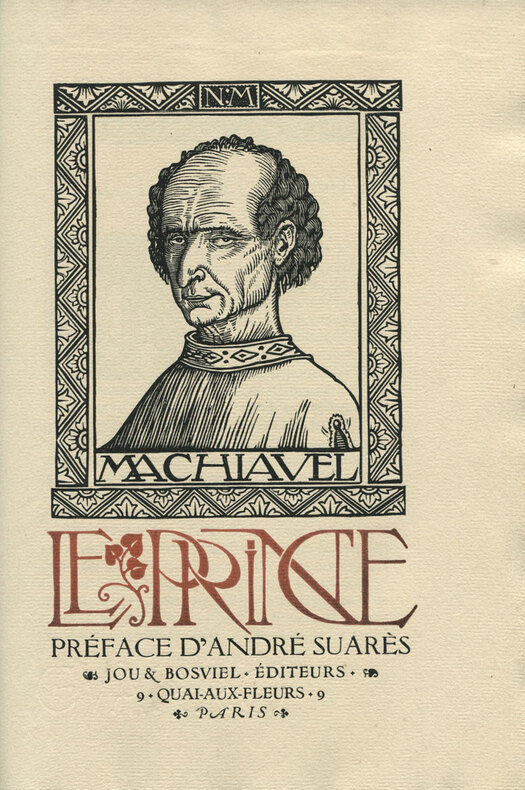
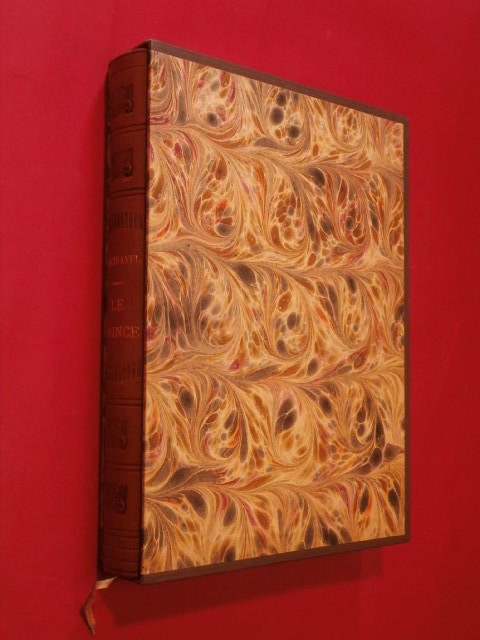
1921LIQ-5416P. Jou et Bosvier 1921 In-4° broché en feuilles (quelques rousseurs éparses)
18741S.l., 1613. 2 parties en 1 vol. petit in-8°, vélin ivoire à rabats, titre écrit à la plume au dos. Reliure de l'époque. Agréable exemplaire. Ex-libris cancellé sur le titre. (4) ff., 288 pp. mal chiffrées 290, (7) ff., (1) f. blanc; 85 pp., (5) pp., (1) feuillet blanc. Signatures : at4 [A-Z]8 [Aa-Oo]8 ; [a-k]8 l4. Rousseurs uniformes, larges mouillures pâles.
137241948 La tradition Reliure demi cuir à bandes, couverture conservée, 158p. Trés bon état.
180438088Milano: Dalla Societa Tipografica De Classici Italiani. Very Good with no dust jacket. 1804. Leather. plates; 632 pages; Vols I-X complete. Solidly bound in full calf leather and sympathetically rebacked. Marbled end papers. Italian language text. The two major political works The Prince 1513 and Discourses are included in Volumes 2 and 3. Provenance- C W Thompson signed on each second fep. 1804-1805. His portrait by Guiseppe Bennaglia as frontis in vol I and also a plate showing an allegorical figure holding a cameo of Niccolo. Errata bound in. Fine binding with marbled eps and matching text block edges. Includes a few foldout plates. . Dalla Societa Tipografica De Classici Italiani hardcover
1949B0328Oxford 1949-01-01. Hardcover. Very Good. 1949 Oxford reprint Fine/Near Fine DJ in Mylar dustjacket has tiny nick at top of front hinge slight fading to orange color on spine in new Mylar with price intact tight binding firm-square corners no markings found a very nice copy pics available on request. Oxford hardcover
162928869Paris Anthoine Robinot 1629 Fort Petit In-8 (5) - 276 ff - 6 ffnch de tables - 81 ff - (8) 193 ff ( 5 planches dépliantes ). toutes les pages sont foliotées et non paginées, doublez les chiffres indiqués pour avoir le nombre de pages donc.Les lacets du vélin sont modernes - Bonne reliure d'époque pour cette petite édition parisienne
192987715Paris:: Helleu et Sergent. Very Good. 1929. Hardcover. Text is in French. Translated from the Italian. Thirteen page preface by Benito Mussolini. Illustrated with wood engravings. Limited edition: this copy is number 886 of 1550 copies. Duodecimo sturdy vellum binding with black and red lettering on the spine top edge gilt sewn-in ribbon bookmark original covers bound in. Some dust soiling to the vellum binding else very good or better. Binding is solid and tight. ; 300 pages . Helleu et Sergent, hardcover
1815059319Albany NY: Henry C. Southwick 1815. No Statement of Printing. . Hardcover. Good/No Dust Jacket. A Good copy in full brown leather with black leather spine labels lettered in gold marbled endpapers. The covers are rubbed and appear original but the spine has been re-backed using the original spine leather but newer spine labels. The binding is sound and the text is unmarked but the paper has tanned/foxed throughout. Good quality paper: not brittle. The Art of War is paginated 3-285 followed by Anecdotes on the Life and Writings 286-322 and Hints 323-349. Not ex-library. <br/> <br/> Henry C. Southwick hardcover
192987715Paris:: Helleu et Sergent. Very Good. 1929. Hardcover. Text is in French. Translated from the Italian. Thirteen page preface by Benito Mussolini. Illustrated with wood engravings. Limited edition: this copy is number 886 of 1550 copies. Duodecimo sturdy vellum binding with black and red lettering on the spine top edge gilt sewn-in ribbon bookmark original covers bound in. Some dust soiling to the vellum binding else very good or better. Binding is solid and tight. ; 300 pages . Helleu et Sergent, hardcover books
1983332715Pennsylvania: Franklin Library 1983. First Edition; First Printing. Hardcover. Illustrated by Geoffrey Moss. Very Good Leather Bound. Printed on archival paper with gilded edges. The endsheets are of moire fabric with a silk ribbon page marker. Smyth sewing and concealed muslin joints to ensure the highest quality binding. This book is in full leather with hubbed spines. Notes From the Editor neatly laid in. Shelfwear on front panel side edge.; The Great Books of the Western World. Franklin Library hardcover
1983207967Franklin Center Pennsylvania: Franklin Library 1983. First Edition; First Printing. Hardcover. Near Fine in boards. Book accented in 22kt gold. Printed on archival paper with gilded edges. The endsheets are of moire fabric with a silk ribbon page marker. Smyth sewing and concealed muslin joints to ensure the highest quality binding. This book is in full leather with hubbed spines.; Great Books of the Western World. Franklin Library hardcover