Jean Le Rond d' Alembert, Pierre Mouchon, Denis Diderot; Voltaire, Rousseau, Montesquieu, MarmontelBiblio.com
214 résultats
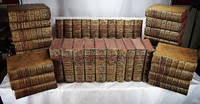
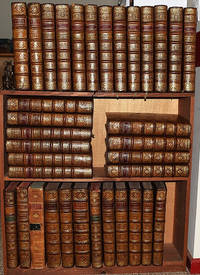
17512605210193Chez Briasson David Le Breton Durand A Paris; Amsterdam 1751 - 1777 1751. First Edition. Hardcover. Very Good. 0x0x0. The Organization of Enlightenment Thought: The Revolution in Ideas. A first edition of this foundational encyclopedia of 18th century knowledge. A massive thirty-five volume set. Large folios volumes 39.5 x 25 cm. Bound in 18th-century French calf. Spines gilt with raised bands. One volume non-uniformly bound in light calf. <br> The set includes: Encyclopedie Paris: 1751-57 & Neuchatel 1765. 17 volumes; Recueil de planches. Paris: 1762-72. 11 volumes 1 2 part I 2 Part II 3 5 6 7 8 9 10 11; Supplement a l'Encyclopedie. Paris & Amsterdam: 1776-77. 5 volumes including the Suite de recueil de planches; Table Analytique. Paris: 1780. <br> Profusely illustrated with engraved plates. <br> Diderot's famous Encyclopedie was initially a modest translation of Chambers's Cyclopaedia. It grew as a project into a massive project which attempted to collect human knowledge from a rationalistic perspective instead of by nature or theology. In organizing knowledge from a position where human reason was paramount the supremacy of the Church was imperiled. As a result the Encyclopedie was widely controversial and placed on the Index Librorum Prohibitorum by the Catholic Church. In discussing fundamental philosophical issues such as on political authority and natural rights articles in the Encyclopedie shifted the basis of governmental authority from the divine right of Kings to radical concepts popular consent was the basis of legitimacy and the ideals of a social contract. The work was banned by the King of France. It spread the foundational ideas of the French Revolution and enlightenment thinkers. "No encyclopaedia perhaps has been of such political importance or has occupied so conspicuous a place in the civil and literary history of its century. It sought not only to give information but to guide opinion." "It was a war machine; as it progressed its attacks on both the church and still more on despotic government as well as Christianity itself became bolder and more undistinguished and it was met with persecution and opposition unparalleled in the the history of encyclopedias." - Encyclopedia Britannica 11th ed p. 1483. "A monument in the history of European thought; the acme of the age of reason; a prime motive force in undermining the ancien regime and in heralding the French Revolution" Printing in the Mind of Man 200. Refs: Grolier/Horblit 25b; Norman 637; PMM 200. <br> Includes: 17 v. : ill. ; 41 cm. supplement 4 volumes plates 11 volumes plates supplement 1 volume. Table Analytique 1 volume. This is an oversized or heavy book which requires additional postage for international delivery outside the US. Chez Briasson, David, Le Breton, Durand, A Paris; Amsterdam (1751 - 1777) hardcover
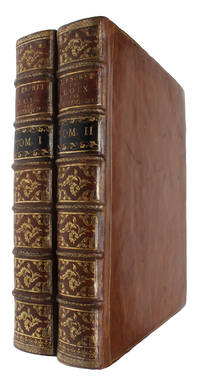
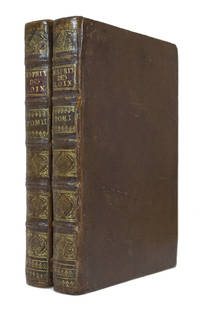
174854277Geneve Barrillot sic! & Fils 1748. 4to. Two lovely contemporary uniform full calf bindings with richly gilt spines gilt title- and tome-labels and single gilt line-borders to boards. Edges of boards blindtooled. Very neatly restored at hinges and corners barely noticeable. 19th century book-plate "FAMA" to inside if front boards. Old handwritten notes in ink to front free end-papers. Some leaves evenly browned as usual. Vol. I with contemporary owner's inscription "B. Heiman/ 1756/ S. st." to verso of title-page. Light inkspotting to half-title and occasional light brownspotting. Vol. II with very small owner's name to verso of front free end-paper: "Mr. Gustavo Horta" and with a worm tract. The worm tract is mostly very small and only in the very top corner of the upper blank margin or as a tiny hole in the inner blank margin towards the hinge. From pp. 493 to 544 the worm tract is larger but still situated in the blank margin outer and far from affecting text at any point. With both half-titles preface vol. 1 and tables of contents. No errata at the end of volume one and no folded map. Woodcut printer's devices to title-pages. 8 XXIV 522; 4 XVI 564 pp. <br/><br/><em>The very rare first edition first issue of Montesquieu's seminal main work "in many ways one of the most remarkable works of the eighteenth century" PMM 197 in which the author presents his theory of constitutional monarchy advocating constitutionalism and the separation of powers and explains human laws and social institutions. The very first printing i.e. the first edition first issue of the present work is of the utmost scarcity. Numerous editions and issues of the work were printed in the months following the first appearance. The present copy has the first issue pointers the two "r"s in "Barrillot" on the title-page no errata. It does not have a folding map as mentioned by Brunet but whether this is actually supposed to be present or not in the first printing has not been established - some bibliographers say that it should not be there.Montesquieu began writing this his magnum opus in 1743 by the end of which year he had almost finished the first draft of it. The same year he began the first of two great revisions of it which he finished in 1746. In 1747 he finished his second revision adding several new chapters and chose J. Barrillot from Geneva to publish the work which finally appeared for the first time in November 1748 in two quarto volumes with no mention of author or year. Numerous editions and issues appeared the following months and years and by 1751 22 editions of the work had appeared. Already in 1750 the work was published in English the English editions amounting to 10 by 1773 and by 1801 the work had appeared in both German 1789 Dutch Danish Polish Italian and Russian 1801. The work exercised the greatest of influence both negative and positive and numerous anti-Montesquieu-pamphlets and articles appeared during the last half of the 18th century. Because of the work Montesquieu was also attacked by the Sorbonne as well as in the general assembly of the French clergy and in Rome. In 1751 the work was placed on the Index.As the number of editions translations etc. bears witness to the work provided the greatest of impact on 18th century political thought as well as actual politics and law. In fact few other works can be claimed to possess the same power of influence as this one directly affecting the likes of Tocqueville and Catherine the Great. Although Montesquieu had to defend himself against great thinkers like Voltaire "his theories underlay the thinking which led up to the American and French revolutions and the United States Constitution in particular is a lasting tribute to the principles he advocated." PMM 197. "Montesquieu was one of the great political philosophers of the Enlightenment. Insatiably curious and mordantly funny he constructed a naturalistic account of the various forms of government and of the causes that made them what they were and that advanced or constrained their development. He used this account to explain how governments might be preserved from corruption. He saw despotism in particular as a standing danger for any government not already despotic and argued that it could best be prevented by a system in which different bodies exercised legislative executive and judicial power and in which all those bodies were bound by the rule of law. This theory of the separation of powers had an enormous impact on liberal political theory and on the framers of the constitution of the United States of America." SEP.Kress: 4920; Tchemerzine: VIII 459; PMM 197. </em> hardcover
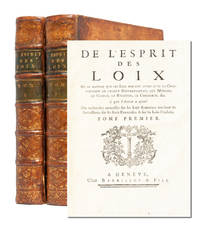
174869043Geneve: Chez Barrillot & Fills 1748. Full Description:<br> <br> MONTESQUIEU Charles de Secondat Baron de. De l'Esprit des Loix Ou du rapport que les Loix doivent avoir avec la Constitution de chaque Gouvernement les Moeurs le Climat la Religion le Commerce &c. à quoi l'Auteur a ajouté Des recherches nouvelles sur les Loix Romaines touchant les Successions sur les Loix Françoises & sur les Loix Féodales. Geneva: Chez Barrillot & Fils i.e. Paris: Prault n.d. 1748.<br> <br> First edition. With the double "r" spelling of the printer on both title-page as described by Tchemerzine. Two quarto volumes 9 3/4 x 7 1/4 inches; 247 x 184 mm. 2 blank 8 xxiv 522; 2 blank 4 xvi 564 2 blank pp. Woodcut device on title decorative woodcut tail-pieces. Both volumes with half-titles. Without the errata as is normal for the first edition.<br> <br> Full contemporary acid-treated calf. Each volume with two original tan morocco spine labels lettered in gilt. Spine stamped in gilt. All edges marbled. Outer hinges of both volumes with some repairs. Previous owner's armorial book plate on front paste down of each volume. Some minor rubbing to boards. A few pages of light toning but generally very clean. Previous owner's light unobtrusive pencil marginalia. A very good set. Both volumes housed in a morocco-edged marbled board slipcase.<br> <br> "Finally in 1743 he began De l'Esprit des Loix. It took four years to write and when it was finished almost all his friends advised him not to publish it. Montesquieu paid no attention and it was printed in Geneva in the autumn of 1748. It consists of six main sections the first dealing with law in general and different forms of government and the second with the means of government military matters taxation and so on. The third deals with national character and the effect on it of climate; a subject of peculiar originality and the one most discussed at the time. The fourth and fifth deal with economic matters and religion; the last is an appendix on law-Roman feudal and modern French. The most distinctive aspect of this immense syllabus is its moderation: a quality not designed to achieve official approval in 1748. It is an always original survey which is neither doctrinaire visionary eccentric nor over-systematic. The scheme that emerges of a liberal benevolent monarchy limited by safeguards on individual liberty was to prove immensely influential. his theories underlay the thinking which led up to the American and French revolutions and the United States Constitution in particular is a lasting tribute to the principles he advocated" Printing and the Mind of Man .<br> <br> En Français dans le texte 138. Kress 4920. Printing and the Mind of Man 197. Tchemerzine VIII p. 460.<br> <br> HBS 69043.<br> <br> $24500. Chez Barrillot & Fills unknown
17482590Geneva: Chez Barrillot & Fills 1748. First edition. With the double "r" spelling of the printer on both title-page as described by Tchemerzine. Two quarto volumes 253 x 191 mm. Full contemporary speckled calf rebacked with original spine. Each volume with two original green morocco spine labels lettered in gilt. Spine stamped in gilt. All edges speckled red. Hinges cracking but holding firm. Some rubbing to boards. Previous owner's book plate on front paste down of each volume. Collating 2 blank 8 xxiv 522; 2 blank 4 xvi 564 2 blank. Woodcut device on title decorative woodcut tail-pieces. Both volumes with half-titles but without the errata. Some occasional tiny black ink spots in text. A few pages of light toning but generally very clean. A very good set. <br/><br/>"De l'Esprit des Loix.took four years to write and when it was finished almost all his friends advised him not to publish it. Montesquieu paid no attention and it was printed in Geneva in the autumn of 1748. It consists of six main sections the first dealing with law in general and different forms of government and the second with the means of government military matters taxation and so on. The third deals with national character and the effect on it of climate; a subject of peculiar originality and the one most discussed at the time. The fourth and fifth deal with economic matters and religion; the last is an appendix on law Roman feudal and modern French. The most distinctive aspect of this immense syllabus is its moderation: a quality not designed to achieve official approval in 1748. It is an always original survey which is neither doctrinaire visionary eccentric nor over-systematic. The scheme that emerges of a liberal benevolent monarchy limited by safeguards on individual liberty was to prove immensely influential. His theories underlay the thinking which led up to the American and French revolutions and the United States Constitution in particular is a lasting tribute to the principles he advocated" PMM. <br/><br/>En Français dans le texte 138. Kress 4920. PMM 197. Tchemerzine VIII p. 460. Chez Barrillot & Fills unknown books
172189501721 A Cologne, chez Pierre Marteau, 1721. Deux tomes en un volume in-12° (100 x 166 mm) de 172 (y compris le titre)+187+[1bl] pages, sans feuillet de titre au tome II. Reliure de lépoque en pleine basane fauve marbrée, dos à nerfs orné, pièce de titre en maroquin orange, tranches rouges. Plats et dos légèrement frottés, mais autrement, lexemplaire est en parfait état.
176794<p>"Very rare first edition published in Florence by the abbe de Guasco in 1767. It contains among other things three letters against Mme Geoffrin pp. 222-241 which caused the destruction of a large part of the edition by Mme Geoffrin herself who was eagerly looking for copies" Tchémerzine IV 931.</p><p>Tchemerzine IV 931 Cat. James de Rothschild II 1897.</p><p>The abbe de Guasco was "the closest of the familiars and the most appreciated interlocutor of Montesquieu" Catherine Volpilac-Auger Un auteur en quête d'éditeur p. 185</p><p>"The 2 lim. ff. include an engraved frontispiece which represents the two faces of the medal struck in the honor of Montesquieu after the publication of the Esprit des Loix and an engraved title. </p><p>The abbot of Guasco who had a regular correspondence with Montesquieu had this volume printed in Florence in 1767. There he published three letters against Mme Geoffrin pp. 222-241 which she deleted from a reprint which she herself had executed under the rubric of Florence and Paris Vincent Durant neveu 1767 in-18. This part of the correspondence is not even found in an infringement executed in Paris the same year. The care which Mme Geoffrin put in seeking in order to destroy them the copies of the true Florentine edition explains why they have become very rare " Émile Picot Cat. James de Rothschild n° 1897.</p><p><b>" <i>Montesquieu's correspondance his most lively work remained unpublished in his lifetime</i> "</b></p><p>Roger Caillois.</p><p>The first edition one of the only books described as "very rare" by Émile Picot in the catalogue of the Rothschild library contains the Letters of Montesquieu addressed to his Italian friends from 21 December 1729 to February 1755 a few days before his death.</p><p>The most spicy part concerns pages 222 to 241 a true indictment against the Parisian "dictatorship" of Madame Geoffrin 1699-1777.</p><p>Her home was one of the busiest of the century in which the offices of mind had such an influence on the literary and philosophical movement.</p><p>In Les Causeries du Lundi Sainte-Beuve she is depicted as follows: "The spirit that Mrs. Geoffrin brought to the comforts and economy of this small empire that she had so widely conceived was a spirit of naturalness accuracy and finesse that descended to the smallest details a clever active and gentle spirit. His activity was among those that are noticed mainly by good order one of those discreet activities that act on all points almost in silence and insensitivity. Mistress of the house she has the eye to everything; she presides; yet she growls but of a rumbling which is only hers; she want us to be silent in time ; she polices her salon. They fear her. Its principle is to intervene only at certain moments. It is then that she places wise maxims pungent tales and anecdotal morality in action usually sharpened by some familiar expression or image".</p><p><b>A wide-margined copy preserved in its publisher's boards as issued.</b></p><p>Provenance : Martelli's family in Florence ex-libris " Sola Virtus vera Nobilitas "</p>
174921444Geneva but Paris: Chez Barrillot et Fils n.d. 1749 1749. Book. Very Good. Full Leather. First Counterfeit Edition ie. Second E. Quarto. Two volumes. Pp. 4 p.l. xxiv 522 2 errata; 2 p.l. i-xvi 564. Complete with half-titles woodcut printer's device to each title and woodcut tail-pieces. Contemporary full mottled calf with triple gilt fillets gilt-tooled spines to a floral design in compartments between raised bands matching red morocco labels gilt marbled endpapers red stained edges. Minor wear to extremities of bindings joints flaking slightly corners slightly exposed discreet repairs to headcaps and lower joints of both volumes tiny piece shaved from upper corner of front free endpaper of first volume armorial bookplate on pastedown but overall an exceptionally clean crisp set internally in handsome and carefully restored bindings. The First Counterfeit Edition ie. Second Edition First Issue of Montesquieu's philosophical masterpiece "The Spirit of Laws". The original edition of Montesquieu's anonymously written work was published in 2 volumes 4to by Barrillot & Fils in Geneva in October 1748 although undated. Its appearance was quickly followed by an unauthorised edition published by Prault in Paris in January 1749 with the false imprint of "Barrillot & Fils Geneva" also undated. There were three issues of this pirated edition only the first containing the errata at the end of the first volume as does this copy. The piracies were distinguishable from the original by the misspelling of Barrillot with one "r" and the absence of the 14 cancels in the original. Within two years of its initial publication Montesquieu's treatise on political liberty had achieved such popularity that he was able to write "Il y a vingt-deux éditions de mon ouvrage répandeus dans toutes l'Europe." Gébelin p.22 . The book generated enormous controversy and its author was accused of atheism in the pages of the influential Jensenist periodical "Nouvelles Ecclésiastiques". In spite of his "Défense" published in 1750 Montesquieu's work was placed on the Index in 1751. Montesquieu died not long after but the principles he advocated in his writings the ideas of freedom and toleration and the natural rights of the individual went on to inspire the French and American Revolutions and provide the philosophical underpinnings of the American Constitution. Tchemerzine VIII 459-460. Kress 4920. PMM 197. Gébelin 2. Chez Bar[r]illot et Fils, n.d. [1749] Hardcover
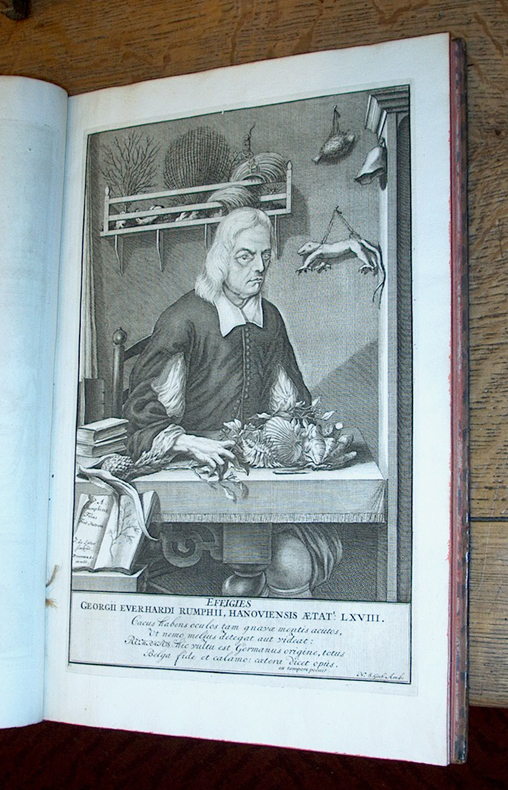
1711002657Lugduni Batavorum (Leide, Leyde), Apud Petrum Van der Aa, Bibliopolam, 1711 In-folio (41 x 27 cm), (1) ff., 15 pp., (8) pp., veau marbré, dos à six nerfs orné, pièce de titre de maroquin rouge, triple filet à froid entourant les plats, double filet doré sur les coupes, tranches rouges (reliure d'époque). Illustré d'un frontispice, un portrait de l'auteur, 1 vignette de titre, 4 vignettes dans le texte, et 60 planches gravées. Première édition en latin du "Cabinet des raretés de l'île d'Amboine" (Amboinsche Rariteitkamer), publié en hollandais en 1705 ; l'auteur, atteint de cécité, est ici représenté dans son cabinet. Précieux exemplaire provenant de la famille de Charles de MONTESQUIEU, de la bibliothèque du Château de la Brède, avec l'ex-libris des Secondat, barons de la Brède et de Montesquieu, "Virtutem Fortuna Secondat, Ex Bibliotheca Bredanense", et les initiales C. M. à l'encre. Bel exemplaire. // Folio (41 x 27 cm), (1) ff., 15 pp., (8) pp., marbled calf, spine tooled raised on six bands, red morocco title label, triple blind fillet borders on covers, double gilt fillet on turns-in, red edges (contemporary binding). Illustrated with a frontispiece, a portrait of the author, 1 vignette on title, 4 vignettes in the text, and 60 engraved plates. First edition in latin of the "Ambonese Curiosity Cabinet" (Amboinsche Rariteitkamer), first published in german in 1705 ; the author, blind, is here depicted in his office. Precious copy from Charles de MONTESQUIEU family, from the "Château de la Brède" library, with the book-plate of the Secondat, barons de la Brède et de Montesquieu "Virtutem Fortuna Secondat , Ex Bibliotheca Bredanense", and initials C. M. hand-written. Fine copy (Nissen ZBI 3520)
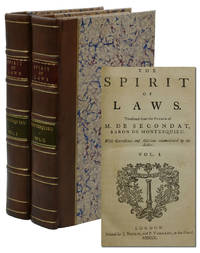
1750140941341London: J. Nourse & P. Vaillant 1750. First British Edition. Near Fine. First British edition and the first edition in the English language of Baron de Montesquieu's pioneering work in comparative law. Bound in recent marbled paper boards over leather spine with raised bands and morocco title labels lettered in gilt. Cigar smoke odor to pages small stain to edges of rear pages of Volume I; Stain to gutter of title page of and faint water stain to rear pages of Volume II. An important treatise on political theory in which Montesquieu's views underlie the American and French revolutions. J. Nourse & P. Vaillant unknown books
17772308270001Geneva: Pellet 1777-79; Neuchatel: La Societe Typographique 1777. troisieme. Hardcover. Very Good. The Organization of Enlightenment Thought: The Revolution in Ideas 41 of 45 volumes. Quartos 25 x 19.5 cm. Bound in handsome catspaw calf. All edges red. Good bindings and covers. Clean unmarked pages. Includes Vol. 1-36 of the Encyclopedie important note: lacks 3 text volumes 23 30 31; Vol. 37-38: Recueil de planches pour la nouvelle edition du dictionnaire raisonne des sciences des arts et des metiers; lacks the final plate volume v.39 Vol. 40-45 Table Analytique Et Raisonnee Des Matieres. <br> Diderot's famous Encyclopedie was initially a modest translation of Chambers's Cyclopaedia. It grew as a project into a massive project which attempted to collect human knowledge from a rationalistic perspective instead of by nature or theology. In organizing knowledge from a position where human reason was paramount the supremacy of the Church was imperiled. As a result the Encyclopedie was widely controversial and placed on the Index Librorum Prohibitorum by the Catholic Church. In discussing fundamental philosophical issues such as on political authority and natural rights articles in the Encyclopedie shifted the basis of governmental authority from the divine right of Kings to radical concepts popular consent was the basis of legitimacy and the ideals of a social contract. The work was banned by the King of France. It spread the foundational ideas of the French Revolution and enlightenment thinkers. "No encyclopaedia perhaps has been of such political importance or has occupied so conspicuous a place in the civil and literary history of its century. It sought not only to give information but to guide opinion." "It was a war machine; as it progressed its attacks on both the church and still more on despotic government as well as Christianity itself became bolder and more undistinguished and it was met with persecution and opposition unparalleled in the the history of encyclopedias." - Encyclopedia Britannica 11th ed p. 1483. Geneva: Pellet, 1777-79; Neuchatel: La Societe Typographique hardcover
174962678à Genève Geneva Paris: Barillot & fils Durand 1749. Fine. Barillot & fils Durand à Genève Geneva Paris s. d. 1749 19 x 25 cm 2 volumes reliés 188x251cm Second edition in order of publications. Parisian counterfeit published in January 1749 it would have been printed by Prault; the original extraordinarily rare dates from October 1748. This counterfeit is distinguished by a few points: it reproduces the same pagination errors in the preface as in the first edition. The address only has one R in Barillot. There must be a errata sheet at the end of volume I a detail which attests to the first issue of this second edition. Although rare this counterfeit is much easier to find that the earlier 1748 edition which was mainly sold in England. Contemporary binding in full brown sheep spine in five compartments decorated with gilt panels and fleurons title pieces in red morocco triple blind tool frame on the boards gilt roll tooling on the spine-ends all edges red. Three caps and several corners skillfully restored. Emblematic and flagship book of the 18th century @L'Esprit des lois# The Spirit of the Laws namely the principles and trends by which bills become law will have a decisive influence on political life and will be a guide for the writing of the 1791 constitution and that of the United States. Handwritten ex-libris: Madame de Dumesnil. Barillot & fils[ Durand] hardcover
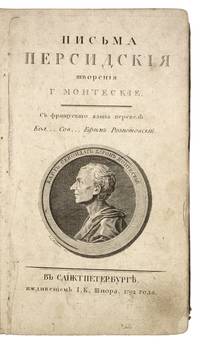
17922006<p><strong>A masterpiece of French Enlightenment in Catherine's Russia: very rare early translation of Montesquieu the first illustrated. </strong></p><p>Completed in 1721 this important piece of French literature recounts in 161 letters the experiences of two Persian noblemen Usbek and Rica as they travel through France between 1712 and 1720. The two protagonists write to friends and mullahs commenting on numerous aspects of western Christian society particularly French politics and the Moors ending with a biting satire of the system of John Law.</p><p>The work therefore provides a subtle critique of the Ancien Régime disguised as the observations of naive foreigners. The Lettres persanes was an immediate success and has since been frequently reedited and imitated.</p><p>In Russia the text circulated widely among upper classes but it was available only in the original French or in other western European languages. The first complete Russian translation by Fiodor Pospelov was published in 1789 without any illustration after a few extracts had appeared in 1782. This was followed closely by the present edition with the text newly translated by the retired collegiate councillor Efim Roznotovskii 173792. Interestingly and paradoxically both editions appeared during the heights of the French Revolution which prompted in Catherine's Russia some clampdown on free-thought - the 1789 edition being even published by the State Academy of Sciences! There will not be any further edition in the 18th century.</p><p>Our edition is illustrated on the title page by an interpretation of Dassier's famous profile of Montesquieu captioned with the author's name in Russian. It was engraved by Johann Christoph Nabholz 1752-c. 1796 a German artist who then lived in St. Petersburg and produced many portraits of the aristocracy. This portrait was not included in the extensive study<em> Portraits de Montesquieu. Répertoire analytique</em> by A. Ehrard Presses universitaires Blaise Pascal Clermont-Ferrand 2014.</p><p><strong>Very rare.</strong> WorldCat locates only two copies in the libraries of Harvard and Cambridge Universities while Svod. Kat. mentions 5 copies in Russian libraries.</p><p><strong>Physical description:</strong> Two parts in a vol. small 8vo 19 x 11.5 cm. Title with portrait of Montesquieu engraved by I.K. Nabholz and 563 pp. Contemporary Russian calf black and red morocco label to spine lettered in blind contemporary Russian patterned 'zig-zag' endpapers.</p><p><strong>Condition: </strong>Binding rubbed and worn block a bit shaken but solid; some small marginal repairs to leaves small loss of text 1-2 letters partly restored in contemporary writing on pp. 131-132 134 511-514 corners of pp. 497-498 and 563-564 torn off not affecting text occasional contemporary inscriptions one in different hand from 1935 to upper fly leaf.</p><p><strong>Bibliography:</strong> Obolian. p.632 #264 "Persidskiia pesni"!!; Sopikov 6303; Svod. Kat. XVIII 4334 illustrated; the portrait not mentioned in Rovinskii Slovar Russ. Graverov 461-64.</p> Shnor, Sankt Peterburg,
1796545965 vol. grands in-4 ( 23 x 30,3 cm en marges) reliure postérieure premier partie XIXe demi-chagrin vert, Chez Plassan, Régent-Bernard et Grégoire, De l'Imprimerie de Plassan, Paris, l'An IV, 1796, Tome I : 5 ff., LXXX-406 pp. avec portrait de Montesquieu en frontispice et 2 cartes dépliantes ; Tome II : 2 ff., 468-XIV pp. ; Tome III : 2 ff., 466-IV pp. avec une planche hors texte ; Tome IV : 2 ff., 487-IV pp. avec deux planches hors texte ; Tome V : 2 ff., 471-IV pp. avec 10 planches hors texte
174846405825Genève, chez Barillot et Fils, (1748) ; 2 volumes in-4, veau fauve marbré, dos à nerfs avec beau décor doré, tranches rouges. 4 ff. n. ch., XXIV pp., 522 pp., 1 f. errata - 2 ff., XVI pp., 564 pp.SECONDE ÉDITION, imprimée à Paris, par Prault. C’est une contrefaçon de la première édition de Genève parue la même année. Il en a été fait trois tirages, celui-ci étant le premier, avec le f. d’errata. Le nom de Barrillot est orthographié avec un seul r. - Tchemerzine VIII, 459-460 - Rochebilière Claudin et Place n°797.Le premier possesseur de cet exemplaire a corrigé à la plume un grand nombre de fautes et de coquilles sur tout le 2e tome, fautes non signalées dans l’errata.Bel exemplaire en plein veau de l’époque, une coiffe un peu émoussée et 2 courtes fentes à une charnière.
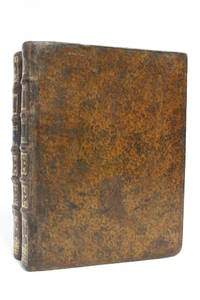
173046402087Amsterdam, J. Desbordes, 1730 ; 2 tomes en 1 volume in-12, vélin ivoire à rabats, tranches bleues. (Reliure de l’époque.) 312 pp., 347 pp.Troisième édition. Il s’agit de la réimpression page pour page et ligne pour ligne de la seconde, les caractères et les fleurons sont aussi les mêmes que l’édition de 140 lettres datée de 1721 mais probablement antidatée (elle serait de 1723.) La seconde édition est la première à laquelle l’auteur a pris une grande part, l’ordre des lettres diffère entièrement de la première et de ses contrefaçons. Cette troisième édition comme toutes les éditions précoces de ce livre a été contrefaite. Il s’agit ici de la véritable troisième édition avec 312 pp. au tome 1 et la bonne marque. En fait, J. Desbordes à Amsterdam est probablement la vraie adresse de la seconde édition qui a paru sous la fausse adresse de Cologne, chez Jacques Marteau.Tchemerzine VIII, p. 452 – Claudin 776 – Très bel exemplaire. Ex-libris armorié Sack.
177216580Paris, Le Mire, 1772. In-4 de [3]-VII-104 pages, plein maroquin cerise à grains longs, dos à nerfs orné de filet et fleuron dorés, roulette dorée en encadrement des plats, double filet aux coupes et dentelle dorée aux chasses, tranches dorées. Séduisante reliure de l'époque joliment conservée.
174866821Geneve: Chez Barillot & Fills 1748. One of the Most Remarkable Works of the Eighteenth Century"<br> <br> MONTESQUIEU Charles de Secondat Baron de. De l'Esprit des Loix ou Du rapport que les loix doivent avoir avec la constitution de chaque gouvernement les moeurs le climat la religion le commerce &c. à quoi l'auteur a ajouté. Des recherches nouvelles sur les loix Romaines touchant les Successions sur les Loix Françoises & sur les Loix féodales. Geneve: Chez Barillot & Fils i.e. Paris: Prault n.d. 1748.<br> <br> Second edition first issue same year as first edition 1748 with "Barillot" spelled with one "r" on title and with the errata leaf at the end of Volume I. Two quarto volumes. 8 xxiv 522 1 errata 1 blank; 4 xvi 564 pp.<br> <br> Contemporary calf expertly rebacked with original spines laid down corners and ends of spine renewed. Spines decoratively tooled in gilt in compartments with raised bands and brown and red morocco labels. Gilt board edges marbled endpapers. All edges stained red. Front joint of volume I just starting. Bookplates. Contemporary ink inscriptions o n titles and front fly-leaves. Occasional light marginal spotting. Still a v e r y good copy of this important work.<br> <br> In 1743 Montesquieu began work on De l'Esprit des Loix "one of the most remarkable works of the eighteenth century.It took four years to write and when it was finished almost all his friends advised him not to publish it. Montesquieu paid no attention and it was printed in Geneva in the autumn of 1748. It consists of six main sections the first dealing with law in general and different forms of government and the second with the means of government military matters taxation and s o on. The third deals with national character and the effect on it of climate; a subject of peculiar originality and the one most discussed at the time. The fourth and fifth deal with economic matters and religion; the last is an appendix on law-Roman feudal and modern French. The most distinctive aspect of this immense syllabus is its moderation: a quality not designed to achieve official approval in 1748. It is an always original survey which is neither doctrinaire visionary eccentric nor over-systematic.The scheme that emerges of a liberal benevolent monarchy limited by safeguards on individual liberty was to prove immensely influential.his theories underlay the thinking which led up to the American and French revolutions and the United States Constitution in particular is a lasting tribute to the principles he advocated" Printing and the Mind of Man. Kress 4920. Tchemerzine VIII p. 460. Printing and the Mind of Man 197 first edition.<br> <br> HBS 66821<br> <br> $3000. Chez Barillot, & Fills unknown
174866821ìOne of the Most Remarkable Works of the Eighteenth Centuryî MONTESQUIEU Charles de Secondat Baron de. De l'Esprit des Loix ou Du rapport que les loix doivent avoir avec la constitution de chaque gouvernement les moeurs le climat la religion le commerce &c. ‡ quoi l'auteur a ajoutÈ. Des recherches nouvelles sur les loix Romaines touchant les Successions sur les Loix FranÃoises & sur les Loix fÈodales. Geneve: Chez Barillot & Fils i.e. Paris: Prault n.d. 1748. Second edition first issue same year as first edition 1748 with ìBarillotî spelled with one ìrî on title and with the errata leaf at the end of Volume I. Two quarto volumes. 8 xxiv 522 1 errata 1 blank; 4 xvi 564 pp. Contemporary calf expertly rebacked with original spines laid down corners and ends of spine renewed. Spines decoratively tooled in gilt in compartments with raised bands and brown and red morocco labels. Gilt board edges marbled endpapers. All edges stained red. Joints starting. Bookplates. Contemporary ink inscriptions o n titles and front fly-leaves. Occasional light marginal spotting. Still a v e r y good copy of this important work. In 1743 Montesquieu began work on De l'Esprit des Loix ìone of the most remarkable works of the eighteenth century.It took four years to write and when it was finished almost all his friends advised him not to publish it. Montesquieu paid no attention and it was printed in Geneva in the autumn of 1748. It consists of six main sections the first dealing with law in general and different forms of government and the second with the means of government military matters taxation and s o on. The third deals with national character and the effect on it of climate; a subject of peculiar originality and the one most discussed at the time. The fourth and fifth deal with economic matters and religion; the last is an appendix on lawóRoman feudal and modern French. The most distinctive aspect of this immense syllabus is its moderation: a quality not designed to achieve official approval in 1748. It is an always original survey which is neither doctrinaire visionary eccentric nor over-systematic.The scheme that emerges of a liberal benevolent monarchy limited by safeguards on individual liberty was to prove immensely influential.his theories underlay the thinking which led up to the American and French revolutions and the United States Constitution in particular is a lasting tribute to the principles he advocatedî Printing and the Mind of Man. Kress 4920. Tchemerzine VIII p. 460. Printing and the Mind of Man 197 first edition. HBS 66821 $3000 Chez Barillot, & Fills hardcover books
1749elala1368Leyden i.e. Lyon: "Chez Les Libraires Associés 1749. 1749. 2 Volumes in 1. 4to. pp. viii 14 369; 2 p.l. 306 i.e. 395 12 16Critique 50Défense. woodcut ornaments & initials. contemporary mottled calf rebacked corners renewed some light foxing & browning. few early ms. notes in margins & corrections in text. Early Edition of one of the most remarkable works of the eighteenth century treating the philosophical principles of law and government and the determining influence of geographical and economic factors on social thought customs and legal and political institutions. Montesquieu was unanimously advised by his friends including Helvétius and Fontenelle not to publish but he ignored them. Despite Helvétius criticism that the work was too moderate it was placed on the Index and the Sorbonne planned a regular censure of it. Although largely misunderstood or ignored by his contemporaries including the philosophes Montesquieus theories exerted a profound influence; "they underlay the thinking which led up to the American and French Revolutions and the United States Constitution in particular is a lasting tribute to the principles he advocated." PMM This edition is unrecorded in the bibliographies. cfBrunet III 1859-60. cfCioranescu 46153. cfGraesse IV 589. cfPrinting and the Mind of Man 197. Leyden [i.e. Lyon?]: "Chez Les Libraires Associés, 1749. unknown
1721221721 Cologne, Pierre Marteau [i. e. Amsterdam, Susanne de Caux], 1721 ; 2 vol. petit in-12, 312 pp. ; 347 pp., maroquin bleu nuit janséniste, dos à nerfs, coupes filetées, dentelle intérieure, tranches dorées (Thivet).
1796SKU016<p>Bibliographical Description Author: MONTESQUIEU Charles-Louis de Secondat Baron de. Title: Œuvres de Montesquieu. Edition: A new and complete edition published in Paris 1796. Publisher: Paris Chez Plassan Régent-Bernard et Grégoire. De l'Imprimerie de Plassan. Date: L'An IV 1796. Format: 5 volumes. Grand in-4° Large Paper Copy. Technical Details: • Paper: Printed on Grand Papier Vélin high-quality wove paper. Characterized by exceptionally wide margins and a superior smooth finish. • Illustrations: Complete with a frontispiece portrait of Montesquieu in Volume 1 and 13 copperplate engravings plates after designs by renowned artists such as Moreau le Jeune Vernet and Peyron. • Maps: Includes the 2 large folding maps in Volume 1: "Carte pour l'intelligence du livre intitulé De l'Esprit des Loix" and "Supplément pour la Carte du Livre intitulé De l'Esprit des Loix". Both maps are dated L'An IV. • Binding: Housed in the original "Bradel" paper-covered boards from the period of publication. Spines feature the original red morocco leather labels with gilt-lettered titles and volume numbers. Marbled covers. Provenance & Cataloging Notes: • Includes contemporary handwritten bibliographical notes in pencil and ink on the endpapers identifying the set as a luxury "Grand Papier" copy. • Bearing the original bookseller's label from the prestigious Parisian firm Giraud-Badin. • Historically regarded as "La meilleure édition collective du XVIIIe siècle" The finest collected edition of the 18th century. Condition Report: The internal condition is remarkable; the pages are notably clean crisp and white with minimal foxing. The printing remains sharp. The original bindings show natural age-related wear to the spine ends capitals and corners but remain structurally sound and unrestored.</p> Plassan, Regent-Bernard, Gregoire hardcover
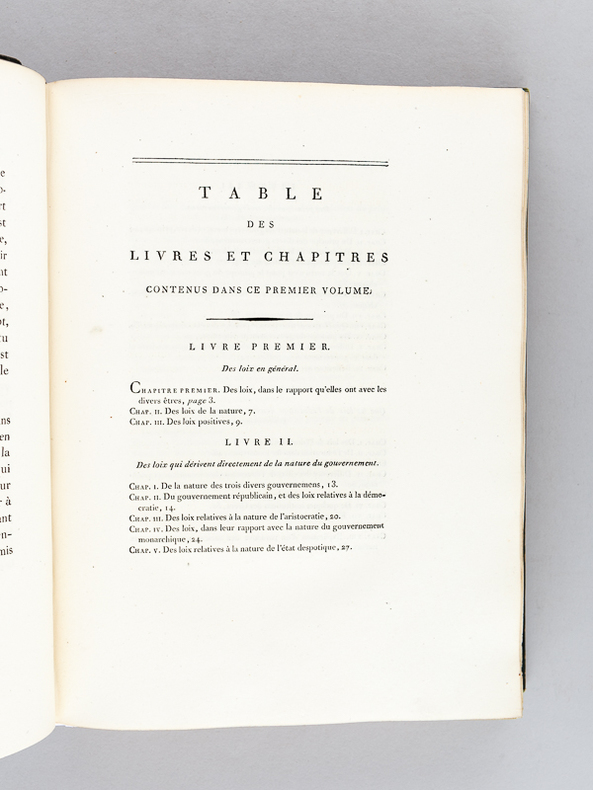
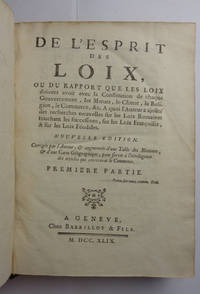
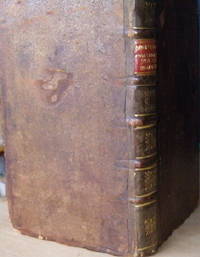
1749024094<p>Geneve: Barrillot 1749. Titolo completo: De l'Esprit des Loix ou du rapport que les loix doivent avoir avec la Constitution de chaque Gouvernement les Moeurs le Climat la Religion le Commerce etc. A quoi l'Auteur a ajouté des Recherches niouvelles sur les Loix Romaines touchant les Successions sur les Loix Françaises & sur les Loix Féodales. Nouvelle edition. Corrigé par l'Auteur & augmentée d'une Table des Matieres & d'une Carte Géographique pour servir à l'intelligence des articles qui concernent le Commerce. Volume premier … Second. -Due tomi in un volume in 4° 20x265 cm di XXIV-326pp; 2-XIV-398pp. Carta geografica del mondo ripiegata in fondo. Un taglio al margine bianco della pagina di titolo per togliere una firma che peraltro è presente nella pagina di titolo della Seconda parte. Una nota manoscritta su un foglio ripiegato cioè quattro facciate riporta delle Observations sur le Livre de l'Esprit des Loix tratte dall'Origine du despotisme oriental di Boulanger. Altre note manoscritte per tre fitte pagine sono contenute nell'ultimo foglio bianco e nel foglio bianco dietro la risguardia e sembrano tratte dal Mercure de France del Novembre 1753. Terza edizione. Legatura coeva in tutta pelle dorso a nervi ornato e dorato piccola mancanza di pelle a un angolo tagli rossi. Risguardie in carta marmorizzata. Condizioni molto buone tranne il taglio indicato a un margine bianco per questa preziosa edizione di pochi mesi successiva alla prima.</p> Barrillot
1751WFH1London: Noursse 1751. Vol. 1 upper cover almost detached other 2 vols. quite tight. Previous owner signature of ffep of all volumes. Scattered foxing throughout. Four years in the writing this work was immensely influential in development of the enlightened principles of human rights which underlay the political and humanistic principles of the American and French Revolutions and later representative governments. . Full-Leather. Fair/No Jacket. 12mo - over 6¾" - 7¾" tall. Trade. Noursse Hardcover books
173420012205Amsterdam: Jaques sic Desbordes 1734. Full contemporary calf rebacked with gilt tooled calf leather spine label. Owner's name and "le President de Montesquieu" written in pen on title page very lightly rubbed at cover extremities small indentation scar on rear cover: a very nice VG copy. Small 8mo. Printing and the Mind of Man p 117: ". this was immediately recognized as a major work and it has remained the most popular and widely read of his books." ". neither its style a masterly succintness nor its matter . have lost their value. 1st edition. 1st issue. Title page in red and black. Le Petit p. 493-4. This copy has neither the mispagination error on pp. 101-104 nor the errata page. It does have all errors on pages 129 130 131 & 267. None of these is a cancel sheet. cf Brunet. Jaques [sic] Desbordes hardcover
1749228724Geneve: Barrillot & Fils 1749. Nouvelle Edition Second Edition . Full Leather. Very Good. Second edition appeared in 1749 one year after the initial publication of Montesquieu's very important work in the history of political philosophy. 463 510 pages Two volumes bound as one. Illustrated with scarce folding map. Brown leahter with red and gold titles gilt decoration on spine top and base of spine corners are lightly bumped and worn top front corner heavily bumped light wear to edges a few scuffs and marks clean marbled endpapers previous owner's names on leaf following ffep at head of full-title text is clean and unmarked binding and hinges are strong and unbroken crease to top corner of frep foxing to text edges as usual Very Good. Photographs are available upon request. Please do not hesitate to ask. A very good copy of an early edition of a work that has indelibly shaped the character of western political thought since its publication. <br/> <br/> Barrillot & Fils hardcover