1 986 résultats
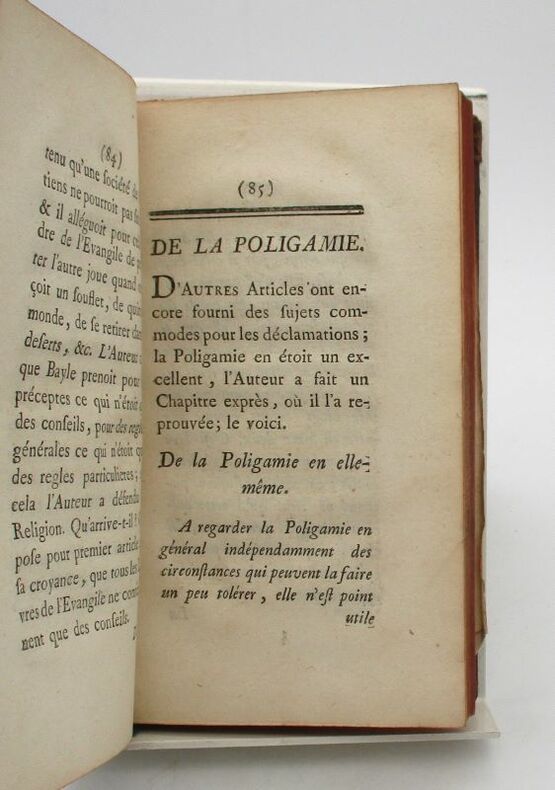
39317In-8, demi-basane mouchetée de l'époque, 98, (2) p. S.l., 1789.
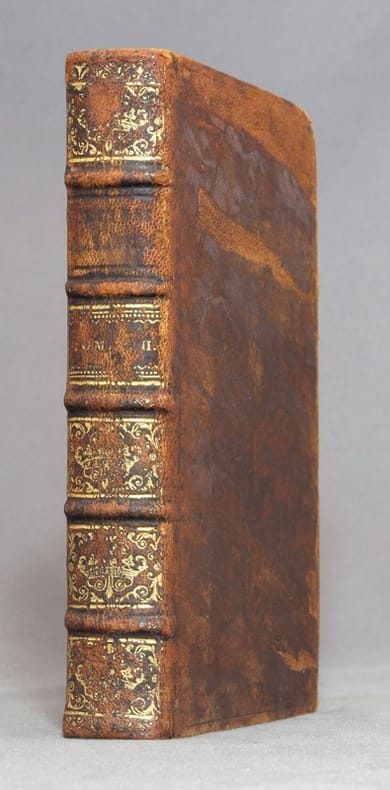
In-12, demi-veau blond, dos romantique orné de 4 faux nerfs guillochés or, fleuron à froid estampé entre-nerfs, filets et palettes dorés, tranches marbrées (rel. vers 1830), (4), v, (2), 129 p. Edition originale et unique. La deuxième oeuvre du "berger Sylvain", alors jeune homme âgé de 21 ans, futur "homme sans dieu", et sa véritable entrée dans le monde littéraire. Cet hommage à Montesquieu et au 'Temple du Gnide' auquel il se réfère est également marqué par la sensibilité héritée de J.-J. Rousseau et sa conception de la "vertu". "Par l'agrément, la grâce et la légèreté de cette oeuvre" (M. Dommanget, p. 27), Sylvain Maréchal va gagner sa place dans deux salons littéraires: celui du poète épicurien Guillaume Vassé et celui de Madame Lépine, la diva italienne de la rue Neuve Saint Eustache où l'auteur rencontre la future Madame Roland, Manon Phlipon. (Conlon, 'Siècle des Lumières', 71:1155. Dommanget, 'S. Maréchal', Bibliographie, p. 445). Le livre est peu commun: WorldCat ne recense que 4 exemplaires dans le monde, dont un unique en France, celui de la BnF. Infime défaut à la coiffe supérieure. Petit accroc de papier en coin du faux titre et en marge supérieure p. 59 sans perte. Quelques petites auréoles claires. Bon exemplaire, bien relié.
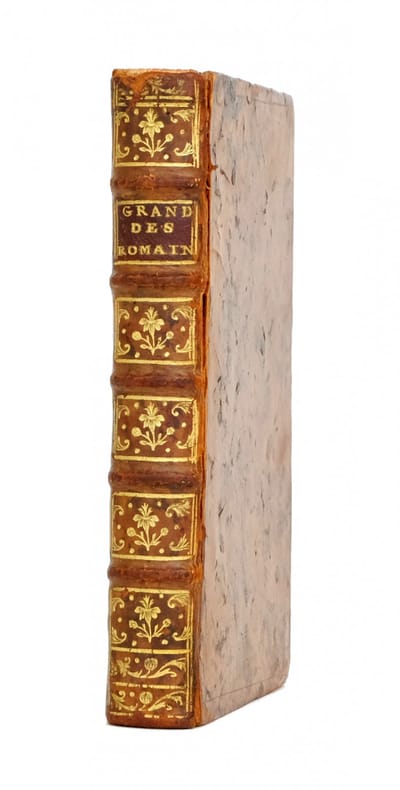
17515611Edinbourg Edinburgh: Chez Hamilton Balfour & Neill 1751. 8vo pp. iv 336. Contemporary calf spine divided by double gilt rules red morocco label edges yellow. One leaf torn and sometime repaired a touch of spotting. Somewhat rubbed label partially defective front board marked. Pencil sketches to rear endpapers. An Edinburgh printing of Montesquieu’s influential book on the Roman Empire based on the 1748 revised edition published in Paris. ESTC records 9 locations 7 in the UK and 2 in North America. ESTC T165268. Chez Hamilton, Balfour, & Neill unknown
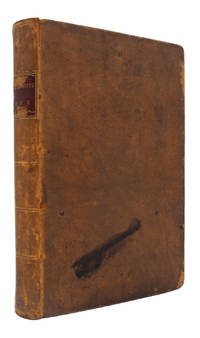
173597677BB1735 . 2me édition. Amsterdam: Jaques Desbordes 1735. Kl.-8°. 2 277 S. Holzstichvignette auf Titelblatt. Rot/schwarzes Titelblatt. Halbleder. Einband marmoriert. Rückentitel in Goldschrift mit- Filletten. Umlaufender Gelbschnitt. altersgemäss gebräunt; Buchdeckel innen und Vorsätze mit Leimschatten; Rücken beschabt; Kanten etwas berieben; Ecken bestossen; Kopfschnitt angestaubt Charles de Secondat Baron de Montesquieu 1689-1755 Gelehrter. unknown
1749BOOKS202277Lausanne: Marc-Michel Bousquet & Comagnie. G/NO DUSTJACKET. 1749. Revised. Leather. Considerations on the causes of the granduer of the Romans and their decadence new re-examined edition corrected & increased by l' author has which one joined a dialogue De Sylla and D' Eucrate . 0 cover rubbed and dry hinges cracked but tight . Marc-Michel Bousquet & Comagnie hardcover
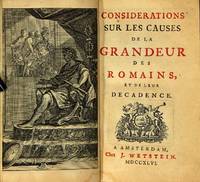
174639020Amsterdam: J. Wetstein 1746. 12mo pp. 190; engraved frontispiece title page printed in red and black; full contemporary calf a couple of stains on back cover spine in 6 compartments red morocco label and 2 paper heart-shaped labels one of which is torn added later to top and bottom compartments "11" in ink on both labels; minor worm holes to leather spine edges rubbed; pages trimmed else a very good copy. OCLC locates 3 copies in the United States at Kansas Florida Atlantic and Bowdoin. See Brunet III 22933 for the first edition of 1734. J. Wetstein unknown
173420012205Amsterdam: Jaques sic Desbordes 1734. Full contemporary calf rebacked with gilt tooled calf leather spine label. Owner's name and "le President de Montesquieu" written in pen on title page very lightly rubbed at cover extremities small indentation scar on rear cover: a very nice VG copy. Small 8mo. Printing and the Mind of Man p 117: ". this was immediately recognized as a major work and it has remained the most popular and widely read of his books." ". neither its style a masterly succintness nor its matter . have lost their value. 1st edition. 1st issue. Title page in red and black. Le Petit p. 493-4. This copy has neither the mispagination error on pp. 101-104 nor the errata page. It does have all errors on pages 129 130 131 & 267. None of these is a cancel sheet. cf Brunet. Jaques [sic] Desbordes hardcover
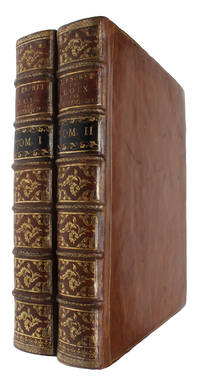
174854277Geneve Barrillot sic! & Fils 1748. 4to. Two lovely contemporary uniform full calf bindings with richly gilt spines gilt title- and tome-labels and single gilt line-borders to boards. Edges of boards blindtooled. Very neatly restored at hinges and corners barely noticeable. 19th century book-plate "FAMA" to inside if front boards. Old handwritten notes in ink to front free end-papers. Some leaves evenly browned as usual. Vol. I with contemporary owner's inscription "B. Heiman/ 1756/ S. st." to verso of title-page. Light inkspotting to half-title and occasional light brownspotting. Vol. II with very small owner's name to verso of front free end-paper: "Mr. Gustavo Horta" and with a worm tract. The worm tract is mostly very small and only in the very top corner of the upper blank margin or as a tiny hole in the inner blank margin towards the hinge. From pp. 493 to 544 the worm tract is larger but still situated in the blank margin outer and far from affecting text at any point. With both half-titles preface vol. 1 and tables of contents. No errata at the end of volume one and no folded map. Woodcut printer's devices to title-pages. 8 XXIV 522; 4 XVI 564 pp. <br/><br/><em>The very rare first edition first issue of Montesquieu's seminal main work "in many ways one of the most remarkable works of the eighteenth century" PMM 197 in which the author presents his theory of constitutional monarchy advocating constitutionalism and the separation of powers and explains human laws and social institutions. The very first printing i.e. the first edition first issue of the present work is of the utmost scarcity. Numerous editions and issues of the work were printed in the months following the first appearance. The present copy has the first issue pointers the two "r"s in "Barrillot" on the title-page no errata. It does not have a folding map as mentioned by Brunet but whether this is actually supposed to be present or not in the first printing has not been established - some bibliographers say that it should not be there.Montesquieu began writing this his magnum opus in 1743 by the end of which year he had almost finished the first draft of it. The same year he began the first of two great revisions of it which he finished in 1746. In 1747 he finished his second revision adding several new chapters and chose J. Barrillot from Geneva to publish the work which finally appeared for the first time in November 1748 in two quarto volumes with no mention of author or year. Numerous editions and issues appeared the following months and years and by 1751 22 editions of the work had appeared. Already in 1750 the work was published in English the English editions amounting to 10 by 1773 and by 1801 the work had appeared in both German 1789 Dutch Danish Polish Italian and Russian 1801. The work exercised the greatest of influence both negative and positive and numerous anti-Montesquieu-pamphlets and articles appeared during the last half of the 18th century. Because of the work Montesquieu was also attacked by the Sorbonne as well as in the general assembly of the French clergy and in Rome. In 1751 the work was placed on the Index.As the number of editions translations etc. bears witness to the work provided the greatest of impact on 18th century political thought as well as actual politics and law. In fact few other works can be claimed to possess the same power of influence as this one directly affecting the likes of Tocqueville and Catherine the Great. Although Montesquieu had to defend himself against great thinkers like Voltaire "his theories underlay the thinking which led up to the American and French revolutions and the United States Constitution in particular is a lasting tribute to the principles he advocated." PMM 197. "Montesquieu was one of the great political philosophers of the Enlightenment. Insatiably curious and mordantly funny he constructed a naturalistic account of the various forms of government and of the causes that made them what they were and that advanced or constrained their development. He used this account to explain how governments might be preserved from corruption. He saw despotism in particular as a standing danger for any government not already despotic and argued that it could best be prevented by a system in which different bodies exercised legislative executive and judicial power and in which all those bodies were bound by the rule of law. This theory of the separation of powers had an enormous impact on liberal political theory and on the framers of the constitution of the United States of America." SEP.Kress: 4920; Tchemerzine: VIII 459; PMM 197. </em> hardcover
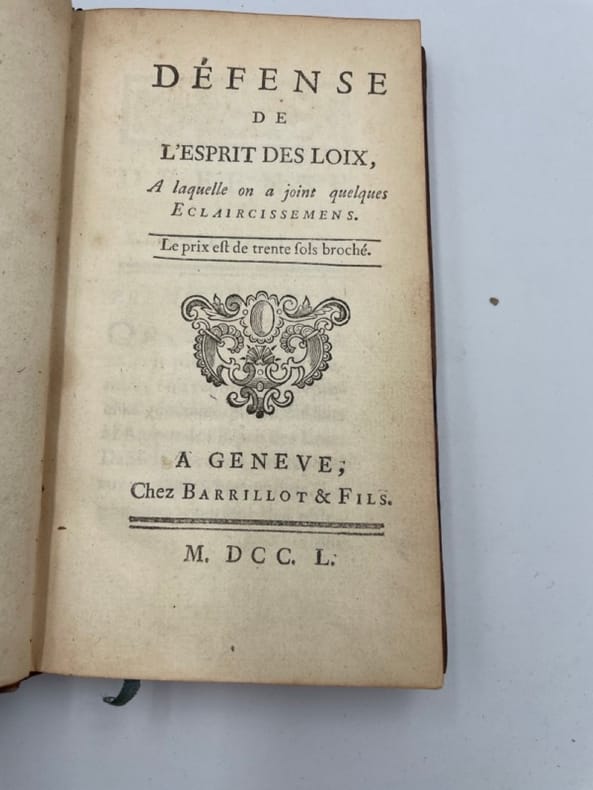
1750132221750. A GenÂve Paris chez Barrillot & Fils 1750 - A GenÂve chez Antoine Philibert 1751 - A Berlin s.ÂŽ. 1751. 3 vol. reliÂŽs en un vol. in-12 167 x 103 mm de 207 pp. ; 173 pp. et 1 f. de catalogue ÂŽditeur in fine ; 1 f. n.fol. et 76 pp. Reliure dÂŽbut XIXÂme de demi-chagrin glacÂŽ havane filet et filet sinuso•dal verticaux ˆ froid portÂŽs sur les plats dos lisse ornÂŽ de filets dorÂŽs roulettes dorÂŽes et ˆ froid titre dorÂŽ palette dorÂŽe en tÂte et queue. Recueil composite renfermant trois prÂŽcieux textes en originale dont La DÂŽfense de l'Esprit des loix de Montesquieu. La publication de l'Esprit des lois 1748 souleva un concert de louanges mais aussi une campagne de critiques qui devait aboutir ˆ sa mise ˆ l'Index en 1751. Le philosophe prÂŽconisait avec insistance une franche sÂŽparation du politique et du religieux. Dans sa DÂŽfense il rÂŽtorque que l'ouvrage est un livre de droit non de thÂŽologie. in Rahir. ''Montesquieu avait rÂŽsolu de ne rÂŽpondre ˆ aucune des critiques qui seraient faites de L'Esprit des lois ; mais il ne put passer sous silence les attaques d'un auteur anonyme Joseph de La Porte qui dans un journal l'avait dÂŽchirÂŽ avec fureur et le peignait comme un athÂŽe. Il lui importait de repousser les insinuations calomnieuses du gazetier ecclÂŽsiastique. Il voulait en Âme temps rÂŽfuter d'avance les thÂŽologiens de la Sorbonne qui peu contents de quelques passages de L'Esprit des lois allaient procÂŽder ˆ une censure de cet ouvrage. C'est dans ce double but qu'il ÂŽcrivit sa DÂŽfense modÂle de discussion solide et de plaisanterie lÂŽgÂre. La Beaumelle a publiÂŽ une suite de cette DÂŽfense''. in QuÂŽrard. ''L'ouvrage constitue une rÂŽponse aux critiques de l'abbÂŽ de La Porte dans les Nouvelles ecclÂŽsiastiques de la France de 1749 et dans le Journal des savants de 1750. Celui-ci ayant rÂŽpliquÂŽ dans le Journal de TrÂŽvoux il lui fut rÂŽpondu par M. de La Beaumelle par une Suite de la DÂŽfense de l'esprit des Loix Ã.''. in Graesse. Barbier III Dictionnaire des ouvrages anonymes 615 puis IV 575-b - Pour la DÂŽfense de l'Esprit des Lois : Tchemerzine VIII Bibliographie d'ÂŽditions originales et rares d'auteurs franÂais 461 - Rahir La BibliothÂque de l'amateur p. 550 - Graesse IV TrÂŽsor de livres rares et prÂŽcieux p. 589 - Brunet III Manuel du libraire et de l'amateur de livres 1860 - QuÂŽrard VI La France littÂŽraire p. 238 - Cioranescu II Bibliographie de la littÂŽrature franÂaise du XVIIIÂme 46140. LÂŽgers frottements affectant le papier marbrÂŽ des plats. Quelques feuillets lÂŽgÂrement brunis. Rousseurs ÂŽparses dans le texte. Nonobstant bel ensemble. b42961 unknown
1758517Amsterdam: Arkstee & Merkus. 1758. Bottom 1/2 inch of spine missing light rubbing to extremities some small surface abrasions text is clean binding solid. Old bookplate on pastedown Cottin de Fontaine - found no record G. ; 16mo mottled calf with gilt lettering and ornamentation on spine marbled endpapers crimson edges ribbon marker 436p. plus 4p. Catalogue des Livres. . Arkstee & Merkus unknown
208408Genève [Paris], Barillot, & fils, s.d. (1749) 2 vol. in-4, [4] ff. n. ch. (faux-titre & titre, deux premiers ff. de la préface), XXIV-522 pp., un feuillet non chiffré d'errata ; [2] ff. n. ch. (faux-titre & titre), XVI-564 pp., veau fauve marbré, dos à nerfs cloisonné et fleuronné, pièces de titre et de tomaison cerise, encadrement de double filet à froid sur les plats, tranches mouchetées (reliure de l'époque). Restaurations aux coiffes et aux coins. Quelques discrètes mouillures (T.I).
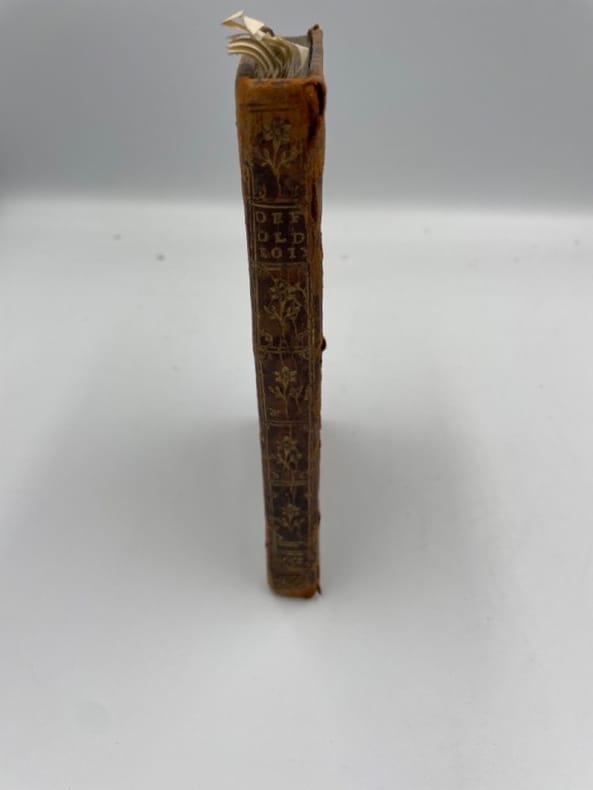
236595Genève, Barrillot & fils, 1750 in-12, 207 pp., y compris le titre, veau fauve marbré, dos lisse orné, tranches marbrées (reliure de l'époque). Usures au dos, mors supérieur fendu.
238381Genève, Barrillot & fils, 1750 in-12, 207 pp., y compris le titre, veau fauve marbré, dos lisse orné, triple filet doré en encadrement sur les plats, tranches rouges (reliure de l'époque). Étiquette de cote de bibliothèque au contreplat.
16032Paris, chez Ant. Aug. Renouard, 1795. 2 vol. in-12, 267 pp. 1 pl. + 259 pp., veau raciné havane, double filet doré en encadrement sur les plats cantonné de fleurons dorés, dos long orné de filets et fleurons dorés, pièce de titre verte, pièce de tomaison rouge, tranches dorées (quelques petites épidermures, 3 coins émoussés, quelques petites taches ou rousseurs éparses).
20194Cologne, Pierre Marteau [Avignon ?], 1744. 3 tomes en 1 vol. in-12, veau brun marbré, dos à nerfs orné de caissons dorés, pièce de titre en maroquin rouge, roulette dorée sur les coupes, roulette dorée intérieure, tranches rouges. Reliure de l'époque, coiffe sup. réparée, coins émoussés. Bon exemplaire. (1) f., 172 pp., (1) f. blanc; (1) f., 196 pp.; 71 pp. Quelques rousseurs.
175013222A Genève [Paris], chez Barrillot & Fils, 1750 - A Genève, chez Antoine Philibert, 1751 - A Berlin, s.é., 1751. 3 vol. reliés en un vol. in-12 (167 x 103 mm) de 207 pp. ; 173 pp. et 1 f. de catalogue éditeur in fine ; 1 f. n.fol. et 76 pp. Reliure début XIXème de demi-chagrin glacé havane, filet et filet sinusoïdal verticaux à froid portés sur les plats, dos lisse orné de filets dorés, roulettes dorées et à froid, titre doré, palette dorée en tête et queue.
42217A Amsterdam, chez Jaques Desbordes, 1734. Pt. in-8°, 277p. Reliure plein veau d'époque, dos à nerfs orné de fleurons dorés, pièce de titre beige.
1539Paris : Moreau, 1755. LE PREMIÈRES RÉFLEXIONS DE MONTESQUIEU SUR LA PHILOSOPHIE POLITIQUE
16558Genève, chez Barillot, 1750. In-12, 207 pp., veau marbré brun de l'époque, dos à nerfs orné de caissons et fleurons dorés (pièce de titre manquante, manques, mors fendus, coiffe arasée, petites rousseurs).
173912860A Londres, aux dépens de la Compagnie, 1739. 2 tomes en un volume in-12 de [2]-159; [2]-183 pages, plein veau moucheté, dos à 5 nerfs orné de fleurons et encadrements dorés, tranches rouges.
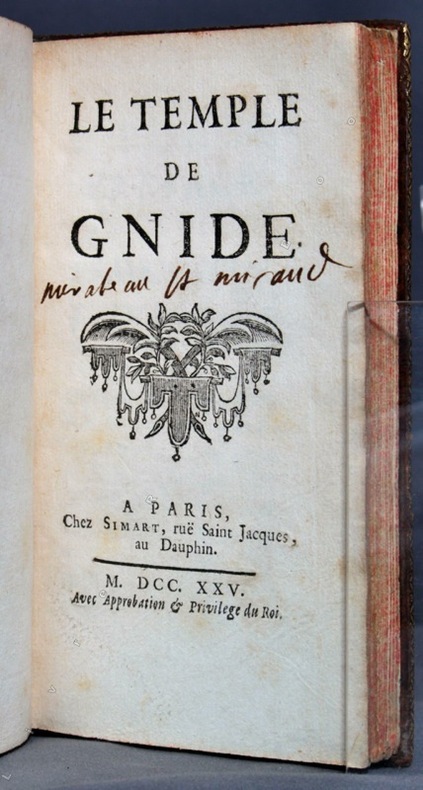
17258844A Paris, Chez Simart, 1725. In-12 de [12]-82-[2] pages, plein veau brun, dos à nerfs orné de filets et fleurons dorés, mors proprement restaurés.
17311078Cologne, Pierre Marteau, 1731 ; 2 vol. in-12 de [1] f., 312 pp. ; [1] f., 340 pp., veau brun moucheté de l'époque, dos à nerfs ornés de motifs dorés, pièces brunes, tranches rouges.
1721221721 Cologne, Pierre Marteau [i. e. Amsterdam, Susanne de Caux], 1721 ; 2 vol. petit in-12, 312 pp. ; 347 pp., maroquin bleu nuit janséniste, dos à nerfs, coupes filetées, dentelle intérieure, tranches dorées (Thivet).
9080Londres, [sans nom], [sans date]. Petit in-8 de [4]-136 pages, plein veau brun, dos à nerfs orné de filets et fleurons dorés, pièce de titre rouge, filet doré sur les coupes, tranches rouges.
5055Amsterdam, 1781– in-12, 440 pp – rel. basane havane, tr. rouges, ex-libris manuscrit Ducournau