1 369 résultats
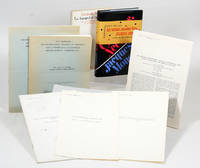
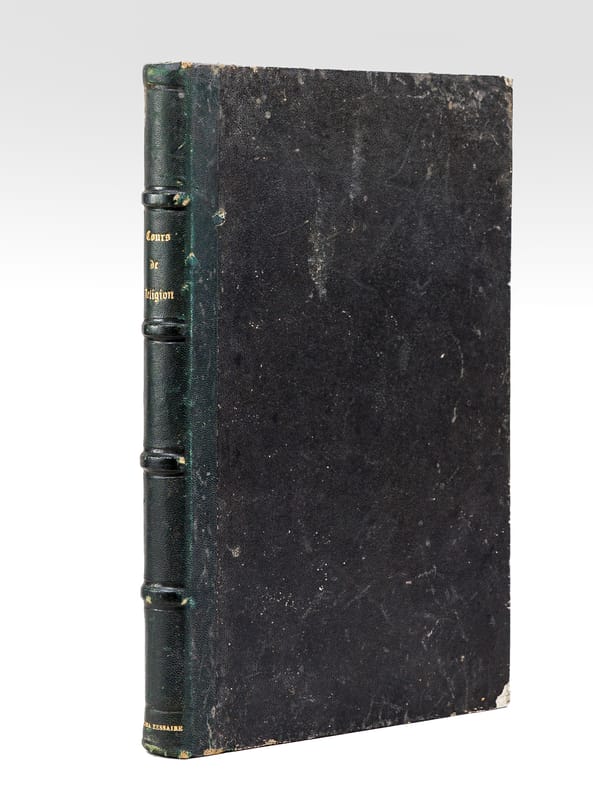
1968387331968. <p>Jacob Francois 1920- ; Monod Jacques 1910-75; Lwoff Andre 1902-94; & Brenner Sydney 1927- . Group of 22 offprints mimeographs etc. on molecular biology and bacterial genetics together with 2 related papers by other authors. Various sizes. 1947-1968. Together in one volume cloth "Institut Pasteur" in gilt on the spine. Overall good to very good; see detailed condition descriptions below. From the library of G. G. and Elinor Meynell authors of Theory and Practice in Experimental Biology 1970 with their address label on the front endpaper and ownership signatures on several of the offprints.</p> <p>First / First Separate Editions. Jacob Monod and Lwoff all colleagues at the Institut Pasteur received the 1965 Nobel Prize in physiology / medicine for their discoveries concerning genetic control of enzyme and virus synthesis-discoveries that "opened up a new field of research that deserved to be called 'molecular biology'" Magill The Nobel Prize Winners: Physiology or Medicine II p. 921. Their work answered the fundamental question of how the hereditary information contained in DNA can be translated into the chemical processes that synthesize cellular proteins this question had been posed most succinctly and explicitly in Francis Crick's theoretical paper "On protein synthesis" 1957 which laid the groundwork for over a decade's worth of research in this area. Brenner another key figure in this field worked with Jacob and Matthew Meselson on providing experimental evidence for messenger RNA; he was awarded a share of the 2002 Nobel Prize for his discoveries concerning genetic regulation of organ development and programmed cell death.</p> <p>The collection we are offering here focuses largely on the Nobel Prize-winning work done by the Institut Pasteur group-Lwoff Jacob and Monod-in the 1950s and 1960s. The work can be divided into four sections: </p> <p>1 lysogeny and bacterial conjugation</p> <p> 2 expression of the genetic material via messenger RNA</p> <p> 3 the regulation of the genetic activity of bacterial cells by operons</p> <p>4 the organization of bacterial genetic material.</p> <p> In the following paragraphs we will attempt to highlight the more important papers in this remarkable collection; however all the papers here touch upon these central questions of molecular biology.</p> <p>Lysogeny defined as the hereditary ability to produce the bacteriophage virus is a peculiar type of infection in which the phage becomes part of the genetic material of a bacterial cell; in this non-infective form prophage it can then be inherited by succeeding generations of cells becoming virulent only when some environmental stimulus causes the bacterium to produce and release phage.</p> <p> "Lysogeny brought a model for the interrelation between a virus and a cell. And also a model for the possible mode of action of carcinogenic agents which could disturb something in this balance" Judson p. 368. Lwoff studied this phenomenon intensively in the late 1940s and early 1950s successfully demonstrating the genetic nature of lysogeny which was disputed by several scientists including Delbruck and discovering how it is induced. In 1953 he published an important review of the subject "Lysogeny" Bacteriological Review 17; see no. 2 below. Lysogeny was also studied by Jacob and Elie Wollman whose paper "Induction of phage development in lysogenic bacteria" CSH Symposia on Quant. Biol. 18 1953; see no. 5 below summarizes what had been learned about lysogeny as of that date.</p> <p>Lwoff's work on lysogeny inspired Jacob and Wollman to investigate the phenomenon of bacterial conjugation the transfer of genetic information from a male donor bacterium to a female recipient resulting in genetic recombination to see if they could discover where in the bacterium's genetic material the prophage was located. In 1955 working with a highly recombinant strain of E. coli K12 discovered by William Hayes Jacob and Wollman performed what came to be known as their "coitus interruptus" experiment in which they used a Waring blender to interrupt the mating bacteria at various stages of their conjugation. They found that the donor cell's genetic characteristics were not transferred all at once but rather sequentially over time-a discovery of great importance. </p> <p>"Wollman and Jacob had stumbled upon a way to measure off the genes on the bacterial chromosome as directly and physically as a child squeezes toothpaste onto a brush or a carpenter unrolls a coiled steel tape measure. As they saw instantly and reported in a note in mid-June 1955 in the weekly Comptes rendus of the Academie des Sciences "Sur le mecanisme du transfert de materiel genetique au cours de la recombinaison chez E. coli K12"; see no. 6 below they had the means to make a genetic map of biochemical characteristics expressed in units of time" Judson p. 385.</p> <p> In 1956 Wollman and Jacob published the first albeit rudimentary timed map of the K12 strain of E. coli in a paper published in France. This map was printed again in their English-language paper "Conjugation and genetic recombination in E. coli K-12" CSH Symposia on Quant. Biol. 21 1956; see no. 8 below which also contained the first publication of Thomas Anderson's famous electron micrograph of two conjugated bacteria.</p> <p>In 1958 Jacob delivered his paper "Transfer and expression of genetic information in E. coli K12" see no. 9 below at a symposium in Brussels; this paper together with one given by Jacob's sometime colleague Arthur Pardee "ranged over the whole matter of transfer of genes between bacteria and the regulation of their expression" Judson p. 400. Jacob and Wollman had originally represented the hereditary material in linear form while stating that the genetic map could be formally represented as a circle. In 1963 at a Cold Spring Harbor conference the researcher J. Cairns provided physical evidence that the E. coli chromosome was circular; at this same conference Jacob Brenner and co-author Francois Cuzin presented their paper "On the regulation of DNA replication in bacteria" CSH Symposia on Quant. Biol. 28; see no. 16 below containing their "replicon model of chromosome replication in bacteria a model that almost required circularity of chromosomal and F factor DNA" Brock p. 103.</p> <p>Experimental proof of the existence of messenger RNA the substance responsible for coding protein synthesis was announced in Brenner Jacob and Meselson's landmark paper "An unstable intermediate carrying information from genes to ribosomes for protein synthesis" Nature 190 1961; see no. 1 below. The theoretical groundwork for messenger RNA had been laid in Crick's "On protein synthesis" 1957; demonstration of the substance's existence had been foreshadowed by Volkin and Astrachan's discovery of a high-turnover unstable RNA distinct from the ribosomal and transfer varieties 1956 and by the famous "PaJaMo" experiment demonstrating the negative control mechanism of enzyme induction 1958. However it was not until the spring of 1960 that these previous findings were combined by Brenner Jacob and Francis Crick into a biological model setting forth the exact means of communication between gene and cytoplasm while eliminating the various problems associated with earlier ribosome-based theories of gene expression. As Brock puts it the ribosome was now seen as "simply a nonspecific translation machine something like a computer whose behavior depended on what software it contained" Brock p. 306.</p> <p> Working with Matthew Meselson who had developed experimental techniques for tagging and separating ribosomes Brenner and Jacob performed the critical experiment described in their paper which provided direct evidence for the existence of an unstable rapidly turning over messenger RNA.</p> <p>The concept of the operon-a group of adjacent genes functioning as a unit under the control of another gene the operator gene-developed between 1958 and 1960 on the basis of work done by Monod and Jacob who were investigating the repressor model of gene regulation. Jacob developed the idea that gene regulation was based on a repression system that operated like an on-off switch and that "genetic units of a higher order existed . . . that contained several genes subject to unitary expression. . . . On the basis of these ideas and observations Jacob and Monod developed the concept of two kinds of genes structural which coded for the synthesis of proteins and regulatory which did not" Brock p. 300. In October 1959 Jacob and Monod published the theoretical basis for the operon in "Genes de structure et genes de regulation dans la biosynthese des proteines" C. r. Acad. Sci. 249; see no. 11 below. Their paper "established the sharp distinction between the familiar genes that determined protein structures and the new class of genes that regulated. It even looked to them then as though the product of the regulatory gene were not a protein by RNA. But the fact to be underlined they said was that in every known case when several structural genes had their expression controlled by the same regulatory gene-'that is to say in all probability by a unique repressor'-the structural genes were grouped tightly together. . . . The best fit to the evidence was that the group of genes had among them a single element: the operator target of the repressor" Judson p. 410. </p> <p>The Jacob/Monod operon model of gene expression was further explored in their 1961 paper "On the regulation of gene activity CSH Symposia on Quant. Biol. 26; see no. 14 below which presented a more detailed examination of the mechanics of protein synthesis. For further information see Judson The Eighth Day of Creation 2nd ed. and Brock The Emergence of Bacterial Genetics; specific references are given below.</p> <p>1. Brenner Sydney; Jacob Francois; & Meselson Matthew. An unstable intermediate carrying information from genes to ribosomes for protein synthesis. Offprint from Nature 190 May 13 1961. 576-581pp. Diagrams. Without wrappers as issued. Light toning. Ownership signature of E. W. Meynell on the first page. Garrson-Morton 256.10. Brock ch. 10.12. Judson pp. 414-27.</p> <p>2. Lwoff Andre. Lysogeny. Offprint from Bacteriological Review 17 1953. 269-337pp. Without wrappers. Small stamp on first page. Brock ch. 7.4.</p> <p>3. Monod Jacques. Inhibition de l'adaptation enzymatique chez une bacterie E. coli infectee par un bacteriophage. Offprint from C. r. Acad. Sci. 224 1947. 2 2 blankpp. Without wrappers. Light browning creased horizontally with small tear along crease. Ownership stamp and ms. annotations of A. A. Miles.</p> <p>4. Lwoff & Siminovitch Louis. Induction de la lyse d'une bacterie lysogene sans production de bactÈrophage. Offprint from C. r. Acad. Sci. 233 1951. 3pp. Fore-edge frayed marginal tear affecting a few words. A. A. Miles's signature.</p> <p>5. Jacob Francois & Wollman Elie. Induction of phage development in lysogenic bacteria. Offprint from CSH Symposia on Quant. Biol. 18 1953. 101-121pp. Without wrappers. Light soiling a few annotations. Owner's name on first page. Judson p. 382.</p> <p>6. Wollman & Jacob. Sur le mecanisme du transfert de materiel genetique au cours de la recombinaison chez E. coli K12. Offprint from C. r. Acad. Sci. 240 1955. 3pp. Without wrappers. Creased horizontally light toning. Ownership signature of Elinor Meynell. Brock ch. 5.7.</p> <p>7. Jacob; Alfoldi Lajos; & Wollman Elie. Zygose letale dans des croisements entre souches colicinogenes et non colicinogËnes d'E. coli. Offprint from C. r. Acad. Sci. 244 1957. 3pp. Without wrappers. Small marginal tears. Elinor Meynell signature.</p> <p>8. Wollman; Jacob & Hayes W. Conjugation and genetic recombination in E. coli K-12. Offprint from CSH Symposia on Quant. Biol. 21 1956. 141-162pp. Without wrappers. Brock ch. 5.11.</p> <p>9. Jacob. Transfer and expression of genetic information in E. coli K12. Manuscript for the Symposium of the Society for Cell Biology Brussels 1958. 29 3pp. Dittoed table. Mimeographed. Without wrappers. Edges a bit frayed. E. Meynell signature. Judson p. 400.</p> <p>10. Jacob & Fuerst Clarence R. The mechanism of lysis by phage studied with defective lysogenic bacteria. Offprint from J. Gen. Microbiol. 18 1958. 518-526pp. Without wrappers. E. Meynell signature.</p> <p>11. Jacob & Monod. Genes de structure et genes de regulation dans la biosynthese des proteines. Offprint from C. r. Acad. Sci. 249 1959. 3pp. Without wrappers. Creased horizontally. E. Meynell signature. Brock ch. 10.10. Judson p. 410.</p> <p>12. Changeux Jean-Pierre. Sur l'expression biochimique de determinants genetiques d'E. coli introduits chez Salmonella typhimurium. Offprint from C. r. Acad. Sci. 250 1960. 3pp. Creased horizontally. Meynell signature.</p> <p>13. Jacob. Comments. Offprint from Cancer Research 20 1960. 695-697pp. Without wrappers.</p> <p>14. Jacob & Monod. On the regulation of gene activity. Offprint from CSH Symposia on Quant. Biol. 26 1961. 193-211pp. Without wrappers. Meynell signature. Brock ch. 10.13.</p> <p>15. Jacob & Monod. Elements of regulatory circuits in bacteria. Unesco Symposium on Biological Organization. Paris 1962. Mimeographed. 27pp. plus tables and figures. Without wrappers. Light browning.</p> <p>16. Jacob; Brenner Sydney; & Cuzin Francois. On the regulation of DNA replication in bacteria. Offprint from CSH Symposia on Quant. Biol. 28 1963. 329-348pp. Without wrappers. Meynell signature. Brock ch. 5.11.</p> <p>17. Jacob & Ryter Antoinette. Etude au microscope Èlectronique des relations entre mÈsosomes et noyaux chez Bacillus subtilis. Offprint from C. r. Acad. Sci. 257 1963. 4pp. Plate. Without wrappers. Meynell signature.</p> <p>18. Lennox Edwin S. ; Novick Aaron; & Jacob. Relation between repression level and rate of enzyme synthesis. Offprint from Colloques Internationaux du Centre Nat. de la Recherche Scientifique. No. 124. Mecanismes de regulation des activites cellulaires chez les microorganisms 1965. 209-219pp. Orig. wrappers. Meynell signature.</p> <p>19. Sebald Madeleine & Schaeffer Pierre. Toxinogenese et sporulation chez Clostridium histolyticum. Offprint from C. r. Acad. Sci. 260 1965. 3pp. Without wrappers.</p> <p>20. Jacob & Ryter. Segregation des noyaux chez Bacillus subtilis au cours de la germination des spores. Offprint from C. r. Acad. Sci. 263 1966. 4pp. Plate. Without wrappers. Meynell signature.</p> <p>21. Jacob & Ryter. Segregation des noyaux pendant la croissance et la germination de B. subtilis. Offprint from C. r. Acad. Sci. 264 1967. 3pp. Plate. Without wrappers.</p> <p>22. Jacob. Genetics of the bacterial cell. Offprint from Science 152 1966. 9pp. Orig. printed self-wrappers. Nobel address. Meynell signature.</p> <p>23. Jacob; Pereira da Silva Luiz; & Eisen Harvey. Sur la rÈplication du bacteriophage l. Offprint from C. r. Acad. Sci. 266 1968. 3pp. Without wrappers.</p> <p>24. Ryter A.; Hirota Y.; & Jacob. DNA-Membrane complex and nuclear segregation in bacteria. Offprint from CSH Symposia on Quant. Biol. 33 1968. 669-676pp.</p> . unknown books
19582205various: various 1958. First edition offprints. Original wrappers. Very Good. FIRST EDITIONS OFFPRINT ISSUES OF FOUR CLASSIC PAPERS REPORTING THE WORK OF FRENCH BIOCHEMIST JACQUES MONOD AND HIS COLLABORATORS ON THE MECHANISMS BY WHICH GENETIC INFORMATION IS EXPRESSED AND BY WHICH SUCH EXPRESSION IS REGULATED OFFERED WITH INSCRIBED COPIES OF THE FIRST EDITION AND FIRST EDITION IN ENGLISH OF MONOD'S SEMINAL WORK IN THE PHILOSOPHY OF SCIENCE "LE HASARD ET LA NÉCESSITÉ.". The discovery that genetic information is stored in DNA - and the work of Watson Crick Franklin and others which provided basic insights into the structural basis of genetic information storage - opened the doors in the 1950s and 1960s to wide-ranging research on the mechanisms by which genetic information is expressed - in other words the path by which the genetic information stored in DNA "genotype" determines the physical characteristics of a cell or organism its "phenotype" and how such expression is regulated. The question of the regulation of gene expression was a particularly vexing one since cells within an organism that have apparently identical genotypes - for example liver cells and muscle cells - have widely varying phenotypes. Key insights into these issues were provided by the work of the biochemist hero of the French Resistance anti-Stalinist leftist and philosopher of science Jacques Monod. The important and highly dangerous work that Monod and his close friend Albert Camus carried out for the French Resistance during World War II is described in the book by Sean B. Carroll quoted above which also shows how Camus made common cause with Monod in opposing the Lamarckian genetic theories of Trofim Lysenko which were being promoted by Stalin and by the Stalinist Left in France. The four offprints offered here document the classic experimental work carried out by Monod and his colleagues to test their hypotheses on the mechanisms of gene expression and gene regulation. These scientists demonstrated that the products of certain bacterial genes known as "repressors" act as molecular switches suppressing the expression of other genes. For example activity of the enzyme β-galactosidase which participates in the metabolism of lactose is observed in the bacterium E. coli only when lactose is present in the nutrient solution in which it is being grown. In other words enzyme activity is observed only when it is needed. Prior to Monod's work a number of hypotheses were put forward to explain this observation; one theory for example proposed that β-galactosidase was continuously synthesized by the cell but that the presence of lactose was somehow required to "activate" the enzyme. However according to the model that was developed by Monod and his colleagues and that was supported by them in a brilliant series of experiments a repressor protein produced by a separate gene normally attaches to a site the "operator" on the DNA molecule upstream from the β-galactosidase gene and thereby prevents it from being expressed. Lactose when present interferes with the attachment of the repressor to DNA and thus has the effect of "un-repressing" the normally repressed β-galactosidase gene thus ensuring that the enzyme will be synthesized in exactly the circumstances in which it is needed i.e. what lactose is present. Aside from providing fruitful insights into the problem of gene regulation this work led to the discovery that there is an intermediate - now known as messenger RNA mRNA for short - that carries information from DNA to structures in the cell known as ribosomes where the proteins encoded by particular genes are synthesized. The proof of the mRNA hypothesis established the nature of ribosomes as generic "protein synthesis machines" whose instructions are provided by mRNA. It thus undermined the competing theory that different types of ribosomes are created for each type of protein that the cell synthesizes. In short ribosomes are all-purpose hardware while the mRNA "downloaded" from an organism's DNA provides the specific software or "app" for synthesizing a particular protein. Offprints of the following papers are offered here: a Pardee Arthur B. François Jacob & Jacques Monod "Sur l'expression et le róle des allèles 'inductible' et 'constitutif' dans la synthèse de la β-galactosidase chez des zygotes d'Escherichia coli" in Comptes Rendus des Seances de l'Academie des Sciences 1st ed. offprint issue 1958. This is the first report of the classic "PaJaMo" experiment a whimsical designation derived from the first letters of the authors' names and meant to suggest "pajama" which demonstrated the role of repressors in bacterial gene regulation and stimulated the development of the hypothesis that a short-lived messenger later identified as mRNA acted as an intermediate information carrier between DNA and the site of protein synthesis. The instability of mRNA is important because it enables more precise control of when a protein will and will not be synthesized - such precision would be impossible if mRNA lingered after it had done its job. Two copies of the offprint are offered printed on paper of distinctly different sizes. We have not established any priority between what appears to be two separate printings of the offprint edition. Original wrappers. Both issues with center mailing fold and some toning around wrapper edges. b Pardee Arthur B. François Jacob & Jacques Monod "The Genetic Control and Cytoplasmic Expression of 'Inducibility' in the Synthesis of β-Galactosidase by E. coli" in Journal of Molecular Biology 1st ed. offprint issue 1959. This paper provides a more detailed discussion of the results that were presented in preliminary form in the Comptes Rendus paper. "In consequences the PaJaMo experiment ranks - where To say one can place it not far behind Oswald Avery's evidence that the transforming principle must be DNA ahead of Alfred Hersey and Martha Chase's demonstration that DNA not protein was the genetic material of bacteriophage about on a level with Paul Zamecniks' proof that the ribosome was the site of protein synthesis would be accurate but inadequate. A demonstration a model a theory has its first importance in the peculiar quality of its relation to work around it. In this relation the PaJaMo experiment was unexpectedly powerful. It forced the solution of two problems. First it turned upside down the logic of regulation of enzyme synthesis that Monod had been investigating and led to a general theory of the repressor and of groups of genes controlled together to be termed the 'operon.' "Operon" was Monod's terminology for the complex consisting of an upstream regulatory site and the genes that it regulated. Second when accepted the PaJaMo experiment. led to the theory of the messenger and the solution of the coding problem" Judson H.F. The Eighth Day of Creation: Makers of the Revolution in Biology. "The PaJaMo paper itself proposing a mechanism for genetic regulation with broad explanatory power was a flash of clarity in the murky sea of vaguely outlined theories that had been proposed up to this time. The concreteness and simplicity of the repressor model and the mode of analysis suddenly turned the intractable problem of gene regulation into one that could be readily studied by the classical genetic approach of dominance-recessiveness analysis" Joklik Wolgang K. et al. eds. Microbiology: A Centenary Perspective. Thick paper wraps possibly added around original self-wrappers. Owner signature on likely extra wrapper. Fine condition. c Riley Monica Arthur B. Pardee François Jacob & Jacques Monod "On the Expression of a Structural Gene" in Journal of Molecular Biology 1st ed. offprint issue 1960. Riley's paper was based on experiments she had conducted with Arthur Pardee at Berkeley. That work "new technically amusing and persuasive amounted to removal of the gene for βgalactosidase from the cell after it had begun to function." "Inactivation of the gene . abolished protein synthesis without delay. Stable intermediates between the gene and its protein such as ribosomes specialized to synthesize particular proteins were ruled out. Continual action of the gene was necessary either directly or by way of an intermediate that was unstable and so had to be steadily renewed" - a key finding leading to the recognition of the role of mRNA in protein synthesis. Judson op. cit. Original self-wrappers. Fine condition. d Jacob François & Jacques Monod "Genetic Regulatory Mechanisms in the Synthesis of Proteins" in Journal of Molecular Biology 1st ed. offprint issue 1961; copy of the geneticist Guido Pontecorvo with his signature and with penciled notes on the cover that may be his. This is a review article building on the PaJaMo experiment and related work by Jacob and Monod. "In this seminal paper in 1961 Jacob and Monod proposed a general model for bacterial gene regulation. Mainly on the basis of genetic information they predicted the existence of repressors encoded by a new class of non-structural i.e. regulatory genes. They were regulated by metabolites or other environmental factors which could promote or antagonize their function. Repressors acted through operators that functioned in cis with i.e. close to the regulated genes.; however the precise nature of the repressors and how they interacted with operators was unclear. This visionary paper stimulated a quest for the isolation of repressors which culminated in the isolation of the lac and lambda repressors in 1966 and 1967 respectively" "Nature Milestones in Gene Expression:. The Repressor Model" in Nature December 1 2005. "This paper's impact was immense and was hardly lessened by the fact that several of its elements - notably the repressor and the messenger - were already published and well discussed. The paper is one of the most famous in the science" Judson op. cit. Guido Pontecorvo the geneticist who was the original owner of the offered copy of this paper "was elected a Fellow of The Royal Society in 1955 for his contributions to the genetics of Drosophila and the fungus Aspergillus nidulans. Pontecorvo was a leading British geneticist prominent in the decade preceding the discovery of DNA who enriched our understanding of genes and whose pioneering work on the parasexual cycle in fungi found application in human somatic cell genetics" Biographical Memoirs of the Fellows of the Royal Society; see also "Guido Pontecorvo 'Ponte': A Centennial Memoir" in Genetics 177:1439-44 2007. He was the brother of Bruno Pontecorvo a nuclear physicist who was also a Soviet spy and who defected to the Soviet Union in 1950. Original self-wrappers. Pontecorvo's signature on front wrapper along with some scholarly notes in pencil and ink markings. Light wear but generally fine. d Brenner S. François Jacob & Matthew Meselson "An Unstable Intermediate Carrying Information From Genes to Ribosomes for Protein Synthesis" in Nature 1st ed. offprint issue 1961. This paper reported the classic experiment supporting the Jacob/Monod hypothesis that "ribosomes are non-specialized structures which receive genetic information from the gene in the form of an unstable intermediate or 'messenger'" this paper page 576. Stimulated by the PaJaMo experiments and other recent research Francis Crick Sydney Brenner and François Jacob met in Cambridge in 1960 to discuss the messenger hypothesis. "During this gathering Jacob and Brenner developed an experimental strategy for proving the existence of this new type of RNA and for distinguishing it from ribosomal RNA. These experiments were performed in the summer of 1960 in Matthew Meselson's laboratory in California." Using isotope labeling techniques the authors showed that RNA synthesized by a bacterium after infection by a bacteriophage a virus infecting bacterial cells bound to ribosomes that were present before the infection. "The ribosomes thus merely played a passive role in the synthesis of phage proteins: they were the material support upon which the short-lived messenger RNA molecules were bound in order to be translated into proteins" Michel Morange A History of Molecular Biology. Original self-wrappers. Fine condition. These four papers are offered here with inscribed copies of the first edition and the first edition in English of Monod's book Le Hasard et la Nécessité Chance and Necessity in the English translation. "Chance and Necessity was a slim book laden with technical details of oligomeric proteins telomeric structures and microscope perturbations. Despite the technical jargon the book sold over 200000 copies in its first year and became a best seller in Germany and Japan. It was bested in France only by Erich Segal's Love Story" Oren Harman "'Chance and Necessity' Revisited" in Los Angeles Review of Books. Strongly influenced by Camus' existentialism Chance and Necessity used recent discoveries in molecular biology as a starting point for presenting a materialist non-teleological philosophy of science. The approach taken in the book is well-summarized by its two epigraphs. The first which gave Monod his title is a quotation attributed to Democritus: "Everything existing in the Universe is the fruit of chance and necessity." On the meaning of this quotation see Daniel W. Graham trans. and ed. The Texts of Early Greek Philosophy: The Complete Fragments and Selected Testimonies of the Major Presocratics. "Democritus. insists that every event happens from necessity in the sense of having sufficient antecedent conditions to bring about the event; that that event can still be from another perspective a chance event in that it does not happen for a purpose. Thus he believes that natural events are causally necessary but happen by chance from a teleological perspective." But Monod immediately makes it clear that Democritus' rejection of teleology is not necessarily a cause for despair with his second epigraph - a famous quotation from Camus's The Myth of Sisyphus: "Sisyphus teaches the higher fidelity that negates the gods and raises rocks. This universe henceforth without a master seems to him neither sterile nor futile. Each atom of that stone each mineral flake of that night-filled mountain in itself forms a world. The struggle itself towards the heights is enough to fill a man's heart. One must imagine Sisyphus happy." AN OUTSTANDING AND EXTREMELY RARE COLLECTION DOCUMENTING ONE OF THE CENTURY'S MOST IMPORTANT BIOLOGICAL DISCOVERIES. various unknown books
2012106472Kehrer Verlag Heidelberg. New. 2012. Hardcover. 3868283145 . FREE UPGRADE to Courier/Priority Shipping Upon Request - IN STOCK AND IMMEDIATELY AVAILABLE FOR SHIPMENT - Flawless copy brand new pristine never opened - Text in English and German. 72 pages; illustrated. -- with a bonus offer-- . Kehrer Verlag Heidelberg hardcover
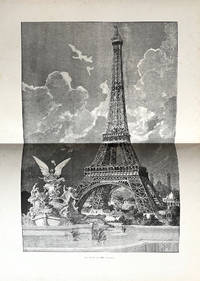
189061004Paris: E. Dentu Editeur Libraire de la Societe des Gens de Letteres 1890. Four Vols. Folio. 9.75 x 13 in. xxxi 1 666 2; 4 618 2; 4 670 2; 8 pp unpaginated. with 82 engravings on 70 plates many double-page. Extra-illustrated title page frontispiece in vol. I 100’s of text woodcut-engravings tables diagrams charts decorated head- and tail-pieces decorated initials. Uniformly bound in elaborately decorated gray-lilac-coloured cloth embossed decorative borders in burgundy-colour gilt lettering front covers & spines t.e.g. minor edgewear inner hinges starting in a few places due to weight of the textblock minor wear and slight bumping to corners darkening and more wear to Atlas volume still a VG set. First edition of this nicely printed and weighty set chronicling the fourth great Paris World’s Fair an extraordinary Exposition which refashioned Paris and celebrated the Centennial of the French Revolution and the storming of the Bastille. The Exposition was intended to pull France out of a ruinous recession and attracted over 61000 exhibitors as well as 32 million visitors many of whom came to view the iconic Eiffel Tower and even a profit of 8000000 francs. This lavish production details the development and history of the Exposition the construction of the Eiffel Tower as well as the development of the sites along the Seine. The companion album includes 82 woodcut-engraved images executed by such artists as Baude Baulenaz and Hauger many of them from original photographs shot by Messiers J. Levy et Cie. Levy had also shot photographs for the 1867 Paris L’Exposition Universelle and his photos captured many views of the exhibition grounds and buildings and focused on many in the Javanese Tonkin and Streets of Cairo attractions. E. Dentu, Editeur, Libraire de la Societe des Gens de Letteres, hardcover
1920007893Paris: Librairie Lutetia 1920. Limited First Edition. Wraps. Fine. No. 150 of 250 copies and now truly scarce with no copies located on OCLC First Search nor in commerce on the date of this listing. Exquisite Art Deco pochoir leporello with 12 humorous caricature panels one for each month. The leporello is housed in a larger light card stock wrapper which is basically a folded sheet and the leporello is loosely held in by a string. The cover of the wrapper has a lovely stylized pochoir illustration of a woman in a panniered dress. The rear has a simple woodcut of a potted tree and the date of publication. The inside of the wrappers is a repeat motive of a potted plant against a blue background. The characters of "caricature" are mostly a French everyman. Each illustration has two lines of captioning at the base. The artist whose real name was Samuel Monod was accomplished in many aspects of letters. He was not just a cartoonist and illustrator but also a writer publisher journalist art critic and theorist and finally a historian of typography. Librairie Lutetia unknown
1890R300140104E.DENTU. 1890. In-4. Cartonnage d'éditeurs. Bon état, Couv. convenable, Dos satisfaisant, Intérieur frais. 666 pages + 618 pages + 670 pages + album contenant environ 70 planches en noir et blanc - nombreuses illustrations en noir et blanc dans et hors texte - 7 photos disponibles.. . . . Classification Dewey : 708-Galeries, musées, collections d'art
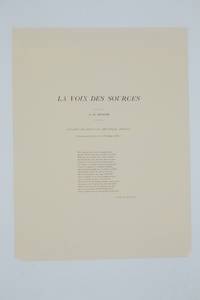
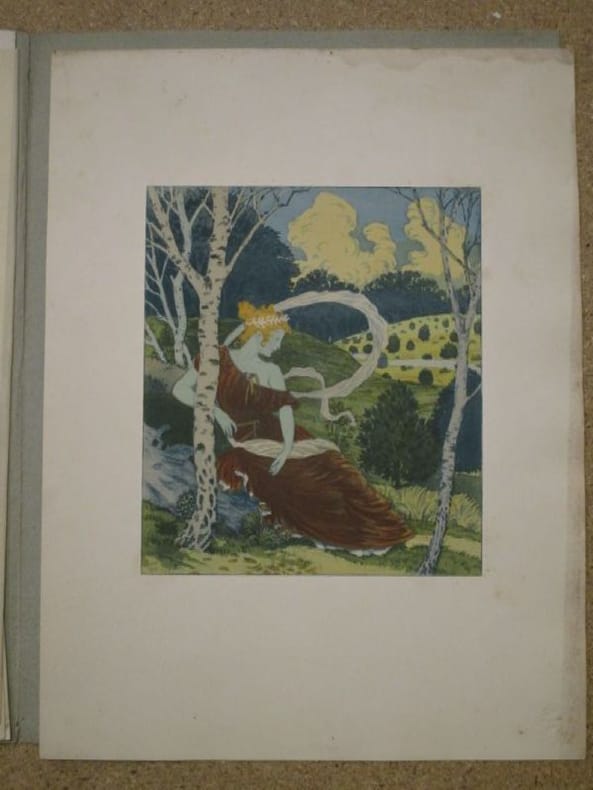
189974833Paris: Imprimerie Champenoispour CH. MassonH. Piazza 1899. Fine. Imprimerie Champenois pour CH. Masson H. Piazza Paris Mars 1899 30.50 x 25 cm une feuille et une serpente Rare original color lithograph executed by Lucien Hector Monod for L'Estampe Moderne series number 23 published in March 1899. One of 50 deluxe proofs printed on Japan paper with wide margins artist's signature in the plate publisher's dry stamp depicting a child's profile in the lower margin numbered luxury edition stamp on the verso; engraving preceded by a tissue guard captioned with the artist's name the title and text. Lithograph inspired by an extract from a work by Henri de Régnier reproduced on the print's tissue guard. Magnificent French monthly publication edited between May 1897 and April 1899 L'Estampe moderne consists of original chromolithographs which unlike other magazines such as Les Maîtres de l'Affiche and as stipulated on the tissue guards were created specially by each artist for the magazine. Thus 100 prints appeared in total covering the major artistic movements of the late 19th century: Symbolism Art Nouveau Pre-Raphaelites Orientalists and Belle Époque. Each delivery of four prints was issued in 2000 copies sold for 3.50F and 100 on Japan paper offered at 10F. Henri Piazza also planned a confidential very deluxe printing: 50 copies on Japan paper with wide margins and 50 in black on China paper at the considerable price of 30F. This print of beautiful format is superbly printed on the most prestigious of papers: Japan paper. Thick silky satiny and pearlescent it contributes to making each page a work in its own right. Its quality of ink absorption and its affinity with colors also make it the ideal support for these very beautiful lithographs. The interest of French collectors in artistic posters intensified at the beginning of the 1890s. Octave Uzanne to qualify this fever invented the term ""affichomanie."" The poster originally popular and plastered in the streets of the capital then became an art object and its ephemeral support became precious and destined for preservation. Piazza decided to remove the poster from its advertising vocation and elevate it to the rank of a work of art in its own right on the same level as the illustrated deluxe book. He thus composed a prestigious collection of entirely original works by the most prominent European artists of the moment: Georges de Feure Eugène Grasset Henri Detouche Emile Berchmans Louis Rhead Gaston de Latenay Lucien Lévy-Dhurmer Gustave-Max Stevens Charles Doudelet Hans Christiansen Henri Fantin-Latour Steinlen Ibels Engels Willette Henri Meunier Evenepoël Bellery-Desfontaines Charles Léandre etc. Handsome copy. Imprimerie Champenoispour CH. MassonH. Piazza unknown
1991008423Paris Futuropolis Gallimard 1991 Cartonnage de L'éditeur
189974833Imprimerie Champenois pour CH. Masson H. Piazza | Paris (Mars 1899) | 30.50 x 25 cm | une feuille et une serpente
77661, vers 19508, in-4, 43 p, fig. dans le texte, Broché, Document tapuscrit original dans lequel Jacques Monod fait état de l'ensemble de ses titres et travaux scientifiques jusqu'à la date de 1958 : curriculum vitae, rapports et conférences, résumé de ses travaux de recherche et publications. Jacques Monod remporta le Prix Nobel en 1965 grâce à son travail de recherche à L'Institut Pasteur. Envoi manuscrit à l'encre brune de Jacques Monod à Louis De Broglie sur la première de couverture. Couverture rigide
1890RO30011424E. Dentu. 1890. In-4. Cartonnage d'éditeurs. Bon état, Couv. convenable, Dos satisfaisant, Intérieur frais. Tome 1: 664 pages, petit accroc sur le dos, et couverture un peu abîmée. Tome 2: 618 pages, dernier plat un peu abîmé. Tome 3: 667 pages, légères tâches sur les plats et dos légèrement plié. Néanmoins les trois sont en bon état. Les trois volumes sont illustrés de gravures noir et blanc, dans et hors-texte. Relié toilé, titre doré.. . . . Classification Dewey : 900-GEOGRAPHIE, HISTOIRE, SCIENCES AUXILIAIRES DE L'HISTOIRE
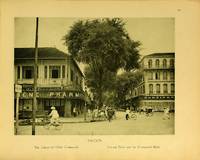
193043483Saigon: Édition Photo Nadal 1930. First edition oblong 4to pp. 113 1; profusely illustrated throughout with sepia toned and black & white photographic illustrations of various people places and way of life in Saigon & Cholon; parallel text in French and English; marbled endpapers front hinge cracked corners bumped and chipped else very good in quarter brown calf over marbled boards with gilt lettering and decoration on spine with raised bands. Édition Photo Nadal unknown
193043483Saigon: Édition Photo Nadal 1930. First edition oblong 4to pp. 113 1; profusely illustrated throughout with sepia toned and black & white photographic illustrations of various people places and way of life in Saigon & Cholon; parallel text in French and English; marbled endpapers front hinge cracked corners bumped and chipped else very good in quarter brown calf over marbled boards with gilt lettering and decoration on spine with raised bands. <br/><br/> Édition Photo Nadal hardcover books
189974834Paris: Imprimerie Champenoispour CH. MassonH. Piazza 1899. Fine. Imprimerie Champenois pour CH. Masson H. Piazza Paris Mars 1899 30.50 x 25 cm une feuille Rare original lithograph executed by Lucien Hector Monod for L'Estampe Moderne series number 23 published in March 1899. One of 50 deluxe proofs printed on China paper with wide margins artist's signature in the plate publisher's dry stamp depicting a child's profile in the lower margin mounted on a sheet of laid paper with the numbered luxury edition stamp on the verso some foxing. Lithograph inspired by an extract from a work by Henri de Régnier. Magnificent French monthly publication edited between May 1897 and April 1899 L'Estampe moderne consists of original chromolithographs which unlike other magazines such as Les Maîtres de l'Affiche and as stipulated on the tissue guards were created specially by each artist for the magazine. Thus 100 prints appeared in total covering the major artistic movements of the late 19th century: Symbolism Art Nouveau Pre-Raphaelites Orientalists and Belle Époque. Each delivery of four prints was issued in 2000 copies sold for 3.50F and 100 on Japan paper offered at 10F. Henri Piazza also planned a confidential very deluxe printing: 50 copies on Japan paper with wide margins and 50 in black on China paper at the considerable price of 30F. This print of beautiful format is superbly printed on one of the most prestigious papers: China paper. ""Despite all its qualities China paper too inconsistent owes its reputation not to its own beauty but indeed to its particular affinities with printing ink. Its texture smooth and soft together is more apt than any other to receive a beautiful printing. This property makes China paper sought after for printing engravings."" Anatole France. The interest of French collectors in artistic posters intensified at the beginning of the 1890s. Octave Uzanne to qualify this fever invented the term ""affichomanie."" The poster originally popular and plastered in the streets of the capital then became an art object and its ephemeral support became precious and destined for preservation. Piazza decided to remove the poster from its advertising vocation and elevate it to the rank of a work of art in its own right on the same level as the illustrated deluxe book. He thus composed a prestigious collection of entirely original works by the most prominent European artists of the moment: Georges de Feure Eugène Grasset Henri Detouche Emile Berchmans Louis Rhead Gaston de Latenay Lucien Lévy-Dhurmer Gustave-Max Stevens Charles Doudelet Hans Christiansen Henri Fantin-Latour Steinlen Ibels Engels Willette Henri Meunier Evenepoël Bellery-Desfontaines Charles Léandre etc. Handsome copy. Imprimerie Champenoispour CH. MassonH. Piazza unknown
ORD-7498Prix atteints dans les ventes. Suites et états. Biographies et Bibliographies. Aide-Mémoire de l'Amateur et du Professionnel. Paris. Morancé. 1920-1931. 9 volumes in-8 (165 x 252mm) brochés, couverture imprimées et ornées en rouge et noir, XVI, 276; 3ff., 280; 3ff., 287; 3ff., 277; 3ff., 280; 3ff., 292; 3ff., 288; 3ff., 279 et 3ff., 280, (3) pages. Classement alphabétique. Qq. pages un peu brunies mais bon exemplaire, complet.
1863691571 vol. in-4 reliure demi-chagrin noir, dos à 4 nerfs, 1863 - 1864, environ 150 ff. dont 92 ff. manuscrits (le feuillet de titre partiellement imprimé, complété à la plume)
BN106133Editions Ereme. Softcover. AMBROISE MONOD LE RECUP'ART <br/><br/>AMBROISE MONOD LE RECUP'ART Editions Ereme paperback
199236521Ides et Calendes Jaquette en très bon état Couvertures rigides toile Neuchâtel 1992
189974834Imprimerie Champenois pour CH. Masson H. Piazza | Paris (Mars) 1899 | 30.50 x 25 cm | une feuille
1969EEKMANNI007239Pierre Cailler Gen�ve. 1969. First edition. Square octavo. pp 29 1 81 plates several in colour and tipped in. Glossy card wrappers. Includes ''une biographie une bibliographie et une documentation compl�te sur le peintre et son oeuvre''. The Belgian figurative artist and illustrator born Nikolaas Mathijs Eekman was known variously as Nico Eekman Nic Eekman and Ekma.Number 6 of fifty de luxe copies with two laid-in original dry-point etchings signed and numbered ''Luxe 6/50'' by the artist. The etchings are in his fantasy-allegorical style which has strong echoes of Rackham's.Front cover slightly creased at bottom corner. Very good indeed. The etchings are in fine state. Pierre Cailler, Gen�ve. unknown
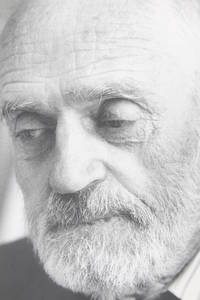
198484864s. l. Paris: S. n. 1984. Fine. S. n. s. l. Paris avril 1984 24 x 30.50 cm une feuille Original photograph. Vintage black and white gelatin silver print. Artist's proof signed on verso. Portrait of writer Théodore Monod. In 1983 Bruno de Monès began a regular collaboration with Le Magazine littéraire which would last until the mid-1990s. S. n. unknown
18901256956Paris: E. Dentu 1890. first edition. Thick folios in grey hardcovers with brown gilt and gold letters; VG; boards have moderate soiling; volume one corners slightly bumped; edges dusty; paper clean; text clean; in French; foxing on a few pages; app. 600 pages each volume; shelved above French section; please contact us for shipping costs. 1256956. Shelved Dupont Bookstore. E. Dentu unknown books
18901256956Paris: E. Dentu 1890. first edition. Thick folios in grey hardcovers with brown gilt and gold letters; VG; boards have moderate soiling; volume one corners slightly bumped; edges dusty; paper clean; text clean; in French; foxing on a few pages; app. 600 pages each volume; shelved above French section; please contact us for shipping costs. 1256956. Shelved Dupont Bookstore. E. Dentu unknown
GOR003410573Paperback. Very Good. paperback
1899118915Estampe moderne 1899 Imp. Champenois, l'Estampe Moderne, Numéro 23, Mars 1899, environ 41x31cm, couverture d'après Mucha, complet des 4 estampes (2 sont contrecollées à une page plus grande, les 2 autres sont directement imprimées). Dos en partie fendu, premier plat insolé. Une mouillure dans la marge de l'illustration de Monod. Marges de l'illustrations de Granès piquées. 2 petits trous de punaise et une mouillure en bordure de la page sur laquelle est contrecollée l'illustration de Grasset. Bon état pour le reste.