Mirbeau, OctaveBiblio.com
307 résultats
1409727688.Gpaperback. Good. Access codes and supplements are not guaranteed with used items. May be an ex-library book. paperback
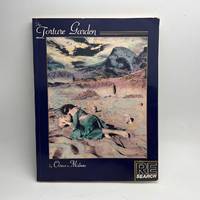
1989Q-0940642131Re-Search Pubns 1989-06-01. Paperback. New. In shrink wrap. Looks like an interesting title! Re-Search Pubns paperback
1989C65807San Francisco 1989. First Edition Thus. Paperback. Covers a little worn at edges corners bumped with some creasing inside very faint smell of tobacco but nothing too obtrusive else clean. good plus. Bobby Neel Adams. 4to. pp 120. Original publisher's colour illustrated laminated card covers. Copiously illustrated in black and white throughout.ISBN: 0940642131 paperback
1906110026.Gpaperback. Good. Access codes and supplements are not guaranteed with used items. May be an ex-library book. paperback
0259017906.Gpaperback. Good. Access codes and supplements are not guaranteed with used items. May be an ex-library book. paperback
1246566060.Gpaperback. Good. Access codes and supplements are not guaranteed with used items. May be an ex-library book. paperback
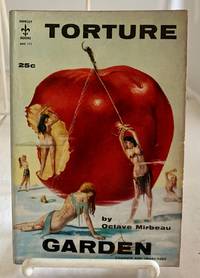
1955A47317New York NY: Berkley. 1955. First Edition Thus; First Printing. Paperback. Very Good. This is a mass market paperback book. Berkley books number AMC 111 priced at .25 cents. The book is in Very Good condition and was issued without a dust jacket. The spine ends and corners of the book covers have some light bumping and rubbing. The text pages are clean but have generalized toning. There is a bit of a dusty smell to the text block. "Octave Mirbeau 16 February 1848 – 16 February 1917 was a French novelist art critic travel writer pamphleteer journalist and playwright who achieved celebrity in Europe and great success among the public whilst still appealing to the literary and artistic avant-garde with highly transgressive novels that explored violence abuse and psychological detachment. His work has been translated into 30 languages. " from Wikipedia; Anc 111; Mass Market PB; 157p. pages; Pictured 12/6/23 . Berkley paperback
1931200-06533C. Kendall 1931. Good. Good condition with wear. C. Kendall unknown
1948012604New Y New York: Citadel Press 1948. 1st Thus. . Hardcover. Very Good/Fair. Collectible. To view more titles by this author enter the keywords; Mirbeau or Mystery. The book is in excellent condition with very minor wear o/w tight clean and square. The D/J has several chips scuffs and small tears. Translated from the French by Alvah C. Bessie with a foreward by James Huneker. Rare book. <br/> <br/> Citadel Press hardcover
0353774650.Ghardcover. Good. Access codes and supplements are not guaranteed with used items. May be an ex-library book. hardcover
0353742600.Ghardcover. Good. Access codes and supplements are not guaranteed with used items. May be an ex-library book. hardcover
190411461904. Near fine. 3pp 4to. Holograph manuscript in pen in French writing on the rectos only the first two pages are filled with text the last page is trimmed with only 4 lines and Mirbeau’s signature. Creases stains smudges offsetting but cleanly written legible and very good. An article for the left-wing newspaper L’Humanité published 25/Sept/1904. The newspaper was founded only a few months earlier by SFIO leader Jean Jaures who also served as editor. In the article Mirbeau criticizes France for its refusal to intervene in the Russo-Japanese war. With biting irony he mimics the indifferent French attitude: "Let's wait two five ten twenty years if we have to. We'll keep on slaughtering each other over there. But what are we risking. Life is good our restaurants are still the best in the world. There are still the prettiest girls in the theaters of Paris." He exposes the hypocrisy of French foreign policy: "as allies not of the Russian people whose infinite sufferings like those of all peoples are of absolutely no concern to us but as allies of the czar whose glory alone is important to us let us be no less faithful czarists than the czar himself is." Drawing a powerful parallel Mirbeau connects the mounting casualties of the Russo-Japanese conflict with the Armenian massacres—which had already reached devastating proportions by 1904. A different but contemporary newspaper clipping is laid in seemingly part 2 by Mirbeau: it records a conversation with a merchant marine captain recently returned from the Far East who despite personally witnessing naval battles admits he comprehends little of the war's true nature beyond scattered disturbing details he finds too horrific to fully describe.<br /> <br /> The early 1900s particularly 1904-1905 marked a transformative period in the development of anti-imperialist critique within European leftist thought. The Russo-Japanese conflict illuminated the contradictions within Western powers' foreign policies particularly France's relationship with Tsarist Russia. The French left's growing disillusionment with the Franco-Russian alliance exemplified broader ideological shifts that would shape socialist internationalism for decades. As ordinary Russians died for imperial ambitions while French elites remained indifferent behind a facade of nationalist solidarity socialist thinkers increasingly recognized patterns linking capitalist interests to colonial violence. This period also witnessed the emergence of more sophisticated leftist analyses connecting imperial competition abroad with class exploitation at home. The juxtaposition of European indifference toward both the Russo-Japanese War casualties and the Armenian massacres demonstrated how Western powers selectively applied humanitarian concerns based on strategic interests—a critique that would become central to anti-colonial movements throughout the 20th century and presage the internationalist anti-war position that would later fracture the European left during World War I.<br /> <br /> Octave Mirbeau 1848-1917 emerged as one of France's most incisive social critics during the Belle Époque developing a literary voice defined by moral outrage and stylistic innovation that transcended conventional boundaries between journalism and literature. His artistic sensibilities were profoundly shaped by traumatic experiences—including abuse at a Jesuit school and service in the Franco-Prussian War—which fostered his lifelong commitments to anarchism pacifism and the defense of individual dignity against institutional power. Beyond his novels exposing societal hypocrisy including the controversial "Le Jardin des supplices" 1899 and "Le Journal d'une femme de chambre" 1900 Mirbeau distinguished himself as a prescient art critic who championed misunderstood avant-garde figures like Van Gogh Rodin and Monet recognizing artistic genius that his contemporaries often dismissed. His prolific output—spanning over twelve hundred works across multiple genres—consistently demonstrated his willingness to confront uncomfortable truths about violence sexuality and power that bourgeois society preferred to ignore establishing him as an intellectual forerunner to modernist aesthetic and political movements of the twentieth century. unknown
MA09C-04258New York Citadel. Used - Good. NY: The Citadel Press 1949. 2nd Printing. 8vo Hardcover. 253pp. Good book and Good dust jacket. erotica literature sexuality Inquire if you need further information. New York Citadel hardcover
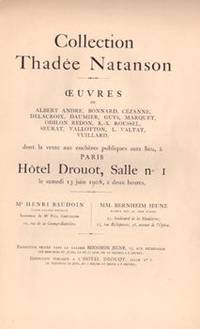
16-5640Paris: Henri Baudoin & Bernheim Jeune 1908. 4to. 21 x 31.5 cm. Original wraps with Claude Roger-Marx's notation on the cover.Oeuvres de Albert Andre Bonnard Cezanne Delacroix Daumier Guys Marquet Odilon Redon K.X. Roussel Seurat Vallotton L. Valtat Vuillard. 65 works cataloogued wihout illustrations. No original copies in OCLC. .Thadée Natanson 1868-1951 was the co-founder in 1889 of La Revue blanche with his brother. He married the famous muse Misia Godebska in 1893.Thadée Natanson né à Varsovie en 1868 est issu d'une riche famille polonaise émigrée à Paris. Avec ses deux frères Alexandre et Louis-Alfred et leurs camarades du lycée Condorcet il fonde en 1889 une revue entièrement dédiée à la poésie La Revue Blanche. Il épouse Misia Godebska en 1893 laquelle devient rapidement la "Reine de Paris". Le couple reçoit des personnalités du monde artistique et littéraire de la Belle Époque notamment Stéphane Mallarmé Félix Vallotton Toulouse-Lautrec Octave Mirbeau ou encore Marcel Proust. Son engagement en faveur d'Alfred Dreyfus lui fait perdre de nombreux soutiens et La Revue Blanche fait faillite peu de temps après son divorce avec Misia en 1905. Natanson se tourne alors vers les affaires et l'industrie jusqu'à sa mort en 1951 à Paris. .Expertise by Alain Nicolas and Pierre Gheno Paris. Paris: Henri Baudoin & Bernheim Jeune, 1908 paperback
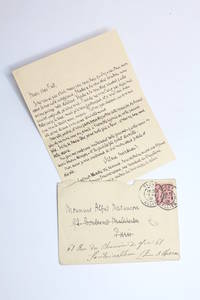
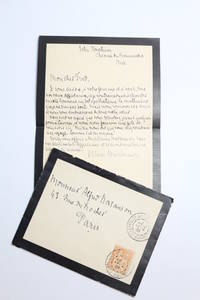
190673674Vichy 1906. Fine. Vichy 10 août 1906 11.60 x 18 cm une feuille Moving autograph letter signed by Octave Mirbeau addressed to the playwright and founder of the Revue Blanche Alfred Natanson when he had just lost his father. 18 lines in black ink on a folded sheet envelope included. ""Mon cher Fred Je ne vous ai pas écrit ; mais vous savez bien qu'il n'y a pas dans mon cur la moindre indifférence. Thadée a dû vous dire combien nous avions partagé votre douleur. Thadée a dû vous dire souvent quelle amitié profonde j'ai pour vous. Peut-être ne vous l'ai-je pas exprimée telle que je la sens mais je la sens fortement et je voudrais bien que vous la sentiez aussi un peu. C'est un gros chagrin que de ne plus être aimé de ceux qu'on aime véritablement. Vous allez partir ; et vous faîtes bien de quitter cette maison où durant plus de six mois vous avez assisté à l'horrible agonie de votre pauvre père. Tâchez de travailler pour notre joie à tous. et revenez avec une belle uvre."" ""My dear Fred I have not written to you; but you know well that there is not the slightest indifference in my heart. Thadée must have told you how much we shared your grief. Thadée must have told you often what deep friendship I have for you. Perhaps I have not expressed it to you as I feel it but I feel it strongly and I would very much like you to feel it too a little. It is a great sorrow to no longer be loved by those one truly loves. You are going to leave; and you do well to quit this house where for more than six months you witnessed the horrible agony of your poor father. Try to work for all our joy. and return with a beautiful work."". Mirbeau was particularly close to the group of the Revue Blanche since its launch in Paris in 1891. But it was since the Dreyfus affair that his intimate and lasting friendship with the Natanson brothers Thadée Alexandre and Alfred was strengthened. After aesthetic disagreements about Art Nouveau and the Nabis Mirbeau finally reunited with Thadée around 1900 in a now common inclination for the young Nabis painters of the Revue Blanche Bonnard Vallotton and Vuillard. The Revue Blanche played an essential role in France as confirmed by historian Paul-Henri Bourrelier: ""Most of the most prominent writers painters musicians politicians and intellectuals of the late 19th and early 20th centuries collaborated with it or were associated with it. Created financed and directed by the three Natanson brothers young Polish Jews with the enthusiastic complicity of their classmates from the Condorcet lycée La Revue blanche quickly became a place of debate on all subjects that stirred France. It waged political battles under the impulse of anarchists like Fénéon Mirbeau; socialists such as Blum G. Moch Péguy; Dreyfusards and founders of the League of Human Rights like Reinach and Pressensé."" unknown
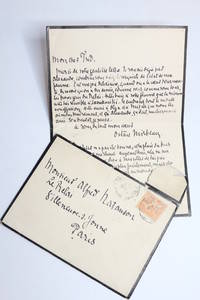
190173686s. l. cachet de Seine-et-Marne 1901. Fine. s. l. cachet de Seine-et-Marne 15 Septembre 1901 12.50 x 17.60 cm une feuille Moving autograph letter signed by Octave Mirbeau addressed to the playwright and founder of the Revue Blanche Alfred Natanson. 15 lines in black ink on a folded sheet mourning paper with black border watermarked ""JDL & cie"" envelope attached. ""Thank you for your kind letter. I already knew from Alexandre Natanson how worried you had been about my wife's condition. It is a delicious joy when one's heart is tormented to know that one has friends like you like all of you the good people of the Relai. Please tell your wife that mine was very touched by her friendship. And embrace everyone with effusion. Also tell Olga Alexandre Natanson's wife and Misia Thadée's wife that we love them tenderly and Alexandre that he is a charming friend."" Long postscript on the poor health of his wife the former actress Alice Régnault: ""Yesterday was not a good day and the wound on her arm presented a nasty appearance. Today it is a little better. But it is something to watch very closely. Movements are made a little more easily but she still suffers extremely at night at the slightest play of the muscles"". Mirbeau had been particularly close to the Revue Blanche group since its launch in Paris in 1891. But it was during the Dreyfus affair that his intimate and lasting friendship with the Natanson brothers Thadée Alexandre and Alfred was strengthened. After aesthetic disagreements over Art Nouveau and the Nabis Mirbeau finally reunited with Thadée around 1900 in a now shared inclination for the young Nabis painters of the Revue Blanche Bonnard Vallotton and Vuillard. The ""Relai"" corresponds to a former coaching inn in Villeneuve-sur-Yonne purchased by Thadée Natanson in 1897 which became a destination for all their writer and artist friends. One could encounter the Nabis painters Vuillard Vallotton Bonnard or Roussel as well as Toulouse-Lautrec. The Revue Blanche played an essential role in France as historian Paul-Henri Bourrelier confirms: ""Most of the most prominent writers painters musicians politicians intellectuals of the late nineteenth and early twentieth centuries collaborated with it or were associated with it. Created financed and directed by the three Natanson brothers young Polish Jews with the enthusiastic complicity of their fellow students from the Condorcet lycée La Revue blanche quickly became a place of debate on all the subjects that stirred France. It led political battles under the impetus of anarchists like Fénéon Mirbeau; socialists such as Blum G. Moch Péguy; Dreyfusards and founders of the League of Human Rights like Reinach and Pressensé."" unknown
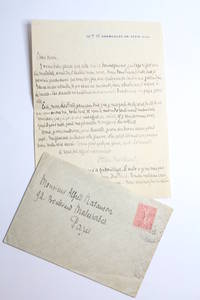
190673701Cormeilles-en-Vexin 1906. Fine. Cormeilles-en-Vexin 22 août 1906 ou 1908 12.60 x 17 cm une feuille Friendly autograph letter signed by Octave Mirbeau addressed to the playwright and founder of the Revue Blanche Alfred Natanson. 12 lines in black ink on a folded sheet letterhead paper ""Cormeilles-en-VexinS.&O."" envelope included. ""Cher ami J'avais bien pensé que cette vieille bonne femme qui tape si fort sur les matelas avait du écorcher mon nom. Mais dans l'incertitude car je pouvais penser aussi que vous étiez pris avec quelqu'un de très sérieux . Ceci mon cher Fred pour vous dire que je suis parti de chez vous triste de ne pas vous avoir vu voilà tout et sans le moindre sentiment mauvais. Vous savez que j'ai pour vous une affection solide et je vous connais assez gentil pour moi pour me permettre de supposer des sottises. ."" ""Dear friend I had indeed thought that this old good woman who beats the mattresses so hard must have mangled my name. But in uncertainty for I could also think that you were busy with someone very serious . This my dear Fred to tell you that I left your house sad not to have seen you that's all and without the slightest bad feeling. You know that I have a solid affection for you and I know you well enough to be kind to me to allow myself to suppose foolish things. ."" With an amusing postscript: ""Ne prêtez pas attention à ce gribouillage. L'auto a je ne sais pas quoi j'y travaille. et n'y fait rien de bon. d'ailleurs. Et mon mécanicien se prend la tête à deux mains noires d'huile grasse ."". ""Don't pay attention to this scribbling. The car has something wrong I don't know what I'm working on it. and it's not doing any good. anyway. And my mechanic is holding his head in his two hands black with greasy oil ."". Mirbeau was particularly close to the Revue Blanche group since its launch in Paris in 1891. But it was from the Dreyfus affair that his intimate and lasting friendship with the Natanson brothers Thadée Alexandre and Alfred was strengthened. After aesthetic disagreements about Art Nouveau and the Nabis Mirbeau finally reunited with Thadée around 1900 in a now common inclination for the young Nabis painters of the Revue Blanche Bonnard Vallotton and Vuillard. The Revue Blanche played an essential role in France as confirmed by historian Paul-Henri Bourrelier: ""Most of the most prominent writers painters musicians politicians intellectuals of the late 19th and early 20th centuries collaborated with it or were associated with it. Created financed and directed by the three Natanson brothers young Polish Jews with the enthusiastic complicity of their classmates from the Condorcet lycée La Revue blanche quickly became a place of debate on all subjects that stirred France. It led political battles under the impulse of anarchists like Fénéon Mirbeau; socialists such as Blum G. Moch Péguy; Dreyfusards and founders of the League of Human Rights like Reinach and Pressensé."" unknown
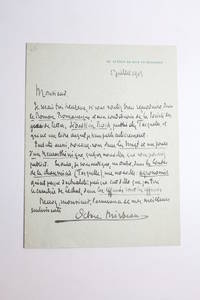
190373704s. l. Paris 1903. Fine. s. l. Paris 1er Juillet 1903 13.80 x 18.30 cm une feuille Autograph letter signed by Octave Mirbeau addressed presumably to Léon Tonnelle director of the review Le Roman Romanesque. 12 lines in black ink on a folded sheet grey paper with letterhead ""68 avenue du bois de Boulogne"". ""Monsieur je serais très heureux si vous vouliez bien reproduire dans Le Roman Romanesque et aux conditions de la Société des gens de lettres Sébastien Roch publié chez Fasquelle et qui est un livre auquel je tiens particulièrement. Peut-être aussi trouverez-vous dans Les vingt et un jours d'un neurasthénique quelques nouvelles que vous pourriez publier. En outre je vous indique en outre dans Les Contes de la Chaumière Fasquelle une nouvelle : Agronomie qui est presque d'actualité puisque c'est d'elle que j'ai tiré le caractère de Lechat dans Les Affaires sont les affaires. ."" ""Sir I would be very happy if you would kindly reproduce in Le Roman Romanesque and under the conditions of the Société des gens de lettres Sébastien Roch published by Fasquelle and which is a book to which I am particularly attached. Perhaps also you will find in Les vingt et un jours d'un neurasthénique some short stories that you could publish. Furthermore I also indicate to you in Les Contes de la Chaumière Fasquelle a short story: Agronomie which is almost topical since it is from this that I drew the character of Lechat in Les Affaires sont les affaires. ."". Octave Mirbeau published his novel Le Calvaire in issue 8 of the review le Roman Romanesque published in December 1903. The titles mentioned in the letter were ultimately not published. unknown
190173700Nice Villa Ibrahim chemin des Baumettes Nice 1901. Fine. Nice Villa Ibrahim chemin des Baumettes Nice 8 Février 1901 12.50 x 17.60 cm une feuille Friendly autograph letter signed by Octave Mirbeau addressed to the playwright and founder of the Revue Blanche Alfred Natanson some time after his marriage. 12 lines in black ink on a folded sheet mourning paper with black border watermarked ""JDL & cie"" envelope included. ""Je vous envoie à votre femme et à vous tous nos vux affectueux et je voudrais pouvoir chanter en votre honneur un bel épithalame. Le malheur est que je ne suis pas poète. Mais nous somme vos amis et nous vous embrassons de tout notre cur. Nous avions espéré que vous viendriez passer quelques jours à Cannes et nous nous faisions une fête de vous avoir ici. Misia nous dit que vous avez renoncé à ce voyage. Comme c'est ennuyeux ! ."". ""I send to your wife and to you all our affectionate wishes and I would like to be able to sing a beautiful epithalamium in your honor. The misfortune is that I am not a poet. But we are your friends and we embrace you with all our heart. We had hoped that you would come to spend a few days in Cannes and we were looking forward to having you here. Misia tells us that you have given up this trip. How annoying! ."". Mirbeau was particularly close to the Revue Blanche group since its launch in Paris in 1891. But it was from the Dreyfus affair that his intimate and lasting friendship with the Natanson brothers Thadée Alexandre and Alfred was strengthened. After aesthetic disagreements about Art Nouveau and the Nabis Mirbeau finally reunited with Thadée around 1900 in a now common inclination for the young Nabis painters of the Revue Blanche Bonnard Vallotton and Vuillard. The Revue Blanche played an essential role in France as confirmed by historian Paul-Henri Bourrelier: ""Most of the most prominent writers painters musicians politicians intellectuals of the late 19th and early 20th centuries collaborated with it or were associated with it. Created financed and directed by the three Natanson brothers young Polish Jews with the enthusiastic complicity of their classmates from the Condorcet lycée La Revue blanche quickly became a place of debate on all subjects that stirred France. It led political battles under the impulse of anarchists like Fénéon Mirbeau; socialists such as Blum G. Moch Péguy; Dreyfusards and founders of the League of Human Rights like Reinach and Pressensé."" unknown
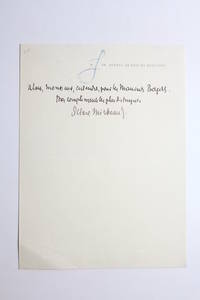
189773703s. l. Paris 1897. Fine. s. l. Paris 1897 13.50 x 18.30 cm une feuille Autograph letter signed by Octave Mirbeau. 2 lines in black ink on a folded sheet letterhead paper ""68 avenue du bois de Boulogne"". ""Alors Monsieur entendu pour les Mauvais Bergers"". The Mauvais bergers corresponds to Octave Mirbeau's tragedy a social drama performed at the Renaissance Theatre on December 15 1897 with Sarah Bernhardt and Lucien Guitry in the leading roles. unknown
0484540408.Ghardcover. Good. Access codes and supplements are not guaranteed with used items. May be an ex-library book. hardcover
1331155479.Gpaperback. Good. Access codes and supplements are not guaranteed with used items. May be an ex-library book. paperback
B9781019887561Hardback. New. hardcover
ria9783752442373_inpHardcover. New. New Book; Fast Shipping from UK; Not signed; Not First Edition; N/A hardcover
50154383like new. unknown