PETRARQUE [Francesco PETRARCA]Biblio.com
33 résultats
155381681In Vinegia Venice: Apresso Gabriel Giolito de Ferrari 1553. Fine. Apresso Gabriel Giolito de Ferrari In Vinegia Venice 1553 15.30 x 22.50 cm relié Third edition of these works by Petrarch commented by Gesualdo the first of which appeared in Venice in 1533. They comprise the Canzoniere in italics prima parte and seconda parte with commentary distributed around it and the Trionfi also accompanied by commentary. 2 engraved title pages the first general one with portraits of Laura and Petrarch on either side of the portico and the second for the Trionfi. Numerous engraved and historiated initials and 6 title vignettes for the trionfi. A map of the Vaucluse site where Petrarch lived. Later Italian binding ca 1840 in half cherry red morocconized shagreen with red percale boards. Spine with 4 false flat raised bands decorated with 3 tools and blind frames roulettes on the bands and thick blind fillets. Initials in one of the compartments: CG. Traces of rubbing. Stains on boards and rubbing. Title-frontispiece cropped short with small lacks to corners and outer margin. Traces of pale yellow dampstains in margin of first 5 preliminary leaves then on Petrarch's life on 2 leaves dampstain trace at mid-page and in margin. Gathering 553 detached. On leaves 647 to 657 outer margin nibbled for 1cm then diminishing. Some scattered light foxing in margins but overall relatively fresh notably the text of the Canzoniere; more significant but still very light foxing at end of work. The preliminary pages include a stylistic analysis the lives of Petrarch and Laura. This edition of Gesualdo's commentary was revised in light of Vellutello's critical edition published later. Addressing very diverse and erudite questions Gesualdo's commentary is renowned for its great elegance. Apresso Gabriel Giolito de Ferrari hardcover
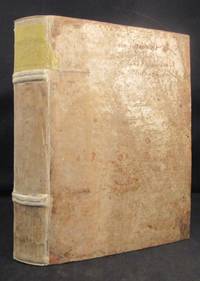
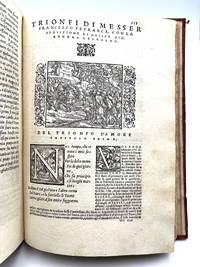
1554242933Vinegia: Giovan. Griffio 1554. hardcover. very good. Griffin and putti woodcut device on title page griffin passant device at end 5 large woodcut illustrations and historiated letters. Italic and roman letter. 218 pages small 4to full vellum lacks title label on spine. Vinegia: Giovan. Griffio 1554. A beautiful copy of a scarce book.<br/><br/> Not in Brunet; Cornell 104; not in Graesse; Haym 73 9; Hortis 55 99; Marsand 68.<br/><br/> Giovan. Griffio unknown books
1554242933Vinegia: Giovan. Griffio 1554. hardcover. very good. Griffin and putti woodcut device on title page griffin passant device at end 5 large woodcut illustrations and historiated letters. Italic and roman letter. 218 pages small 4to full vellum lacks title label on spine. Vinegia: Giovan. Griffio 1554. A beautiful copy of a scarce book.<br/> <br/> Not in Brunet; Cornell 104; not in Graesse; Haym 73 9; Hortis 55 99; Marsand 68.<br/> <br/> Giovan. Griffio unknown
152832165Venegia: Maestro Bernardino de Vidali 1528. A very early Edition of the Vellutello Petrarca. With fine heraldic ownership label. Illustrated with the rare two page view of the Valchiusa. This copy with the Babylonian Sonnets 165 ff not censored and still included in the text. Rare thus. 4to mm. 190 x 140 handsomely bound in fine full vellum of the period. 11ff 185 ff 51 ff Del Triumpho pp. A contemporarily bound copy in a pleasing state of preservation generally crisp and clean throughout some interesting notes in very early hands to the pastedowns a few here and there in the margins of the text-block interesting notes concerning prohibition to the leaves that contain the Babylonian verses the back sometime strengthened the vellum binding strong and in good order. A FINE AND VERY EARLY PRINTING OF THE VELLUTELLO PETRARCA. The volume was dedicated to Carlo Grotta Chancellor to Cardinal Cristofor Madruzzo Principe Vescovo of Trent and organizer of the Council of Trent. This edition of Petrarca with the commentary of Vellutello is considered the most important. Especially important is the celebrated commentary on the Canzoniere out of the edition of 1525. Also important is the biography of the poet.<br> This copy contains the Babylonian Sonnets which were generally censored and seldom included in copies of Petrarca's writings. These Babylonian sonnets a group of three poems that criticized the Avignon Papacy were initially banned because they were included in a prohibited Protestant work. In 1557 Pier Paolo Vergerio wrote Alcuni importanti luochi an attack against the Church that emphasized those three sonnets from Petrarch. Many clerics denounced the greed and corruption of the Avignon papacy. In the 1340s Petrarch wrote “I am living in the Babylon of the West†comparing Avignon to the biblical city of vice and corruption. He went on to condemn the habits of prelates who feasted at “licentious banquets†and rode white horses “decked in gold fed on gold and soon to be shod in gold if the Lord does not check this slavish luxury†Petrarch in Tuchman p. 29. His disgust found fuller expression in several sonnets among them Sonnet 138 which he addressed to the papal court at Avignon: “O foundry of deceits cruel prison where good dies and evil is / created and nourished a hell for the living: it will be a great / miracle if Christ does not finally show his anger against you†<br> The Canzoniere poetic “songbook†is also known as the Rime Sparse “scattered rhymesâ€. The work is a series of erotic poems that Petrarch wrote in the Italian vernacular about his love for the mysterious beauty “Laura†whom he first encountered on April 6 1327 at the church of St. Clare. Apparently in 1348 Laura and Cardinal Colonna both succumbed to the Black Death the bubonic plague that was ravaging Europe. Petrarch himself escaped the plague though he recorded these devastating personal losses in the Canzoniere; Laura’s death in particular shaped the resolution of the sequence of poems. Tiring of Church politics Petrarch left Avignon in 1353 and spent his remaining years in various Italian provinces. He continued work on the Canzoniere sorting and arranging its poems until his death in 1374. Although Petrarch was best known among contemporaries for his Latin writings his vernacular works especially the Canzoniere are now regarded as his masterpieces. His exploration of the emotional states of love yearning and spiritual aspiration in this work would have a major influence on future generations of poets. Maestro Bernardino de Vidali hardcover
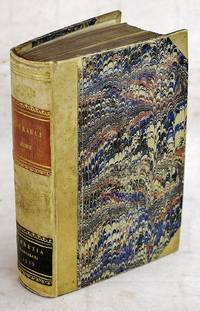
15392109100001Venetia : Stampato per Francesco Marcolino 1539. Hardcover. Very Good. Early Italian Emblem Book 2 volumes bound as one. Octavo 15 cm. Bound in later 1/2 vellum over marbled boards. Leather spine labels. Good binding and cover. 4 354 18 pages 180 leaves. Architectural title vignette with portrait of Petrarch. Engraved printer's device at end of first volume. Second volume has an engraved title with a portrait of Alunno. <br> Provenance: From Professor John MacQueen's library of Scotland. Includes related ephemera associated with Renaissance studies. "It is appropriate that Petrarch be printed in Italics a type invented in 1501 by the famous Venetian printer Aldus Manutius was said to have adopted Petrarch's own handwriting for . creating the new type." - Note inside front cover. <br> Refs: Fiske / Fowler 97; Ley 159-161; Brunet III 477. Venetia : Stampato per Francesco Marcolino hardcover
1512047500Venice: Angelo Scinzenzeler 1512. Early Edition. Hardcover Full Leather. Good Condition. Rebound in modern tooled leather. With the Opera bound before the Sonnets - with only 3 of the 6 engravings otherwise complete. Lacking the leaves at g5 i4 and q7 each with an engraving on the verso. 10 125 of 128; 116pp. With some mispagination and a switch to Arabic numerals from 89 but mispaginated 69 to 96. Modest foxing throughout lighter and heavier in spots first and lst pages worn. Old ink stains to Triumph of Time plate. and a few other stray old ink drops. Still very good or better overall save for the missing leaves. <br /> <br /> A rare edition a reimpression of Scinzenzeler's 1507 edition and with fine engravings by an unknown artist from the 1494 edition. Size: Folio. 2-volume set complete. Quantity Available: 1. Shipped Weight: Under 1 kilo. Category: Poetry; Inventory No: 047500. Angelo Scinzenzeler hardcover
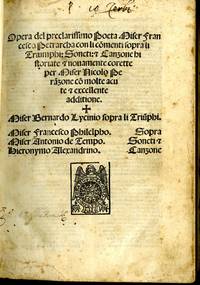
154975611549 In Vinegia : Per Pietro & Gioanmaria fratelli de Nicolini da Sabio, ad instanza di M. Giombattista Pederzano libraro al segno della Torre appresso il ponte di Rialto & compagni, 1549. In-8: 16x21,5 cm, 1 f. de titre avec «A gli Studiosi del Petrrarcca Giovanbattista» au vo., 11 ff. n. chiff. dintroduction et «Tavola dei Sonetti», 237 ff. Chiff. 1 à 237 pour les Sonetti et la Canzoni, 3 ff. n. chiff des «Altri sonetto del detto» et dachevé d'imprimer. Précieuse édition XVIe des oeuvres de Pétrarque (1304-1374) établie par léditeur vénitien Giovanni Antonio de Nicolini da Sabio et enrichie dune page de titre entièrement gravée avec les portraits du poète et de Laura en médaillon, de six figures sur bois à demi-page et de nombreuses lettrines initiales historiées. Une édition très correcte qui contient un texte très pur. (Graesse, V, 227). Il sagit de la deuxième édition, très augmentée et illustrée des six bois gravés pour les Trionfi, de lédition de 1541 du Canzoniere établie par Giovanni Antonio de Nicolini da Sabio, accompagnée des commentaires de Bernardino Daniello repris des notes de Trifone Gabriele. Lédition de 1549 « est plus belle et plus soignée que la précédente». (Brunet, IV, 550). «Fu fatta con molta diligenza, e nitidezza de caratteri; e graziose pur sono le stampe dintaglio, che adornano i Trioni». (Marsand, Biblioteca petrarchesca, pp. 57-58). Reliure en vélin. Dos à cinq nerfs avec titre et fleuron manuscrits à lencre noir. Tranches bleues. Ex-libris: André Gutzwiller. En excellent état avec un papier particulièrement frais et blanc.
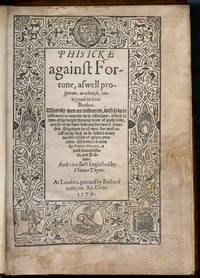
1579384London: Richard Watkyns 1579. First Edition. Very Good. Small 4to; 7 1/2 x 5 5/8 in. 190 x142 mm; pp. 4 xiv 1-152 First Booke Physicke for Fortune: 153-343 Second Booke Phisicke against Fortune vi table of contents 2. Each book with Epistolary preface by Franucis Petrarche. Translated into English from Latin by Thomas Twyne whose introduction dedicates the work to "Richard Bertie Esquier." Title within woodcut decorative border woodcut decorative initials set in gothic and latin type lacking sig.B and final blank lower corner of title torn and repaired with loss supplied first gathering lower corners repaired some dampstaining and toning throughout but sheets supple and intact. 19th century calf gilt panels from early English blind-stamped binding laid down on covers corners worn rubbed. Front pastedown with small engraved bookplate with initials "I N"<br /> <br /> Title page reads: «Physicke against Fortune as well prosperous as adverse contained in two Bookes<br /> Whereby men are instructed with lyke in differencie to remedie theyr affections aswell in tyme of the bright shyniyng sunne of prosperities as also of the foule lowiyng stonnes of adversities. Expedient for all men but most necessary for such as be subiect to any notable insult of eyther extremities. Written in Latine by Francis Petrarch a most famous Poet and Oratour. And now first Englished by Thomas Twyne.»<br /> <br /> STC 19809; ESTC S114602. This is the first edition in English of "De Remediis Utriusque Fortunae" "Remedies for Fortune Fair and Foul" written in Latin by the Humanist Francesco Petrarca 1304-1374 commonly known as Petrarch a collection of 254 dialogues mostly drawn from classical sources which seeks to instruct on moral philosophy and show how thought and deed can generate happiness on the one hand or sorrow and disillusionment on the other. It touches on a number of diverse subjects including dancing ball games gambling wrestling hunting and hawking alchemy libraries schoolmasters spectacles toothache lechery gout blindness and deafness. In a recurring theme throughout the dialogues Petrarch advises humility in prosperity and fortitude in adversity. It remained a popular book in Europe over the ages and was translated into English by the Elizabethan physician Thomas Twyne 1543-1613.<br /> <br /> "Latin work by Petrarch begun in 1354 but completed between 1360 and 1366 on how to deal with both good and bad fortune. The first of its two parts contains 122 dialogues between Ratio Gaudium and Spes and deals with how one should behave at times of good fortune; the second contains 131 dialogues between Ratio Dolor and Timor and deals with the behaviour appropriate to adverse fortune. It is a practical manual of moral philosophy and was widely read until the 17th c." Oxford Companion to Italian Literature. Richard Watkyns unknown