[PASCAL, Blaise]Biblio.com
69 résultats
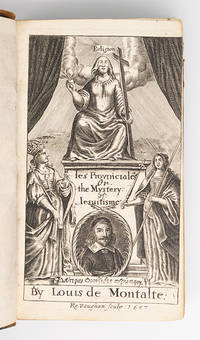
1657100589London: Printed by J.G. for R. Royston 1657. First edition in English. 12mo. Additional engraved title by Robert Vaughan. 22 504 405-409 7 pp. COLLATION: A-Y12 Z6 complete with blank A1 and errata and catalogue at rear. Contemporary blind-ruled sheep; rubbed with some surface loss; occassional light staining to text some small paper flaws with flaw on K5 costing a few letters Anonymous translation sometime incorrectly ascribed to John Evelyn of Pascal's 18 Lettres provinciales 1656-1657 an attack on the Jesuits in defense of Jansenism an ascetic reform movement within the Catholic Church that Pascal had joined in 1654. "This is one of the great polemical works of French literature ranging in tone from ironical mockery to angry denunciation and using a number of very successful argumentational devices and tactics" New Oxford Companion to Literature in French. "Pascal's weapon was irony and the freshness with which the gravity of the subject contrasts with the lightness of the manner is an enduring triumph. The vividness and distinction of his style recalls the prose of Milton" PMM. The engraved title uses Pascal's pseudonym Louis de Montalte. REFERENCE: ESTC R203163; PMM 140; Thomason E.16231 Printed by J.G. for R. Royston unknown
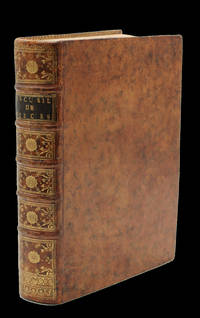
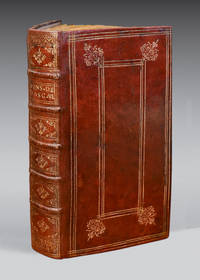
167016644Paris, Guillaume Desprez, 1670. In-12 de (72)-365-(23) pp., maroquin Lavallière, dos à nerfs, tranches dorées (L. Claessens).
165766919"The first example of French prose as we know it today"óPMM PASCAL Blaise. Les Provinciales: Or The Mysterie of Jesuitisme. Discover'd in certain Letters Written upon occasion of the present differences of Sorbonne between the Jansenists and the Molinists from January 1656 to March 1657. S.N. Displaying the corrupt Maximes and Politicks of that Society. Faithfully rendred into English. London: Printed by J.G. for R. Royston 1657. First edition in English first printed in French at Cologne in 1656-7. Twelvemo. 24 409 1 blank 6 pp. With preliminary blank a post-script leaf referring to the seventeenth letter and two final leaves of errata and advertisements. Added engraved title-page by Robert Vaughan. Eighteenth-century paneled calf neatly rebacked retaining old morocco lettering label. Spine lettered in gilt with decorative gilt board-edges. Eighteenth-century armorial bookplate of John Hustler of Acklam mounted on verso of engraved title-page. Early ink notations at bottom of engraved title-page. Leaves Q thru Q12 have been affected by printer's ink mostly just a little smudging; verso of Q10 is the only page where two lines of text have been affected. Apart from the few flaws this is a fine copy of a very rare and famous work. This work is a series of eighteen letters in which "Pascal defended Arnauld and satirized his Jesuit opponents and their theological and moral views. The work was published under the pseudonym Louis de Montalte and were probably the cooperative work of Pascal Arnauld and Pierre Nicole though they were principally Pascal" Edwards P. The Encyclopedia of Philosophy p. 52. Les Provinciales is considered one of the great French literary masterpieces and the first example of French prose. No translator's name ever appeared in any of the English editions and to this day the translator remains unknown. There is however a strong possibility that the work might have been translated by Evelyn. In 1664 a third volume on Jesuitisme appeared and the translation was fully acknowledged by Evelyn. In his diaries he writes: "This day was publish'd by me that part of the Mysterie of Jesuitism translated and collected by me tho' without my name containing the Imaginarie Heresy with 4 letters and other pieces.Evelyn included the book in the list of his works sent to Dr. Plot and though he did not refer to it again in his Diary his interest in the subject remained very active" Keynes John Evelyn pp. 124-126. Printing and the Mind of Man 140. Wing P643. HBS 66919. $2000 Printed by J.G. for R. Royston unknown books
165766919London: Printed by J.G. for R. Royston 1657. The first example of French prose as we know it today"-PMM<br> <br> PASCAL Blaise. Les Provinciales: Or The Mysterie of Jesuitisme. Discover'd in certain Letters Written upon occasion of the present differences of Sorbonne between the Jansenists and the Molinists from January 1656 to March 1657. S.N. Displaying the corrupt Maximes and Politicks of that Society. Faithfully rendred into English. London: Printed by J.G. for R. Royston 1657.<br> <br> First edition in English first printed in French at Cologne in 1656-7. Twelvemo. 24 409 1 blank 6 pp. With preliminary blank a post-script leaf referring to the seventeenth letter and two final leaves of errata and advertisements. Added engraved title-page by Robert Vaughan.<br> <br> Eighteenth-century paneled calf neatly rebacked retaining old morocco lettering label. Spine lettered in gilt with decorative gilt board-edges. Eighteenth-century armorial bookplate of John Hustler of Acklam mounted on verso of engraved title-page. Early ink notations at bottom of engraved title-page. Leaves Q thru Q12 have been affected by printer's ink mostly just a little smudging; verso of Q10 is the only page where two lines of text have been affected. Apart from the few flaws this is a fine copy of a famous work.<br> <br> This work is a series of eighteen letters in which "Pascal defended Arnauld and satirized his Jesuit opponents and their theological and moral views. The work was published under the pseudonym Louis de Montalte and were probably the cooperative work of Pascal Arnauld and Pierre Nicole though they were principally Pascal" Edwards P. The Encyclopedia of Philosophy p. 52. Les Provinciales is considered one of the great French literary masterpieces and the first example of French prose.<br> <br> No translator's name ever appeared in any of the English editions and to this day the translator remains unknown. There is however a strong possibility that the work might have been translated by Evelyn. In 1664 a third volume on Jesuitisme appeared and the translation was fully acknowledged by Evelyn. In his diaries he writes: "This day was publish'd by me that part of the Mysterie of Jesuitism translated and collected by me tho' without my name containing the Imaginarie Heresy with 4 letters and other pieces.Evelyn included the book in the list of his works sent to Dr. Plot and though he did not refer to it again in his Diary his interest in the subject remained very active" Keynes John Evelyn pp. 124-126.<br> <br> Printing and the Mind of Man 140. Wing P643.<br> <br> HBS 66919.<br> <br> $2000. Printed by J.G. for R. Royston unknown
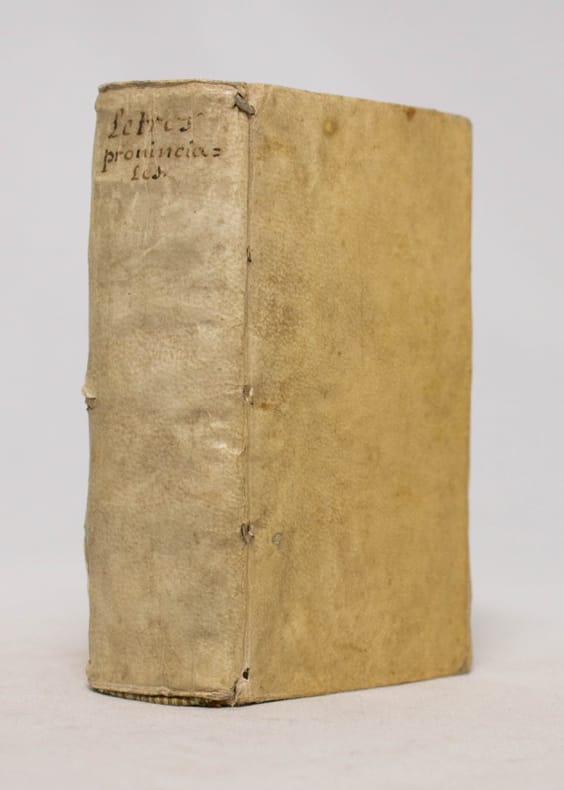
165718774Cologne [Leyde], Pierre de la Vallée [Elzevier], 1657. In-12 de [24]-396-108 pages, plein vélin souple du temps, titre inscrit à l'encre au dos, tranches rouges.
16599095chez Nicolas Schoute 11 x 17,5 Cologne 1659 Deux volumes petit in-8, reliure plein veau raciné de l'époque, dos à cinq nerfs guillochés, entre-nerfs ornés de fleurons et de petits fers dorés, pièces de titre et de tomaison, titre et tomaison dorés, plats encadrés d'un léger filet à froid, filet doré sur les coupes, tranches jaspées de rouge. Premier volume : [1] f. bl., [7] ff. bl., de titre et d'advertissement, 320 pp. pour les Lettres, [1] f. de titre pour "La Théologie morale", [1] f. de table, 1 f. de faux titre, 240 pp., pour les deux premières partie de "La Théologie morale des Jésuites". Deuxième volume : [1] f. bl., [1] de faux titre, pp. 243 à 328 pour la troisième partie et 493-[1] pp., pour les dernières parties de "La Théologie morale des Jésuites". Rare troisième édition française et dernière édition publiée du vivant de Pascal par Jean Elzevier de Leyde. Cette édition des Provinciales "amplement retravaillée" et "considérablement augmentée de pièces relatives à la lutte contre les casuistes" (Jean Mesnard) est l'oeuvre du janséniste Louis Gorin de Saint-Amour (1619-1687). Il existe deux versions de cette édition, l'une se termine par 415 pp., l'autre, la plus complète - notre exemplaire - par 493 pp. Elle est réputée "par sa belle impression, par la composition de ses titres et l'excellence du papier" (Jean Hippolyte Basse) et intéressante par ses variantes. C'est cette édition qui avait été "retenue par l'abbé Louis Cognet pour l'édition des classiques Garnier en 1965, et rééditée avec des compléments par Gérard Ferreyrolles en 1992". (Jean Mesnard). Sources : "Monographie des éditions des lettres provinciales par Blaise Pascal", n° 29, J. H. Basse, 1876 / "Catalogue d'une collection unique de volumes imprimés par les Elzévier", n° 853 et 854, Edouard Rahir, 1896 / "Préludes à l'édition des Provinciales", Jean Mesnard, in Varia, Centre International Blaise Pascal, 1996. Habiles restaurations, intérieur frais, Bel exemplaire. Peu fréquent. (Bbis8). PHOTOS NUMERIQUES DISPONIBLES PAR EMAIL SUR SIMPLE DEMANDE-DIGITAL PHOTOGRAPS MAY BE AVAILABLE ON REQUEST
16599095chez Nicolas Schoute 11 x 17,5 Cologne 1659 Deux volumes petit in-8, reliure plein veau raciné de l'époque, dos à cinq nerfs guillochés, entre-nerfs ornés de fleurons et de petits fers dorés, pièces de titre et de tomaison, titre et tomaison dorés, plats encadrés d'un léger filet à froid, filet doré sur les coupes, tranches jaspées de rouge. Premier volume : [1] f. bl., [7] ff. bl., de titre et d'advertissement, 320 pp. pour les Lettres, [1] f. de titre pour "La Théologie morale", [1] f. de table, 1 f. de faux titre, 240 pp., pour les deux premières partie de "La Théologie morale des Jésuites". Deuxième volume : [1] f. bl., [1] de faux titre, pp. 243 à 328 pour la troisième partie et 493-[1] pp., pour les dernières parties de "La Théologie morale des Jésuites". Rare troisième édition française et dernière édition publiée du vivant de Pascal par Jean Elzevier de Leyde. Cette édition des Provinciales "amplement retravaillée" et "considérablement augmentée de pièces relatives à la lutte contre les casuistes" (Jean Mesnard) est l'oeuvre du janséniste Louis Gorin de Saint-Amour (1619-1687). Il existe deux versions de cette édition, l'une se termine par 415 pp., l'autre, la plus complète - notre exemplaire - par 493 pp. Elle est réputée "par sa belle impression, par la composition de ses titres et l'excellence du papier" (Jean Hippolyte Basse) et intéressante par ses variantes. C'est cette édition qui avait été "retenue par l'abbé Louis Cognet pour l'édition des classiques Garnier en 1965, et rééditée avec des compléments par Gérard Ferreyrolles en 1992". (Jean Mesnard). Sources : "Monographie des éditions des lettres provinciales par Blaise Pascal", n° 29, J. H. Basse, 1876 / "Catalogue d'une collection unique de volumes imprimés par les Elzévier", n° 853 et 854, Edouard Rahir, 1896 / "Préludes à l'édition des Provinciales", Jean Mesnard, in Varia, Centre International Blaise Pascal, 1996. Habiles restaurations, intérieur frais, Bel exemplaire. Peu fréquent. (Bbis8). PHOTOS NUMERIQUES DISPONIBLES PAR EMAIL SUR SIMPLE DEMANDE-DIGITAL PHOTOGRAPS MAY BE AVAILABLE ON REQUEST
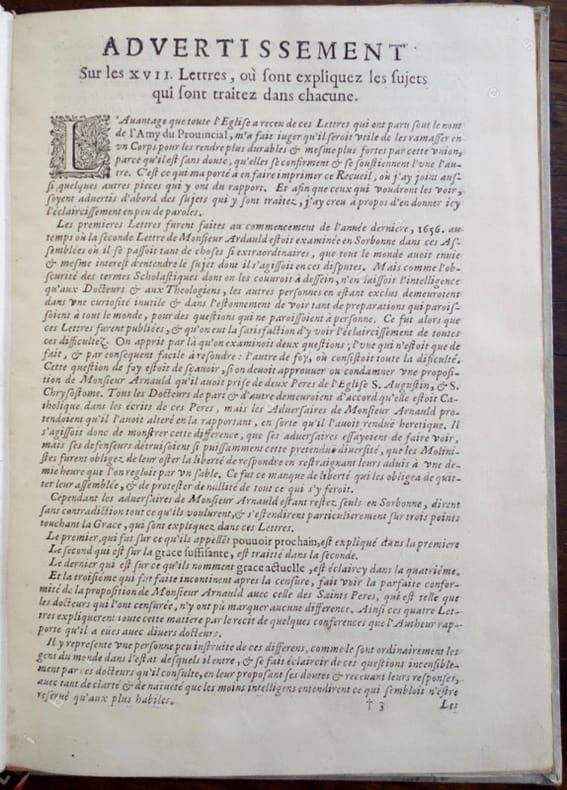
1656211911656 Cologne, Pierre de la Vallée (adresse fictive), 1656-1657, in-4 de 3 ff. d'avertissement, 8 pp.-8 pp.-8 pp.-8 pp.-8 pp.-8 pp.- 8 pp.- 8 pp.- 8 pp.- 8 pp.- 8 pp.-8 pp.- 8 pp. (réfutation)- 8 pp.-8 pp.-8 pp.-12 pp.-8 pp.-12 pp.-12 pp., (la 18e lettre est ici en double), reliure de la deuxième moitié du XIXe siècle de plein velin ivoire à la Bradel, signée Thierry successeur de Petit-Simier, nom d'auteur titre et date (1651657) dorés au dos, bel exemplaire relié sans le titre collectif qui a paru après, mais avec l'avertissement qui ne figure pas toujours dans cette réunion des 18 lettres en tout premier tirage, défaut d'impression page 8 de la dix-septième lettre. Bel exemplaire.
1656ST12177-11Paris or Leyden 1656-57; related material 1657-58. 235 x 165 mm. 9 1/4 x 6 1/2". With 16 of 18 letters lacking letters IV and XVIII as well as general title and "Advertisement" leaf. 17 of 19 individually issued parts including the "Refutation de la Réponse à la Douzième Lettre". <br/> The original parts bound up in pleasing modern tan crushed morocco blind-ruled border raised bands gilt titling new endpapers. PMM 140; Tchemerzine V 62-63. ◆Light brown stain to head margin of the last quarter of the leaves occasional faint browning or foxing elsewhere more conspicuous on final gathering minor worming in bottom margin of a few leaves otherwise a very good copy internally with nothing approaching a serious defect and in a pleasing unworn binding.<br/> <br/> In addition to related material normally not included this volume contains 17 of the rare original 19 separately issued letters or "Provinciales" by the French polymath Blaise Pascal 1623-62 a series characterized by PMM as "the first example of French prose as we know it today perfectly finished in form . . . on a subject of universal importance . . . and an expression of one of the finest intelligences of the seventeenth century." Prompted by the Jesuits' condemnation for heresy of Pascal's friend Antoine Arnauld the letters are "a magnificent sustained invective" PMM against the laxity and casuistry of his detractors and at the same time a defense of Jansenism that theological movement and faction within Catholicism that grew out of the writings of Dutch theologian Cornelius Jansen 1585-1638 and that emphasized many of the Calvinist tenets of faith human sinfulness lack of free will and the necessity of divine Grace. The additional material apparently collected from a variety of sources comprises letters Pascal wrote to parish priests seeking assistance with the controversy. There is also a copy of Noel de la Lane's "Recit de ce qui s'est Passé au Parlement au Sujet de la Bulle de Nostre S. Père le Pape Alexandre VII. contre les Censures de Sorbonne" ca. 1665. Pascal 1623-62 was a man of many attainments in several fields among them physics philosophy and mathematics. Above all he was a profound thinker a devout Christian and the creator of memorable prose. Written simply lucidly objectively and wittily the "Provinciales" represents a landmark in French literature an early expression of Enlightenment thinking. It was enormously successful dealt the Jesuits a fatal setback and influenced the prose of Voltaire and Rousseau. Not surprisingly the book was put on the Index and ordered to be burned. Originally printed clandestinely by various printers as separate publications at various times during 1656 and 1657 the series is bibliographically complicated but it is clear that our quarto format versions precede the duodecimo printing dated 1657 and obviously those editions with later dates. It is likely given the small parts we are missing that someone assembled the various letters found here as they were issued at the time. A complete set of these letters in first edition--which is rarely seen--would sell for a considerable amount of money. unknown
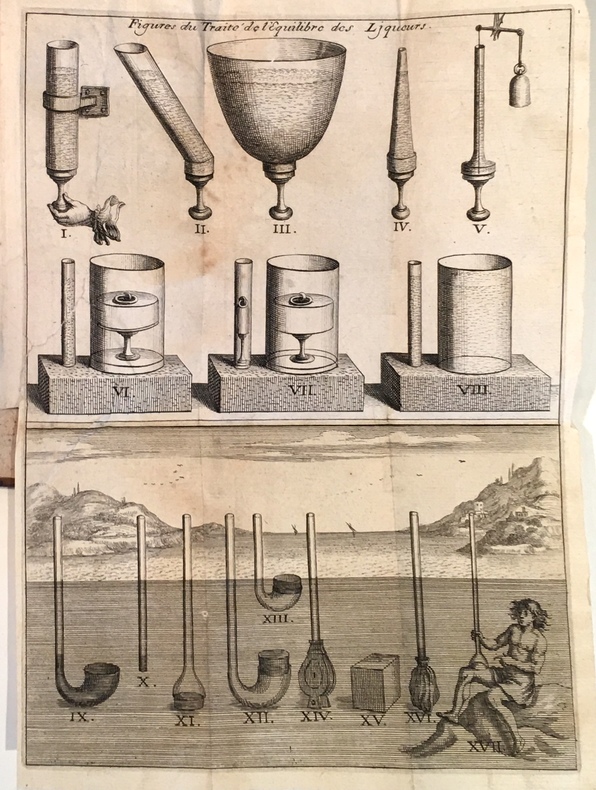
16634279Paris, Guillaume Desprez, 1663. 1663 1 vol. in-12° (147 x 82 mm) de : [28] ff. (titre, préface, avertissement, privilège, fautes à corriger) ; 232 pp. (dont 1 schéma et des tableaux) ; [4] ff. (table) ; 2 planches gravées dépliantes. 2 ex-libris gravés armoriés sur les gardes. (Déchirures discrétement restaurées aux planches). Plein veau d'époque, dos à nerfs orné et titré à l'or, encadrement de filets dorés sur les plats, roulette dorée sur les coupes, tranches jaspées rouges. Etui recouvert de toile (Coins restaurés, un mors partiellement fendu. Provenance: 2 ex-libris armoriés gravés).
1684CLL-207Cologne, Balthasar Winfelt, 1684 In-8 de (20) ff., 613 pp., maroquin marine à grain long, plats ornés d'une succession d'encadrement de filets dorés et de roulettes à froid avec larges fleurons d'angle, dos à nerfs orné et doré, coupes et bordures décorées, tranches dorées (Thouvenin).
1667156P., Savreux, 1667, un volume in 4 relié en plein veau, dos orné de fers dorés, tranches mouchetées, armes sur les plats (reliure de l'époque), (petit accroc à la coiffe sans gravité, mouillures marginales sans gravité aux trois derniers feuillets), (12), 345pp., 4 PLANCHES REPRESENTANT DES CARRES MAGIQUES, (1-errata), figures dans le texte
165728515Cologne" i.e. Paris: Chés Pierre de la Vallée 1657. First edition first issue the 18 separate letters plus the refutation bound together. 23.7 x 17.5 cm. Letters 1-15 have 8 pages; 16-18 have 12 pages. "Refutation de la reponse a la douziéme lettre" bound before the 12th letter. Full brown morocco gilt a.e.g. by Riviere. Small chip at the top of the spine; joints neatly repaired edges lightly rubbed; former owners' signature and bookplate. Fifth letter lightly browned; small hole repaired with loss of a few letters on 18:7/8. First state of advertisement leaf with spelling"advertisement". "These letters were originally issued clandestinely in eighteen parts as a series of separate publications by a variety of different printers between 23 January 1656 and 15 January 1657. No detailed or authoritative information on these separate issues is available" PMM. "The Lettres Provinciales as they are called are the first example of French prose as we know it today perfectly finished in form varied in style and on a subject of universal importance.Pascal was an infant prodigy whose work in mathematics and natural science attracted considerable attention before he was sixteen. But he will always be chiefly remembered as a moralist more especially as the great apologist for Jansenism the seventeenth-century French ascetic movement of reform inside the Roman Catholic Church.At the end of 1655 the movement had been much under attack from the Jesuits and Pascal was persuaded to write a rejoinder.his counter-attack took the form of a brilliant exposure of the casuistical methods of argument employed by the Jesuits.Pascal's weapon was irony and the freshness with which the gravity of the subject contrasts with the lightness of the manner is an enduring triumph. The vividness and distinction of his style recalls Milton at its best." Printing and the Mind of Man 140. Chés Pierre de la Vallée unknown
165728515"Cologne" i.e. Paris: Chés Pierre de la Vallée 1657. First edition first issue the 18 separate letters plus the refutation bound together. 23.7 x 17.5 cm. Letters 1-15 have 8 pages; 16-18 have 12 pages. "Refutation de la reponse a la douziéme lettre" bound before the 12th letter. Full brown morocco gilt a.e.g. by Riviere. Small chip at the top of the spine; joints neatly repaired edges lightly rubbed; former owners' signature and bookplate. Fifth letter lightly browned; small hole repaired with loss of a few letters on 18:7/8. First state of advertisement leaf with spelling"advertisement". "These letters were originally issued clandestinely in eighteen parts as a series of separate publications by a variety of different printers between 23 January 1656 and 15 January 1657. No detailed or authoritative information on these separate issues is available" PMM. "The Lettres Provinciales as they are called are the first example of French prose as we know it today perfectly finished in form varied in style and on a subject of universal importance.Pascal was an infant prodigy whose work in mathematics and natural science attracted considerable attention before he was sixteen. But he will always be chiefly remembered as a moralist more especially as the great apologist for Jansenism the seventeenth-century French ascetic movement of reform inside the Roman Catholic Church.At the end of 1655 the movement had been much under attack from the Jesuits and Pascal was persuaded to write a rejoinder.his counter-attack took the form of a brilliant exposure of the casuistical methods of argument employed by the Jesuits.Pascal's weapon was irony and the freshness with which the gravity of the subject contrasts with the lightness of the manner is an enduring triumph. The vividness and distinction of his style recalls Milton at its best." Printing and the Mind of Man 140. <br/><br/> Chés Pierre de la Vallée unknown books
165744634A Cologne, chés Pierre de la Vallée, 1657. In-4, maroquin rouge, dos orné à nerfs, triple filet doré d'encadrement sur les plats, dentelle intérieure, tranches dorées, étui bordé (Honnelaître).
165725133Cologne Amsterdam: Pierre de la Valle'e Elzevier 1657. First duodecimo edition and First Elzevier edition same year as the first complete 4to edition printed in Paris. This is the first and uncorrected state of two nearly identical issues. 12mo beautifully bound in regal 18th century full red morocco the covers framed by an elaborate decorative gilt rolled border surrounding a gilt coat of arms the spine beautifully gilt tooled in compartments between fine gilt tooled bands one compartment with a black morocco label gilt lettered and stippled gilt turn-ins and board edges marbled endpapers a.e.g. Ex-Libris of the Chateau de Sampigny. xxiv 398 111 pp. A fine and beautiful copy. FIRST ELZEVIER AND EXTREMELY EARLY PRINTING OF THIS MASTERPIECE OF THE MODERN FRENCH LANGUAGE. PMM 140. "The vividness and distinction of his style recalls the prose of Milton at its best". Elzevier’s was Pascal’s definitive version of the text. It was the first edition to gather the eighteen letters within continuous pagination and has become the standard text for all successive editions. It also contains attached at the end and paginated separately the 'Advis de Messieurs les Curez de Paris<br> "The Lettres Provinciales as they are called are the first example of French prose as we know it today perfectly finished in form varied in style and on a subject of universal importance. Pascal's weapon was irony and the freshness with which the gravity of the subject contrasts with the lightness of the manner is an enduring triumph. The vividness of and distinction of his style recalls the prose of Milton at its best". Printing and the Mind of Man. Pierre de la Valle'e [Elzevier] unknown
167054474Paris: Guillaume Desprez 1670. First edition second issue the first issue of 1669 - virtually unobtainable - is known by 2 copies only both in France; 12mo pp. 82 365 21; printer's device on title page engraved headpiece woodcut ornaments; 19th-century full brown levant by the Paris binder Trautz-Bauzonnet gilt-lettering direct on spine gilt turn-ins a.e.g.; very lightly scuffed else fine. Blaise Pascal 1623-1662 was a French mathematician physicist and religious philosopher. He laid the foundation for the modern theory of probabilities formulated what came to be known as Pascal's principle of pressure and propagated a religious doctrine that taught the experience of God through the heart rather than through reason. The subject of endless controversy these fragmentary meditations on faith and reason influenced generations of thinkers both sceptics and believers alike making this work a fundamental text in the history of western thought and literature. Printing and the Mind of Man 152; Brunet IV 398;. <br/><br/> Guillaume Desprez unknown books
165778<p>An exceptional copy of the 1st edition of Provinciales with 28 other first editions 2 of Pascal and one autographe provenant de la fameuse bibliothèque Maxime Denesle.</p><p>Pascal Blaise. Les Provinciales ou lettres écrites par Louis de Montalte à un provincial de ses amis et aux RR. PP. Jésuites sur le sujet de la morale et de la politique de ces pères. </p><p><i>Cologne Pierre de la Vallée 1657.</i></p><p>Followed by 28 other first editions published between 1657 and 1732.</p><p>4° calf from beginning of the 18th century<i> <br /></i></p><p>246 x 181 mm.</p><p><b>First edition of Pascal's 18 letters written between January 23rd 1656 and March 24th 1657</b> containing <i>Réfutation de la réponse à la douzième lettre</i> and the 17th letter in 12 pages. </p><p>Published separately and in secret all are here published together and bound without the title and <u>the warning leaves: a sign of first printing which is a very sought-after and rare state. It shoiw that the cipoy was constituted as letters were being published</u>. </p><p>Trois corrections manuscrites anciennes. </p><p>Bound together </p><p>29 other pieces 700 pages in total in first edition relating to Jansenism some very rare and of which two are from Pascal are related to the following including a manuscript: </p><p>- Advis de Messieurs les Curez de Paris 8 pp.</p><p>- Extrait des plus dangereuses propositions de Morale de Casuistes 20 pp.</p><p>- Factum pour les Curés de Paris. Paris 1657. Edition originale attribuée à Pascal. 8 pp.</p><p>- Factum pour les Curés de Rouen. Paris 1657. 12 pp.</p><p>- Lettre pastorale de M. L'Évêque de Troyes. Paris 1732. E. O. 10 et 80 pp.</p><p>- La Calomnie portée au dernier excez contre les Appelans. 1728. 25 pp.</p><p>- Ordonnance de M. le Cardinal de Noailles. 1703. E. O. 10 pp.</p><p>- Lettre de la Mère supérieure de la Visitation. 1726. E. O. 3 pp.</p><p>- Lettre et mandement de l'Évêque de Montpellier. 1727. E. O. 4 ; 3 et 4 pp.</p><p>- Mandement de l'archevêque d'Utrecht. 1730. E. O. 8 pp.</p><p>- Requête de l'Évêque d'Auxerre. 1730. E. O. 10 pp.</p><p>- Recueil de pièces. 6 pp.</p><p>- Mandement de l'Évêque de Senez. 1727. E. O. 28 pp.</p><p>- Lettre et instructions de l'Évêque de Montpellier. 1726. E. O. 20 pp. ; 1728 E. O. 29 pp.</p><p>- Mandement de l'Évêque de Saintes 16 pp.</p><p>- Instruction et Lettres de l'Évêque de Montpellier 1726. E. O. 16 et 19 pp.</p><p>- manuscript of the letter of Évêque de Montpellier à Mosseigneurs les Évêques datée Montpellier ce 2 may 1725. 14 pp.</p><p>- Quatre lettres de l'Évêque de Montpellier à l'Évêque de Soissons 1727. E. O. de 16 pp. 40 pp. 35 pp. 26 pp.</p><p>- Lettre de l'Évêque de Soissons à l'Évêque de Montpellier 1727. E. O. 22 pp.</p><p>- Ordonnance et instruction de l'Évêque de Montpellier portant condamnation du livre intitulé " <i>Institutionnes Catholicae</i> " 1726. E. O. 42 pp.</p><p>- Défense et consultation de MM. Les Avocats de Paris 1729. E. O. 115 pp. et 44 pp. </p><p> A beautiful copy of <i>" </i><i>the purest masterpiece of French language "</i> <i>"</i> the first book of genius in prose <i> "</i> Voltaire <i>from Maxime Denesle</i>'s library.</p><br /><br /><br /><br /><br /> Pierre de la Vallée hardcover
1670LCS-A1<p><strong>The 1670 <em>Pensées</em> by Pascal bound in red morocco à la Duseuil of the period.</strong></p><p><strong>Prestigious copy from the library of the master teacher of the Plessis-Sorbonne college </strong></p><p><strong>the Abbé de Saint-André enriched with his handwritten ex-libris dated March 21 1698.</strong></p><p><strong>"<em>Labbé de St André. A Paris au Collège du Plessis Sorbonne</em></strong></p><p><strong><em>l'an mil six cents nonante huit ce jourduy 21 mars</em></strong><strong>".</strong></p><p>12mo. Collation: 41 preliminary leaves 365 pages 10 leaves of table.</p><p>Full red morocco covers decorated in the style of Duseuil richly decorated spine with raised bands gilt edges. <em>Contemporary morocco binding</em>.</p><p>148 x 82 mm.</p><p>Precious edition of the <em>Pensées</em> printed in the year 1670 bound in red morocco of the period the copy of the Abbé de Saint-André master at the famous College du Plessis-Sorbonne in the year 1698.</p><p>Copy belonging to the second of the four editions published in 1670 <em>Brunet</em> supplément II 167 gives it priority and calls it the original edition; <em>Tchemerzine</em> ranks it second calling it the first counterfeit from the library of the "Abbé de Saint-André master at the Collège du Plessis-Sorbonne A Paris the year 1698 this day March 21".</p><p>This college was founded in 1317 by Geoffroy du Plessis-Balisson apostolic notary and secretary to Philippe le Long under the name Collège Saint-Martin-au-Mont. But it quickly came to be known as the Collège du Plessis. It was joined to the Sorbonne in 1646 and then took the name Plessis-Sorbonne. Its buildings are now occupied by the current Lycée Louis-le-Grand.</p><p>The classical 19th-century bibliographers considered the present edition as the true original. Thus Deschamps in the <em>Supplément de Brunet</em> II-167 described it as:</p><p>"Original edition; it consists of 41 preliminary leaves 365 pages and 10 leaves of table; the privilege granted to sieur Périer given in Paris on December 27 1666 says at the end: Completed printing for the <em>first time January 2 1670; there is an errata on the verso.</em>"</p><p><em>M. Petier was the first to carefully compare this edition with the unique copy of the 1669 edition preserved in the Bibliothèque Nationale; the two editions are essentially the same; the number of pages the ornaments and the typographic layout are identical; the differences are these: the title is not exactly the same; the 1669 copy lacks ecclesiastical approvals the privilege and the table ends at the word <em>Charnel</em> meaning the last nine leaves are missing; moreover the 1669 copy was not revised that is it did not undergo the deletions or changes likely demanded by the Archbishop of Paris.</em></p><p>Two other editions appeared in the same year 1670.</p><p>1/ "<em>A second counterfeit under the same date with identical collation has a slightly different title. The monogram of G. Desprez is replaced by the fleuron from the <em>Provinciales</em> quarto edition of 1657</em>" Tchémerzine V 71.</p><p>2/ The true second edition of the <em>Pensées</em> this time with the errors corrected. The title is identical to that of the original edition but the collation differs: duodecimo of 39 leaves 358 pages numbered as 334 and 10 leaves.</p><p>Among these four editions published in 1670 ours would occupy the second place in chronological order. It is extremely rare bound in morocco of the period.</p><p><em>"Pascal remains unique not so much because he is 'one of the greatest intellects to have appeared' Paul Valéry but for his passion his momentum for that aggressiveness which seizes the reader's soul for those discoveries those surprises which he holds in store which astonish and confound the reader and make him discover within himself not only abysses but the meansor rather the only meansof crossing them."</em></p><p><em>"As it was known that Pascal had planned to work on religion great care was taken after his death to collect all the writings he had made on that subject. They were found all together strung together in various bundles but without any order without any sequence. And all of it was so imperfect and so poorly written that it took immense effort to decipher them"</em> says Étienne Périer in his preface. Pascal's friends Roannez Brienne and Étienne Périer ultimately decided to publish the fragments arranging them in a certain order grouping together the thoughts with related subjects merely "<em>clarifying and embellishing"</em> them. The result of this work was the 1670 edition.</p><p>Copies of Pascal's <em>Pensées</em> printed in 1670 and bound in contemporary morocco are rare; one belonging to the first original edition of 1670 was sold for 230000 by Sotheby's 24 years ago Sotheby's December 5 2001; another from the Pierre Bérès collection trimmed and restored was sold for 120000 twenty years ago.</p><p>Precious copy bound in decorated morocco of the period with superb provenance: "<em>Labbé de St André Collège du Plessis-Sorbonne ce 21 mars 1698</em>"</p><p>The rise of Paris as the capital of France was supported by the development and influence of the University of Paris. It came into being during the 12th century as a result of the steady growth of the Parisian schools grouped on the Montagne Sainte-Geneviève. These schools provided an education preparing for three degrees: the baccalaureate grammar dialectic rhetoric the license arithmetic geometry astronomy music and the doctorate medicine canon law theology.</p><p>By the end of the Middle Ages the University of Paris had become the largest cultural and scientific center in Europe attracting some 20000 students. Its reputation rested on the prestige of its teachers but also on its libraries whose richness was matched only by the papal library. The University of Paris was the cradle of the "second French humanism" in the 15th century and it was at the Sorbonne that the first printing press in France was installed in 1469 by the royal librarian Guillaume Fichet and the prior of the college Jean Heynlin.</p><p>"The institution endowed with a significant library a chapel and dormitories intended for the comfort of its students was indeed associated with the faculty of theology and established itself permanently in the heart of medieval Paris. From century to century the college later known as 'la Sorbonne' played an increasingly important role in the life of the Kingdom of France actively participated in intellectual debate and tirelessly pursued its educational mission. In 1622 its illustrious principal and soon-to-be cardinal Richelieu seeking a place to house his own tomb undertook major renovations and began the construction of a chapel. This marked the beginning of a continuous modernization of the buildings as the University's reputation kept growing throughout Europe. In 1698 the Abbé de Saint-André master at the Collège du Plessis-Sorbonne inscribed his handwritten ex-libris on this copy of the 1670 <em>Pensées</em> bound in morocco of the period.</p><p>FRANCAIS</p><p><strong>Les Pensées de Pascal de 1670 reliées en maroquin rouge à la Duseuil de l'époque.</strong></p><p><strong>Prestigieux exemplaire provenant de la bibliothèque du maître enseignant du Plessis-Sorbonne l'abbé de Saint-André enrichi de son ex-libris manuscrit en date du 21 mars 1698.</strong></p><p><strong>" <em>Labbé de St André. A Paris au Collège du Plessis Sorbonne </em></strong></p><p><strong><em>l'an mil six cents nonante huit ce jourduy 21 mars</em></strong><strong> ".</strong></p><p>In-12. Collation : 41 feuillets liminaires 365 pages 10 feuillets de table.</p><p>Plein maroquin rouge encadrement de filets à la Duseuil sur les plats dos à nerfs richement orné coupes décorées tranches dorées. <em>Reliure en maroquin de l'époque</em>.</p><p>148 x 82 mm.</p><p>Précieuse édition des Pensées imprimée dès l'année 1670 reliée en maroquin rouge de l'époque l'exemplaire de l'abbé de Saint André maitre du célèbre collège du Plessis Sorbonne en l'année 1698.</p><p>Exemplaire appartenant à la seconde des quatre éditions parues en 1670 <em>Brunet</em> supplément II 167 lui donne la priorité et la qualifie d'édition originale ; <em>Tchemerzine</em> la classe en seconde position la qualifiant de première contrefaçon provenant de la bibliothèque de l'abbé de Saint-André maître au collège du Plessis-Sorbonne A Paris l'an 1698 cejourdhuy 21 mars "</p><p>Ce collège fut fondé en 1317 par Geoffroy du Plessis-Balisson notaire apostolique et secrétaire de Philippe le Long sous le nom de collège Saint-Martin-au-Mont. Mais il fut vite désigné sous le nom de collège du Plessis. Il fut uni à la Sorbonne en 1646 et prit alors le nom de Plessis-Sorbonne. Ses bâtiments sont occupés par l'actuel lycée Louis le Grand.</p><p>Les bibliographes classiques du XIXe siècle considéraient la présente édition comme la première originale. Ainsi Deschamps dans le Supplément de Brunet II-167 la décrivait-il ainsi :</p><p>" Edition originale ; elle se compose de 41 ff. limin. de 365 pp. et de 10 ff. de table ; le privilège délivré au sieur Périer donné à Paris le 27 décembre 1666 porte à la fin : Achevé d'imprimer pour la<em> première fois le 2 janvier 1670 ; il y a un errata au verso.</em></p><p><em>M. Petier le premier confronta minutieusement cette édition avec l'exemplaire unique de l'édition de 1669 que conserve la Bibliothèque Nationale ; les deux éditions n'en font qu'une ; le nombre des pages les fleurons les dispositions typographiques sont les mêmes ; il n'y a de différences que celles-ci : le titre n'est pas absolument le même ; l'exemplaire de 1669 n'a ni les approbations ecclésiastiques ni le privilège et la table finit au mot Charnel c'est-à-dire que les ix derniers ff. manquent ; de plus l'exemplaire de 1669 n'a pas été cartonné c'est-à-dire qu'il n'a pas subi les suppressions ou modifications qui furent exigées sans doute par l'archevêque de Paris</em> ".</p><p>Deux autres éditions virent le jour en cette même année 1670.</p><p>1/ " <em>Une seconde contrefaçon sous la même date avec collation identique a un titre un peu différent. Le monogramme de G. Desprez y est remplacé par le fleuron des </em>Provinciales<em> éd. in-4 de 1657 </em>" Tchémerzine v 71.</p><p>2/ La véritable seconde édition des " <em>Pensées</em> " avec cette fois les fautes corrigées. Le titre est identique à celui de l'édition originale mais la collation est différente : in-12 de 39 ff. 358 pp. chiff. 334 et 10 ff.</p><p>Parmi ces quatre éditions parues en 1670 la notre occuperait la seconde place par ordre chronologique. Elle est infiniment rare reliée en maroquin de l'époque.</p><p>" <em>Pascal reste unique non pas tant parce qu'il est " une des plus fortes intelligences qui aient paru " Paul Valéry mais par sa fougue par son élan par cette agressivité qui empoigne l'âme du lecteur par ces découvertes ces surprise qu'il lui réserve qui l'étonnent qui le confondent et lui font découvrir en lui non seulement des abîmes mais les moyens ou plutôt l'unique moyen de les franchir. </em>"</p><p>" <em>Comme l'on savait le dessein qu'avait Pascal de travailler sur la religion l'on eut un très grand soin après sa mort de recueillir tous les écrits qu'il avait faits sur cette matière. On les trouva tous ensemble enfilés en diverses liasses mais sans aucun ordre sans aucune suite. Et tout cela était si imparfait et si mal écrit qu'on a eu toutes les peines du mondes à les déchiffrer</em> " dit Etienne Périer dans sa préface. Les amis de Pascal Roannez Brienne et Étienne Périer s'en tinrent finalement à l'édition des fragments en les disposant dans un certain ordre groupant celles des pensées qui avaient quelque affinité par le sujet se contentant de les " <em>éclaircir et embellir</em> ". Le résultat de ce travail fut l'édition de 1670.</p><p>Les exemplaires des " <em>Pensées</em> " de Pascal imprimés en 1670 reliés en maroquin de l'époque sont rares ; l'un appartenant à la première édition originale de 1670 fut vendu 230 000 par Sotheby's il y a 24 ans Sotheby's 5 décembre 2001 ; le second provenant de la bibliothèque Pierre Bérès court de marges et restauré fut vendu 120 000 il y a 20 ans.</p><p>Précieux exemplaire relié en maroquin décoré de l'époque à superbe provenance : " <em>Labbé de St André Collège du Plessis-Sorbonne ce 21 mars 1698</em> "</p><p>L'affirmation de Paris comme capitale de la France s'appuya sur le développement et le rayonnement de l'Université de Paris. Celle-ci vit le jour au cours du XIIe siècle au terme d'une croissance continue des écoles parisiennes regroupées sur la Montagne Sainte-Geneviève. Ces écoles dispensaient un enseignement qui préparait à trois grades : le baccalauréat grammaire dialectique rhétorique la licence arithmétique géométrie astronomie musique et le doctorat médecine droit canonique théologie.</p><p>A la fin du Moyen-Âge l'Université de Paris était devenue le plus grand centre culturel et scientifique européen attirant quelque 20 000 étudiants. Elle tirait sa renommée du prestige de ses maitres mais également de ses bibliothèques dont la richesse n'avait d'égale que celle de la bibliothèque pontificale. L'Université de Paris fut le berceau du " second humanisme français " au xvè siècle et c'est à la Sorbonne que fut installée en 1469 la première imprimerie de France par le bibliothécaire du roi Louis xi Guillaume Fichet et le prieur du collège Jean Heynlin.</p><p>" L'établissement doté d'une bibliothèque d'envergure d'une chapelle et de dortoirs destinés au confort de ses étudiants s'associe en effet à la faculté de théologie et s'implante durablement au cur du Paris médiéval. De siècle en siècle le collège que l'on nomme par la suite " la Sorbonne " joue un rôle grandissant dans la vie du royaume de France participe activement au débat intellectuel et poursuit sans relâche sa tâche d'enseignement. En 1622 son illustre proviseur et bientôt cardinal Richelieu à la recherche d'un lieu pour accueillir son propre tombeau entreprend de grands travaux de rénovation et débute alors la construction d'une chapelle. C'est le début d'une modernisation constante des bâtiments à mesure que la renommée de l'Université ne cesse de s'accroître dans toute l'Europe. En 1698 l'Abbé de Saint André maître au collège du Plessis-Sorbonne apposait son exlibris manuscrit sur cet exemplaire des Pensées de 1670 relié en maroquin de l'époque.</p> Guillaume Desprez.