Bardenhewer OttoABAA
156 résultats
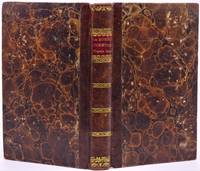
1882008693Freiburg im Breisgau: Herdersche Verlagschandlung 1882. RARE in current commerce no auction records found. xviii 330 pages.Text in German Latin and Arabic. At first attributed to Aristotle De Causis later came to be recognized as being derived from "Elements of Theology" by Proclus. Bound in contemporary half black morocco over decorative embossed metallic paper boards gilt title back Art Deco end papers the small ticket of William Salloch of New York noted bookseller at front paste down. Very Good institutional stamps of "Arca Seminarii Philos. Lib. Prov. Mo. S.J." remnants of bookplates front end papers call letters stamped at base of spine scattered light pencil markings in text dampstain at gutters of first few front pages. . First Edition. Half Morocco. Very Good/No Jacket As Issued. 8vo - over 7¾" - 9¾" tall. Herdersche Verlagschandlung Hardcover books
1777007710Groningae: Apud Jacobum Bolt 1777. RARE. 9 institutinal holdings worldwide according to Worldcat. Bound in quarter leather over marbled boards red leather label back with gilt decorations and rules. 14 300 p. Text in Latin. Very Good back repaired in keeping rubs to corners small letter in ink front paste down inscription concering Grotius dated 1839 page facing title page text clean and fresh. " 'The Universal Law of Nature or of Mankind' as it is represented by Grotius examined by Henry Lewis Wichers". . First Edition. Quarter Leather. Very Good/No Jacket As Issued. 8vo - over 7¾" - 9¾" tall. Apud Jacobum Bolt Hardcover books
17922291994Published for D. Jordan Piccadilly 1792. Ninth Edition. Hard Cover. Near Fine/No Jacket. Ninth edition printed in the same year as part two's original release and just a year after the first appearance of part one. ESTC T5876 and N13105. Howes P31 and P32. Rebound in grey paper-covered boards with paper spine label and new end sheets. Brief pencil marginalia on just a couple pages a few pages very faintly foxed otherwise an exceptional copy. 1792 Hard Cover. viii 110 2 xiii 14-142 2 pp. 4to. Both parts of Paine's famous work in defense of political revolution. The first part was originally printed in 1791 and the second part followed the next year. "Rights of Man 1791 a book by Thomas Paine including 31 articles posits that popular political revolution is permissible when a government does not safeguard the natural rights of its people. Using these points as a base it defends the French Revolution against Edmund Burke's attack in Reflections on the Revolution in France 1790." "Thomas Paine February 9 1737 O.S. January 29 1736 â June 8 1809 was an author pamphleteer radical inventor intellectual revolutionary and one of the Founding Fathers of the United States. Born in Thetford Norfolk Paine emigrated to the British American colonies in 1774 in time to participate in the American Revolution. His principal contributions were the powerful widely-read pamphlet Common Sense 1776 advocating colonial America's independence from the Kingdom of Great Britain and The American Crisis 1776â1783 a pro-revolutionary pamphlet series. The historian Saul K. Padover in the biography Jefferson: A Great American's Life and Ideas refers to Paine as "a corsetmaker by trade a journalist by profession and a propagandist by inclination." Paine greatly influenced the French Revolution. He wrote the Rights of Man 1791 a guide to Enlightenment ideas. Despite not speaking French he was elected to the French National Convention in 1792. The Girondists regarded him as an ally so the Montagnards especially Robespierre regarded him as an enemy. In December of 1793 he was arrested and imprisoned in Paris then released in 1794. He became notorious because of The Age of Reason 1793â94 his book advocating deism promoting reason and freethinking and arguing against institutionalized religion and Christian doctrines. He also wrote the pamphlet Agrarian Justice 1795 discussing the origins of property and introduced the concept of a guaranteed minimum income. Paine remained in France during the early Napoleonic era but condemned Napoleon's dictatorship calling him "the completest charlatan that ever existed". In 1802 at President Jefferson's invitation he returned to America where he died on June 8 1809. Only six people attended his funeral as he had been ostracized for his criticisms and ridicule of Christianity. Published for D. Jordan, Piccadilly hardcover books
164724501London: Printed by M. S. for H. Blunden at the Castle in Corne-hill 1647. 1st Edition variant issue Wing B-3408A. Another issue of the same year has the printer's name "Matth. Simmons. in the yeare 1647". Period full leather with modern rebacking to style. Red morocco title label in second spine compartment. Modern eps. An overall VG copy text paper beginning to brown at edges with some associated chipping/repaired hole to lower right quarter of E2 affects last few words of two lines on p 25 and first few words of four lines on page 26/occasional po marginal pencil annotation a/o check mark. 18 155 7 28 4 pp. Separate t.p. for "Clavis". Last 4 pp: 2 pp 'Catalogue of Bookes' viz. bibliographical list by Behmen 1 pp of "Faults Escaped in Printing" & a blank. Inserted table & plate imperfect lacking 'folded' left side approx. 1 - 1.5". 4to: ¢4 -¢1 a half-title a2 a3 B1 A4 -A1 C - 2B4 2C2. <br/><br/>Bohme a German philosophical mystic who had a profound influence on such later intellectual movements as idealism and Romanticism. Born of poor parents in Goerlitz Germany as a boy he tended cattle later becoming a shoemaker marrying & fathering 4 children. Boehme at the robust age of 37 in 1612 wrote his first treatise Aurora oder Die Morgenroete in Aufgang. In 1613 an unauthorized copy of the manuscript was copied and circulated by Karl von Ender. Its reception "raised him out of his homely sphere and made him the centre of a local circle of liberal thinkers considerably above him in station and culture." However the local pastor primarius of Gorlitz Gregorius Richter leveled a charge of heresy. The local muncipal council administered an admonishment to no further "meddle in such matters." This charge Boehme publicly followed for 5 years. In 1618 Boehme again started writing expository & polemical treatises. The majority of his works were written though not formally published from 1619 - 1624. A second major work Der Weg zu Christo was published in 1624 and signaled a renewal of clerical hostility. Boehem however was destined to suffer but a short period of this second persecution; he died of an illness on 17 November 1624. Boehme has been said to have a "fertility of ideas" and a "trasncendent greatness of religious insight." Boehme was studied by Sir Isaac Newton and influenced the work Henry More as well as and especially William Law 1686 - 1761. Xl Questions concerning the Soule was translated by the English mystic John Sparrow in collaboration with John Ellstone & financed by Humphrey Blunden. This the first of several works by Boehme that Sparrow & Ellstone were to translate into English between 1644 - 1662. Boehme proved to be highly popular in England where there were regular societies of Behmenists at the time. This work XL Questions went into a second edition in 1648 and a third edition in 1665. 11th EB. A scarce title in the Boehme canon. We find no copies currently offered via the major on-line databases OCLC records but 4 institional cc and the work has only appeared at auction 3 times in the last 25 years the last in 1989. Printed by M. S. for H. Blunden, at the Castle in Corne-hill hardcover books
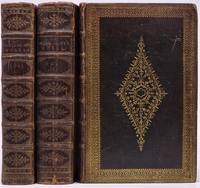
1737008315London: Printed by James Purser 1737. Three volumes in sumptuous contemporary binding of dark brown calf with broad intiricate gilt dentelle bordered covers with large diamond centerpieces enhanced by delicate floral tools the backs with six raised bands with five of the compartments with floral gilt tooling marbled end papers with narrow gilt dentelle all edges gilt. Vol. I with tipped note card "to Robt. Smart donor the Rev. W. Chafin. Mr. Rolling & Miss Floyd present their compliments to Mr Smart & by his acceptance of Lord Shaftesburys Works Mr. Chafin & Miss Floyd consign to Mr. Smart". Each title page with inked inscription "Robt.Smart Donor Rev W. Chafin 1802". Vol. I with engraved frontis portrait and two title pages with vignettes and headpiece Vols. II and III with title page vignette and headpiece all by Gribelin. Very Good gilt at spines dulled joints showing wear but holding nicely small edge tears to end pages of Vol. I light wear at corners and spine ends. Internally clean and bright free of any toning or foxing. A lovely set in 18th century fine presentation binding. . Sixth Edition. Calf. Very Good/No Jacket As Issued. 8vo - over 7¾" - 9¾" tall. Printed by James Purser Hardcover books
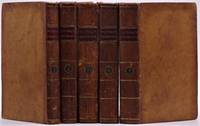
1790008075London: Printed for G.G.J. & J. Robinson & J. Bew 1790. RARE. The Second English Edition five volumes in 2 series: 2 & 3 published 1790. Bound uniformly in contemporary calf red leather title labels and small round black volume labels in gilt with gilt rules The armorial bookplates of Charles MacKenzie Esq. of Kilcoy front paste downs. Very Good Plus calf a bit darkened joints starting at top edge Vol. III but holding nicely a bit of period writing in ink front end pages the interiors clean and lovely. Of this 2nd English Edition Tobias Smollett said; "We found the first translation so faulty that it is with pleasure we see the work again undertaken by some more competent author. Our present translator has executed his task with accuracy and fidelity; but to translate Rousseau is a labour of difficulty it is bending the bow of Ulysses which few weaker hands can perform." The Critical Review or Annals of Literature 1756-1763 p. 360 Lowndes IV 1585. A heavy set please be advised added shipping charges will be requested for international orders. . Second English Edition . Full Calf. Very Good Plus/No Jacket As Issued. 12mo - over 6¾" - 7¾" tall. Printed for G.G.J. & J. Robinson, & J. Bew, Hardcover books