Priestley JosephABAA
156 résultats
20032161225Kessinger Publishing 2003. Reissue. Large Softcover. Near Fine. 2003 Large Softcover. We have more books available by this author!. 16 pp. Suitable facsimile of the original 1774 edition of Joseph Priestley's work on religious liberty as it relates to government Kessinger Publishing paperback books
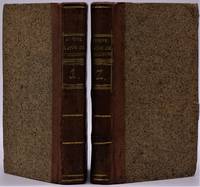
1784008015Paris: The Author 1784. RARE WorldCat shows only eight institutional holdings. Portrait of René Descartes engraved on copper frontispiece Vol. I. Very Good quarter calf over paper covered boards expertly rebacked early 19th c. with gilt lettering and rules decorative end papers. Boards bumped and rubbed at edges. Vol. II with six fold-out plates engraved on copper at the end of the volume representing geometric figures diagrams of astronomy a terrestrial globe instruments of physics and the 12 astrological signs. Introduction and author's notes in French text in Latin and in French. Internally quite clean and lovely with no toning. . . First Edition. Quarter Calf. Very Good/No Jacket As Issued. 12mo - over 6¾" - 7¾" tall. The Author Hardcover books
199924851Amherst: Prometheus Books. Near Fine in Fine dust jacket. 1999. Hardcover. 1573921637 . Third printing. Hi-liting on a few pages else near fine in a fine dust jacket. . Prometheus Books hardcover books
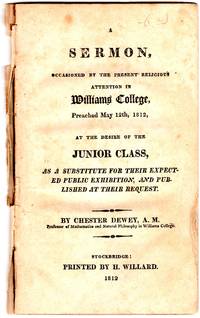
18122395Stockbridge: Printed by H. Willard 1812 . First Edition. Pamphlet. Very good. 24p. removed. None in trade many in holdings. <br/><br/> Printed by H. Willard unknown books
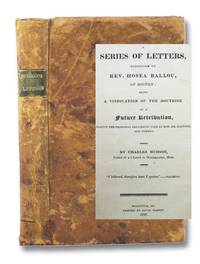
18272093318David Watson 1827. First Edition. Full-Leather. Good/No Jacket. First edition. Boards rubbed top corner lightly stained lightly foxed throughout pencil name on front endpaper. 1827 Full-Leather. v 307 pp. 12mo. A collection of religious expositions focusing on the topic of future retribution a subject about which the author and Rev. Ballou disagreed. In other words a philosophical exploration of the concepts of Heaven and Hell or divine judgment of human souls in the afterlife. More information on Hosea Ballou: "30 Apr. 1771-7 June 1852 theologian and clergyman was born in Richmond New Hampshire the son of Maturin Ballou a farmer and unpaid Baptist minister and Lydia Harris who came from a Rhode Island Quaker family and died when her son was two years old. Growing up in extreme poverty Ballou had less than three years of formal schooling. A few months before his nineteenth birthday he came forward in a revival meeting and joined his father's church. But before the year was over Ballou's interest in religion had led him to become a Universalist. Moving in with an older brother who was already a Universalist minister Ballou prepared himself to teach and preach by attending first a community school and then a nearby academy. Despite the fact that his friends after hearing his first sermon delivered in 1791 doubted his "talent for such labor" Ballou preached wherever he found an open door. The next year he determined to make the ministry his career even though he had to support himself by teaching. In 1793 he went to the first of the nearly fifty New England Universalist conventions he would attend and by the next year's session he had so impressed his colleagues that they spontaneously ordained him. In 1796 Ballou moved to Dana Massachusetts and in September of that year he married Ruth Washburn; they had nine children. In addition to ministering to churches primarily in Massachusetts and Vermont where he and his family moved in 1803 Ballou participated wholeheartedly in Universalist doctrinal controversies. His theology and original thinking shaped Universalist doctrine particularly in three areas: its transition from a trinitarian to a unitarian belief in the nature of God its belief that all sins would be punished on earth and its new perspective on the doctrine of the atonement. Fitting these ideas together Ballou gave Universalist theology more coherence. Ballou early published two works Notes on the Parables 1804 in which he stressed that one should not attempt to gain eternal life through legal righteousness and A Treatise on Atonement 1805 his most influential work. In Treatise he rethought the theology that John Murray the chief founder of American Universalism had derived from the English preacher James Relly. Rejecting the doctrine of vicarious atonement or substitutionary sacrifice in which Christ suffered on the cross to atone for the sins of humanity Ballou insisted that "every sinner must bear the penalty of his own disobedience" Allen and Eddy p. 435 and that Christ suffered to show human beings the way to God's love. Yet Ballou believed that rather than "a wrathful deity seeking justice" God was "full of infinite love" given to all "not reserved for a select few" Miller vol. 1 p. 104. John Coleman Adams who wrote the introduction to Treatise's fourteenth edition in 1902 called it "one of the great books on American theology" and "the first American book to anticipate all the essential points of. liberal theology" Miller vol. 2 p. 865. Ballou was unable to find scriptural justification for the doctrine of the Trinity so he rejected it and embraced unitarianism. Christ he insisted was not co-equal with God but was God's representative to the world. Ballou spiced his reasoning with a little humor declaring "If the Godhead consists of three distinct persons and each of those persons is infinite the whole Godhead amounts to the amazing sum of infinity multiplied by three!" Miller vol. 1 p. 105. By 1805 Ballou's acceptance of unitarianism like his view of the atonement had "pervaded the Universalist ministry with but few exceptions" Miller vol. 1 p. 105. One of these exceptions was Murray whose Boston pulpit Ballou filled for ten Sundays in 1798. On Ballou's last Sunday when he rose to give notice of the closing hymn an announcement instigated by Judith Sargent Murray the minister's wife rang out from the choir loft: "The doctrine which has been preached here this afternoon is not the doctrine which is usually preached in this house" Eddy vol. 1 p. 509. Chagrined at the rudeness of this announcement and wanting to hear more of Ballou's revisionist preaching some members of Murray's congregation offered to start a second Universalist church in Boston if Ballou would move there. But he discouraged them saying "I cannot do anything to injure Brother Murray nor the beloved society to which he ministers" Eddy vol. 1 p. 511. From 1809 until 1815 Ballou--who supported the War of 1812 despite its unpopularity in New England--preached and operated with his grandnephew Hosea Ballou II a small school in Portsmouth New Hampshire. He also continued his religious controversies. "So addicted" was he "to the argumentative" a contemporary noted "that even his prayers" were "characterized by it" Miller vol. 1 p. 103. After a brief stay in Salem Massachusetts on Christmas Day 1817 Ballou became the first pastor of the School Street Church the newly formed Second Society of Universalists in Boston. Nearly two decades after he had first been urged to come to Boston he settled and remained there for the rest of his life. While in Boston he engaged in frequent preaching tours continued his writing and became his denomination's "oracle very nearly its pope" Miller vol. 1 p. 182. In 1819 Ballou became the first editor of the Universalist Magazine which became the leading denominational newspaper. In 1830 with his grandnephew Hosea Ballou he edited the scholarly journal Universalist Expositor which later was renamed the Universalist Quarterly and General Review. In 1834 Ballou published another major work An Examination of the Doctrine of Future Retribution which was partly an outgrowth of the Restorationist Controversy a theological argument over whether there would be future punishment as Calvinists and the founders of Universalism had believed. After being ambivalent on the subject in 1817 and 1818 Ballou who was one of the first Universalists to discuss the controversy formally later said there would be no future punishment then decided there would be a time when "the impenitent will be miserable" and finally reverting to his former opinion came down firmly against "any belief in punishment in a future state" Miller vol. 1 p. 113. Although some of Ballou's colleagues with Calvinist leanings threatened to leave the church over the controversy and used the unpleasantness surrounding it to challenge his dominant position in the church nearly all Universalists by 1827 agreed with him that the idea of future punishment was repellent. Called Father Ballou and very much the elder statesman of his denomination he died in Boston. His influence fellow Universalists maintained was "greater on the religious mind than that of any other clergyman of the age" Miller vol. 1 p. 103. As a self-taught man whose writings lacked polish and whose sermons were "always and entirely argumentative" his great influence is remarkable Miller vol. 1 p. 103. By holding fast to truth as he saw it Ballou gave Universalism an undergirding it had previously lacked. For him "truth--plain simple and unadorned"--constituted "the all and the everything" Miller vol. 1 p. 103." - American National Biography Olive Hoogenboom David Watson hardcover books
1977257600Cambridge Mass: Harvard University Press 1977. Very Good binding. Very Good binding/no dust jacket. Binding sound; small amount of staining to bottom of boards and text block; scant pencil underlining/marginalia. Very Good binding / no dust jacket. Harvard University Press unknown books