Rene Descartes, Benedict De SpinozaBiblio.com
874 résultats
1982204491Franklin Center Pennsylvania: Franklin Library 1982. First Edition; First Printing. Hardcover. Very Good Leather Bound. Printed on archival paper with gilded edges. The endsheets are of moire fabric with a silk ribbon page marker. Smyth sewing and concealed muslin joints to ensure the highest quality binding. This book is in full leather with hubbed spines. Faint foxing along top/side text block edges.; Great Books of the Western World. Franklin Library hardcover
64697-V1-2De Heuvelpers S.H. de Roos Hilversum 1928. Eerste uitgave van de Heuvelpers en eerste Nederlandse private press uitgave geheel in het Latijn. Blinde linnen band tekst fraai in rood en zwart gedrukt 111 p. Oplage van 125 dit exemplaar is ongenummerd. -Hoekjes gestoten schutbladen verkleurd pagina's ongesneden. De Heuvelpers (S.H. de Roos), Hilversum, 1928 unknown
18925686<p><strong>First edition of the best Russian translation of Spinoza's '</strong><strong><em>Ethics</em>'</strong><strong>.</strong></p><p>The translator <strong>Nikolai Ivantsov</strong> 1863-1927 a philosopher and biologist was a member of the Moscow Psychological Society which was the first professional association of psychologists in Russia. He completed this translation in 1884 at the age of 21 but chose not to publish it at the time. His translation was subsequently reissued several times in both Russia and the USSR. <br />It's worth noting that <em>the Spinoza Collection</em> at The Hebrew Union College Library does not include a copy of this particular edition.</p><p>OCLC locates one copy of this edition in the US only: in University of Pennsylvania Libraries. </p> Tip. A. Gattsuk hardcover
201029185UK: Kessinger Publishing 2010. Paperback. Good. Paperback in good condition Kessinger Publishing paperback
1995RARIGRE00kwEaston 1995. Fine. Aristotle. The Great Philosophers. 12 vols. Plato; Kant Immanuel; Locke John; Descartes Rene; Kierkegaard Soren; de Spinoza Benedict; Nietzsche Friedrich; Hume David; Berkeley George; Mill John Stuart; Hegel Georg W. F. Norwalk: Easton 1995. 8vo. Book condition: Near fine. Easton Press Published expressly for the personal library of bookplate sticker laid in each vol. Easton unknown
1995315699Easton Press 1995. Hardcover. Near Fine. Twelve volumes in uniform bindings of full bright red leather stamped in gilt spine titles in black labels. No corners or spine ends bumped or pushed. All have an unused bookplate laid in. Three have no flaws whatsoever to the page edge gilt eight have very minor almost imperceptible flaws Plato has two white spots on the top edge. This set will be remarkably attractive on your shelf. Please request a shipping quote before ordering. Easton Press hardcover
1633-14Stuttgart. Mezler 1830. gr.-8°. LXXVIII 664 S. Mit 2 Tafeln. Halbleder d. Zeit. Kanten berieben. - Corpus Philosophorum optimae notae qui ab restauratione litterarum ad Kantium usque floruerunt. Bd. 3 Enthält die erste Veröffentlichung Spinozas: "Principia philosophiae Cartesianae Pars I-III" weiters: "Cogitata metaphysica" und "Tractato theologico-politicus". Der zweite Teil enthält die posthum veröffentlichten Schriften Spinozas "Ethica ordine geometrico demonstrata" Tractatus politicus" "Tractatus de intellectus emendatione" und "Epistolae doctorum quorundam virorum".Teils mit Zwischentitelblättern auf dem Zwischentitelblatt für die posthumen Schriften ist das Datum der Erstausgabe von 1677 angegeben. Es entspricht auch textlich der Ausgabe von 1677 die von Jarig Jelles um 1620-1683 einem Amsterdamer Kaufmann unmittelbar nach dem Tod Spinozas herausgegeben und mit einem Vorwort versehen wurde. Stuttgart., Mezler 1830. unknown
19969476Ashland Ohio U.S.A.: Purdue Univ Pr. New. 1996. Hardcover. 1557530815 . FREE UPGRADE to Courier/Priority Shipping Upon Request - IN STOCK AND IMMEDIATELY AVAILABLE FOR SHIPMENT - FLAWLESS COPY AVOID WEEKS OF DELAY ELSEWHERE. -- clean and crisp tight and bright pages with no writing or markings to the text. -- with a bonus offer-- . Purdue Univ Pr hardcover
200791643Continuum. New. 2007. Hardcover. 0826493939 . FREE UPGRADE to Courier/Priority Shipping Upon Request - IN STOCK AND IMMEDIATELY AVAILABLE FOR SHIPMENT - Flawless copy brand new pristine never opened -- 160 pages. Description: "This important book examines Spinoza's moral and political philosophy. Specifically it considers Spinoza's engagement with the themes of Stoicism and his significant contribution to the origins of the European Enlightenment. Firmin DeBrabander explores the problematic view of the relationship between ethics and politics that Spinoza apparently inherited from the Stoics and in so doing asks some important questions that contribute to a crucial contemporary debate. Does ethics provide any foundation for political theory and if so in what way Likewise does politics contribute anything essential to the life of virtue And what is the political place and public role of the philosopher as a practitioner of ethics In examining Spinoza's Ethics his most important and widely-read work and exploring the ways in which this work echoes Stoic themes regarding the public behaviour of the philosopher the author seeks to answer these key questions and thus makes a fascinating contribution to the study of moral and political philosophy. " -- with a bonus offer-- . Continuum hardcover
200434511Focus Publishing/R. Pullins Co Incus. New. 2004. Hardcover. 1585101125 . FREE UPGRADE to Courier/Priority Shipping Upon Request - IN STOCK AND IMMEDIATELY AVAILABLE FOR SHIPMENT - FLAWLESS COPY PRISTINE NEVER OPENED -- 480 pages; clean and crisp tight and bright pages with no writing or markings to the text. -- TABLE OF CONTENTS: Translator's Remarks Acknowledgements Spinoza's Preface TEXT OF THEOLGOICO-POLITICAL TREATISE Spinoza's Annotations Glossary Interpretive Essay Selected Bibliography Indexes: Citations Names Terms. -- DESCRIPTION: A new and complete translation in English of this modern text with substantive apparatus to allow the student and serious reader to grapple in a meaningful way with this seminal text which Dr. Yaffe describes in his Translators Remarks: the philosophical founding-document of both modern biblical criticism and modern liberal democracy. As such it is also the philosophical founding-document of modern liberal religion. Tools in the text for the serious reader include the translation ample footnotes Spinozas annotations an interpretative essay glossary and other indices. REVIEW: "Professor Yaffe's learned study of the treatise and his interpretations of its significance are simply among the most intelligent studies that one may find - his devotion to researching the teachings of the treatise has encouraged the production of this new English translation of it which is unique and comprehensive.and is valuable to every reader of Spinoza at every level of ability. Indeed I have every confidence that his translated edition of the treatise together with the outstanding scholarly critical apparatus that it employs will be acknowledged universally as the best English translation and edition of the work available." -Paul J. Bagley President North American Spinoza Society. -- with a bonus offer-- . Focus Publishing/R. Pullins Co Inc,us hardcover
16100Mineola New York U.S.A.: Dover Pubns. As New. 1951. Paperback. 0486202496 . FREE UPGRADE to Courier/Priority Shipping Upon Request - IN STOCK AND IMMEDIATELY AVAILABLE FOR SHIPMENT - AS NEW THE TEXT BLOCK IS PRISTINE CLEAN UNMARKED AND IN EXCELLENT CONDITION - -- with a bonus offer-- . Dover Pubns paperback
193889146J. M. Dent & Sons Limited. As New. 1938. Hardcover. FREE UPGRADE to Courier/Priority Shipping Upon Request - IN STOCK AND IMMEDIATELY AVAILABLE FOR SHIPMENT - AS NEW THE TEXT BLOCK IS PRISTINE CLEAN UNMARKED AND IN EXCELLENT CONDITION - - -- with a bonus offer-- . J. M. Dent & Sons, Limited hardcover
194339157La Salle IL: Open Court Publishing Co. As New. 1943. Paperback. FREE UPGRADE to Courier/Priority Shipping Upon Request IN STOCK AND IMMEDIATELY AVAILABLE FOR SHIPMENT - TEXT PRISTINE -- with a bonus offer-- . Open Court Publishing Co. paperback
195189023Dover Publications. As New. 1951. Hardcover. FREE UPGRADE to Courier/Priority Shipping Upon Request - IN STOCK AND IMMEDIATELY AVAILABLE FOR SHIPMENT - Text pristine unmarked and tight to spine - Includes "A Theological-Political Treatise" "A Political Treatise" "On the Improvement of the Understanding" "The Ethics" and some of Spinoza's correspondence with Fabritius Hugo Boxel and others. -- with a bonus offer-- . Dover Publications hardcover
13478Modern Library. As New. 1927. Hardcover. 112230630X . FREE UPGRADE to Courier/Priority Shipping Upon Request - IN STOCK AND IMMEDIATELY AVAILABLE FOR SHIPMENT - -- with a bonus offer-- . Modern Library hardcover
27897Tudor Publishing Company. As New. Hardcover. FREE UPGRADE to Courier/Priority Shipping Upon Request - IN STOCK AND IMMEDIATELY AVAILABLE FOR SHIPMENT - AS NEW THE TEXT BLOCK IS PRISTINE CLEAN UNMARKED AND IN EXCELLENT CONDITION - . No publication date cited; preface dated 1926. -- with a bonus offer-- . Tudor Publishing Company hardcover
196153895Open Court Pub Co. As New. 1961. Hardcover. FREE UPGRADE to Courier/Priority Shipping Upon Request IN STOCK AND IMMEDIATELY AVAILABLE FOR SHIPMENT - AS NEW THE TEXT BLOCK IS PRISTINE CLEAN UNMARKED AND IN EXCELLENT CONDITION - - 177 pages. -- with a bonus offer-- . Open Court Pub Co hardcover
189937660London: Duckworth and Co. As New. 1899. Hardcover. FREE UPGRADE to Courier/Priority Shipping Upon Request IN STOCK AND IMMEDIATELY AVAILABLE FOR SHIPMENT - -- with a bonus offer-- . Duckworth and Co. hardcover
1909883Kazan: N.P. 1909. First Edition. Hardcover. Very good. SPINOZA Baruch Bogoslovsko-Politicheskii Traktat Tractatus Theologico Politicus translated into Russian from the Latin by Mikhail Lopatkin N.P. Kazan 1906. 1 blank leaf TP half title i - iv = translators introduction 1 - 440 i - iv = contents 1 leaf = corrections blank leaf octavo FIRST RUSSIAN EDITION. <br /> <br />First Russian translation of Spinozas most dangerous book the Tractatus Theologico-Politicus. Spinozas philosophy proved highly influential among the 19th and early 20th century Russian intelligentsia. Georgi Plekhanov noted that if one looks for philosophical predecessors of Marxism they can be found in the materialist tradition especially in Spinoza and the radical Enlightenment Interestingly Lenin allied himself with the Spinozistic Plekhanov in order to suppress the leftist and subjectivist tendencies in his own Bolshevik faction. Lenins philosophical alliance with Plekhanov in 1909 had far-reaching consequences Oittinen V. Soviet Spinoza: introduction. Stud East Eur Thought 74 267277 2022. <br /> <br />CONDITION: Very good or better in contemporary quarter leather with marbled boards. Minor edgewear. A few pages in the contents with wrinkling from old moisture but pages mostly clean crisp and unmarked. Neat stamp to title page and hint of old ownership name to top corner. Pages minimally browned. <br /> <br/><br/> N.P. hardcover
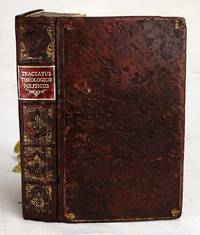
1678ABC_50006Amsterdam: Jacob Smith = Israel de Paull for Jan Rieuwertsz. Sr. 1678. Contemporary mottled calf gold-tooled spine with a red morocco title-label lettered in gold gold-tooled board edges marbled endpapers. 12mo. With a woodcut vignette on title page ornament E in the description of Van de Ven. First French edition of Spinoza's famous Tractatus Theologico-Politicus 1670 printed by Israel de Paull for Jan Riewertsz. Sr. in Amsterdam but appearing with the false imprint of "Hamburg Henricus Künrath". The original Latin edition is one of two works by Spinoza that originally appeared during his lifetime the other work is his Principia philosophiae cartesianae 1663. The present French translation was published only a year after Spinoza's death in 1677 and was still so controversial that it was published without mentioning the author's name and with false imprints. Three issues of the first French edition are known all three dated 1678 but with different titles and false imprints: 1: Reflexions curieuses d'un esprit des-interressé sur les matieres les plus importantes au salut Leiden Pierre Warnaer 1678; 2: La clef du santuaire Cologne Claude Emanuel 1678; and 3: the present work Traitté des ceremonies superstitieuses des juifs. In chapter 5 pp. 200-255 of Van de Vens bibliography of Spinoza's works the complicated printing history of the French translation is covered in detail; our issue has the number X3. The translation presumably launched by Spinozas Amsterdam publisher Jan Rieuwertsz Sr. is commonly attributed to a French Hugenot Gabriel Lord of Saint Glain 1620-1684 who had been a zealous Protestant before he came to know Spinoza. He grew into one of his disciples and one of his greatest admirers. He settled in The Hague about the same time when Spinoza moved to that same city where they could have met each other.What makes this edition of the French translation extra important also for the general Spinoza bibliography is that it contains at the end the 31 "Adnotationes ad Tractatum theologico-politicus" here called "Remarques curieuses et necessaires pour lIntelligence de ce livre" pp. 1-30: notes clarifying obscurities in Spinozas book. The majority of these Adnotationes were composed by Spinoza himself some were arguably made by others. The precise sources for these notes which were unpublished until this French translation are unknown. In the autumn of 1675 Spinoza was planning - as he wrote to his correspondent H. Oldenburg in London - a new edition of his Tractatus together with his Adnotationes marginal notes to explain passages easily to be misinterpreted by critical readers written in the margins of his copy of the first edition now lost. But there are more copies known and lost with a varying number of notes 31-39. If Saint Glain was indeed the translator of the Tractatus this would indicate that he must have gotten hold of either Spinozas holograph or an apograph of the notes whether or not written in de margins of a copy of the first Latin edition probably through Jan Rieuwertsz who was after the death of Spinoza in the possession of his written legacy. It may even be speculated that Rieuwertsz himself did ask and commission Saint Glain to translate the Tractatus into French and to append the still unpublished Adnotationes in French.With a manuscript inscription initials on the verso of the first flyleaf a crossed out manuscript owner's inscription of Abraham Couet du Vivier 1646-1719 Hugenot pastor and author in The Hague at the head of the title page with the manuscript additions of the Latin title and "par Benedict. Spinosa" around the printed title in the same hand. The binding shows clear signs of wear the front hinge is weakened the corners of the boards are slightly damaged the marbled endpapers are slightly rubbed and frayed slight browning throughout. Otherwise in good condition.l Akkerman F. Introduction to his translation into Dutch 1997; Kingma/Offenberg p. 15; STCN 840787480; USTC 1561976; Van der Linde p. 12; Ven J.M.M. van de Printing Spinoza Leiden Brill 2022 Chapter 5 pp. 200-255 nr. X3; cf. STCN 843272147 other issues of this ed. Jacob Smith [= (Israel de Paull for) Jan Rieuwertsz. Sr.], unknown
16742110210037N.P.: Amsterdam : Jan Rieuwertsz 1674. 3rd. Hardcover. Good. The Origins of Secular Thought: Moral Philosophy Unbound from Religion Octavo 162 x 102 mm. 2 parts in one volume. Bound in contemporary sheep with gilt spine. Rebacked and restored with new spine label. Scattered spotting. Collated: 22 334 4; 16 182 19 pages including blanks Z3-4. 18th-century signatures of George Wycherley and Alexander Hatton of St. John's College Cambridge on front free endpaper. <br> Van der Linde states that the text block was printed in 1673 while the title page was printed in 1674. No publisher is listed because the work was banned in Holland this edition was intended for distribution in England. This work was censored for its dangerous ideas arguing for a philosophical interpretation of scripture. "Spinoza's thought a fusion of cartesian rationalism and the Hebraic tradition in which he grew up is a solitary but crystal-clear exposition of the theory of natural right. It is also the forerunner of modern Biblical criticism." - Printing and the Mind of Man 153 1670 original edition; Bamberger T3.E this edition. N.P.: [Amsterdam] : [Jan Rieuwertsz] hardcover
16631005<p>First Edition of Spinoza's First Book – Explicating Descartes</p><p>SPINOZA Benedict. Renati Des Cartes Principiorum Philosophiæ Pars I & II More Geometrico demonstratæ per Benedictum de Spinoza per Amstelodamensem . Accesserunt Eiusdem Cogitata Metaphysica Rene Descartes' Principles of Philosophy Parts I & II Demonstrated According to the Geometric Method by Benedict de Spinoza of Amsterdam. the same followed by Metaphysical Thoughts Johannem Riewerts Amstelodami Amsterdam 1663. 1 blank leaf TP i-vii = Præfatio viii = Ad Librum ix-xiv = Index 1-90 91 = half-title 93-140 blank leaf; Small Quarto. First Edition in original paper wrappers Kingma-Offenberg 1.</p><p>This Spinoza's first work is the only one published during his lifetime that identified him as the author and had the correct information on the printer-publisher. Spinoza's next two works Tractatus Theologico-Politicus & Opera posthuma were very much his own radical thought rather than a reworking of Descartes ideas as here and so were necessarily published anonymously listing false information about the printer-publisher on the title page. The radical nature of Spinoza's thought and the dangers of publishing such materials in this time and place are brilliantly explained in Jonathan Israel's Radical Enlightenment Oxford 2001. Here Spinoza presents an exposition of Cartesian philosophy but he has recast it using his own geometrical method of reasoning and presentation. The origins of this work are interesting and clearly explained by the author himself in a letter to his friend Oldenburg written shortly after the book's publication: "Some of my friends asked me to make them a copy of a treatise containing a precise account of the Second Part of Descartes' Principia Philosophiæ 1644 demonstrated in the geometric style and of the main points treated in metaphysics. Previously I had dictated this to a certain young man to whom I did not want to teach my own opinions openly. They asked me to prepare the First Part also by the same method as soon as I could. Not to disappoint my friends I immediately undertook to do this and finished it in two weeks. I delivered it to my friends who in the end asked me to let them publish the whole work. They easily won my agreement on the condition that one of them Lodewijk Meyer in my presence would provide it with a more elegant Latin style and add a short preface warning readers that I did not acknowledge all the opinions contained in this treatise as my own since I had written many things in it which were the opposite of what I held and illustrating this by one or two examples. One of my friends to whose care the publishing of this little book has been entrusted has promised to do all this and that is why I stayed for a while in Amsterdam" Nadler Spinoza A Life 205. This rather straightforward – though completely reformatted – exposition of Descartes is followed by the Cogita Metaphysica 91-140 – with its own half-title page which is written from the Cartesian perspective defending for instance the freedom of the will but with some serious foreshadowing of Spinoza's later doctrines.</p><p>CONDITION: Very good in original brown paper wrappers most of backstrip lacking with wear to extremities. Woodcut illustr. to title-page and several woodcut mathematical and physical illustrations throughout. Annotations to both free end-paper. Some minor brownspotting and even light browning to leaves. A very nice and attractive copy of Spinoza's first book housed in a custom cloth archival box.</p> Johannem Riewerts paperback
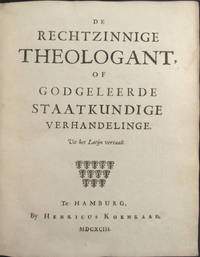
169329710Amsterdam: N.p.: Henricus Koenraad' i.e. Jan Rieuwiertsz jun. 1693. First edition in Dutch of TRACTATUS THEOLOGICO-POLITICUS the THEOLOGICAL-POLITICAL TREATISE. 8vo 16 x 20cm handsomely bound in full vellum with leather bands spine lettered in manuscript. xxviii 360 pp. A very fine and handsome copy of this very scarce first edition printing the text-block very fresh and clean a strong impression of the text the binding as pristine. FIRST ISSUE FIRST PRINTING OF THE VERY RARE DUTCH EDITION WHICH SPINOZA DID NOT WANT PUBLISHED OUT OF FEAR OF RETRIBUTION. QUITE ELUSIVE AND ONE OF THE MOST IMPORTANT PHILOSOPHICAL WORKS OF THE EARLY MODERN PERIOD. Baruch Spinoza is unquestionably one of the most important philosophers of all time -- and certainly perhaps the most radical of the early modern period. His thought combines a commitment to Cartesian metaphysical and epistemological principles with elements from ancient Stoicism and medieval Jewish rationalism into a nonetheless highly original system. His extremely naturalistic views on God the world the human being and knowledge serve to ground a moral philosophy centered on the control of the passions leading to virtue and happiness. They also lay the foundations for a strongly democratic political thought and a deep critique of the pretensions of Scripture and sectarian religion. Of all the philosophers of the seventeenth-century perhaps none have more relevance today than Spinoza.<br> Spinoza's aim in TRACTATUS THEOLOGICO-POLITICUS which he completed and published anonymously in 1670 was to prove that the stability and security of society is not undermined but rather enhanced by freedom of thought meaning primarily the freedom to philosophize. As is clear from the text he concluded that the primary threat to this freedom emanated from the clergy whom he accused of playing upon the fears and superstitions of people in order to maintain power. His solution was to divest the clergy of all political power even to placing authority over the practice of religion into the hands of the sovereign. The sovereign Spinoza argued should extend broad liberties within this domain requiring adherence to no more than a minimal creed that was neutral with respect to competing sects and the meaning of which was open to a variety of interpretations. This he hoped would allow philosophers the freedom to do their work unencumbered by the constraints of sectarianism. <br> As was to be expected the work was met with a firestorm of criticism. It was condemned as a work of evil and its author was accused of having nefarious intentions in writing it. Even some of Spinoza's closest friends were deeply unsettled by it. Though he had assiduously tried to avoid it Spinoza found himself embroiled in heated religious controversy and saddled with a reputation for atheism something he greatly resented. <br> Shortly after the publication Spinoza moved to the Hague where he was to live out his remaining years. Besides having to deal with fallout from this treatise he witnessed a political revolution that culminated in the murder by an angry Orangist-Calvinists mob of the Grand Pensionary of Holland Jan De Witt as well as his brother Cornelius. Spinoza admired De Witt for his liberal policies and was horrified by the murder. With the ascent of the Orangist-Calvinist faction he felt his own situation to be tenuous.<br> In the words of PRINTING AND THE MIND OF MAN ".The TRACTATUS THEOLOGICO-POLITICUS constituted an extension to political thought of his ethical views. Man is moved to the knowledge and love of God; the love of God involves the love of our fellow men. Man in order to obtain security surrenders part of his right of independent action to the State. But the State exists to give liberty not to enslave; justice wisdom and toleration are essential to the sovereign power. <br> Baruch Spinoza 1632-1677 scion of a leading Jewish family in Europe's most cosmopolitan city of the seventeenth century Amsterdam provided the intellectual architecture for a philosophic structure which would level current assumptions and conclusions. For his endeavors Spinoza was excommunicated by his own community and his name Baruch-Benedict which means blessed became anathema both in the community he left and the larger community he never entered. During his lifetime Spinoza's works were published anonymously and even his posthumously published Opera contains neither place nor date of publication. His rise to a central position in the drama of humankind's search for truth came slowly but inexorably as human reason came to be more and more relied upon over the ideas promulgated by an adherence to divine dogma. It is said that Thomas Jefferson would have been one of the first Americans to have accepted Spinoza as his spiritual kin. N.p.: Henricus Koenraad' (i.e. Jan Rieuwiertsz jun.) hardcover
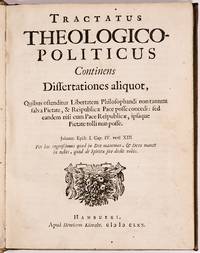
167042820837<p>Contemporary vellum hand-lettered spine edges sprinkled blue. A fine copy.</p><p><strong>First edition of this landmark of 17th-century thought the Theological-Political Treatise.</strong></p><p>This is the rare first edition readily identified by the misspelled "Künraht" imprint and the mis-numbering of page 104 as 304. "Although there is only one genuine first edition the other quarto editions also pretend that they were printed in the year 1670. … The reason for this is that the work was highly controversial: although formally banned only in 1674 it was considered illegal from its publication and there were attempts to have it repressed from the very start. So the Amsterdam publisher Jan Rieuwertsz had to be careful. He did not reveal his identity on the title page which carries a fictitious imprint: Henricus Künrath in Hamburg and when there was a demand for reprints it was important to make the book look like copies left over from the original 1670 issue rather than newly printed ones" Melamed and Rosenthal.</p><p>Baruch Spinoza is a giant of 17th-century thought and a key figure of the Enlightenment. "He made significant contributions in virtually every area of philosophy and his writings reveal the influence of such divergent sources as Stoicism Jewish Rationalism Machiavelli Hobbes Descartes and a variety of heterodox religious thinkers … He is usually counted along with Descartes and Leibniz as one of the three major Rationalists. … Spinoza has remained an enormously controversial figure. For many he is the harbinger of enlightened modernity who calls us to live by the guidance of reason. For others he is the enemy of the traditions that sustain us and the denier of what is noble within us" IEP.</p><p>"Spinoza's thought a fusion of Cartesian rationalism and the Hebraic tradition in which he grew up is a solitary but crystal clear exposition of the theory of natural right. He defends with eloquence the liberty of thought and speech in speculative matters and the Tractatus contains the first clear statement of the independence of each other of philosophy and religion" PMM. Spinoza held that "Man is moved to the knowledge and love of God; the love of God involves the love of our fellow men. Man in order to obtain security surrenders part of his right of independent action to the State. But the State exists to give liberty not to enslave; justice wisdom and toleration are essential to the sovereign power" Printing and the Mind of Man 153.</p><p>Spinoza's<em> Tractatus Theologico-Politicus</em> was a notorious book in its own time both for what it attacked and for what it advocated. Spinoza scrutinized religious teachings and Scripture to argue that they were mere products of the human mind. At the same time he "believed that the political model of the ancient Hebrews could be imitated in certain key respects. … Unlike Hobbes whose social contract theory justified absolute monarchy Spinoza argued that democracy was a preferred form of government. And finally he thought that the state would be better off if it granted limited religious toleration and the freedom to philosophize" Melamed and Rosenthal eds. <em>Spinoza's Tractatus Theologico-Politicus: A Critical Guide</em>.</p><p>The author's concerns about political repercussions delayed publication of the book for years. It finally appeared anonymously in 1670 with a false imprint. The <em>Tractatus</em> was soon placed on the Index of Prohibited Books and was interdicted in Holland. Leibniz rejected its scandalous arguments while Hobbes is said to have declared "I durst not write so boldly." Spinoza has come to be embraced by many seemingly irreconcilable "-isms" including liberalism Marxist materialism conservatism and Zionism.</p><p><strong>The first printing of the <em>Tractatus</em> is rarely found in this excellent condition. This true first edition has become a rare book in a period binding.</strong></p> Heinrich Künraht [i.e. Amsterdam: Rieuwertsz] hardcover