Aristoteles [Aristotle]Biblio.com
5 résultats
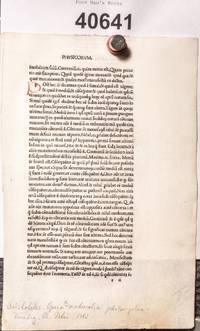
148240641Venice: Unknown. Very Good with no dust jacket. 1482. Leaf. 8" x 12"; 1 leaf pages; Later penciled marginalia in lower margin. Single column. Black face type. Philosophy . Unknown unknown
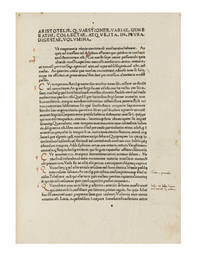
149864765Venedig, Bartholomaeus de Zanis für Octavianus Scotus, 9. August 1498. 4°. Mit zahlr. tlw. figürl. Holzschn.-Initialen u. Holzschn.-Druckermarke von Scotus am Ende. 6 nn., 89 num. Bll. (ohne das letzte weiße), Späterer blindgepr. Ldr.-Bd. a. 3 Bünden im Stil d. Zt.
1500284J<p>Venice: Simon de Luere for Andreas Torresanus 4 September 1500 1500.</p><p>Second edition after that of 1481. This copy is bound in contemporary 1/4 blind-tooled goatskin over wooden boards with 3 of 4 metal catches on front cover rebacked retaining most of original backstrip conspicuous termite damage on front cover rear cover replaced with modern board endpapers renewed; contents washed with residual soiling on opening leaves worming through much of volume generally not impairing legibility crude restoration in blank margins at beginning and end .G</p><p>Ethica Nicomachea Books 1-10 in the Latin translation of Robertus Grosseteste 1175-1253 incipit "OMnis ars et omnis doctrina similiter autem et actus et electio bonum quoddam ap=petere videtur. Jdeo bene enunciauerunt bonum quod omnia appetunt" b1r-y9v; colophon Venetijs impresse arte Simonis de Leure: impensis viro domini Andree Torresani de Asula. Anno M.D. die vero IIIJ. Septebris. y10r; printer's register y10r. Wood cut diagrams. The first Latin translations of Aristotle's Nicomachean Ethics the Ethica vetus and the Ethica nova are the object of six commentaries from the first half of the thirteenth century presumably written by Parisian arts masters. Typical for these early commentaries is the interpretation of Aristotle's doctrine in the light of Christian religion. In 1246/1248 Robert Grosseteste achieved a complete translation of the Nicomachean Ethics. The first to write commentaries on it were Albert the Great twice and Thomas Aquinas. Both attempted to interpret Aristotle philosophically avoiding the theological implications. Burley turned to moral philosophy and varia rather late in his life completing his exposition of Aristotle's Ethics in 1333-1334 and of the Politics in 1340-1343.</p><p>¶There are two printed editions of this work the one offered here is the second the first is quite rare-Goff B 1300 3 copies Harvardand St Bonaventure Univ. and University of Penn</p><p>¶The copy offered today is also rare- Goff B1301 3 copies</p><p>Free Library of Philadelphia Newberry Library U. of Illinois.</p><p>Goff; B-1301 ; BM 15th cent.; V 576 IB. 24667; GW; 5779; ; Hain-Copinger; 4144; Harman; 191; ISTC online; ib01301000; Proctor; 5269; Pellechet; 3080</p><p>.</p> Venice: Simon de Luere for Andreas Torresanus, 4 September 1500 hardcover
149329071<p>Printed in Venice in 1493 by Simon Bevilaqua for Alexander Calcedonius this folio edition of Saint Thomas Aquinas's commentary on Aristotle's Metaphysics remains complete including the final leaf with the printer's mark. The volume represents a critical text in early philosophical scholarship combining scholastic interpretation with Aristotelian inquiry. The commentary captures core metaphysical themes including form substance and being. With 308 unnumbered leaves this folio presents the content in a clear typographic layout typical of Venetian incunabula. Entries appear in ISTC Goff GW HC and Proctor reinforcing its documentation among major catalogues. Edition: First Bevilaqua edition. Format: Folio 31cm x 23cm single volume. Condition: Very good. Collation: 308 leaves. Illustrations: One woodcut printer's device. References: ISTC it00246000; GW M46202; Goff T246; HC 1509; Proctor 5383. #00000 PHOTOS AVAILABLE UPON REQUEST.</p> for Alexander Calcedonius, Simon Bevilaqua hardcover
1472112<p>Very rare first edition mentioned by Goff of the<i> Introduction à la Philosophie de Platon</i> by Alcinous his disciple.</p><p>A superb and precious copy with huge margins ink rubricated initials and the first two letters illuminated the first one being enhanced in gilt.</p><p><b>Very rare first incunabula edition of the Introduction à la philosophie de Platon by Alcinous.</b></p><p>Given by Antoine Koburger.</p><p>It is the only one mentioned by Goff.</p><p>Goff A-365 ; Hain 620; Pellechet 419; Stillwell A-332 ; Proctor 1965 ; BMC II 412 ; Panzer p.9 ; Santander II n°58 ; A. A. Renouard <i>Catalogue de la bibliothèque d'un amateur</i> I p.174.</p><p>A superb and precious copy with rubricated initials in red ink and the first two letters illuminated the first one being enhanced in gilt. </p><p><i>"A rare piece."</i> Renouard</p><p>"<i>First very rare edition printed on long lines with no distinction of chapter or sections and without numbers signatures or catchwords. The totality of this volume is of 22 printed leaves: at the beginning there is a dedication epistle by the bishop of Tropea Petrus Balbus Pisanus author of this Latin version of Alcinous to the cardinal Nic. De Cusa ; then comes the text at the end of which we can read this subscription: Epitoma Alcinoi in disciplinaru Platonis definit. Anno salutis. M. CCCC. LXXII. Die vero XXIIII. Mensis Novebris."</i>Santander who lists this edition as being the first</p><p>Antoine Koburger 1443-1515 a German editor bookseller and one of the most distinguished and active printers of the 15th century was renowned for the "<i>Chroniques de Nuremberg</i>" he published in 1493.</p><p>Alcinous was popular in the 1st century CE.</p><p>A student of the school of Alexandria and faithful to its spirit he was one of the first to start blending into Plato's doctrine Aristotle's opinions and some oriental ideas. </p><p>There is sufficient proof of that in his <i>Introduction à la philosophie de Platon</i> a digest where he largely exposes this vast system while adding some foreign elements to it. For example when he speaks of spirits and demons he seems to know a lot more than Plato: to him some are visible and some invisible; he distributes them among all of the elements and tells us about their relationships their influence — before our eyes a complete demonology is born from which the only next step possible is towards magic." <i>Dictionnaire des Sciences philosophiques</i> pp.48-49 </p><p>We know of Plato and some of his texts; but there are only a few who have an accurate and precise idea of the whole philosophical system of the prince of philosophers. </p><p>Presenting to amateurs of philosophy a summarized tableau of what Platonism is was doing them a great favor. </p><p>This is what the Platonist philosopher Alcinous undertook and executed in this book that we can consider like a lost pearl in the dust of the centuries.</p><p><u>How intriguing it is to find gathered in a miniature frame a philosophical system that for so long sat at the highest level of the opinion especially nowadays when this kind of curiosity is hard to satisfy: for it is difficult to have in one's possession the complete works of Plato. </u></p><p><u>Plato's texts are numerous and quite diverse but there is no order that links the different treaties between them. This reduced map of Platonism must be considered very precious as it gives the mind the ability to grasp this vast ensemble at first glance. </u>J. J. Combes-Dounous</p><p>This translation of Alcinous' text is due to the talent of Pietro Balbus.</p><p><b>A superb and precious copy of this very rare incunabula edition with very wide margins height: 315 mm </b><b>rubricated initials in red ink with the first two letters illuminated the first one being enhanced in gilt.</b></p><p>The copy mentioned by BMC was only 303 mm high.</p><p>Provenance : Library of <i>Moreau</i> 10 December 1934 n° 18.</p> Antoine Koburger hardcover