WS Hett Aristotle W SBiblio.com
4 109 résultats
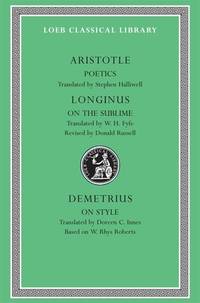
6827628Harvard University Press pp. 546 Indices. Hardback. New. Harvard University Press hardcover
2091202133300586Kyoto University Academic Press N.A. Soft Cover. Fine. Number of pages: 564 14p Size: 20cm Kyoto University Academic Press paperback
20052090202120405598Kyoto University Academic Press 2005. Soft Cover. Fine. Number of books: 1 Kyoto University Academic Press paperback
19692091502133535556Kawade Shobo Shinsha 1969. Soft Cover. Fine. The book is in fine condition. Kawade Shobo Shinsha paperback
2080202103705231Iwanamishoten N.A. Soft Cover. Fine. Page size: 334 20p Size: 15cm Bunko size Iwanamishoten paperback
19682091202133206071Iwanamishoten 1968. Soft Cover. Fine. Number of books: 16 Iwanamishoten paperback
19922080502107002479Iwanamishoten 1992. Soft Cover. Fine. Number of pages: 525p Size: 15cm Iwanamishoten paperback
2111902158405982Iwanamishoten N.A. Soft Cover. Fine. Number of pages: 223 8p Size: 21cm Iwanamishoten paperback
19972092902140303574Iwanamishoten 1997. Soft Cover. Fine. Number of books: 1 Iwanamishoten paperback
20062081402109301269Iwanamishoten 2006. Soft Cover. Fine. Number of pages: 356p Size: 15cm Iwanamishoten paperback
19752081002109000485Iwanamishoten 1975. Soft Cover. Fine. Number of pages: 465 33p Size: 15cm Iwanamishoten paperback
19422082502113901608Iwanamishoten 1942. Soft Cover. Fine. Number of books: 1 Iwanamishoten paperback
20171234187PN. New. 2017. Reprint Edition. Soft Cover. Date is copyright date; this is a later reprint edition . PN paperback
200010780<p>Fade to spines owner sticker on endpaper of all volumes</p> Oxford Univ Press hardcover
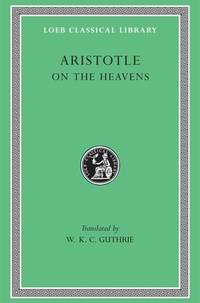
6827571Harvard University Press pp. 420 Index. Hardback. New. Harvard University Press hardcover
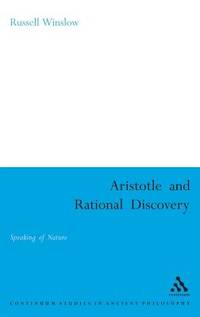
200791624Continuum. New. 2007. Hardcover. 0826496873 . FREE UPGRADE to Courier/Priority Shipping Upon Request - IN STOCK AND IMMEDIATELY AVAILABLE FOR SHIPMENT - Flawless copy brand new pristine never opened -- 160 pages. Description: "In this lively and original book Russell Winslow pursues a new interpretation of logos in Aristotle. Rather than a reading of rationality that cleaves human beings from nature this new interpretation suggests that for Aristotle consistent and dependable rational arguments reveal a deep dependency upon nature. To this end the author shows that a rational account of a being is in fact subject to the very same principle that governs the physical motion and generation of a being under inquiry. Among the many consequences of this argument is a rejection of both of the prevailing oppositional claims that Aristotle's methodological procedure of discovery is one resting on either empirical or conceptual grounds: discovery reveals a more complex structure than can be grasped by either of these modern modes. Further Winslow argues that this interpretation of rational discovery also contributes to the ethical debates surrounding Aristotle's work insofar as an ethical claim is achieved through reason but is not thereby conceived as objective. Again the demand for agreement in ethical/political decision will be disclosed as superseding in its complexity both those accounts of ethical decision as subjective for example 'emotivist' accounts and those as objective 'realist' accounts." -- with a bonus offer-- . Continuum hardcover
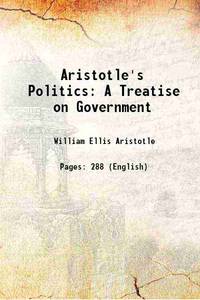
2018BIBHB0021813792018. Hardcover. New. The Title 'Aristotle's Politics A Treatise on Government written/authored/edited by William Ellis Aristotle' published in the year 2018. The ISBN 9789361588198 is assigned to the Hardcover version of this title. This book has total of pp. 288 Pages. The publisher of this title is Facsimile Publisher. This Book is in English. The subject of this book is History. Size of the book is 14.34 x 22.59 cms Vol: hardcover
1959mon00001264381959-01-01. Unknown Binding. Good. in x in x in. Ex-Library. Hardback/Hardcover with dust cover. Clean copy in good condition. unknown
6827407Harvard University Press pp. 544 Indices. Hardback. New. Harvard University Press hardcover
0484959204.Gpaperback. Good. Access codes and supplements are not guaranteed with used items. May be an ex-library book. paperback
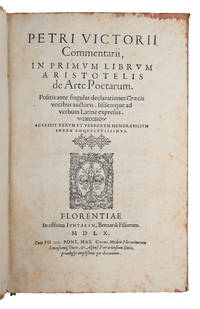
161062508Florence In officina Iuntaru Barnardi Filiorum 1560. Small folio. 18th century full vellum with gilt labels to spine. Wear to capitals and small worm tracts towrad opper hinges. Corners a bit bumped. A very nice and sturdy binding. Marbled edges. Some browspotting throughout. Small wormholes to blank margin of final leaf far from affecting imprint. Woodcut vignette to title-page and to verso of colophon-leaf. 10 308 12 ff. <br/><br/><em>The rare first edition of Vittore's main work his great edition translation and commentary on Aristotle's Poetics which is arguably the most important and influential commentary on the work ever published profoundly shaping our understanding and interpretation of Aristotelian literary theory. Petrus Victorius or Piero/ Pietro Vittore/Vettore 1499-1584 is not only the “first great editor of the Poetics†McMahon he is also considered "the greatest Greek scholar of Italy" Whibley “the leading Italian scholar of his time†Encycl. Britt. “the last great figure from that period in the domain of Greek studies†Willamowitz and “the foremost representative of classical scholarship in Italy during the sixteenth century which for Italy at least may well be called the “saeculum Victorianumâ€.†Sandys. His magnum opus and without doubt most influential work is his edition with commentary of Aristotle’s Poetics which is of seminal importance in several respects. It is crucial to our understanding of Aristotle’s great work shaping the way that all later scholars have read it. The understanding of Aristotle’s work on poetry came to define the way that we have understood literature and fiction ever since the Renaissance and Victorius is the leading interpreter. ““From the sixteenth century to Romanticism European literary theory used the term marvel or wonder It. meraviglia ammirabile Fr. merveille Sp. maravilla to designate everything that was on the conceptual margins of the poetics of probability and imitation. The discovery and complete reception of Aristotle’s Poetics between the fifteenth and sixteenth centuries resulted in the dissemination of an idea of poetry as the imitation of the actions of men whose main part was the plot or the structuring of actions ordered according to the laws of necessity credibility and probability. This formed the basis of Neo-Aristotelian poetics which determined the ways of thinking about literature and fiction for more than four centuries.†Vega p. 280. Especially the idea of “wonder†in Aristotle’s Poetics came to be one of the founding ideas of modern literary theory. And especially here Victurius’ reading is groundbreaking playing a central part in the reception and understanding of the work over the centuries to come. “A single editorial decision in just one passage and what is more in a complex fragmentary unfinished text like the Poetics affects the entire work…†Vega p. 284. “The text of the Poetics that can be read in the editions and translations of the sixteenth century and a large part of the seventeenth with one exception as we shall see NB. This exception is Victorius does not include the term alogon in the passage that deals with wonder. It does not appear in the first Greek edition the famous Aldine princeps of 1508 or in the Latin translations of the end of the fifteenth century; it is not in the edition and translation by Alexander Paccius or Pazzi the one most widely read in the sixteenth century neither does it appear in the edition with commentary by Francesco Robortello nor in Vincenzo Maggi’s Enarrationes nor in the vernacular commentaries of Ludovico Castelvetro and Alessandro Piccolomini. What is more a detailed revision of the history of the text reveals that no manuscript of the Poetics and no direct or indirect testimonies not even in the Arabic branch of its transmission have ever included the term alogon.†Vega p. 282. It is Victorius who is solely responsible for the reading that is generally accepted today as well. “The moment when the idea of irrationality alogon appears for the first time in Aristotle’s text can be identified without hesitation as 1560 which is the date when the edition translation and commentary on the Poetics by the philologist and Hellenist Pier Vettori or Victorius was printed on the presses of Giunti in Florence. Vettori is the one who first edits alogon even though no testimony provides him with this reading and he does so fully aware of his choice and its implications†Vega pp. 287-89. “The success of Victorius’ reading while not immediate was extraordinary.†Vega p. 287 Antonio Viperano accepts the reading “alogon†with all it involves De poetica libri tres Ricciboni adapts it in his edition of Aristotle’s Poetics Tasso embraces it Discorsi dell’arte poetica Discorsi del poema eroico and it is implicit in Alonso López Pinciano’s Philosophia Antigua Poetica. Vossius in 17th century Germany makes abundant glosses on alogon in his books on poetics and the commentators and translators of the “Poetics†in France preferred Victorius’ reading in every case. “Victorius’ conjecture seems to have convinced all editors and commentators who reproduce it without question in every case.†Vega p. 289. The influence of Victorius’ interpretation of Aristotelian literary theory that he presented in his magnum opus i.e. the present work was not limited to the use of specific words that changed the reception history of Aristotle’s Poetics. His entire view of poetry through an interpretation of Aristotle was highly original and came to define the way we understand literature in general. Victorius was one of the first to put forth the belief that heroic poetry should present a Platonic idea of perfect virtue contributing to the centuries long doctrine of the perfect hero as perfect exemplar and he was one of the first to revive Aristotle’s idea of purgation from tragedy still widespread today and to also understand the existence of a purgation from poetry. “He viewed poetry as a moderator of minds “By reading poetry men “become moderate in temper and their turbid motions are extinguished.†Poems “purge our minds of blemish and spotâ€. Vettori realized that Aristotle’s reference to catharsis should be applied to tragedy alone but he added that similar purgations could be achieved by other kinds of poetry effective however on other passions than pity and fear and with the aid of other instruments.†Hathaway pp. 292-93. Apart from his overall interpretation of Aristotle’s literary theory and his groundbreaking reading of the most central passages of the Poetics Victorius was also the first to determine that the Aristotelian text that has come down to us is not complete. “Victorius was the first to see that the treatise now known as the Poetics is only the surviving portion of a larger work.†Bywater p. XX. “during his lifetime five medals were struck in his i.e. Victorius’ honour and his portrait was painted by Titian… His fame was not limited to his own land or his own time. His scrupulous care and unwearied industry are lauded by Turnebus who declines to be compared with him even for a moment; the epiteths doctissiums optimus and fidelissimus are applied to him by the younger and the greater of the two Scaligers while Muretus calls him eruditorum coryphaeus; and similar eulogies might be quoted from Justus Lipsius. Dacius … and Graevius. He is described as having climbed the “hill of virtue†and taken his place on its summit between Cicero and Aristotle. In his funeral oration Salviati says of him in the personification of Italia: “Now no more shall distant peoples cross the snows of the Alps to see Victorius or men of mark arrive from every land to hear him; or princes hold converse with him. Now no more shall the works of scholars in all parts of the world be sent here for his approval; or youth learn wisdom from his lips.†Sandys pp. 139-40. “No one said a contemporary of his in a funerary laudatio ‘left Aristotle in a cleaner state purgatior’.†Baldi. _____________________________________________ Adams: 1905; Brunet V: 1179; Graesse I: 213 â€Ã©dition excellente quant à la critique†and noting that some copies bear the dates 1563 and 1564. Sandys: A History of Classical Scholarship Vol. II 2003 pp. 135-140. Hathaway Baxter: The Age of Criticism: The Late Renaissance in Italy. Cornell University Press 1962. A.Philip McMahon: On the Second Book of Aristotle's Poetics and the Source of Theophrastus' Definition of Tragedy Authors. In: Harvard Studies in Classical Philology 1917 Vol. 28 1917 pp. 1-46. Christopher Rowe: Petrus Victorius and Aristotle’s Eudemian Ethics Cambridge University Press online 2025. Vega Maria José: Wonder and the Irrational. The Invention of Aristotle’s Poetics in the Sixteenth Century. In: Nous Polis Nomos. Berlin Academia Verlag 2016. Baldi: Il greco a Firenze e Pier Vettori 1499–1585 Alessandria 2014 117. </em> hardcover
150565845Venetiis: 1505-1507. later old quarter vellum over marbled baords. Some old ink annotations and a neat repair to one corner of the first leaf; neat old marginal annotations in Latin to the Aristotle. Some inoffensive scattered marginal stains; contents very attractive. 4to. hardcover
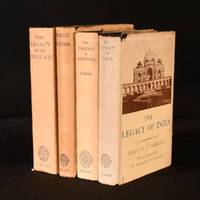
19271001N4Oxford: Clarendon Press 1927-1960. Cloth. Very Good Indeed/Very Good. 7.5" by 5". Various. Four scholarly works published by Oxford University's prestigious Clarendon Press including classics from Aristotle and Hobbes as well as essays on historical legacy. Four charming works from Oxford University's Clarendon Press including scarce impressions published between 1926-1960.In the publisher's original cloth in the original clipped dust wrappers.Renowned for its scholarly excellence a work published by the Clarendon Press is an authoritative marker for showing a work is academically rigorous. These four volumes include classics within political philosophy Aristotle and Hobbes as well as essays on the historical legacy of the Middle Ages and India.- The Legacy of the Middle Ages edited by C.G. Crump and E.F. Jacob. An early impression first published in 1926. Contains a frontispiece as well as all forty-one other illustrated plates. Collated complete. 1927.- Hobbes's Leviathan reprinted from the edition of 1651 with an essay by the late W.G. Pogson Smith. A scarce impression first published in 1909. Contains one illustrated plate of the iconic decorative title leaf from the original work. 1929.- The Legacy of India edited by G.T. Garratt with an introduction by the Marquess of Zetland. An early reprint first published in 1937. Contains a frontispiece a folding map of Indian and Levant trade routes to the rear and all other twenty-three illustrated plates. Collated complete. 1938.- The Politics of Aristotle translated with notes by Ernest Barker. The shortened edition. A scarce impression first published in 1948. 1960. In the publisher's original cloth in the original clipped dust wrappers. Externally very smart with the odd small mark minimal to Aristotle a little heavier to rear board of India. Slight bumping to the heads and tails of the spine and to the extremities. Dust wrappers are generally bright and clean with signs of browning and fading heavier to India. The odd small mark to rear of India wrapper. Slight edgewear with the odd small chip to the head and tail of wrapper spines and to the extremities a little heavier to India. End papers are bright and mostly clean with the odd faint spot to India and the odd small mark to Leviathan lighter to Middle Ages. Bookseller's stamp to rear pastedown of Middle. Ink inscriptions to front free end papers of Middle Ages and Leviathan. Internally firmly bound. Pages are bright and clean with minor age toning to India extremities. Very Good Indeed Clarendon Press hardcover
1993__3050017961Akademie-Verlag 1993. Hardcover. New. 1326 pages. German language. 9.44x6.69x2.83 inches. Akademie-Verlag hardcover
19912-3050006501Akademie-Verlag 1991. Hardcover. New. 390 pages. German language. 9.75x6.75x1.00 inches. Akademie-Verlag hardcover