6 résultats
1769RO40210566A Amsterdam. 1769. In-12. Relié plein cuir. Etat passable, 2ème plat abîmé, Dos abîmé, Fortes mouillures. 566 pages. Auteur, titre, tomaison, fleurons, caissons et filets dorés sur le dos. Manque important sur le dos. Petits manques sur le 2e plat. Page de titre abîmée. Nombreuses pages collées par l'humidité.. . . . Classification Dewey : 94.3-Livres anciens XVIII ème
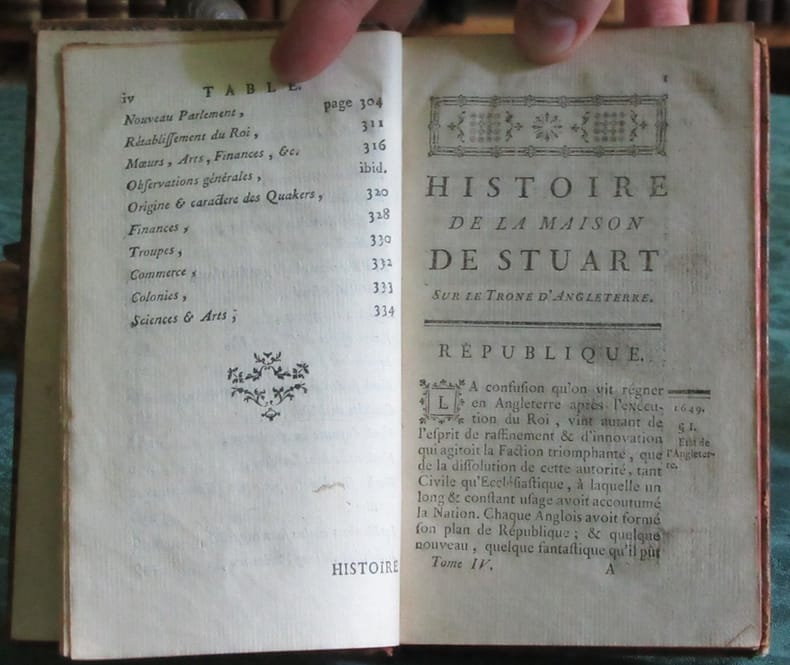
17650266Amsterdam, sans mention d'éditeur, 1765 et 1769. Deux tomes de l'Histoire d'Angleterre de Hume, sur les six consacrés aux Plantagenet. Traduit par Mme Belot (née Octavie Guichard, devenue Octavie Guichard Durrey de Meinières) avec des révisions de l'auteur. In-12, 163 x 108 mm, 431 et 401 pp. Reliés cuir d'époque. Reliure demi-tabac à coins, dos à 4 nerfs pour le tome 3 avec dos et plats frottés, plein cuir avec dos à 5 nerfs soulignés, entreparcourus de fleurons, avec pièce de titre maroquin rouge et tomaison pour le tome 4. Tomes à tranches jaspées, à l'image des contreplats et pages de garde, fourni avec une protection plastique. Le tome III s'étend des chapitres IX (sur Henri II) à XII, qui se conclut avec la mort de Richard III. Le tome IV, qui commence avec une liste des chapitres des trois premiers tomes et recommence le chapitrage, va d'Henri III à l'an 1307.
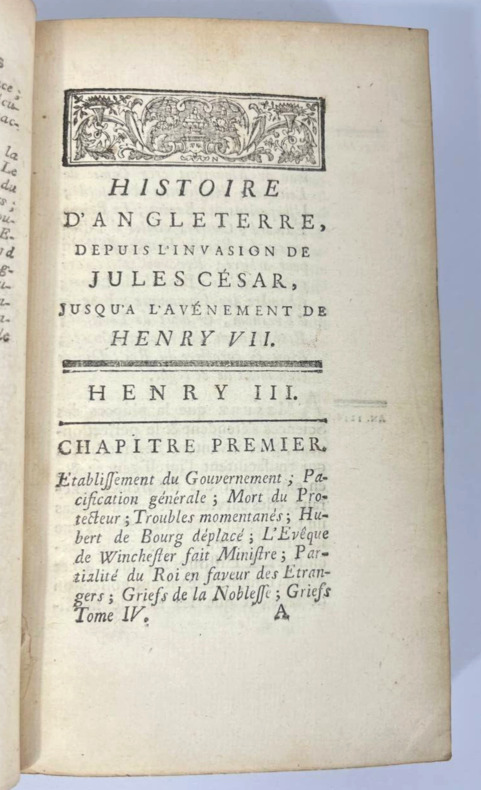
176119996David Hume (1711-1776) avocat puis philosophe, accompagna l'ambassadeur Saint Clair à Viennes, à Turin puis Lord Herford, ambassadeur en France. Son histoire de l'Angleterre est remarquable, elle se décompose en trois périodes: les Plantagenet, les Tudor, les Stuart.A Londres, non nommé - 1761. Tampons ex-libris.Reliure plein veau marbré de l'époque. Dos lisse orné et doré avec pièces de titre rouges et de tomaison fauves. Tranches rouges. Petits accidents aux coiffes et aux dos des tomes 1 et 5. Coins émoussés. Mouillures marginales au T3. Tampons. Pas de rousseur. Bon état. Format in-12°(17x10).
176383261763 6 volumes, reliure plein veau marbré havane in-octavo, dos long - entre-nerfs à fleuron au centre avec des petits fers isolés en remplissage et des feuillages exécutés aux filets courbes aux angles - pièce de titre sur fond bleu-marine et pièce de tomaison sur fond grenat, tranches peignées, coiffes supérieures légèrement défraîchies, 391+420+466+371+503+455 pages, 1763 à Londres,
1763R300124907A AMSTERDAM. 1763. In-4. Relié plein cuir. Bon état, Couv. convenable, Dos à nerfs, Intérieur frais. 554 pages + 515 pages - contre plats jaspés - filets dorés sur les plats - dos à 5 nerfs - titre, tomaison et caissons dorés sur le dos - ouvrages en bon état - 2 photos disponibles.. . . . Classification Dewey : 840.05-XVIII ème siècle
17971044281797. First Edition. HUME David. Commentaries on the Law of Scotland Respecting the Description and Punishment of Crimes. Two Volumes. WITH: Commentaries on the Laws of Scotland Respecting Trial For Crimes. Two volumes. WITH: Supplemental Notes to Mr. Hume's Commentaries on the Law of Scotland Respecting Crimes. Edinburgh: Printed for Bell and Bradfute and for E. Balfour for first two works 1797 1800 1814. Five volumes altogether. Large quarto contemporary full brown calf raised bands red and black morocco spine labels. $6500.First edition of Baron Humes groundbreaking authoritative Commentaries on the Description and Punishment of Crimes the standard work on Scottish criminal law DNB together with first edition of his two-volume Commentaries on Trial for Crimes and exceedingly scarce first edition of his Supplemental Notes. Rarely found together a seminal five-volume work by the nephew of philosopher David Hume laying the foundations of our modern criminal law"" uniformly bound in contemporary calf.""A landmark event in Scottish legal history occurred in 1797 when Baron David Hume published his Commentaries on the Law of Scotland Respecting the Description and Punishment of Crimes"" Hewitt Symbolic Interactions 1. A revered Professor of Scots Law at University of Edinburgh with achievements that include his appointment as Baron of the Scots Exchequer in 1822 Baron Hume was ""influenced by the views of his uncle David Hume the philosopher with whom he had a close friendship. The elder had supervised his education"" Criminal Law 47n. Baron Hume ""laid the foundations of our modern criminal law"" British Justice Hamlyn Lectures. This rare complete five-volume set of Commentaries including the rarely found Supplemental Notes provides ""the classic statement of Scottish criminal law"" Kilday Women and Violent Crime 32. With this groundbreaking ""standard work on Scottish criminal law"" DNB Baron Hume ""carried the torch into all the recesses of actual practice. He not only made himself familiar with all the scattered matter that had been published though much of it lay hid in places not commonly explored; but he was the very first who went systematically to the records"" Edinburgh Review 83:197. To Sir Walter Scott Baron Hume was ""an architect to the law of Scotland' Scott on Himself 42. Hume's lectures at the University of Edinburgh provided the basis of these works.To his contemporaries the Commentaries and Hume's authoritative research into ""the rise and progress of this law will ever be held to communicate the most philosophical views of the criminal law in a popular and perspicuous manner"" Edinburgh Law Journal I:485. Hume importantly highlights as well ""the differences between Scottish and English laws shaping the former into a symbol of cultural and national identity for England's 'bloody code' of hundreds of offenses punishable by death did not extend to Scotland. The differences were celebrated in Hume's Commentaries"" Hewitt 52 44. ""The first study of judicial decisions"" in Scottish criminal law Commentaries has been officially ""afforded 'authoritative' status"" Gibb & DuffCriminal Justice Systems 7. Hume particularly focused on common law. Like ""Blackstone and Bentham in England Kames and Hume in Scotland were intensely engaged by the question of whether and how the common-law system of maintaining continuity through precedent and of accommodating change through reinterpretation could meet the demands of 18th- and early 19th-century Britain As Farmer explains 'The belief that the law matured in the late 18th century taking the form of liberal and flexible principles was set out clearly for the first time by Hume. Hume affirms the sense that the past had been leading more progressively to a more enlightened present A lasting result of Hume's book and its outlook . strongly implies the autonomy of criminal law from the rest of culture"" Bardsley Belief and Beyond 235-239. ""Indeed Hume still has high status in Scottish legal history. According to Walker . 'his examination based on primary sources is invaluable"" Bardsley Yale Journal of Law & the Humanities V14 2002:238-9 20-21n. Commentaries 1797 with title page imprints ""Edinburgh: Printed for Bell & Bradfute Booksellers to the Faculty of Advocates; And for E. Balfour."" ""Another issue of this work appeared in 1797 with the imprint: Edinburgh: printed for Bell & Bradfute; and E. Balfour"" ESTC T98602: no priority established. Harvard Law Catalogue I:967. Marvin 405. Edinburgh Review 139:267. ESTC T98600; T98602; T98601. See NYU Catalogue 251. Interior fresh and clean only light edge-wear minor rubbing to spine labels of boards. A near-fine set rarely found complete and uniformly bound in contemporary calf. hardcover