[sans auteur] - [PELLISSON FONTANIER (Paul)].Livre Rare Book
28 résultats
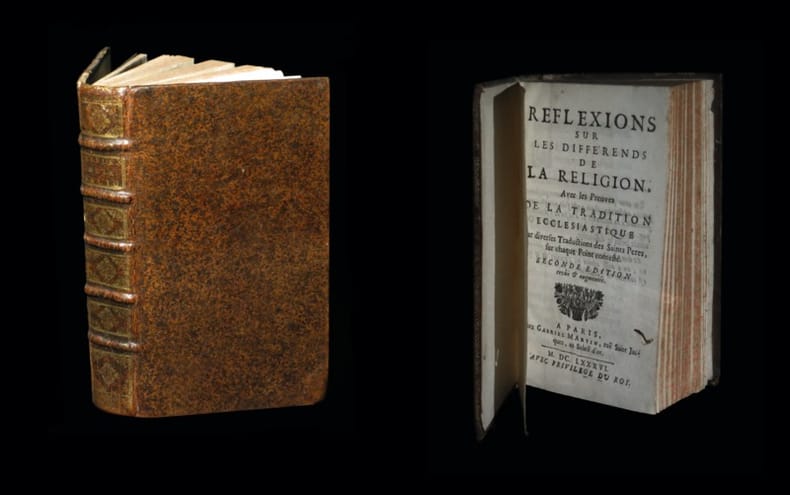
168625828A Paris, chez Gabriel Martin, 1686. 3 parties reliées en un vol. au format in-12 (164 x 98 mm) de 10 ff. n.fol., 154 pp. et 1 f. bl. ; 164 pp. et 111 pp. Reliure de l'époque de plein veau glacé et moucheté havane, plats jansénistes, dos à nerfs orné de filets gras à froid, roulette dorée sur les nerfs, caissons d'encadrement dorés, larges fleurons dorés, titre doré, palette dorée en tête et queue, roulette dorée sur les coupes, tranches jaunes et mouchetées.
167294271Akademie-Verlag 1672-01-01. Hardcover. Very Good. Very Good in Good dust jacket; Hard Cover; Akademie-Verlag; 1672; 0 Akademie-Verlag hardcover
1691614611691. Acta Eruditorum 1691/ 19. - Leipzig Grossium & Gleditsch Januar September 1691 4° 48 pp. 2 Kupferstichtafeln; pp.401-448 feiner Pappband. Erstdruck! "Papin behauptete nun in Mechanicorum de viribus motricibus sententia Acta erud. Jan. 1691 S.6-13 dass ein Effekt weder durch den zurückgelegten Weg noch durch die Zeitdauer der Bewegung sondern allein durch den zu überwindenden Widerstand gemessen wird. Als Konsequenz daraus verneinte er u. a. die Möglichkeit einer vollständigen Übertragbarkeit der Kraft. In seinem folgenden Beitrag De legibus naturae et vera aestimatione virium motricium contra Cartesianos Acta erud. Sept. 1691 S. 439-447 versuchte Leibniz Papins Argument der Nichtübertragbarkeit der gesamten Kraft eines Körpers auf einen anderen zu entkräften. Durch ein Gedankenexperiment erbrachte Leibniz den Nachweis einer vollständigen Kraftübertragung von einem Körper mit größerer auf einen mit kleinerer Masse. Nach Leibniz lagen gleiche Kräfte dann vor wenn eine gleiche Anzahl von elastischen Federn mit gleicher Spannkraft in den gleichen Spannungszustand elastischen Federn mit gleicher Spannkraft in den gleichen Spannungszustand überführt werden konnten. Zur Bestimmung des Kraftmaßes dürften nur solche Effekte herangezogen werden bei denen die Kraft die aufgenommen wurde auch wieder abgegeben werden könne wie etwa bei gespannten Federn oder bei erstiegenen Fallhohen im Schwerefeld." Gottfried Wilhelm Leibniz Sämtliche Schriften und Briefe III 7.Bd. 2011 pp.LII-LIII Ferner enthalten: Bernoulli Jacobus: Specimen calculi differentialis in dimensione parabolae helicoidis pp.13-23 Tab. I: Fig.4-8. Leibniz Gottfried Wilhelm : De solutionibus problematis catenarii vel funicularis pp.435-439. Enthält Leibniz' Lösung der Catenaria unter Zuhilfenahme seines Kalküls d.h. die Bestimmung der Gestalt eines biegsam an zwei Punkten frei aufgehängten Seils. unknown
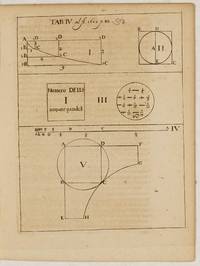
1683539821683. Acta Eruditorum 1683/10. - Leipzig Grossium & Gleditsch Oktober 1683 4° pp.417-464 1 Holzschnitt 2 Kupferstichtafeln feiner Pappband. Erstdruck! Mathematik Statistik und Versicherung - "Auch selbst hat sich Gottfried Wilhelm Leibniz 1646-1716 eingehend mit Fragen der Versicherungsmathematik insbesondere des Barwertes des Gesundheitswesens und der Statistik befaßt. Er forderte die jährliche Veröffentlichung von Geburts- und Sterbelisten im Interesse des Ausbaus der Personenversicherung. Außerdem dachte er an eine "Reservekasse als Nothpfennig für Witwen und Waisen" wofür jedem Beamten von seiner Besoldung jeweils ein bestimmter Betrag abgezogen werden sollte um die Hinterbliebenen vor dem äußersten Ruin und Armut nach dem Tode des Ernährers zu schützen. Dem weiteren Fortschritt des Versicherungswesens kam schließlich außer der Erfindung seiner Rechenmaschine die Entwicklung der Zinseszinsrechnung zu statten die er 1683 in der damaligen Gelehrtenzeitschrift "Acta Eruditorum" veröffentlichte." Peter Koch Geschichte der Versicherungswissenschaft in Deutschland: Aus Anlass seiner . 1998 pp.61-62 "A detailed legal and economic apologia for the principle of discounting with compound interest is to be found for the first time in the works of Gottfried Wilhelm Leibniz in 1682. He shows that the calculation of capital values follows from three self-evident legal maxims for the premature redemption of a debt. Compound interest is a result of the reinvestment of money released from an investment. And that is why the discussion on whether compound interest is usury was bound to lead to the discovery of the reinvestment premises in investment accounting procedures." Hans Pohl & Bernd Rudolph Ed.: German Yearbook on Business History 1985 p.32 Ferner findent sich in diesem Monatsheft von Ehrenfried Walther von Tschirnhaus 1651-1708 seine "Methodus datae figurae aut quadraturam aut impossibilitatem ejusdem quadraturae determinandi pp.433-437 1 Holzschnitt. Ravier 88 unknown
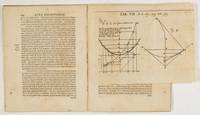
1691614691691. Acta Eruditorum 1691/ 6. - Leipzig Grossium & Gleditsch Juni 1691 4° pp.249-304 3 Kupferstichtafeln feiner Pappband. Erstdrucke dieser sehr wichtigen Arbeiten! 1. Leibniz Gottfried Wilhelm: De linea in quam flexile se pondere proprio curvat ejusque usu insignia ad inveniendas quotcumque medias proportionales & logarithmos. pp.277-281 Tab. VII . Leibniz löst hier das 1690 von Jakob Bernoulli gestellte Problem der Kettenlinie 2. Bernoulli Johann: Solutio problematis funicularii pp.274-276 Tab. VI Fig.1-4. Erste eigenständige Veröffentlichung von Johann Bernoulli. Er beschäftigt sich hier mit der logarithmischen Spirale die er auch wunderbare Spirale "spira mirabilis" nannte. Die vorliegende Arbeit stellt den Beginn der Lehre von den elliptischen Integralen dar. 3. Huygens Christian: Dynastæ in zulechem solutio ejusdem problematis pp.281-282 Tab. VII Fig.2. Hier Huygens' Lösung der Catenaria ohne Zuhilfenahme der Infinitesimalrechnung 4. Bernoulli Jacob: Specimen alterum calculi differentialis in dimetienda spirali ali logarithmica loxodromiis naturarum & areis triangulorum sphæricorum pp.282-29 Tab. VIII. In dieser grundlegenden Arbeit gelingt es Jakob Bernoulli durch die konsequente Einführung der Polarkoordinaten in die Analysis eine Theorie der Evoluten der Kata- und Diakaustiken und der Elastica aufzustellen. Ravier 110 unknown
168345599Leipzig, Grosse & Gleditsch, 1683. 4to. Without wrappers. In: ""Acta Eruditorum Anno MDCLXXXIII"", No.III + X (March and October issues). Pp. 81-128 + pp. 417-464 a. 2 engraved plates. (Entire issues offered). Tschirnhaus's papers: pp. 122-124 + pp. 433-437. Some browning as usual.
168345599Leipzig Grosse & Gleditsch 1683. 4to. Without wrappers. In: "Acta Eruditorum Anno MDCLXXXIII" No.III X March and October issues. Pp. 81-128 pp. 417-464 a. 2 engraved plates. Entire issues offered. Tschirnhaus's papers: pp. 122-124 pp. 433-437. Some browning as usual. <br/><br/><em>First appearance of Tschirnhaus's two papers in which he used infinitisimal methods which were very close to Leibniz's method and where he tried to lay down criteria for rational quadratures in the case of conic cubic and quadratic curves papers that led Leibniz to publish his first paper on the differential calculus the "Nova Methoda" in the Acta for 1684 in order to secure his priority over Tschirnhaus concerning the calculus. Leibniz discovered when he read Tschirnhaus' papers that Tschirnhaus had here published results showing similarity with Leibniz's invention of the calculus as he had confided to Tschirnhaus earlier during their Parisian stay and this without references to Leibniz.The second issue contains an original paper by LEIBNIZ: "Meditatio Juridico-Mathematica de Interusurio simplice". Pp. 425-32. </em> unknown
1682600581682. Acta Eruditorum 1682/ 2. - Leipzig Grossium & Gleditsch Februar 1682 4° pp.33-56 1 Kupferstichtafel feine Broschur. First Edition! This was Leibniz first article published in Acta Eruditorum; He deals with mensuration and describes the Leibniz series 1-1/31/5-1/7.=pi/4. Gottfried Wilhelm Leibniz's 1646-1716 Hannover appointment in the Hanoverian service gave him more time for his favourite pursuits. He used to assert that as the first-fruit of his increased leisure he invented the differential and integral calculus in 1674 but the earliest traces of the use of it in his extant note-books do not occur till 1675 and it was not till 1677 that we find it developed into a consistent system; it was not published till 1684. Most of his mathematical papers were produced within the ten years from 1682 to 1692 and many of them in a journal called the Acta Eruditorum founded by himself and Otto Mencke in 1682 which had a wide circulation on the continent. He was one of the true geniuses of modern history. Although his contributions to the development of differential calculus remain his greatest legacy his definition of identity and his work in establishing a formal notation for all mathematics provided the foundation for others like Peano nearly two hundred years later. Ravier 84 unknown
170046424Hannover, Nicolai Förster, 1700 - Leipzig, Nicolai Förster, 1698. 4to. Contemp. full calf. Raised bands, richly gilt spine. (16),315,40,124,119 pp. Tome 2: (12),292,592 pp. First titlepage and Praefatio (16) leaves a bit browned, otherwise clean with only a few scattered brownspots. Some neath marginal notes in 2 contemporary hands.
169230269Paris Jean Anisson 1692. Small8vo. Cont. full mottled calf. Very skillfull rebacked in old style. Gilt titlelabel in leather on back. All edges gilt. 81472185 pp. First and last leaves slightly browned in margins otherwise fine printed on good paper. <br/><br/><em>The scarce first edition of Leibnitz' important work on the tolerance of religions. Leibnitz was interested in the question of religious controversy all of his life and already at a young age he studied Laurentius Valla and Luther. According to Leibnitz one of the resons for religious controversy and dispute lies in the lack of adequate method for discussing and debating such questions. He reflexts thoroughly on the nature of religious controversy. What he means with tolerance of relions is precicely the possibily of discussing religious matters freely on the basis of normative rules that tells us how to conduct the debate. </em> hardcover
169230269Paris, Jean Anisson, 1692. Small8vo. Cont. full mottled calf. Very skillfull rebacked in old style. Gilt titlelabel in leather on back. All edges gilt. (8),147,(2),185 pp. First and last leaves slightly browned in margins, otherwise fine, printed on good paper.
169441704Leipzig, Grosse & Gleditsch, 1694. 4to. Contemp. full vellum. Faint handwritten title on spine. a small stamp on titlepage. In: ""Acta Eruditorum Anno MDCXCIV"". (2),518 pp.. and 11 folded engraved plates. As usual with various browning to leaves and plates. The entire volume offered. Leibniz's papers: pp. 311-316, pp. 364-375. - Johann Bernoulli's papers: pp. 200-206, pp. 394-99, pp. 435-437, pp. 437-441. - Huygen's papers: pp. 338, pp. 339-41. - Jakob Bernoulli's papers: pp. 262-276, pp. 276-280, pp. 336-338, pp. 391-400. Some mispaginations.
169441704Leipzig Grosse & Gleditsch 1694. 4to. Contemp. full vellum. Faint handwritten title on spine. a small stamp on titlepage. In: "Acta Eruditorum Anno MDCXCIV". 2518 pp. and 11 folded engraved plates. As usual with various browning to leaves and plates. The entire volume offered. Leibniz's papers: pp. 311-316 pp. 364-375. - Johann Bernoulli's papers: pp. 200-206 pp. 394-99 pp. 435-437 pp. 437-441. - Huygen's papers: pp. 338 pp. 339-41. - Jakob Bernoulli's papers: pp. 262-276 pp. 276-280 pp. 336-338 pp. 391-400. Some mispaginations. <br/><br/><em>All papers first appearance dealing with and clarifying the problems and the new applications of Leibniz' inventions of the differential- and integral calculus.In the papers Leibniz shows how to reduce linear first order ordinary differential equations to quadratures. I the other paper he gives a general method of finding the envelope of a family of curves which helped to spread the theory of plane curves.In the groundbreaking paper offered here Jakob Bernoulli introduces THE LEMNISCATE a symmetric self-intersecting curve resembling a figure eight and defined by the condition that the product of the distance of anay point on the curve from two fixed points is d/22 where d is the distance between the fixed points."Jacob Bernoulli was fascinated by curves and the calculus and one curve bears his name - the "lemniscate of Bernoulli" given by the polar equation r2=a cos 2"0". The curve was described in the Acta Eruditorum of 1694 as resembling a figure eight or a knotted ribbon lemniscus. However the curve that most caught his fancy was the logarithmic spiral.he swowed that it had several strioking properties not noted before.it is easy to appreciate the feeling that led Bernoulli to request that the "spira mirabils" be engraved on his tombstone together with the inscription "Eadem mutata resurgo" Though changed I arise again the same." Boyer in his History of Mathematics. </em> hardcover
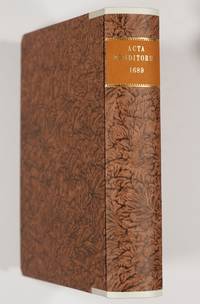
1689614461689. Acta Eruditorum 1689. - Leipzig Grossium & Gleditsch 1689 4° 8 653 7 pp. mit 15 z.T. gefalt. Kupfertafeln feiner Pappand im Stil d.Zt.: frisches Expl. First printing of these extremely important papers in which Gottfried Wilhelm Leibniz 1646-1716 claimed that he independently of Newton had discovered the principal propositions of his "Principia" and which present us with Leibniz's fundamental physico-mathematical theory his dynamics his concepts of force space and time. 1. : De Lineis Opticis et alia; Excerpta ex literis ad pp.36-38 Tab. I Fig. 1 2. : Schediasma de Resistentia Medii Motu projectorum gravium in medio resistente pp.38-46 Tab. I Fig. 2-4. 3. : Tentamen de Motuum Coelestium causis pp.82-96 Tab.II Fig. 1. 4. : De Linea Isochrona in qua grave sine acceleratione descendit & de controversia cum Dn. Abbate D.C. pp.195-198 Tab. IV Fig. 3. The "Tentamen." constitutes Leibniz's response to Newton's theories about the motion of the celestial bodies. Leibniz can be said to have anticipated the modern mathematical principle of relativity as it is his idea of individual co-ordinate systems and his practical rejection of the Galilean co-ordinate system that Newton adopted. Leibniz opposes Newton's ideas of attractions gravitational forces and calls them "occult qualities". The task of the "Tentamen." was to attain a theory mathematically equivalent to Newton's in accounting for planetary motion and especially for the inverse-square law of Kepler's laws but physically sound and capable of explaining the causes of phenomena. Newton attacked Leibniz's claim of priority in his anonymously published paper "Commercium epistolicum" Phil. Transactions 1714 and states that "in those tracts the principal propositions of that book are composed in a new manner and claimed by Mr. Leibniz as if he had found them himself before the publishing of the said book. But Mr. Leibniz cannot be a witness in his own cause. It lies upon him either to prove that he had found them before Mr. Newton or to quit his claim." The features of Leibniz's mathematical representation of motion as put forward in "Tentamen." are -Empty space does not exist. The world is filled with a variety of fluids which are responsible for physical actions including gravity. - Living force and its conservation are the fundamental notion and principle respectively in the investigation of nature however they do not figure prominently in the study of planetary motion. - Finite and infinitesimal variables are regularly employed in the study of motion and of other physical phenomena. Living force and velocity are finite; solicitation and conatus are infinitesimal. - Accelerated motion whether rectilinear or curvilinear is represented as a series of infinitesimal uniform rectilinear motions interrupted by impulses. I call this 'polygonal representation'. Usually the polygon is chosen in such a way that each side is traversed in an equal element of time dt. In polygonal representations accelerations are reduced to a macroscopic phenomenon. - Propositions are often used to safeguard dimensional homogeneity. Constant factors - such as numerical factors mass and the element of time - are usually ignored in the calculations. -cf. D.B. Meli: Equivalence and Priority. Newton versus Leibniz. pp. 90-91. Further we find in this important volume following Papers by Denis Papin - 1. : Descriptio Torcularis cujus in Actis Anni 1688 pag. 646 mentio facta a suit. pp. 96-101 Tab. II Fig. 2 2. : De Gravitatis Causa et proprietatibus Observationes pp.183-188. 3. : Examen Machinæ Dn. Perrault pp.189-195 Tab. IV Fig. 1-3. 4. : Rotatilis Suctor et Pressor Hasciacus in Serenissima Aula Cassellana demonstratus & detectus pp.317-322 Tab. VII Fig. 3-6. This paper describes and depicting Papin's famous invention of the CENTRIFUGAL PUMP 5.: In J.B. Appendicem Illam Ad Perpetuum Mobile Actis Novemb.A. 1688 p. 592. pp.322-324. 6. : Excerpta et Litteris Dn. Dion Papini ad --- de Instrumentis ad flammam sub aqua conservandam pp.485-489 Tab. XI Fig. 2-3. - and 3 papers by Jakob Bernoulli: 1. : De Invenienda Cujusque Plani Declinatione ex unica observatione projectæ a flylo umbræ pp.311-316 Tab. VII Fig. 1-2. 2. : Bernoulli Jakob : Vera Constructio geometrica Problematum Solidorum & Hypersolidorum per rectas lineas & circulos pp.454-459 Tab. X. 3.: Bernoulli Jakob : Novum Theorema Pro Doctrina Sectionum Conicarum. pp.586-588 Tab. XIV. See - Thomas Sonar : The History of the Priority Dispute between Newton and Leibniz: Mathematics . 2018 Ravier 101102103104 unknown
169642863Leipzig, Grosse & Gleditsch, 1696. 4to. Entire volume present. Nice contemporary full vellum. Small yellow paper label pasted to top of spine and library-label to front free end-papers. Internally some browning and brownspotting. Overall a nice and tight copy. [Bernoulli paper:] pp. 264-69. [Leibniz-paper:] pp. 45-47. [Entire volume: (2), 603, (1) pp. + plates].
169642863Leipzig Grosse & Gleditsch 1696. 4to. Entire volume present. Nice contemporary full vellum. Small yellow paper label pasted to top of spine and library-label to front free end-papers. Internally some browning and brownspotting. Overall a nice and tight copy. Bernoulli paper: pp. 264-69. Leibniz-paper: pp. 45-47. Entire volume: 2 603 1 pp. plates. <br/><br/><em>First printing of the famous 1696-edition of Acta Eruditorum in which Johann Bernoulli published a challenge to the best mathematicians:"Let two points A and B be given in a vertical plane. To find the curve that a point M moving on a path AMB must follow such that starting from A it reaches B in the shortest time under its own gravity."Johann adds that this curve is not a straight line but a curve well known to geometers and that he will indicate that curve if nobody would do so that year. Later that year Johann corresponded directly with Leibniz regarding his challenge. Leibniz solved the problem the same day he received notice of it and almost correctly predicted a total of only five solutions: from the two Bernoullis himself L'Hospital and Newton. Leibniz was convinced that the problem could only be solved by a mathematician who mastered the new field of calculus. Galileo had formulated and given an incorrect solution to the problem in his Dialogo. But by the end of the year Johann had still not received any other solutions. However Leibniz convinced Johann that he should extend the deadline to Easter and that he should republish the problem. Johann now had copies of the problem sent to Journal des sçavans the Philosophical Transactions and directly to Newton. Earlier that year Johann had accused Newton for having filched from Leibniz' papers. Manifestly both Johann and Leibniz interpreted the silence from June to December as a demonstration that the problem had baffled Newton. They intended now to demonstrate their superiority publicly. But Newton sent a letter dated Jan. 30 1697 to Charles Montague then president of the Royal Society in which he gave his solution and mentioned that he had solved it the same day that he received it. Montague had Newton's solution published anonymously in the Philosophical Transactions. However when Bernoulli saw this solution he realized from the authority which it displayed that it could only have come from Newton Bernoulli later remarked that he 'recognized the lion by its claw'. The present volume contains the following articles of interest:Jakob Bernoulli: 1 Observatiuncula ad ea quaenupero mense novembri de Dimensionibus Curvarum leguntur.2 Constructio Generalis omnium Curvarum transcendentium ope simplicioris Tractoriae et Logarithmicae.3 Problema Beaunianum universalius conceptum.4 Complanatio Superficierum Conoidicarum et Sphaeroidicarum.Johann Bernoulli5 Demonstratio Analyticea et Syntetica fuae Constructionis Curvae Beaunianae.6 Tetragonismus universalis Figurarum Curvilinearum per Construitionem Geometricam continuo appropinquantem.Tschirnhaus7 Intimatio singularis novaeque emendationis Artis Vitriariae.8 Responsio ad Observationes Dnn. Bernoulliorum quae in Act. Erud. Mense Junio continentur.9 Additio ad Intimationem de emendatione artis vitriariae. </em> hardcover
1690NF2365REFLEXIONS SUR LES DIFFERENTS DE LA RELIGION troisiESme VOLUME. Ou Les chimEres de M. Jurieu RESPONSE GENERAL A SES LETTRES PASTORALES DE LA SECONDE ANNEE CONTRE LE LIVRE DES REFLEXIONS ET EXAMEN ABREGE DE SES PROPHETIES A Paris Chez Gabriel Martin 1690 first and only edition 12 mo 18 pp. 260 pp. 4pp. bound with DE LA TOLERANCE DES RELIGIONS. LETTRES DE M. DE LEIBNIZ ET RESPONSES DE M. PELLISON: OU QUARTRIEME PARITE DE REFLEXIONS SUR LES DIFFERENDS DE LA RELIGION A Cologne de l'Imprimerie d'Andre Pierrot 1692 206 pp. 2 pp. a tight vg copy bound in the publishers original vellum with the bookplate of Giorgio Di Veroli. Gabriel Martin & Andre Pierrot hardcover
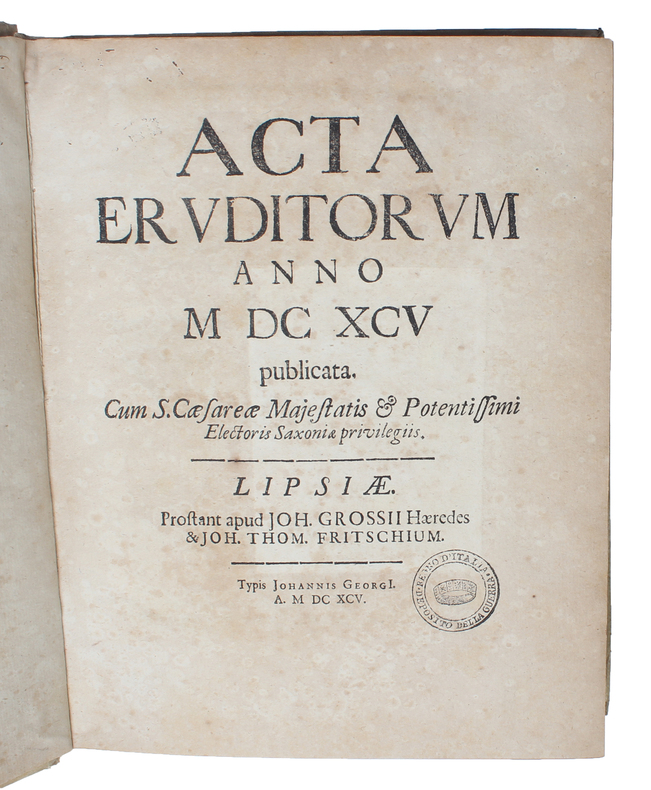
169542860Leipzig, Grosse & Gleditsch, 1695. 4to. Contemp. full vellum. Faint handwritten title on spine. A small stamp on titlepage and pasted library label to pasted down front free end-paper. In: ""Acta Eruditorum Anno MDCXCV"". (2), 560, (52) pp. + 10 plates. As usual with various browning to leaves and plates. The entire volume offered. Leibniz's papers: pp. 145-57" 184-185 310-316 369-372 493-495. Jacob Bernoulli's paper: pp. 537-553 + one folding table 65-66. Johann Bernoulli's: pp. 59-65" 374-376.
169542860Leipzig Grosse & Gleditsch 1695. 4to. Contemp. full vellum. Faint handwritten title on spine. A small stamp on titlepage and pasted library label to pasted down front free end-paper. In: "Acta Eruditorum Anno MDCXCV". 2 560 52 pp. 10 plates. As usual with various browning to leaves and plates. The entire volume offered. Leibniz's papers: pp. 145-57; 184-185; 310-316; 369-372; 493-495. Jacob Bernoulli's paper: pp. 537-553 one folding table; 65-66. Johann Bernoulli's: pp. 59-65; 374-376. <br/><br/><em>First printing of a series of influential papers by Leibniz Jacob Bernoulli and Johann Bernoulli.First publication of Jakob Bernoulli's famous and influential "Bernoulli Equation". In "Notatiuncula Constructiones Lineae" Bernoulli proposed a solution to non linear equations which today is one of the most common used solutions of the general fluid. Bernoulli equations are significant because they are nonlinear differential equations with known exact solutions. In the "Specimen dynamicum" Leibniz presents a conception of body and force which distinct between primitive and derivative forces and between active and passive forces. This article is regarded as being the clearest exposition of Leibniz' dynamics. DSB VII 151b."The first attempt at a detailed account of the dynamics was a long dialogue the "Phoranomus seu de potentia et legibus naturae" written in July 1689 while Leibniz was in Rome. This was quickly followed be the composition of the massive Dynamica de potential et legibus naturae corporeae 1689-90 . Though it was written with the intention of publication and though Leibniz work at publishing it he never considered it entirely finished and it remained unpublished during his lifetime.The later . he finally revealed some of the metaphysical foundations of the project in an essay the present paper." Garber Daniel. Leibniz: body substance monad. 2009. 132 p."Its title suggests a summary of or a selection from the earlier work . However it actually contains something in a way rather more interesting: a careful exposition of the metaphysical foundations of the new science something that is hard to find in the old Dynamica or any of the more Technical pieces." Garber Daniel. Leibniz: Body Substance Monad. 2009. 133 p. </em> hardcover
169632Hannov. et Gurlpherpit Hannover Wolfenbütte: Gothofredi Freytagii Gottfried Freytag 1696. First edition. Papered spine. Printer’s device on last page. In fine condition. First edition. Papered spine. Printer’s device on last page. 8º; a1–b8 c1–3 .; 37 1 p. <p><br /> Scarce pharmacological work on the ipecacuanha root that can be used as an emetic nauseant expectorant and diaphoretic. <br /> <p><p><br /> “Relatio ad inclytam Societatem Leopoldinam Naturae Curiosorum de novo antidysenterico Americano magnis successibus comprobato†Relation to the Illustrious Leopoldine Society of Naturalists Concerning the New American Anti-Dysentery Drug Attested with Great Success is Leibniz’s most comprehensive and influential contribution to the history of medicine and pharmacy. <br /> <p><p><br /> Leibniz wrote the treatise after he read the study on ipecacuanha root written by Willem Piso and Georg Marggraf published in Historia naturalis Brasilia 1648 and evidently after conducted experiences with the root himself. The root was made famous after it was used successfully to treat the King of France Louis XIV’s dysentery in 1672 by the Dutch physician John Frederick Helvetius 1625–1719. <br /> <p><p><br /> The work has been published in the same year as an appendix to Martin Lister’s “Sex exercitationes medicales de quibusdam morbis chronicis†Frankfurt and Leipzig 1696 and also to “Miscellanea curiosa sive Ephemeridum medico-physicarum Germanicarum†Nuremberg 1696. Lister’s work was printed by Freytag too the difference is merely the lack of the colophon on the “Lister-editionâ€.<br /> <p><p><br /> Ref.: Smith J. E. H.: Divine Machines. Leibniz and the Sciences of Life. Princeton University Press 2011.; Dutens II. 2. pp. 110–119.; Ravier 36.<br /> <p>. Gothofredi Freytagii (Gottfried Freytag) unknown
169141859Leipzig, Grosse & Gleditsch, 1691. 4to. Contemp. full vellum. Faint handwritten title on spine. a small stamp on titlepage. In: ""Acta Eruditorum Anno MDCLXXXXI"". (8),590,(6) pp. and 13 (of 15) folded engraved plates. The 2 first plates lacks, but they do not belong to the papers listed.Leibniz' papers: pp.277-281 a. 1 plate, pp. 435-439. Johann Bernoulli: pp. 274-276 a. 1 plate. Huygens: pp. 281-282. - Jacob Bernoulli: pp. 282-290 a. 1 plate.
169141859Leipzig Grosse & Gleditsch 1691. 4to. Contemp. full vellum. Faint handwritten title on spine. a small stamp on titlepage. In: "Acta Eruditorum Anno MDCLXXXXI". 85906 pp. and 13 of 15 folded engraved plates. The 2 first plates lacks but they do not belong to the papers listed.Leibniz' papers: pp.277-281 a. 1 plate pp. 435-439. Johann Bernoulli: pp. 274-276 a. 1 plate. Huygens: pp. 281-282. - Jacob Bernoulli: pp. 282-290 a. 1 plate. <br/><br/><em>All papers first apperance. All 5 of extreme importence in the development of the Calculus. Leibniz' 2 papers on the catenary curve paper 1-2 offered here was written at the instigation of Jacques Bernoulli. Following the example of Blaise Pascal who had initiated in 1658 a contest for the construction of the cycloid Leibniz also provoked the geometers of his time by challenging them to submit at the fixed date of mid-1691 their geometric method for the construction of the catenary curve. Leibniz later provided the answer followed by Johann Bernoulli and Huygens.'These two papers are a historical account of the origin of the study of this transcendental curve and at the same time the first physical-geometric construction showing the species-relationship between the catenary and the logarithmic curves as two companion curves; one arithmetic the other geometric. All of the differentials of the catenary curve are arithmetic means of corresponding differentials of the logarithmic curve; and all of the differentials of the logarithmic curve are geometric means of the catenary.'"The Catenary is the form of a hanging fully flexible rope or chain the name comes from "catena" which means 'chain' suspended on two points. The interest in this curve originated with Galileo who thought that is was a parabola. Young Christiaan Huygens proved in 1646 that this cannot be the case. What the actual form was remained an open question till 1691 when Leibniz Johann Bernoulli and the then much older Huygens sent solutions to the problem to the "Acta" Jakob Bernoulli 1690 Johann Bernoulli 1691 Huygens 1691 and Leibniz 1691 - these 4 1691-papers offered here - in which the previous year Jakob Bernoulli had challenged mathematicians to solve it. As published the solutions did not reveal the methods but through later publications of manuscripts these methods have been known. Huygens applied with great paper 4 virtuosity the by then classical methods of 17th century infinitesimal mathematics and he needed all his ingenuity to reach a satisfactory solution. Leibniz the papers 1-2 and Bernoulli paper 3 applying the new Calculus found the solutions in a much direct way. In fact the catenary was a test-case between the old and the new style in the study of curves and only because the champion of the old style was a giant like Huygens the test-case can formally be considered as ending in a draw." Grattan-Guiness in "From the Calculus to Set Theory 1630-1910.".The paper by JACOB BERNOULLI no. 5 offered here is a milestone papers as it marks the invention of the "SYSTEM OF POLAR COORDINATES" with points located by reference to a fixed point and a line through that point. Although newton had earlier also devised such a coordinate system in 1671 his work was not known so that the credit for the discovery generally goes to Bernoulli. Parkinson Breakthroughs 1691.Further papers contained in this volume of Acta Eruditorum:DENYS PAPIN: Mecanicorum de Viribus Motricibus sententia asserta a D. Papino adversius C.G.G. L. Leibniz objectiones. pp. 6-13. The plate lacks. - and Dion. Papini Observationes quaedam circa materias ad Hydraulicam spectantes. Pp. 208-213 a. 1 plate. This importent paper is part of the LEIBNIZ-PAPIN-CONTROVERSY.JACOB BERNOULLI: Specimen Calculi Differentialis in dimensione Parabolæ helicoidis ubi de flexuris curvarum in genere carundem evolutionibus. Pp. 13-22. The plate lacks. - and J.B. Demonstratio Centri Oscillationis ex Natura Vectis reperta occassione eorum quæ super hac materia in Historia Literaria Roterodamensi recensentur articulo.Pp.317-321.LEIBNIZ: O.V.E. Additio ad Schediasma de Medii Resistentia publicatum in Actis mensis Febr. 1889. Pp. 177-178. and O.V.E. Quadratura Arithmetica Communis Sectionum Conicarum quæ centrum babent.Pp. 178-182 a. 1 plate.TSCHIRNHAUS: Singularia Effecta Vitri Caustici bipedalis quod omnia magno sumtu hactenus constructa specula ustoria virtute superat per D.T. Pp. 517-520 </em> hardcover
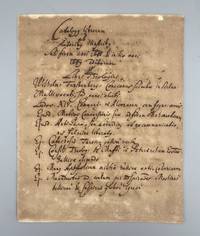
170002965Germany 1700. A single quire unbound evidence of earlier sewing. <p>      LEIBNIZ’S CATALOG OF FIFTY-TWO IMAGINARY BOOKS satirizes European political and military maneuvering in 1688-9 at the outset of the Nine Years’ War. The text was printed in Latin this version and in Latin and German. Together three editions survive in four examples all in German-speaking countries.<br />       Leibniz 1646-1716 grouped the works into theology eighteen law eight medicine ten and philosophy fourteen and closed with two “forthcoming publicationsâ€. The titles’ scholarly veneer hardly disguises his harsh view of contemporary politics. This manuscript copy was likely made between 1691 and 1716 while Leibniz was librarian at Wolfenbüttel then the largest library north of the Alps. Browned the inner bifolium less so.</p> unknown
16962447Leipzig: Gross & Fritsch 1696. First edition. vellum marbled boards. Very Good. FIRST PRINTINGS OF THE PAPERS DOCUMENTING THE PROPOSAL AND SOLUTION OF THE "BRACHISTOCHRONE PROBLEM" ONE OF THE MOST FAMOUS MATHEMATICAL CHALLENGES AND ONE OF THE EARLIEST PROBLEMS POSED IN THE CALCULATION OF VARIATIONS. The challenge of the brachistochrone "began in June of 1696 when Johann Bernoulli published a challenge problem in Leibniz's journal Acta Eruditorum. Obviously a legacy of public challenge remained from the days of Fior and Tartaglia. Although contests were now conducted in the sedate pages of scholarly journals they retained their power to make or break reputations as Johann himself observed:<br /> <br /> '. it is known with certainty that there is scarcely anything which more greatly excites noble and ingenious spirits to labors which lead to the increase of knowledge than to propose difficult and at the same time useful problems through the solution of which as by no other means they may attain to fame and build for themselves eternal monuments among posterity.'<br /> <br /> "Johann's particular challenge was a good one. He imagined points A and B at different heights above the ground and not lying one directly above the other. There is certainly an infinitude of different curves connecting these two points from a straight line to an arc of a circle to any number of other wavy undulating paths. Now imagine a ball rolling from A down to B along such a curve. The time it take to complete the trip depends of course on the curve's shape. Bernoulli challenged the mathematical world to find that one particular curve AMB along which the ball will roll the shortest time. He called this curve the 'brachistochrone' from the Greek words for 'shortest' and 'time'.<br /> <br /> "An obvious first guess is to take AMB as the straight line joining A and B. But Johann cautioned against this simplistic approach:<br /> <br /> '. to forestall hasty judgment although the straight line AB is indeed the shortest between the points A and B it nevertheless is not the path traversed in the shortest time. However the curve AMB whose name I shall give if no one else discovered it before the end of this year is one well-known to geometers.'<br /> <br /> "Johann gave the mathematical world until January 1 1697 to come up with a solution. However when his deadline arrived he had received but one solution from the 'celebrated Leibniz' who:<br /> <br /> 'has courteously asked me to extend the time limit to next Easter in order than in the interim the problem might be made public . that no one might have cause to complain of the shortness of the time allotted. I have not only agreed to this commendable request but I have decided to announce myself the prolongation and shall now see who attacks this excellent and difficult question and after so long a time finally masters it.'"<br /> <br /> At this point Johann and others were surprised and perhaps a little delighted that they had not received a solution from their English rival Sir Isaac Newton. Wondering if Newton has not noticed the challenge Johann sent Newton directly a personal letter outlining the problem. When Newton received the letter he did not disappoint. As Newton's niece Catherine Conduitt explained:<br /> <br /> "When the problem in 1697 was sent by Bernoulli - Sir I.N. was in the midst of the hurry of the great recoinage and did not come home till four from the Tower very much tired but did not sleep till he had solved it which was by four in the morning."<br /> <br /> "Even late in life and tired from a hectic day's work Isaac Newton triumphed where most of Europe had failed! It was a remarkable display of the powers of the great British genius. He had clearly felt his reputation and honor were on the line; after all both Bernoulli and Leibniz were waiting in the wings to publish their own solutions. So Newton rose to the occasion and solved the problem in a matter of hours. Somewhat exasperated he is reported at one point to have said 'I do not love . to be . teezed by foreigners about Mathematical things.'<br /> <br /> "Back in Europe as Easter neared a few solutions came into the hands of Johann Bernoulli. The curve that everyone was seeking - one that 'is well-known to geometers' - was none other than an upside-down cycloid. This important curve was studied by Pascal and Huygens but neither of these mathematicians had realized that it would also serve as the curve of quickest descent. Johann wrote with characteristic hyperbole '. you will be petrified with astonishment when I say that precisely this cycloid . of Huygens is our required brachistochrone.'<br /> <br /> "On Easter the challenge period had expired. All together Johann had received five solutions. There was his own and the one from Leibniz. His brother Jakob came through perhaps to Johann's dismay with a third and the Marquis de l'Hospital added a fourth. Finally there was a submission bearing an English postmark. Opening it Johann found the solution correct although anonymous. He clearly had met his match in the person of Isaac Newton. Although unsigned the solution bore the unmistakable signs of supreme genius.<br /> <br /> "There is a legend - probably of dubious authenticity but nonetheless of great charm - that Johann partially chastened partially in awe put down the unsigned document and knowingly remarked 'I recognize the lion by his claw.'" Quoted from William Dunham Journey Through Genius: The Great Theorems of Mathematics Wiley 1990 page 199-202.<br /> <br /> The Brachistochrone Papers - the proposal and the solutions included:<br /> <br /> Johann: Supplementum defectus geometria cartesianae circa inventionem locorum; 2. Leibniz: Communicatio suae pariter duarumque alienarum ad edendum sibi primum a Dn. Joh. Bernoullio; 3. Johann: Curvatura radii in diaphanis non uniformibus . ; 4. Jakob: Solutio problematum fraternorum . ; 5. L'Hospital: Solutio problematis de linea celerrimi descensus; 6. Tschirnhaus: De methodo universalia theoremata eruendi . ; 7. Newton: Epistola missa ad praenobilem virum D. Carolum Mountague .<br /> <br /> Note: Newton's solution original appeared in the Philosophical Transactions.

<br /> <br /> Provenance With stamps and withdrawal markings 7-3-1984 from the famous John Crerar Library Chicago. <br /> <br /> In: Acta Eruditorum vol. 15 and 16: no.1 in 15:264-69 1 plate; no. 2 in 16:201-5 1 plate; no. 3 in 16: 206-11; no. 4 in 16:211-17; no. 5 in 16: 217-20; no. 6 in 16: 220-23; no. 7 in 16: 223-24. Leipzig: Gross & Fritsch 1696-1697. The two entire volumes offered. Quarto 208x170 mm. Two volumes in uniform contemporary three-quarter vellum over marbled boards. pp 2 604 and 9 plates; 8 594 and 8 plates. Some heavy worming to pp 324-42 and plate vi of volume 15 which is not part of any of the above mentioned articles. 1697 volume with repaired gutter tear to plate 8; reinforcement to p.449/50 and minor restoration to binding. Some toning throughout as usual with the Acta. In all a very good set. Gross & Fritsch unknown books
168941661Leipzig Grosse & Gleditsch 1689. 4to. Contemporary full vellum. Faint hand-written title to spine. A small stamp on title-page. In: "Acta Eruditorum Anno MDCLXXXIX". 8 653 7 pp. and 15 engraved plates. As usual with various browning to leaves and plates. The entire volume offered. Leibniz's papers: pp. 36-38 a. 1 engraved plate; pp. 38-46; pp. 82-89 a. 1 engraved plate; pp. 195-198. <br/><br/><em>First printing of these extremely important papers in which Leibniz claimed that he independently of Newton had discovered the principal propositions of his "Principia" and which present us with Leibniz's fundamental physico-mathematical theory his dynamics his concepts of force space and time. The "Tentamen." constitutes Leibniz's response to Newton's theories about the motion of the celestial bodies. Leibniz can be said to have anticipated the modern mathematical principle of relativity as it is his idea of individual co-ordinate systems and his practical rejection of the Galilean co-ordinate system that Newton adopted. Leibniz opposes Newton's ideas of attractions gravitational forces and calls them "occult qualities". The task of the "Tentamen." was to attain a theory mathematically equivalent to Newton's in accounting for planetary motion and especially for the inverse-square law of Kepler's laws but physically sound and capable of explaining the causes of phenomena.Newton attacked Leibniz's claim of priority in his anonymously published paper "Commercium epistolicum" Phil. Transactions 1714 and states that "in those tracts the principal propositions of that book are composed in a new manner and claimed by Mr. Leibniz as if he had found them himself before the publishing of the said book. But Mr. Leibniz cannot be a witness in his own cause. It lies upon him either to prove that he had found them before mr. Newton or to quit his claim." The features of Leibniz's mathematical representation of motion as put forward in "Tentamen." are see D.B. Meli: Equivalence and Priority. Newton versus Leibniz. pp. 90-91:- Empty space does not exist. The world is filled with a variety of fluids which are responsible for physical actions including gravity.- Living force and its conservation are the fundamental notion and principle respectively in the investigation of nature however they do not figure prominently in the study of planetary motion.- Finite and infinitesimal variables are regularly employed in the study of motion and of other physical phenomena. Living force and velocity are finite; solicitation and conatus are infinitesimal.- Accelerated motion whether rectilinear or curvilinear is represented as a series of infinitesimal uniform rectilinear motions interrupted by impulses. I call this 'polygonal representation'. Usually the polygon is chosen in such a way that each side is traversed in an equal element of time dt. In polygonal representations accelerations are reduced to a macroscopic phenomenon.- Propositions are often used to safeguard dimensional homogeneity. Constant factors - such as numerical factors mass and the element of time - are usually ignored in the calculations.Denys Papin's papers:1. Descriptio Torcularis cujus in Actis Anni 1688 pag. 646 mentio facta a suit. and 1 plate. Pp. 96-101.2. De Gravitatis Causa et proprietatibus Observationes. Pp. 183-188.3. Examen Machinæ Dn. Perrault. Pp. 189-195 a. 1 plate.4. Rotatilis Suctor et Pressor Hasciacus in Serenissima Aula Cassellana demonstratus & detectus. Pp. 317-322 a. 1 plate.5. In J.B. Appendicem Illam Ad Perpetuum Mobile Actis Novemb.A. 1688 p. 592.Pp. 322-324 a. 1 plate.6. Excerpta et Litteris Dn. Dion Papini ad --- de Instrumentis ad flammam sub aqua conservandam. Pp. 485-489 a. 1 plate.With the paper describing and depicting Papin's famous invention of the CENTRIFUGAL PUMP. Rotatilis Suctor et Pressor Hasciacus in Serenissima Aula Cassellana demonstratus & detectus. - The paper offered no.4.Jakob Bernoulli's papers:1. De Invenienda Cujusque Plani Declinatione ex unica observatione projectæ a flylo umbræ. Pp. 311-316 a. 1 plate.2. Vera Constructio geometrica Problematum Solidorum & Hypersolidorum per rectas lineas & circulos. Pp. 586-588 a. 1 plate.3. Novum Theorema Pro Doctrina Sectionum Conicarum. Pp. 586-588 a. 1 engraved plate. </em> hardcover