16 résultats
1958BL3879Hamburg:: Fischer Bucherei 1958. 1958. Sm. 8vo. 219 pp. Printed wrappers; some lifting of plastic cover coating. Very good. Fischer Bucherei, (1958). unknown books
1992ULEIDIS00efPrometheus 1992. Very Good. Leibniz Gottfried Wilhelm. Discourse on Metaphysics and the Monadology. Amherst New York: Prometheus 1992. 88pp. 8vo. Paperback. Book condition: Very good. Prometheus paperback books
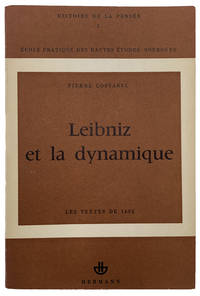
1960BL4300Paris:: Hermann 1960. 1960. Series: Histoire de la Pensee I. 8vo. viii 120 pp. Printed wrappers; curled. Good. Hermann, (1960). unknown books
1984DL1111New York:: Manchester University Press Barnes & Noble 1984. 1984. Sm. 8vo. lvi 200 pp. Printed wrappers. Ownership ink signature of David C. Lindberg. Fine. "In this edition an introduction outlines the historical background and there is a valuable survey of the subsequent discussions of the problem of space and time in the philosophy of science. Significant references to the controversy in Leibniz's other correspondence have also been collected and the relevant passages from Newton's Principia and Opticks are appended." ISBN: 0719006694 Manchester University Press, Barnes & Noble, 1984. unknown books
1960SS12914Paris:: Hermann 1960. 1960. Series: Histoire de la Pensee Ecole Pratique des Hautes Etudes :: Sorbonne I. Sm. 8vo. viii 120 pp. Indexes. Printed wrappers. Very good. Hermann, (1960). unknown books
19671338313Madrid: Ediciones de la Revista de Occidente 1967. 2nd edition. Softcover. 12mo; 2nd edition; 2 volumes; G; Paperback; Spine yellow with black print; Covers have slight edgewear slight shelfwear else clean and bright; Text blocks have vendor label on front flyleaf else clean and tight; Text in Spanish; 2 vols. 264 pages; 250 pages. 1338313. FP New Rockville Stock. Ediciones de la Revista de Occidente unknown books
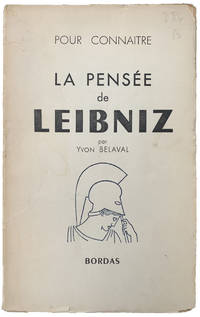
1952SS12913Paris:: Bordas 1952. 1952. Head of title: Pour Connaitre. 8vo. 284 3 pp. Original printed wrappers. Signature of Roger Hahn. Very good. Bordas, 1952. unknown books
1989BL3854Lanham New York London:: University Press of America 1989. 1989. Series: CPS = Center for Philosophy of Science University of Pittsburgh. 8vo. 181 pp. Figs. Dark blue printed wrappers. Very good. ISBN: 0819173584 Contents includes: Leibniz and the Absolute vs. Relational Dispute / John Earman – Leibniz on Why Descartes' Metaphysics of Body is Necessarily False / Glenn Hartz – Leibniz' Formalist Realism and an Early Problem in the Theory of Science. Other papers are included by Emily Grosholz Francois Duchesneau Lois Frankel Francis J. Kovach Ulrich Majer George Gale Klaus Mainzer Larry McCullough John Leslie Wolfgang Lenzen Catherine Wilson and Hans Burkhart. University Press of America, (1989). unknown books
025019Leipzig: Verlag von Felix Meiner. Ãbersetzt von A. Buchenau. Durchgesehen und mit Einleitungen und Erläuterungen herausgegeben von Ernst Cassirer. 1913 2 vols. viii 374; 582p. folded chart original cloth Philosophische Bibliothek 107-108. Verlag von Felix Meiner unknown books
2017653072017. ISBN-13: 9781616195472. ISBN-10: 1616195479. Leibniz Gottfried Wilhelm. Translated with Notes by Carmelo Massimo De Iuliis. The New Method of Learning and Teaching Jurisprudence 1667 According to the Principles of the Didactic Art Premised in the General Part and in the Light of Experience. A Translation of the 1667 Frankfurt Edition with Notes by Carmelo Massimo de Iuliis. lxxxvii 218 pp. Preface by William E. Butler Professor of Law Pennsylvania State University. Clark New Jersey: Talbot Publishing an imprint of The Lawbook Exchange Ltd. 2017. ISBN-13: 9781616195472. ISBN-10: 1616195479. Hardcover. New. $85. The first complete English translation from the Latin of Gottfried Wilhelm Leibniz's Nova Methodus Discendae Docendaeque Jurisprudentiae. Better known for his contributions to philosophy metaphysics and mathematics as co-discoverer along with Isaac Newton of calculus Gottfried Wilhelm Leibniz was also an attorney diplomat state official and judge of the Mainz Court of Appeals. The New Method of Learning and Teaching Jurisprudence is his prescription for a curriculum of study for lawyers and as such is an important indicator of the origins of legal education in the late renaissance year of 1667 when John Milton published Paradise Lost. Already translated into German and French this is the first unabridged translation of the 1667 Frankfurt edition in a modern language a new direct translation of the Latin text with notes by Carmelo Massimo de Iuliis Department of Public and Private Economy Law Universita Cattolica del Sacro Cuore Milano. The translation is enhanced by De Iuliis' introduction which offers a biographical sketch of Leibniz an overview of the reception of his ideas and a discussion of his views on the philosophical concepts of logic and rhetoric as applied to the study of jurisprudence and the systematic reconstruction of legal systems. CARMELO MASSIMO DE IULIIS b. 1960 teaches company law at the Universita Cattolica del Sacro Cuore Milano. In 2014 he edited and commented on the first Italian unabridged translation of the 1666 De Casibus Perplexis in Iure Perplexed Cases in Law by Gottfried Wilhelm Leibniz for his doctoral dissertation. He is the author of several publications on company and banking law. GOTTFRIED WILHELM LEIBNIZ 1646-1716 wrote severa. unknown books
35753New Haven: Yale University Press 2001. Hardcover. 9.5" x 6.25". lxxxviii 484 2pp. Diagrams throughout text. Maroon cloth boards with gold title. Price sticker on back cover. Near Fine. ISBN 0300079117. . VeryGood. Hardcover. . Yale University Press [2001] hardcover books
184719149Frankfurt am Main: Literarische Anstalt J. Rütten 1847. 12mo. 2 vols. I: iv 387 pp. II: vii 470 1 pp. <br><br>Leibnitz and Hessen-Reinfels on religion and politics. An important biographical source for both men. Complete in two volumes. 19th-century German boards with black mottled paper; spines with inked paper title label rubbed and browned. Some rubbing on covers abrasions on edges joints and at head and base of spines; corners bumped. Ex-library with bookplate on front pastedowns call number in black on spines and in pencil on verso of title-pages and paper shelf label with call number blacked out on spines; other markings include two leaves with four-digit number in ink in lower margin a few stray pencil marks in margins and ink and pencil scribblings on rear endpapers of both volumes which fill the entire page; pages overall clean. Literarische Anstalt (J. Rütten) hardcover books
1956165811Chicago: University of Chicago Press 1956. First Edition. hardcover. near fine/fine. Translated and Edited by Leroy E. Loemker. 2 vols. blue cloth. d.w. University of Chicago Press 1956.<br/><br/> A broad selection of Leibniz's writings including many never before available in English. Near fine copies with neat ownership signature in one volume.<br/><br/> University of Chicago Press unknown books
16962447Leipzig: Gross & Fritsch 1696. First edition. vellum marbled boards. Very Good. FIRST PRINTINGS OF THE PAPERS DOCUMENTING THE PROPOSAL AND SOLUTION OF THE "BRACHISTOCHRONE PROBLEM" ONE OF THE MOST FAMOUS MATHEMATICAL CHALLENGES AND ONE OF THE EARLIEST PROBLEMS POSED IN THE CALCULATION OF VARIATIONS. The challenge of the brachistochrone "began in June of 1696 when Johann Bernoulli published a challenge problem in Leibniz's journal Acta Eruditorum. Obviously a legacy of public challenge remained from the days of Fior and Tartaglia. Although contests were now conducted in the sedate pages of scholarly journals they retained their power to make or break reputations as Johann himself observed:<br /> <br /> '. it is known with certainty that there is scarcely anything which more greatly excites noble and ingenious spirits to labors which lead to the increase of knowledge than to propose difficult and at the same time useful problems through the solution of which as by no other means they may attain to fame and build for themselves eternal monuments among posterity.'<br /> <br /> "Johann's particular challenge was a good one. He imagined points A and B at different heights above the ground and not lying one directly above the other. There is certainly an infinitude of different curves connecting these two points from a straight line to an arc of a circle to any number of other wavy undulating paths. Now imagine a ball rolling from A down to B along such a curve. The time it take to complete the trip depends of course on the curve's shape. Bernoulli challenged the mathematical world to find that one particular curve AMB along which the ball will roll the shortest time. He called this curve the 'brachistochrone' from the Greek words for 'shortest' and 'time'.<br /> <br /> "An obvious first guess is to take AMB as the straight line joining A and B. But Johann cautioned against this simplistic approach:<br /> <br /> '. to forestall hasty judgment although the straight line AB is indeed the shortest between the points A and B it nevertheless is not the path traversed in the shortest time. However the curve AMB whose name I shall give if no one else discovered it before the end of this year is one well-known to geometers.'<br /> <br /> "Johann gave the mathematical world until January 1 1697 to come up with a solution. However when his deadline arrived he had received but one solution from the 'celebrated Leibniz' who:<br /> <br /> 'has courteously asked me to extend the time limit to next Easter in order than in the interim the problem might be made public . that no one might have cause to complain of the shortness of the time allotted. I have not only agreed to this commendable request but I have decided to announce myself the prolongation and shall now see who attacks this excellent and difficult question and after so long a time finally masters it.'"<br /> <br /> At this point Johann and others were surprised and perhaps a little delighted that they had not received a solution from their English rival Sir Isaac Newton. Wondering if Newton has not noticed the challenge Johann sent Newton directly a personal letter outlining the problem. When Newton received the letter he did not disappoint. As Newton's niece Catherine Conduitt explained:<br /> <br /> "When the problem in 1697 was sent by Bernoulli - Sir I.N. was in the midst of the hurry of the great recoinage and did not come home till four from the Tower very much tired but did not sleep till he had solved it which was by four in the morning."<br /> <br /> "Even late in life and tired from a hectic day's work Isaac Newton triumphed where most of Europe had failed! It was a remarkable display of the powers of the great British genius. He had clearly felt his reputation and honor were on the line; after all both Bernoulli and Leibniz were waiting in the wings to publish their own solutions. So Newton rose to the occasion and solved the problem in a matter of hours. Somewhat exasperated he is reported at one point to have said 'I do not love . to be . teezed by foreigners about Mathematical things.'<br /> <br /> "Back in Europe as Easter neared a few solutions came into the hands of Johann Bernoulli. The curve that everyone was seeking - one that 'is well-known to geometers' - was none other than an upside-down cycloid. This important curve was studied by Pascal and Huygens but neither of these mathematicians had realized that it would also serve as the curve of quickest descent. Johann wrote with characteristic hyperbole '. you will be petrified with astonishment when I say that precisely this cycloid . of Huygens is our required brachistochrone.'<br /> <br /> "On Easter the challenge period had expired. All together Johann had received five solutions. There was his own and the one from Leibniz. His brother Jakob came through perhaps to Johann's dismay with a third and the Marquis de l'Hospital added a fourth. Finally there was a submission bearing an English postmark. Opening it Johann found the solution correct although anonymous. He clearly had met his match in the person of Isaac Newton. Although unsigned the solution bore the unmistakable signs of supreme genius.<br /> <br /> "There is a legend - probably of dubious authenticity but nonetheless of great charm - that Johann partially chastened partially in awe put down the unsigned document and knowingly remarked 'I recognize the lion by his claw.'" Quoted from William Dunham Journey Through Genius: The Great Theorems of Mathematics Wiley 1990 page 199-202.<br /> <br /> The Brachistochrone Papers - the proposal and the solutions included:<br /> <br /> Johann: Supplementum defectus geometria cartesianae circa inventionem locorum; 2. Leibniz: Communicatio suae pariter duarumque alienarum ad edendum sibi primum a Dn. Joh. Bernoullio; 3. Johann: Curvatura radii in diaphanis non uniformibus . ; 4. Jakob: Solutio problematum fraternorum . ; 5. L'Hospital: Solutio problematis de linea celerrimi descensus; 6. Tschirnhaus: De methodo universalia theoremata eruendi . ; 7. Newton: Epistola missa ad praenobilem virum D. Carolum Mountague .<br /> <br /> Note: Newton's solution original appeared in the Philosophical Transactions.

<br /> <br /> Provenance With stamps and withdrawal markings 7-3-1984 from the famous John Crerar Library Chicago. <br /> <br /> In: Acta Eruditorum vol. 15 and 16: no.1 in 15:264-69 1 plate; no. 2 in 16:201-5 1 plate; no. 3 in 16: 206-11; no. 4 in 16:211-17; no. 5 in 16: 217-20; no. 6 in 16: 220-23; no. 7 in 16: 223-24. Leipzig: Gross & Fritsch 1696-1697. The two entire volumes offered. Quarto 208x170 mm. Two volumes in uniform contemporary three-quarter vellum over marbled boards. pp 2 604 and 9 plates; 8 594 and 8 plates. Some heavy worming to pp 324-42 and plate vi of volume 15 which is not part of any of the above mentioned articles. 1697 volume with repaired gutter tear to plate 8; reinforcement to p.449/50 and minor restoration to binding. Some toning throughout as usual with the Acta. In all a very good set. Gross & Fritsch unknown books
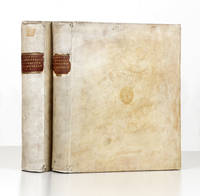
349623 folding engraved plates. 2 p.l. xxviii 484 pp.; 1 p.l. 492 pp. Two vols. Large 4to cont. vellum over boards crowns in gilt in center of each cover brown leather lettering piece on each spine Vol. II's label is a little chipped. Lausanne & Geneva: M.M. Bousquet 1745. First edition. "Important for containing the evidence as embodied in the correspondence between Leibnitz and Jean Bernoulli on the question of the rival claims to priority in the invention of the calculus between Newton and Leibnitz. It was the only serious claim published in Leibnitz's favor and a tardy answer to the Commercium Epistolicum which gave the evidence in Newton's favor."-Babson 196. Our copy does not contain the portrait of Leibniz missing in a great many copies. Fine set. Book label of Sydney Ross. hardcover books
1685131439Leipzig Germany: Joh. Grossium & C.F.F. Hæredes 1685. full vellum. thick 8vo. full vellum. xii 402 6; viii 561 7; ii 591 7; vi 595 13 pages. Text in Latin. Union List 1 53. Four volumes bound in one. Acta Eruditorum was the first scientific journal published in German-speaking lands founded in 1682 by Otto Mencke its first editor and Gottfried Liebniz. It was published by Johann Friedrich Gleditsch. This set includes Volumes I-IV 1682-5. First edition as distinct from the often-confused second issuance of this work. Later continued by Otto's son Johann Burkhard Mencke. Contains all of the Leibniz papers including Nova Methodus Pro Morimus et Minimus published in the 1684 edition p. 122. This was the first announcement by Leibniz of his invention of differential and integral calculus initiating a revolutionary development in mathematics and physics. Numerous diagrams and illustrations. Errata follow text in each volume. In contemporary German vellum binding blued edges a bit of marginal waterstaining at start. Four dedication leaves misbound in Vol. I.part. Plates XIX and XX out of sequence in Vol. I. Plate XI bound upside down in Vol II.<BR><br /> <BR><br /> Heralds 109; Ravier 90; Norman 1326; Sparrow 130. Joh. Grossium & C.F.F. Hæredes unknown books