152 résultats
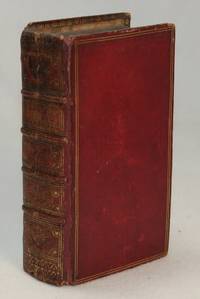
163618353Lugd. Batavorum Leiden: Ex Officina Elzeviriana 1636. Hardcover. Good. 12mo; pp 24 672 44 final section with separate engraved title page: "Coronis apologetica pro colloquiis Erasmi ex ipsius scriptis quantum per otium licuit fideliter collecta à P.S. accedit ejusdem de colloquiorum utilitate dissertatio." Full red leather with gilt spine in five compartments all edges gilt marbled endpapers. Spine toned rear board holding on by one cord; text very clean. Previous owners' bookplates on front pastedown and endpaper and verso of title page. First Elzevir edition; Willems 440. Ex Officina Elzeviriana hardcover books
1777D15687London and Paris: Apud Barbou 1777. Hardcover. Near Fine. 16 mo. Contemporary mottled calf; a.e.g. Engraved frontis. Two volumes in one. pp. 169 and 204. A lovely copy in an exceptionally well preserved binding. Housed in a handsome burgundy clamshell box. Formerly in the Thomas More Collection of the College of New Rochelle Library. <br/><br/> Apud Barbou hardcover books
15421298970Basileæ: In officina Frobeniana 1542. Hardcover. Folio 8 816 pages 28 pages index; VG; bound in contemporary full vellum paneled spine with faded ink lettering to head of spine full tooling to boards partial beveling to edges; bound with two clasps majority of lower clasp missing upper clasp present; slight scraping to text block from clasp; woodcut printer's device on title page and verso of final leaf; woodcut initials; colophon on verso of final leaf; text in Latin with sections in Greek; wide margins; no bookplates or previous owners markings; index in rear; This edition is part 2 of "Nouum Testamentum iam quintum ac postremum accuratissima cura recognitum à Des. Erasmo Roterodamo cum annotationibus . Basileae 1541 1542 - cf. colophon.; consignment; shelved case 4. 1298970. Shelved Dupont Bookstore. In officina Frobeniana hardcover books
16711002105London: E.T. and R.H. for H. Brome B. Tooke and T. Sawbridge 1671. First edition in English of the complete Colloquia Familiaria of Erasmus first published in 1518 and expanded by Erasmus over the next fifteen years a lively collection of Latin dialogues that found a readership far beyond the Renaissance schoolroom. Originally intended to model colloquial conversation for students of Latin the dialogues feature pointed free-thinking exchanges on modern political religious and philosophical questions. In "Of the Abbot and Learned Woman" an ignorant abbot tries and fails to get the better of the classically educated Magdalia a character almost certainly based on Thomas More's eldest daughter: "I think thou art some sophistress thou protest so wittily." Magdalia: "I will not tell thee what I think thou art." And later: "I have often heard it usually spoken that a wise woman is twice a fool." Magdalia: "Indeed it useth to be said so but by fools." The Colloquia Familiaria was widely read and debated across Europe drawing immediate notice for its anticlerical satire: "its influence on the dialogues of Reformation Germany and Tudor England is a critical commonplace" Zlatar Reformation Fictions 11. The original purpose of the Colloquies as a text for teaching Latin postponed its direct translation; this first complete English edition was published more than 150 years after the work's first appearance. The edition opens with a short life of Erasmus and concludes with the first appearance in English of De utilitate colloquiorum Erasmus's 1526 defense of the Colloquies published after the Sorbonne condemned the book for impiety. In response Erasmus makes a case for the educational value of his dialogues' humor: "I cannot tell whether any thing be learned more successfully than that which is learned in playing." Despite his efforts the Colloquies would remain on the Papal Index of banned books through the end of the nineteenth century. Wing E-3190; PMM 53. A very good copy of a humanist landmark in a handsome contemporary binding. Octavo measuring 6.5 x 4.25 inches: 8 555 1. Contemporary Cambridge-style full speckled calf boards ruled and ornamented in blind raised bands red morocco spine label lettered and decorated in gilt top edge stained black. Engraved frontispiece portrait of Erasmus. Final leaf containing second page of bookseller catalogue excised. Joints and spine head expertly repaired; evidence of bookplate removal on front pastedown; effaced signature on title page; some running titles shaved. E.T. and R.H. for H. Brome, B. Tooke, and T. Sawbridge unknown books
164123478Hagae: Ex Officina Theodori Maire 1641. "Editio Nova à multis quibus antea scatebat mendis diligenter repurgata.". Period vellum with maroon leather spine label. Overall VG unobtrusive vellum repair at head of spine. 3 - 22 1 - 630 76 pp. Indices at rear T.p. printer device. Woodcut initial letters. Tailpieces. 12mo. 12 - 1 12 A - 2F12 2G6 last leaf a blank. 15 cm x 9.5 cm. <br/><br/> Ex Officina Theodori Maire hardcover books
14155374Strasbourg: Matthias Schürer 1514-1515. First edition of some material. Hard Cover. Very Good/Several related works of Erasmus collected in one binding including the first edition of Parabolae sive similia a reported 1513 edition of Parabolae was a longstanding bibliographical error and the first appearance of Erasmus's farewell letter to Jakob Wimpfeling Epistle 305. In 1509 the year Mattias Schürer completed his apprenticeship and opened his own print shop he struck an unauthorized edition of Erasmus's Adagia purloined from the first edition of 1500. Anger on the author's part would have been justified. Yet in spite of this commercial indiscretion Erasmus favored Schurer with a warm supportive and lasting friendship. In October 1514 he gave Schürer the manuscript of "Parabolae sive similia" which Schürer decided to publish in tandem with a reprint of De Copia although there are copies extant of Parabolae bound alone. It is fitting that Parabolae should be bound with Adagia in this copy since it expands on the earlier work's idea of compiling classical maxims. Parabolae that is The Parables is a catalogue of didactic similes gleaned from Plutarch Seneca and Pliny who almost never used similes in his own text. The Adagia is also the subject of Erasmus's letter to Wimpfeling whom he thanks for recommending it for a school text. Schürer's edition of Adagia of 1515 is the first to contain the printer's own "table of proverbs" to function as a key to the collection. In all Schürer published 57 editions of 15 titles by Erasmus in the five year period from 1514 to 1519 the year he died. Quarto 21 cm three parts in one volume: I: 6 73 6 leaves; II: 56 leaves; III: 4 57 7 leaves. Numerous five- and six-line "criblé" woodcut initials on black ground decorated with arabesques and figures many of them carefully rubricated. Second title page with woodcut architectural border lightly rubricated. Printer's "usui studiosorum" device on last printed page rubricated. Bound in contemporary or 17th-century blind-stamped alum tawed pigskin over wooden boards with a Cardinal's arms gilt on both boards. Clasps and catches preserved straps renewed. Some small worming at spine ends. First title leaf somewhat toned and soiled. Occasional marginalia in contemporary or early hand. Contemporary ownership inscription on title page. References: VD 16 E-2645 and E-3237; Adams E-318 and E-716; Panzer VI 68 340-341; "Early Editions" Toronto #369 etc. Matthias Schürer hardcover books
197491036Toronto:: University of Toronto Press. Very Good in Very Good dust jacket. 1974. Hardcover. 0802019811 . Volume 1 of the Collected Works of Erasmus. Translated from the Latin by R. A. B. Mynors and D. F. S. Thomson. First edition. Previous owner's stamp on front free endpaper else very good in a very good age darkened impression from a removed sticker on front panel dust jacket. . University of Toronto Press, hardcover books
150031801Lugduni Batavorum Leiden: Pieter van der Aa 170306. Folio extra 39.4 cm 15.5". 10 vols. in 11. I: 3 ff. 24 64 pp. 1226 cols. i.e. 1240; engr. t.-p. 1 double-pg. engr. plt. and 1 full-pg. engr. plt. II: 6 ff. 1212 cols. 54 pp. IIIa: 15 ff. 1104 cols.; 18 full-pg. engr. plts. IIIb: 2 ff. cols. 1105-944 92 ff.; 2 full-pg. engr. plts. IV: 3 ff. 758 cols. i.e. 768; 1 full-pg. engr. plt. 75 single-col. engr. vignettes 3.5 sq. and 6 double-col. engr. vignettes 4.25 x 7.25. V: 3 ff. 1360 cols. VI: 29 ff. 1126 cols. 17 pp. VII: 6 ff. 1198 cols. 1 p. VIII: 3 ff. 652 cols. IX: 3 ff. 1248 cols.; 1 fold-out plt. 1 full-pg. plt. X: 2 ff. cols. 1249860 64 ff. <br><br>Before his death Erasmus 14661536 divided his writings into nine ordines categories for posthumous publication. This is the second edition of his collected works first published in nine volumes by Froben in 1540. Like the original this set includes additions by authors from the Dutch humanist's international circle and portraits of the same as well as => myriad engravings after Holbein. The printer Pieter van der Aa 16591733 was an apprentice of Daniel van Gaasbeeck fl. 165592 and primarily known for maps and travel books.<br>Â Â Â Â The text in all volumes is in Latin with some Greek printed in roman and italic mostly double-column with sidenotes and many large woodcut initials and tailpieces as well as some engraved headpieces. Vol. I has both a general title-page and a volume title-page; each of the volume title-pages is printed in red and black and features a large engraved vignette signed by the illustrator J. Goeree and the engraver J. Baptist; some volumes also have sectional title-pages. There are many engraved plates: vol. I features an added engraved title-page a double-page plate and one full-page plate; in vol. III part one there are => 18 full-page engraved portraits of contemporaries of Erasmus including Melanchthon Alciatus Charles V and Bembo as well as two more full-page portraits in vol. III part two.<br>Â Â Â Â In Praise of Folly in vol. IV is illustrated with => 75 single-column-width engraved vignettes 3.5 sq. and six double-column-width engravings 4.25 x 7.25 after the famous Holbein originals and a full-page engraved portrait of the artist. Vol. IX has one large engraved fold-out plate signed by van der Aa at Leiden engraved by D. Stoopendael as well as one full-page engraved plate unsigned of medallions against a drapery backdrop.<br>Â Â Â Â => A handsome folio set.<br>Â Â Â Â Provenance: Most volumes have a large stamped "Y" on the front pastedown and a faded => 18th-century ink inscription by a monk on the title-page. All volumes in contemporary sheep recently rebacked and repaired using brown calf spine with raised bands accented by gilt ruling with a blind ornament in each compartment title and tome number gilt on green leather spine labels and date gilt collector-style on red leather labels at bases; marbled endpapers and red edges. Boards scuffed and chipped in places; all hinges inside repaired with later marbled paper. Ex- library: most volumes with bookplate and old-fashioned oval stamp on front pastedown stamps on bottom edge and multiple leaves of text early accession number to front free endpaper verso and bottom margin of first text leaf. In all volumes some leaves very browned; occasional dampstaining foxing or other small stains from chemical reactions in paper; small natural paper flaws short closed tears and a few corners torn away not affecting text. Title-page of vol. I with closed interior tear stemming from deep impression of its large engraved vignette; one small tear in vol. IV repaired with monogrammed sticker! Tout entière a nice set. Pieter van der Aa hardcover books
186426134Bruxelles: T.-J.I. Arnold 1864. 4to 23 cm; 9.25". 5 ff. xliv pp. 18 ff. color map facsims. <br><br>Reproduction photo-lithographique avec notice sur la jeunesse et les premiers travaux d'Ersame." "Tiré a 100 exemplaires numérotés à la presse: 1 sur peau de vélin 13 sur papier ancien véritable 13 sur grand papier de Hollande 69 sur papier de Hollande ordinaire."<br>Â Â Â Â Number 36 of 100 copies one of the copies "sur papier de Hollande ordinaire." The facsimile of an early volume of poetry and satires by Erasmus published at Gouda in 1513 occupies the final 18 leaves while C. Ruelens's introduction and study of Erasmus and of this work fills the 44 preliminary pages. Several of the satires do not appear in later compilations of his satires. 19th-century half black morocco raised bands machine made marbled paper on boards. Joints starting. Some foxing to endpapers. An uncut copy. T.-J.I. Arnold hardcover books
Embry 89635Heritage Press N.d. Fine in fine faintly toned publisher's slipcase. Woodcuts by Franz Masereel. Cloth backed boards no dust jacket. Heritage Press, N.d. hardcover books
1808D15701London: Richard Taylor & Co Shoe Lake for John White Fleet Street 1808. Hardcover. Very Good. Soberly and cleanly rebound in blue gray cloth; paper spine labels lettered in black. First thus edition. This is one of the less common sets issued with a third volume containing an appendix letters and documents pertaining to Erasmus. Volume I: A.D. 1467-1529; Volume II: A.D. 1530-1536. Formerly in the collection of College of New Rochelle Library with perforated stamps to title pages. Text is generally bright throughout. Housed in a handsome burgundy clamshell box with labels lettered in gilt. <br/><br/> Richard Taylor & Co, Shoe Lake, for John White, Fleet Street hardcover books
15291832Coloniae: Iohannem Gymnicum 1529. Rare edition a sound complete copy lacking only the final blank. Title within pictorial woodcut border. Octavo contemporary blind-tooled calf over wooden boards dated 1534 in blind brass clasps minor statins and soiling and some early penned marginalia. Also bound in are three additional works De Civilitate Morum Puerilium; Plutarch. De Liberis Educandis; and Horatius Flaccus. Iohannem Gymnicum hardcover books
15213319Mainz:: Johann Schöffer 1521. ONE OF 9 PRINTINGS all in 1521. Place and printer from VD16. Quarto:. 18.5 x 14 cm. 8 pp. Collation: AA4 Bound in modern wrappers. . A good copy with a light dampstain to the upper corner. Occ. light soiling. With a fine woodcut title page border. A German translation of Erasmus’ annotation on Mathew 11:29 taken from his “In Novum Testamentum annotationes†in which Erasmus differentiates between the divine order and human positive law. He laments that people ignore the commands of God and follow human law instead: ‘Christ’s law is inviting and easy but it becomes onerous and difficult through the addition of human prescriptions and dogmas.’ The verses were often used in Protestant propaganda in the early years of the Reformation hence the need for a vernacular version of Erasmus’ text. See Christine Christ von-Wedel Erasmus of Rotterdam: Advocate of a New Christianity Ch. 16 Bezzel 1228; VD16 E 3106 Johann Schöffer, unknown books
15132454Basel: and Strasbourg: and Paris:: Io. Froben and Excusum per Renatum Beck in aedibus zum Thiergarten and Jean Petit In vico Sancti Iacobi 1515 and 1515 and 1513. THIRD FROBEN EDITION of the "Praise of Folly". The two prior editions also appeared in 1515. Written in 1509 as a visitor's gift to Thomas More whose name -Morus- was so aptly similar to the Greek "moros" folly the "Moriae Encomium" was first printed by Gilles de Gourmont at Paris probably in 1511. The first of the Froben editions appeared in 1515. This copy is bound with the "Germania" of Aeneas Sylvius Piccolomini Pope Pius II together with the "Responsio" of Jakob Wimpfeling; and an edition of Lactantius edited by Gilles de Maizières and printed at Paris by Jean Petit. Large Quarto:. 20.2 x 15 cm. 3 works bound in one volume: I. Piccolomini: i-iv A-B4 C8 D-E4 F8 G-H4 I8 K-L4 M8 N-O4 P6. II. Lactantius: A6 B4 a-z8/4 A-D8/4 E6 F-N8/4 O6 P4. III. "Praise of Folly": a-h4 a-z4 A-B4 C6 Bound in contemporary quarter alum-tawed pigskin over wooden boards with working clasps and catches. The pigskin is tooled in blind with repeating vines and floral rolls. The text and binding are beautifully preserved. The contents are fresh and bright with wide margins and a number of deckled edges. Excellent. The "Germania" has a fine title page printed in red and black and surrounded by a fine woodcut border. The printer's beautiful device by Hans Baldung Grien appears on the final leaf. The Lactantius has Jean Petit's device on the title page. The text is adorned with fine floriated criblé initials. A contemporary reader has annotated the "De Opificio Dei" densely in Latin and added a long Latin poem to the final two leaves. The "Praise of Folly" has a fine Holbein border with the decapitation of John the Baptist in the lower register and affine woodcut border with a fool by Urs Graf on the contents leaf. This edition includes the original dedicatory letter to Thomas More whose name Erasmus plays upon cleverly in the title of the work; and the letter to Martin Dorp in which Erasmus explains his motives for writing the "Moria": "My aim in the 'Folly' was exactly the same as in my other works. Only the presentation was different. In the 'Enchiridion' I simply outlined the pattern of a Christian life. In my little book the 'Education of a Christian Prince' I offered plain advice on how to instruct a prince. In my 'Panegyric' I did the same under the veil of eulogy as I had done elsewhere explicitly. And in the 'Folly' I expressed the same ideas as in the 'Enchiridion' but in the form of a joke." The Froben edition is augmented with a number of other texts See the final paragraphs of this description.Praise of Folly:"The 'Praise of Folly' is Erasmus' most famous and controversial work… In Erasmus' lifetime the 'Moria' was condemned in 1527 by the theologians of Paris for its attacks on faith and morality and again in 1533 by the Franciscans who found it full of heresies. The officials of the Sorbonne put it on the list of condemned books in 1542 and 1543 a list that was the basis of the Tridentine Index of 1564…"The 'Moria' may start as a learned joke to amuse a fellow humanist Thomas More but it moves into sharp criticism of contemporary mores and ends with a plea for a return to the Christianity of the Gospels… Erasmus writes in a Lucianic spirit of irreverent burlesque of the gods of classical mythology and light-hearted amusement at the irrationality of mankind. Folly argues that she is all that is natural youthful fecund and happy and that life would be intolerable if it were not ruled by civilized conventions which necessitate a degree of humbug and illusion. By contrast the Stoic ideal rational man is a 'kind of marble statue of a man devoid of sense and any sort of human feeling.' She then shifts her viewpoint and lists the people who enjoy her benefits in so far as they try to preserve their illusions or are happy in their ignorance self-deception or self-love. She even adds superstitious piety to alchemy gambling and the nobility's obsession with hunting and extravagant building…"Next Erasmus starts to deliver a sharp and often bitter attack on all the victims of blind folly those who are deaf to the voice of true religion and lacking the gentler Christian virtues among whom are sycophants self-seekers money-makers pedants scholastics lawyers theologians superstitious worshippers of images and relics courtiers and kings worldly monks and irreligious pontiffs. This section culminates in a savage thrust at Pope Julius II the bellicose pope. The keen wit and ingenuity of the satire can be highly entertaining but there is no note of gaiety now. As Erasmus surveys the gulf between the Church and the 'true philosophy of Christ' he moves into the final section where the alternative offered to barren scholasticism is the vision of reality taken from Plato and folly in the sense used by Saint Paul that of receptivity to the Christian message by the 'fool in Christ.' All irony is dropped until the final short epilogue when Folly light-heartedly cuts short her 'hotch-potch of words'; this is a direct and simply worded account of Erasmus' personal belief moving into an exposition of the Neoplatonist concept that the soul's ascent to beatitude ends in ecstasy a form of folly which is its supreme fulfillment."Betty Radice CWE Vol. 27 pp. 78 ff.Piccolomini's "Germania":Shortly after 1455 Aeneas Sylvius Piccolomini came into possession of the recently rediscovered manuscript of Tacitus' "Germania" the most important ancient account of Germany in the first century. In response to a letter from the Bishop of Mainz lamenting the miserable state of the Holy Roman Empire Piccolomini wrote his "Germania" based on Tacitus' own in which he demonstrates that the present high level of German culture as compared with the barbarous past as presented by Tacitus is an accomplishment of the Church. This edition includes the important response by Jakob Wimpfeling in defense of the ancestors of the Germans.Additional "Moria" texts:The Froben editions of the 'Moria' contain in addition to Erasmus' main text two ancient examples of the mock-encomium Seneca's "Ludus de Morte Claudii Caesaris" and Synesius of Cyrene's "De Laudibus Calvitii" "In Praise of Baldness" translated from the Greek by the Englishman John Phreas d. 1465. In his introductory letter to Thomas More Erasmus cites both the "Ludus" and the "Praise of Baldness" in a pre-emptive defense against those who will object to his literary frivolity "levitas et ludicrum argumenti" pp. 102-104 in this edition. The text of the "Moria" is accompanied by the commentary of Gerard Listrius with assistance from Erasmus. I. "Germania": BM STC German p. 701 = Proctor 10307. Not in Adams. Panzer VI.75.410. Ritter 1878. Muller Bibliographie Strasbourgeoise II 228 no. 26. Schmidt Beck 21. II. Lactantius: Adams L-14; BSB-Ink L-13; HC 9819; Moreau Inventaire chronologique II 637. III. "Praise of Folly": Vander Haeghen I 122; Kossmann 967; Bezzel 1304; Not in De Reuck; BM STC German p. 282; Adams E 392; VD 16E 3184 Io. Froben, and Excusum per Renatu[m] Beck in aedibus zum Thiergarten, and Jean Petit, In vico Sancti Iacobi, 1515 and 1515 and books
15402712Cologne:: Ex officina Ioannis Gymnici 1540. RARE COLOGNE EDITION. Folio: . 31.2 x 20 cm. . 88 3-874 1 pp. A-d6 e8 f-g6 A-Z6 Aa-Zz6 Aaa-Zzz6 Aaaa-Dddd6 last leaf is blank. A very fine copy bound in contemporary pigskin over beveled wooden boards tooled in blind. The clasps lacking some scuffing and soiling to lower board otherwise a very nice binding. Internally a beautiful copy with the lightest of occasional soiling. Gyminus’ fine hippocamp device appears on the title. A very rare Cologne edition of Erasmus’ beloved and extraordinarily influential “Adages†first conceived as a collection of proverbial sayings drawn from the Latin authors of antiquity elucidated for the use of those who aspired to write an elegant Latin style. In its first incarnation the “Adagia†consisted of about eight hundred proverbs. The present version Erasmus' "Adagia Chiliades" “Thousands of Adages†is more than just a vastly expanded edition of that first enterprise: "A glance at its composition reveals that the ‘Adagia Chiliades’ was in fact -as well as in name- a new book and that Greek scholarship was largely responsible for the difference. Instead of 818 adages there were 3260. Of those about four-fifths were either new or substantially altered in form. And 2734 contained Greek passages of two to six lines or more in length.â€Renaissance Humanism vol. 2 pages 232-233. “In the dedication Erasmus pointed out the profit an author may derive both in ornamenting his style and in strengthening his argumentation from having at his disposal a good supply of sentences hallowed by their antiquity. He proposes to offer such a help to his readers. What he actually gave was much more. He familiarized a much wider circle than the earlier humanists had reached with the spirit of antiquity. “Prior to the ‘Adages’ the humanists had to some extent monopolized the treasures of classic culture in order to parade their knowledge of which the multitude remained destitute and so to become strange prodigies of learning and elegance. With his irresistible need of teaching and his sincere love for humanity and its general culture Erasmus introduced the classic spirit in so far as it could be reflected in the soul of a sixteenth-century Christian among the people. Erasmus made current the classic spirit. Humanism ceased to be the exclusive privilege of a few. According to Beatus Rhenanus he had been reproached by some humanists when about to publish the 'Adagia' for divulging the mysteries of their craft. But he desired that the book of antiquity should be open to all." Huizinga p. 39-40 Van der Haeghen I 4; Bezzel 83; VD16 E 1944 Ex officina Ioannis Gymnici, unknown books
15242455Paris:: Jodocus Badius Ascensius 1524. FIRST COMPLETE BADIUS EDITION. Quarto:. 19.8 x 14.5 cm. CXX leaves. Collation: a-p8 Bound in contemporary limp vellum lightly soiled. The contents are in very good condition with a few pencil annotations and light soiling to the title page. With Badius' device of his print shop the “Praelum Ascensianum†showing printers working a press on the title page. With large attractive crible initials and smaller charming historiated initials. Passages in Greek. A fine unsophisticated copy of this rare edition. From the personal library of Bob and Emily De Graaf. The rare 1524 Parisian “Praise of Folly†printed by Erasmus’ friend the scholar-printer Badius Ascensius who printed the first authorized edition in 1512. This edition contains all of the supplementary texts found in the Froben edition of 1516 including the dedicatory letter to Thomas More whose name Erasmus plays upon cleverly in the title of the work; and the letter to Martin Dorp in which Erasmus explains his motives for writing the “Moriaâ€: “My aim in the ‘Folly’ was exactly the same as in my other works. Only the presentation was different. In the ‘Enchiridion’ I simply outlined the pattern of a Christian life. In my little book the ‘Education of a Christian Prince’ I offered plain advice on how to instruct a prince. In my ‘Panegyric’ I did the same under the veil of eulogy as I had done elsewhere explicitly. And in the ‘Folly’ I expressed the same ideas as in the ‘Enchiridion’ but in the form of a joke.†“The ‘Praise of Folly’ is Erasmus’ most famous and controversial work… In Erasmus’ lifetime the ‘Moria’ was condemned in 1527 by the theologians of Paris for its attacks on faith and morality and again in 1533 by the Franciscans who found it full of heresies. The officials of the Sorbonne put it on the list of condemned books in 1542 and 1543 a list that was the basis of the Tridentine Index of 1564… “The ‘Moria’ may start as a learned joke to amuse a fellow humanist Thomas More but it moves into sharp criticism of contemporary mores and ends with a plea for a return to the Christianity of the Gospels… Erasmus writes in a Lucianic spirit of irreverent burlesque of the gods of classical mythology and light-hearted amusement at the irrationality of mankind. Folly argues that she is all that is natural youthful fecund and happy and that life would be intolerable if it were not ruled by civilized conventions which necessitate a degree of humbug and illusion. By contrast the Stoic ideal rational man is a ‘kind of marble statue of a man devoid of sense and any sort of human feeling.’ She then shifts her viewpoint and lists the people who enjoy her benefits in so far as they try to preserve their illusions or are happy in their ignorance self-deception or self-love. She even adds superstitious piety to alchemy gambling and the nobility’s obsession with hunting and extravagant building… “Next Erasmus starts to deliver a sharp and often bitter attack on all the victims of blind folly those who are deaf to the voice of true religion and lacking the gentler Christian virtues among whom are sycophants self-seekers money-makers pedants scholastics lawyers theologians superstitious worshippers of images and relics courtiers and kings worldly monks and irreligious pontiffs. This section culminates in a savage thrust at Pope Julius II the bellicose pope. The keen wit and ingenuity of the satire can be highly entertaining but there is no note of gaiety now. As Erasmus surveys the gulf between the Church and the ‘true philosophy of Christ’ he moves into the final section where the alternative offered to barren scholasticism is the vision of reality taken from Plato and folly in the sense used by Saint Paul that of receptivity to the Christian message by the ‘fool in Christ.’ All irony is dropped until the final short epilogue when Folly light-heartedly cuts short her ‘hotch-potch of words’; this is a direct and simply worded account of Erasmus’ personal belief moving into an exposition of the Neoplatonist concept that the soul’s ascent to beatitude ends in ecstasy a form of folly which is its supreme fulfillment.â€Betty Radice CWE Vol. 27 pp. 78 ff. Vander Haeghen I 123; Kossmann 979; Bibl. Belgica E 866; Not in Bezzel De Reuck or BM STC French; Renouard Badius II 424; Adams E 397. Inventaire chronologique des editions Parisiennes du XVIe siecle III no. 669; Renouard Imprimeurs Parisiens du XVIe siècle II no. 539 Jodocus Badius Ascensius, unknown books
1571D10980Basel: Eusebius Episcopius & heirs of his brother Nicolaus 1571. Hardcover. Very Good. 8vo 165 x 104mm. 36 621 63 pages including final leaf with printers device of the word EPISCOP. Episcopus separated by stork surmounting bishops crozier on verso. Edited by Desiderius Erasmus; revised by Johann Jacob Grynaeus. Contemporary calf over wooden boards with blind-stamped arabesque centerpiece on covers brass catches lacking clasps rebacked spine gilt labeled IRENAEI HAERESES 1571; front joint cracked but cords intact; dark stain on opening leaves paper cracks and small holes in title not affecting text some light dampstaining in hinge toward end. 17th-century signature of Robert Baillie to title the famous Covenanter according to pencil note on front endpaper. 19th-century Chiesa Libera stamp on title; and pictorial bookplate of Douglas and Mildred Horton dated 1962 to front pastedown. Reverend Dr. Douglas Horton married Mildred née McAfee in 1945 who was a prominent female captain in the United States Naval Reserve and later the president of Wellesley College. <br/><br/>Irenaeus theological treatise written c. 180 attacked contemporary Christian heresies particularly Gnosticism and the system devised by Valentinus c. 100-c. 160. Irenaeus treatise also supported the idea that bishops maintained apostolic ties to the era of Christ and that a bishop was the best guide to understanding scripture. Given the very bishop-centric message of this work perhaps it is not curious at all that the Episcopius press expressed interest in printing it In Latin Episcopus is bishop. It was not until the 16th century that Irenaeus Opus eruditissimum was widely disseminated first published in Latin by Froben of Basel in 1526 and in the original Greek in 1570. Erasmus famously edited this Latin edition which appeared a year after the first Greek. In it he removed two annotations which referred to baptism and purgatory and also corrected a passage concerning the fault of Adam. The text itself is a new translation of the first book with an extensive dedication to the Basel Mayor Bernhard Brand and the founder of the Basel Reformed Orthodoxy Church Johann Jacob Grynaeus. Irenaeus Opus appears in 10 editions before this one published in both Basel 1528 1534 1548 1554 1560 and Paris 1541 1545 1563 1567 1570. This volume once belonged to Robert Baillie 1602-1662 a Glaswegian and Presbyterian minister and writer known for his Letters which faithfully recorded public events and his participation via correspondence. Baillie was a leader in the 17th century movement that rejected the Church of Englands Book of Common Prayer. From a reformative point of view Baillie would have found interest in Irenaeus work which recognized the canonical character of the gospels. For a work against the Gnostics it is said to contain valuable historical information and a great many New Testament quotations which are a witness to the New Testament text long prior to any extant manuscript; it is the first systematic exposition of Christian theology--Sarton I 294. Hoffmann II 466. Eusebius Episcopius & heirs of his brother Nicolaus hardcover books
187624975Paris: Librarie Des Bibliophiles 1876. Troisieme edition. Three quarter red morocco over red marbled boards raised bands gilt titles marbled end papers. Very good plus or better copy tight clean just a bit of wear at the extremities. A handsome copy of this somewhat uncommon title. xi 247 pp. Illus. with 83 b/w gravures. Sm. 4to. 20 cm. Number 266 of 500 copies on Holland paper original wrappers sewn in. Book plate of Charles Fairfax Murray the English Pre-Raphaelite Painter 1849-1919 on front pastedown. Librarie Des Bibliophiles hardcover books
1754016211Amsterdam: Jacob Wetstein 1754. Good. 32mo - over 4" - 5" tall. 524 4. Latin text. Engraved title page. His Coloquia Familaria was a collection of his satirical and sometimes biting criticism of the religious and cultural mores of the time. There is a four page biography of Erasmus. This was one of the most popular works of Erasmus in the 18th Century. Jacob Wetstein unknown books
15708875Cologne: Apud Gualtherum Fabricum & JoannemGymnicum sub Monoccrote 1570. Pigskin. Very good . Sm. 8vo. 1675345pp. Woodcut device on title page. 2 woodcut historiated initials. Original roll tooled pigskin binding spine soiled. Covers with a large central stamp depicting a royal personage holding a sword and the scales of justice back cover image rather worn. Ownership signature of Andreas Drischel on verso of front free endpaper dated 1578. VD 16 E 2050. Apud Gualtherum Fabricum, & JoannemGymnicum sub Monoccrote unknown books
1681D15693Geneva: Apud Samuelem De Tournes 1681. Hardcover. Very Good. 12mo. pp. 809. Index at rear. Title page with portrait of Erasmus. Contemporary calf a bit worn but still attractive. Annotations to front flyleaf. Pages at back beginning in the 700s with marginal ink stains not affecting text. Housed in a very handsome burgundy clamshell box. Formerly in the collection of the College of New Rochelle Library and housed in its very handsome burgundy clamshell box with labels lettered in gilt. <br/><br/> Apud Samuelem De Tournes hardcover books
164315177Lugd. Batavorum i.e. Leiden: Elzeviriana 1643. 16mo pp. 24 672 44; engraved title page woodcut head- and tail-pieces woodcut medallion full contemporary vellum red morocco label; very good. Copinger 1624; Willems 552. <br/><br/> Elzeviriana hardcover books
168463010Lipsiae: Impensis Laurentii Sigismundi Corneri 1684. 20 866 37 5 pp. . Lacking frontispiece. 1 vols. Thick 12mo. Modern full tan sheepskin leather spine label. Ex-library with small ink-stamp on title page. 20 866 37 5 pp. . Lacking frontispiece. 1 vols. Thick 12mo. Impensis Laurentii Sigismundi Corneri unknown books
190067256London:: Gibbings & Company. Very Good. 1900. Hardcover. B0006ADY7K . Complete in three volumes. Translated by N. Bailey. Edited with notes by E. Johnson. First edition thus. Small octavos bound in brown cloth with gilt lettering and design top edges gilt. A few bumped corners light edge wear and aging else the three volumes are very good. No dust jackets. Bindings are solid. . Gibbings & Company, hardcover books
169341406Amstelodami: Ex Typographia Blaviana 1693. Small thick 8vo pp. 784 20; engraved title page; full eighteenth century calf borders and spine lined in gilt all edges red; boards considerably rubbed and worn upper cover detached spine label removed; first 6 leaves detached but present else interior very good. Eighteenth century armorial bookplate on front pastedown. <br/><br/> Ex Typographia Blaviana hardcover books


