152 résultats
15708875Cologne: Apud Gualtherum Fabricum & JoannemGymnicum sub Monoccrote 1570. Pigskin. Very good . Sm. 8vo. 1675345pp. Woodcut device on title page. 2 woodcut historiated initials. Original roll tooled pigskin binding spine soiled. Covers with a large central stamp depicting a royal personage holding a sword and the scales of justice back cover image rather worn. Ownership signature of Andreas Drischel on verso of front free endpaper dated 1578. VD 16 E 2050. Apud Gualtherum Fabricum, & JoannemGymnicum sub Monoccrote unknown books
180036911London 1800. First Edition. 4to pp. Illustrated with 12 engraved plates including one folding and one double page. Bound in contemporary 3/4 calf piece nicked from the bottom of the spine some foxing couple of plates with water stain plates foxed. Generally a very clean copy. Author Kenneth Robert's copy with his bookplate. Henrey 615; Nissen 452; King-Hele Erasmus Darwin 58-62; Wheeler Gift 621; McDonald page 224. Erasmus Darwin 1731-1802 was an English physiologist and poet the grandfather of Charles Darwin. A physician in Litchfield UK Darwin kept an 8 acre botanical garden. Darwin's reputation rests on his long poem The Botanic Garden 1789 which anticipates the Linnaean system. It was crude poetry seemingly written in a carriage while Darwin was traveling between patients. He decribed the plants through a misplaced amusing personification . In the present work he described the plants as having sensation and volition. Roberts is best rememebred for his American historical romances ie Trending into Maine Northwest Passage Arundel etc. unknown books
15602A Plan for the Conduct of Female Education in Boarding Schools" by Erasmus Darwin. First edition. 1797. Derby: Printed by J. Drewry; for J. Johnson St. Paul's church-Yard London. Rebacked in half calf over boards; spine ruled in gilt with gilt title; Erasmus Darwin was the illustrious grandfather of Charles Darwin and wrote this treatise on the education of young women to help his daughters Susan and Mary when setting them up as proprietors of a boarding school. Darwin's is a voice of practical moderation in women education as much concerned with health and the physical environment as with the nurturing of mental and social faculties for women and girls. Darwin's treatise takes a comprehensive view of women's education suggesting that it should reach beyond social skills and a women should educate herself in literature history natural sciences and even mathematics. unknown books
1797310467Philadelphia: Printed by T. Dobson at The Stone House 1797. First American Edition. A New Edition. xxiv 486; 8 539pp. 2 vols. 8vo 8-1/4 x 5-3/4 inches. Original quarter sheep and red leather title labels on spine marbled boards uncut. First American Edition. A New Edition. xxiv 486; 8 539pp. 2 vols. 8vo 8-1/4 x 5-3/4 inches. UNCUT IN ORIGINAL BINDING. "As a physician Erasmus Darwin was widely recognized as England's finest medical doctor. He was asked several times to be personal physician to King George although his lack of respect for the monarchy in general and George in particular made this an easy offer to refuse. Much of the philosophy central to Erasmus Darwin's medical beliefs is laid out in his treatise on animal life Zoonomia. Although his views were loaded down with incorrect 18th-century ideas and assumptions. he was generally able to improve the lives of many of his patients using common-sense ideas such as a balanced diet the practice of basic hygiene and the cleaning and dressing of wounds. He was considered progressive in that he believed in a connection between his patient's state of mind and their general health and was one of the first physicians to espouse sympathetic treatment of mental patients who at the time were kept in deplorable conditions. Most of Zoonomia is made up of a Linneaus-inspired classification of all diseases and treatments known at that time. Erasmus tries to arrange them into distinct species genera families and ultimately into four broad classes: diseases of irritation from external sources sensation such as excess pain or pleasure volition caused by desire or aversion and association where diseases of one organ or system can cause other associated problems" Robert Day. This exercise led Darwin to advance the "first consistent all-embracing hypothesis of evolution" Garrison & Morton: "When we observe the essential unity of plan in all warmblooded animals we are led to conclude that they have been alike produced from a single living filament.". Evans 32017 Printed by T. Dobson, at The Stone House unknown books
1688LD6060Nurnberg: Hoffmann c. 1688. Hardcover. Very Good. Modern black morocco gilt-stamped lettering in red leather spine label gilt detail stamped direct on spine; 4to; pp. 3-52 plus 46 plates 11 of which are folding and heavily restored; 1 of which is laid-in. First title-page printed in red and black and with 3 additional lavishly engraved half-title pages. Binding is very fine indeed but condition of text block varies -- many folding plates restored full-page plates sometimes a bit browned sometimes a bit fragile and tissuey and sometimes remarkably nice and bright. A nice copy overall offering images of ornate columns window frames cornices ceilings and more. Sold as is. <br/><br/> Hoffmann hardcover books
1751WRCLIT45949Paris 1751. 6xxiv2222pp. Quarto. Full deep plum straight-grain morocco elaborately stamped in blind lettered and ruled in gilt gilt inner dentelles gilt borders on endsheets a.e.g. Title in red and black. Frontis and fourteen engraved plates engraved head- and tail- pieces. Extremities a bit worn narrow scrapes at fore-tips of lower board armorial bookplate on pastedown slight offset from plates to facing pages; a very good copy. First edition of this translation accompanied by notes by Meunier de Querlon. The frontis plates title-vignette and head- and tail-pieces are engraved by various hands after designs by Charles Eisen. This is a large-paper copy 23.8 x 17.4 cm with the fourteen plates inlaid into larger sheets and with the frontis framed and etched by P.F. Martenasie under the direction of "Mr. Le Bas." SALOMONS pp.98-9. COHEN-DE RICCI VI pp.348-9. unknown books
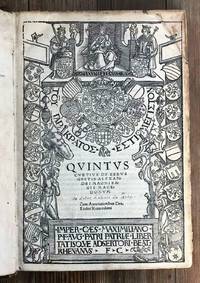
1518curtius<b>Erasmus Finds His Vacation Reading Deficient So He Prepares a New Critical Edition</b><b> <br /></b><br />Folio. 4 LXXXIX leaves; 10 124 pages. Late sixteenth century leather; light scuffing hinges cracked but cords holding tightly; insect damage to text block with loss of text throughout; margins in Orosius trimmed close affecting title image. First printing of Erasmus' critical edition of Quintus Curtius. This first century Roman biography of Alexander the Great was an early Renaissance bestseller with editions from at least a dozen printers throughout Europe by 1517. Erasmus brought it as reading material on a voyage to England in 1517 and finding the text incomplete and corrupt he prepared his own critical edition. This was first published by his friend Strasbourg printer Matthias Schürer in 1518. Erasmus' version proved so popular that five more printers had issued their own editions of his text by 1541; these in turn were reprinted a total of five more times by 1575. This first edition is scarce on the market with Rare Book Hub locating only one sale at auction since 1971 at PBA in 2008 for $2400. <br /><br /><b>Bound with</b>: Paulus Orosius <i>Adversvs paganos historiarvm libri septem</i>. Cologne: Eucharius Cervicornus 1526. An attractive copy of this first universal history by a Christian writer Paulus Orosius c 375-c 418 a Hispanic student of St Augustine who traveled widely throughout the Mediterranean. Elaborate title page border depicting the labors of Hercules signed "AW" Anton Woensam 1493-1541 a prolific painter and woodcut artist whose work was favored by the booming publishing industry in Cologne. Other page borders and initials are also by Woensam as described by Merlo 1864.<br /><br /><br /><br /> Schürer hardcover books
15421298970Basileæ: In officina Frobeniana 1542. Hardcover. Folio 8 816 pages 28 pages index; VG; bound in contemporary full vellum paneled spine with faded ink lettering to head of spine full tooling to boards partial beveling to edges; bound with two clasps majority of lower clasp missing upper clasp present; slight scraping to text block from clasp; woodcut printer's device on title page and verso of final leaf; woodcut initials; colophon on verso of final leaf; text in Latin with sections in Greek; wide margins; no bookplates or previous owners markings; index in rear; This edition is part 2 of "Nouum Testamentum iam quintum ac postremum accuratissima cura recognitum à Des. Erasmo Roterodamo cum annotationibus . Basileae 1541 1542 - cf. colophon.; consignment; shelved case 4. 1298970. Shelved Dupont Bookstore. In officina Frobeniana hardcover books
17971978Derby: J. Drewry 1797. First edition. Contemporary quarter calf over marbled boards; spine ruled in gilt with red morocco label; all edges dyed yellow. Boards and spine rubbed; some chipping along edges. Original stab holes visible in gutter margins. Previous owner's bookplate on front pastedown; ink signature of Mary Wolley to front free endpaper; light foxing. Quarto collates complete with half title and engraved frontispiece: viii 9-128. Bound after Fosbrooke T.D. The Economy of Monastic Life. Glocester: Printed by R. Raikes 1792. First edition dedicated to Edward Jenner who is also listed as a subscriber. Internally a copy in excellent condition.<br/><br/>The grandfather of the illustrious Charles Darwin Erasmus Darwin wrote this treatise on the education of young women to support his own daughters' school at Ashbourne. Darwin's treatise takes a comprehensive view of women's education suggesting that it should reach beyond social skills such as the "perpetual appearance of attention" polite dancing and flattering dress and into formal intellectual pursuits including literature history mathematics and the natural sciences. While he promoted women's education in part to improve the likelihood of companionate marriages Darwin's text tentatively acknowledges that a marital partnership can only function happily when both parties have an intelligent understanding of the world and the ability to participate in it. "A radical campaigner for equality he condemned slavery supported female education and opposed conventional Christian ideas on creation" Farra. With a bookplate from the library of the Wolley family this particular copy has the ownership signature of female reader Mary Wolley. J. Drewry unknown books
1676244187Basle: Genathianis 1676. First edition with Holbein's illustrations. Engraved additional title-page full-page engraved portraits of Erasmus Holbein the Elder and Holbein the Younger engraved transcription of Erasmus' memorial stone & 81 illustrations 6 mounted and folding all with the possible exception of 3 or 4 engraved by Caspar Merian from drawings by Holbein found in Oswald Myconius' copy of the 1515 Froben edition. 1 vols. 8vo. Contemporary calf gilt spine with leather label. Slight wear to spine tips joints starting but solid covers somewhat darkened internally fine. First edition with Holbein's illustrations. Engraved additional title-page full-page engraved portraits of Erasmus Holbein the Elder and Holbein the Younger engraved transcription of Erasmus' memorial stone & 81 illustrations 6 mounted and folding all with the possible exception of 3 or 4 engraved by Caspar Merian from drawings by Holbein found in Oswald Myconius' copy of the 1515 Froben edition. 1 vols. 8vo. Holbein's Illustrations to Praise of Folly. A series of illustrated satirical treates on Catholic dogma this book was released in English as "In Praise of Folly" and enjoyed a long life during the Protestant Reformation in several languages. Graesse II 495; Brunet II 1037 Genathianis unknown books
179143999London: J. Johnson 1791. <p>Darwin Erasmus 1731-1802. The botanic garden: A poem in two parts . . . 4to. xii 214 126 2; 2 ix 197 1pp. General title-leaf misbound before title-leaf to Part II. 20 engraved plates including 5 by William Blake 1757-1827; 2 of the plates are after drawings by John Henry Fuseli 1741-1825. London: J. Johnson 1791. 275 x 207 mm. Half calf gilt marbled boards in period style. Minor foxing and offsetting small marginal stains on two or three plates not affecting the images marginal tears in signature S and one plate repaired but very good. </p> <p> First Edition of Part I; third edition of Part II containing two more plates than the first edition of 1789. Darwin's first major literary work and the chief source of his fame during his lifetime. "The Botanic Garden an annotated scientific poem in Augustan couplets appeared in two parts of which the second The Loves of the Plants 1789 was published before the first The Economy of Vegetation 1791. Darwin decided to publish the second part of the work first because it was better suited ‘to entertain and charm.' The first part of the work is more ambitious than the second covering all natural philosophy and embodying many of the researches and inventions of Wedgwood Watt Boulton and others. The design of the totality was Darwin wrote ‘To enlist Imagination under the banner of Science . . . to induce the ingenious to cultivate the knowledge of botany . . . and recommending to their attention the immortal works of the celebrated Swedish naturalist—Linnaeus'" Dictionary of Scientific Biography. The Botanic Garden is also important for the five plates in Vol. I engraved by William Blake: four engravings of the Portland vase and the "Fertilization of Egypt" after a design by Fuseli. Keynes Blake 103. King-Hele Erasmus Darwin pp. 97-119. </p> . J. Johnson unknown books
16711002105London: E.T. and R.H. for H. Brome B. Tooke and T. Sawbridge 1671. First edition in English of the complete Colloquia Familiaria of Erasmus first published in 1518 and expanded by Erasmus over the next fifteen years a lively collection of Latin dialogues that found a readership far beyond the Renaissance schoolroom. Originally intended to model colloquial conversation for students of Latin the dialogues feature pointed free-thinking exchanges on modern political religious and philosophical questions. In "Of the Abbot and Learned Woman" an ignorant abbot tries and fails to get the better of the classically educated Magdalia a character almost certainly based on Thomas More's eldest daughter: "I think thou art some sophistress thou protest so wittily." Magdalia: "I will not tell thee what I think thou art." And later: "I have often heard it usually spoken that a wise woman is twice a fool." Magdalia: "Indeed it useth to be said so but by fools." The Colloquia Familiaria was widely read and debated across Europe drawing immediate notice for its anticlerical satire: "its influence on the dialogues of Reformation Germany and Tudor England is a critical commonplace" Zlatar Reformation Fictions 11. The original purpose of the Colloquies as a text for teaching Latin postponed its direct translation; this first complete English edition was published more than 150 years after the work's first appearance. The edition opens with a short life of Erasmus and concludes with the first appearance in English of De utilitate colloquiorum Erasmus's 1526 defense of the Colloquies published after the Sorbonne condemned the book for impiety. In response Erasmus makes a case for the educational value of his dialogues' humor: "I cannot tell whether any thing be learned more successfully than that which is learned in playing." Despite his efforts the Colloquies would remain on the Papal Index of banned books through the end of the nineteenth century. Wing E-3190; PMM 53. A very good copy of a humanist landmark in a handsome contemporary binding. Octavo measuring 6.5 x 4.25 inches: 8 555 1. Contemporary Cambridge-style full speckled calf boards ruled and ornamented in blind raised bands red morocco spine label lettered and decorated in gilt top edge stained black. Engraved frontispiece portrait of Erasmus. Final leaf containing second page of bookseller catalogue excised. Joints and spine head expertly repaired; evidence of bookplate removal on front pastedown; effaced signature on title page; some running titles shaved. E.T. and R.H. for H. Brome, B. Tooke, and T. Sawbridge unknown books
15256388Basel: Johannes Froben 1525. Very Good/Erasmus's edition of Pliny's Natural History conserving the notes from Ermolao Barbaro's edition of 1492 printed by Johannes Froben at the height of his powers. Froben's title page is effectively a billboard: "We give you the work of the Divine Pliny called History of the World more emaculate than any edition ever produced before starting with the annotations of erudite men first among them Ermolao Barbaro and then exemplary contributions by learned people which are still worth correcting with faith in the oldest codices from which we have restored many faults do difficult to find that no one no matter how learned could find them or had found them. We have nothing to envy. We have defeated all of our elders. And if someone now takes this prize from us we will not envy them but we will be grateful for the improvement of public education. Go reader and be fruitful. And by the way we added an index that lacks for nothing. Folio 37 cm; 18 leaves 671 143 pages. Woodcut printer's device the double-headed caduceus designed by Holbein on title page on verso of p. 671 on the title page of the index and on the final page. Holbein's detailed chiaroscuro woodcut initials throughout. Bound in vellum over boards titled in manuscript on spine. Old jottings in manuscript on upper board apparently an Italian and Latin vocabulary list including the names of foodstuffs. Portion of vellum near head of spine replaced. Erasmus's name on running head of dedicatory letter aggressively inked over! Occasional scattered very light foxing in a generally bright and unblemished text. References; Adams P-1560; van der Haeghen Biblioteca Erasmiana p. 45. For the initials among Holbein's largest see Schneeli and Heitz table V #II and table LXXXIII #XL. Johannes Froben hardcover books
634118 leaves. Small 4to attractive modern marbled boards red morocco lettering piece on spine. Wittenberg: C. Heyden 1619. First edition of this rare book which is considered by A.D.B. to be the author's most important scientific work; it is a careful record of the third of the three bright comets of 1618-19. Schmidt 1570-1637 was "one of the last of the scholars of Germany who taught the language and literature of Greece in the spirit of Melanchthon. Schmidt was professor first of Greek and next of Mathematics at Wittenberg. His principal work was an edition of Pindar with a Latin translation and a careful commentary 1616."-Sandys II p. 272. Fine copy. ❧ A.D.B. Vol. 32 pp. 27-28. Zinner 4785. hardcover books
15213319Mainz:: Johann Schöffer 1521. ONE OF 9 PRINTINGS all in 1521. Place and printer from VD16. Quarto:. 18.5 x 14 cm. 8 pp. Collation: AA4 Bound in modern wrappers. . A good copy with a light dampstain to the upper corner. Occ. light soiling. With a fine woodcut title page border. A German translation of Erasmus’ annotation on Mathew 11:29 taken from his “In Novum Testamentum annotationes†in which Erasmus differentiates between the divine order and human positive law. He laments that people ignore the commands of God and follow human law instead: ‘Christ’s law is inviting and easy but it becomes onerous and difficult through the addition of human prescriptions and dogmas.’ The verses were often used in Protestant propaganda in the early years of the Reformation hence the need for a vernacular version of Erasmus’ text. See Christine Christ von-Wedel Erasmus of Rotterdam: Advocate of a New Christianity Ch. 16 Bezzel 1228; VD16 E 3106 Johann Schöffer, unknown books
15291832Coloniae: Iohannem Gymnicum 1529. Rare edition a sound complete copy lacking only the final blank. Title within pictorial woodcut border. Octavo contemporary blind-tooled calf over wooden boards dated 1534 in blind brass clasps minor statins and soiling and some early penned marginalia. Also bound in are three additional works De Civilitate Morum Puerilium; Plutarch. De Liberis Educandis; and Horatius Flaccus. Iohannem Gymnicum hardcover books
15402712Cologne:: Ex officina Ioannis Gymnici 1540. RARE COLOGNE EDITION. Folio: . 31.2 x 20 cm. . 88 3-874 1 pp. A-d6 e8 f-g6 A-Z6 Aa-Zz6 Aaa-Zzz6 Aaaa-Dddd6 last leaf is blank. A very fine copy bound in contemporary pigskin over beveled wooden boards tooled in blind. The clasps lacking some scuffing and soiling to lower board otherwise a very nice binding. Internally a beautiful copy with the lightest of occasional soiling. Gyminus’ fine hippocamp device appears on the title. A very rare Cologne edition of Erasmus’ beloved and extraordinarily influential “Adages†first conceived as a collection of proverbial sayings drawn from the Latin authors of antiquity elucidated for the use of those who aspired to write an elegant Latin style. In its first incarnation the “Adagia†consisted of about eight hundred proverbs. The present version Erasmus' "Adagia Chiliades" “Thousands of Adages†is more than just a vastly expanded edition of that first enterprise: "A glance at its composition reveals that the ‘Adagia Chiliades’ was in fact -as well as in name- a new book and that Greek scholarship was largely responsible for the difference. Instead of 818 adages there were 3260. Of those about four-fifths were either new or substantially altered in form. And 2734 contained Greek passages of two to six lines or more in length.â€Renaissance Humanism vol. 2 pages 232-233. “In the dedication Erasmus pointed out the profit an author may derive both in ornamenting his style and in strengthening his argumentation from having at his disposal a good supply of sentences hallowed by their antiquity. He proposes to offer such a help to his readers. What he actually gave was much more. He familiarized a much wider circle than the earlier humanists had reached with the spirit of antiquity. “Prior to the ‘Adages’ the humanists had to some extent monopolized the treasures of classic culture in order to parade their knowledge of which the multitude remained destitute and so to become strange prodigies of learning and elegance. With his irresistible need of teaching and his sincere love for humanity and its general culture Erasmus introduced the classic spirit in so far as it could be reflected in the soul of a sixteenth-century Christian among the people. Erasmus made current the classic spirit. Humanism ceased to be the exclusive privilege of a few. According to Beatus Rhenanus he had been reproached by some humanists when about to publish the 'Adagia' for divulging the mysteries of their craft. But he desired that the book of antiquity should be open to all." Huizinga p. 39-40 Van der Haeghen I 4; Bezzel 83; VD16 E 1944 Ex officina Ioannis Gymnici, unknown books
150031801Lugduni Batavorum Leiden: Pieter van der Aa 170306. Folio extra 39.4 cm 15.5". 10 vols. in 11. I: 3 ff. 24 64 pp. 1226 cols. i.e. 1240; engr. t.-p. 1 double-pg. engr. plt. and 1 full-pg. engr. plt. II: 6 ff. 1212 cols. 54 pp. IIIa: 15 ff. 1104 cols.; 18 full-pg. engr. plts. IIIb: 2 ff. cols. 1105-944 92 ff.; 2 full-pg. engr. plts. IV: 3 ff. 758 cols. i.e. 768; 1 full-pg. engr. plt. 75 single-col. engr. vignettes 3.5 sq. and 6 double-col. engr. vignettes 4.25 x 7.25. V: 3 ff. 1360 cols. VI: 29 ff. 1126 cols. 17 pp. VII: 6 ff. 1198 cols. 1 p. VIII: 3 ff. 652 cols. IX: 3 ff. 1248 cols.; 1 fold-out plt. 1 full-pg. plt. X: 2 ff. cols. 1249860 64 ff. <br><br>Before his death Erasmus 14661536 divided his writings into nine ordines categories for posthumous publication. This is the second edition of his collected works first published in nine volumes by Froben in 1540. Like the original this set includes additions by authors from the Dutch humanist's international circle and portraits of the same as well as => myriad engravings after Holbein. The printer Pieter van der Aa 16591733 was an apprentice of Daniel van Gaasbeeck fl. 165592 and primarily known for maps and travel books.<br>Â Â Â Â The text in all volumes is in Latin with some Greek printed in roman and italic mostly double-column with sidenotes and many large woodcut initials and tailpieces as well as some engraved headpieces. Vol. I has both a general title-page and a volume title-page; each of the volume title-pages is printed in red and black and features a large engraved vignette signed by the illustrator J. Goeree and the engraver J. Baptist; some volumes also have sectional title-pages. There are many engraved plates: vol. I features an added engraved title-page a double-page plate and one full-page plate; in vol. III part one there are => 18 full-page engraved portraits of contemporaries of Erasmus including Melanchthon Alciatus Charles V and Bembo as well as two more full-page portraits in vol. III part two.<br>Â Â Â Â In Praise of Folly in vol. IV is illustrated with => 75 single-column-width engraved vignettes 3.5 sq. and six double-column-width engravings 4.25 x 7.25 after the famous Holbein originals and a full-page engraved portrait of the artist. Vol. IX has one large engraved fold-out plate signed by van der Aa at Leiden engraved by D. Stoopendael as well as one full-page engraved plate unsigned of medallions against a drapery backdrop.<br>Â Â Â Â => A handsome folio set.<br>Â Â Â Â Provenance: Most volumes have a large stamped "Y" on the front pastedown and a faded => 18th-century ink inscription by a monk on the title-page. All volumes in contemporary sheep recently rebacked and repaired using brown calf spine with raised bands accented by gilt ruling with a blind ornament in each compartment title and tome number gilt on green leather spine labels and date gilt collector-style on red leather labels at bases; marbled endpapers and red edges. Boards scuffed and chipped in places; all hinges inside repaired with later marbled paper. Ex- library: most volumes with bookplate and old-fashioned oval stamp on front pastedown stamps on bottom edge and multiple leaves of text early accession number to front free endpaper verso and bottom margin of first text leaf. In all volumes some leaves very browned; occasional dampstaining foxing or other small stains from chemical reactions in paper; small natural paper flaws short closed tears and a few corners torn away not affecting text. Title-page of vol. I with closed interior tear stemming from deep impression of its large engraved vignette; one small tear in vol. IV repaired with monogrammed sticker! Tout entière a nice set. Pieter van der Aa hardcover books
16814103Nürnberg: Wolfgang Moritz Endter and Johann Andreas Endter 1681. Thick 8vo 161 x 95 x 77 mm. 26 1214 2 pages. Title printed in red and black double-page engraved frontispiece or additional engraved title sixty-four numbered engraved plates of which four folding; 43 signed by Cornelius Nicolaus Schurtz 21 unsigned including one of the two frontispiece engravings folding plates 36 and 41 by J. Sandrart. Final errata leaf. Two gothic typefaces woodcut initials typographic printed music on p. 257. Contemporary vellum over pasteboards upper cover stamped in silver-gilt faded I.B.G.V.H. Johann Bernhard Graf von Herberstein and 1681 manuscript spine title edges red-stained lacking pair of fore-edge ties. fine. Provenance: Johann Bernhard Graf von Herberstein 1630-1685 binding and ms. inscription on frontispiece; Christoph Wenzel Graf von Nostitz -Rieneck 1648-1712 bibliophile art collector and art patron engraved armorial bookplate with initials C.W.G.V.N.; stencilled shelfmark 58 on backstrip; with Haus der Bücher Basel catalogue 706 Deutsche Literature der Barockzeit part 1 1963 no. 280.First Edition of a very rare baroque emblem book on the Last Judgment by one of Germany's first professional writers a beautiful copy in immaculate condition. Francisci son of the Lübeck jurist Franciscus von Finx named himself "son of Franciscus" i.e. Francisci. More unusual than this endearing foible was his successful career as a free-lance man of letters. A prolific and popular polymath Francisci died at the age of 68 "having left behind almost as many volumes" Allgemeine Deutsche Biographie. Throughout his career he worked as a sort of house author with the Nuremberg publishing house of the Endter family. "There was hardly an area of knowledge at which he did not try his hand. As one of the first full-time professional authors of Germany Francisci understood how to switch if the need arose to a new area of interest that promised good sales for his publisher" Dunnhaupt Bibliographisches Handbuch I p. 628 my trans. With gusto and success he catered to an audience hungry for tales of distant lands for folklore and "a world saturated with wonders" Faber du Faur German Baroque Literature p. 198 compiling tales of travel and distant lands compendia of natural history and curiosities historical works and devotional meditations. As the thickness of this volume intimates Francisci's Sitzfleisch was awe-inspiring. His versatility huge readership and connections with many members of the "republic of letters" made him one of the most influential German writers of the Baroque. While the prose of his religious works may seem cloying to the modern reader they sold as well as his secular compilations. Being widely read across social classes fine copies of his books are rare. The 64 Bedenckungen considerations of the present treatise are interwoven with fables anecdotes and digressions. Each is illustrated with an engraved emblem Sinnbild set within an exuberant ornamental border the borders of most of the 21 unsigned plates apparently by a less skilled engraver than Schurtz are plainer. Francisci is known to have worked closely with his illustrators and presumably collaborated on the design of these engravings by Cornelius Nicolaus Schurtz Joachim von Sandrart and one other engraver the 21 unsigned plates are in plainer borders and appear to be the work of a less skilled engraver. Characteristically varied in subject-matter the emblems and emblematic scenes are largely secular showing scenes of war domestic life natural disasters seafaring including shipwrecks the plant and animal world including exotic species children romping fireworks alchemical apparatus and even an amputation and a corpse being dissected in an anatomy hall. Only a few contain biblical scenes. Most striking are the four folding plates frightening panoramas of Judgment Day and the two unearthly frontispiece illustrations of which the first shows two men a virtuous man and a sinner in bed dreaming of their respective afterlives. Himself a tireless hymn-writer Francisci dedicated this work on Doomsday to one of the most important composers of Baroque hymns Magdalena Sibylla of Hesse-Darmstadt Duchess of Württemberg 1652-1712. The book includes twenty original hymns or Kirchenlieder to be sung to identified choral melodies. The presumably less well-known music for one Trostlied hymn of consolation is provided on p. 257 with accompanying bass line. This edition collates :8 - :1.8 : : 8 -::8 A-4G8: the signing of the two preliminary quires is odd but this copy is complete. The double-leaf engraving at front may have been counted as the first leaf of the first quire since the first letterpress leaf following the letterpress title is signed ":iii". Both the first quire containing the title-leaf and dedication and the second containing laudatory poems signed by S. E. Gr. zu L and by Joachimus Simon the foreword and the table of contents contain no 8th leaf. This matches other copies and seems to have been due to composing miscalculations resulting in the removal of the final blank of each quire. Some cataloguers included the two-leaf engraved title or frontispiece in their folio count counting 15 preliminary leaves and others more correctly count 13 leaves.Not in NUC; OCLC locates a single copy in an American library at Berkeley. VD-17 reveals that this edition is one of two variant typesettings with the same imprint the other is VD17 1:664300Y; priority is not known and they may be different states of the same edition. A second edition or possibly a re-issue of these sheets appeared in 1684. VD17 12:102498K; Goedeke Grundriss zur Geschichte der Deutschen Dichtung III: 90 176; Dünnhaupt Personalbibliographien zu den Drucken des Barock 1990-93 1538 32.1; Dünnhaupt Bibliographisches Handbuch der Barockliteratur 1980-81 I: 649 32; Praz Studies in Seventeenth-Century Imagery 339. Wolfgang Moritz Endter and Johann Andreas Endter unknown books
1675009581Various places: Various publishers 1675. Book. Very good condition. Hardcover. First Edition. Numerous works bound in one volume. Half vellum binding with marbled paper-covered boards; moderately soiled. Previous owner's bookplate Bilharz on front paste-down endpaper and circular private library sticker at bottom of spine. Works include: 1. Moller D. G. "Dissertatio De Technophysiotameis Von Kunst- und Naturalien- Kammern." Henrici Meyeri: Altdorfii 1704. Dissertaion/Thesis F. S. Wuffbain respondent. 68 pages. 2. Fermin Phillipe. "Memoire sur l'origine de la belemnite contenant la decouverte de l'animal analogue a ce fossile." 4 page manuscript with folding manuscript illustration. Apparently a fair copy of the above named article published in Ph. Renard's "Considerations d'histoire naturelle" pp.63-76 in 1775. 3. Camerarius R. J. "Dissertation inauguralis medica de lapidum figuratorum usu medico." Johannis Cunradi Reissi: Tubingae 1718. Dissertaion/Thesis J. J. Straskircher respondent. 32 pages. 4. Marbodus Bishop of Rennes; edited by F. E. Bruckmann. "Marbodei Galli Poetae Uetustissimi de Lapidibus Pretiosis Enchiridion Cum Scholiis Pictorii Villingensis." Bruckmanniana: Wolffenbuttleae 1740. 82 2 pages. 5. Stella Erasmus; edited by F. E. Bruckmann. "Interpretament Gemmarum Libellus Unicus Plinius Secundus de Gemmis." Carol. Frid. Jungnicolium: Erfurti et Lipsiae 1736. 68 pages. 6. Hebenstreit J. E. "De Ordinibus Gemmarum Verbis C. Plinii ex eius Naturalis Historiae Libr. XXXVII. Qui Totus de Gemmis Est Disserens Panegyrin Medicam." Lipsiae 1747. 16 pages. 7. Hueber G. L. "Disssertatio Inauguralis Physico-Chemico-Medica de Margaritis Earumque Virtute Medica." Joannis Jacobi Christophori Kleyer: Wirceburgi 1744. Dissertaion/Thesis J.G. Gross respondent. 71 xv pages. 8. Vogel R. A. "Terrarum Atque Lapidum Partitio Disputatio Medica Solemnis." Schulzianis Rosenbusch: Gottingae 1762. Dissertaion/Thesis A. F. C. Hempel respondent. 54 pages. 9. Roederer J. G. "Decanus Ordinis Medici in Academia Georgia Augusta Jo. Georg Roderer D. Dissertationem Inauguralem" Schulzianis Rosenbusch: Gottingae 1762. Dissertaion/Thesis with vita of A. F. C. Hempel. 12 pages. 10. Reiske Johannes. "M. Joh. Reiskii de Glossopetris Luneburgensibus ad Virum Nobilissimum Atque Esperientissimum Joh. Georg Hieronymi." Joh. Georg. Lipperi: Lipsiae 1684. 56 pages one folded leaf of illustrations. 11. Guettard Jean Etienne; Philippe Buache. Folding Map. "Carte Mineralogique de la Suisse par Philippe Buache." 1752. 12. Hottinger J. H. "Dissertatio de Crystallis." Bodmeriano: Tiguri 1698. iv 44 pages illustrated by one folding leaf of gems/crystals. 13. Hensing J. T. "Dissertatio Chemica de Germinatione Metallica Arificiali Ejusdemque Novo Invento." Joh. Reinh. Vulpii: Giessae-Hassorum 1718. Dissertaion/Thesis Joh. Georgio Beck respondent. 35 pages. 14. Muller P. L. S. "Dubia Coralliorum Origini Animali Opposita." Io. Diter. Mich. Camerarii: Erlangae 1770. 22 pages. Probably another dissertation: Suscipiet Philippus Ludovicus Statius Muller. 15. Frank Johann. "Disertatio Physica de Coralio Juxta Ductum Plinii Hist. Nat. Lib.32.c.2. adornata." Praelo Bauhoferiano: Jenae 1675. Dissertaion/Thesis Paulus Linsius respondent. 12 leaves. 16. Folding leaf with text and illustrations of tube worms. Measures 10 x 14 inches. "Kurtze Abbildung und Beschreibung der ungewohnten entsetzlichen Wuermen.in gank Nord-holland." Circa 1735. Various publishers Hardcover books
1520253908Basel: Johann Froben 1520. First collected editions. Titles within ornamental woodcut border initials printer's device in colophon. 465 i.e. 495 1; 167 1; and 141 3 pp. 1 vols. 8vo. Contemporary blindstamped pigskin. Covers somewhat soiled one brass clasp missing lower joint just starting but quite firm; internally a SUPERB near flawless copy. Bookplate of scholar and author Nathan Comfort Starr. First collected editions. Titles within ornamental woodcut border initials printer's device in colophon. 465 i.e. 495 1; 167 1; and 141 3 pp. 1 vols. 8vo. First collected editions of these "Paraphrases" of the letters of Paul which were undertaken shortly after Erasmus's revolutionary edition of the Greek New Testament of 1516. As part of that monumental reconstruction of the New Testament Erasmus' intention was to "retell" the books of the New Testament in one uninterrupted voice without the clutter of textual commentary or critical interruption. It was a bold undertaking and in 1517 Erasmus began with the letters of Paul. They were first issued separately starting with Romans in 1517; and editions appeared in Louvain Thierry Martens Leipzig Valentin Schumann and Basel Johann Froben. The collected issues - such as the three which are bound together in this exquisite volume - began to be issued in Basel by Froben in 1519; and finally in 1521 Froben issued a collected edition of all of the Pauline letters. All of the lifetime editions both separate and collected are rare on the market: the last copy of any of the above collected Pauline paraphrases to appear at auction was in 1977. Adams E790; E792; E791 Johann Froben unknown books
15242455Paris:: Jodocus Badius Ascensius 1524. FIRST COMPLETE BADIUS EDITION. Quarto:. 19.8 x 14.5 cm. CXX leaves. Collation: a-p8 Bound in contemporary limp vellum lightly soiled. The contents are in very good condition with a few pencil annotations and light soiling to the title page. With Badius' device of his print shop the “Praelum Ascensianum†showing printers working a press on the title page. With large attractive crible initials and smaller charming historiated initials. Passages in Greek. A fine unsophisticated copy of this rare edition. From the personal library of Bob and Emily De Graaf. The rare 1524 Parisian “Praise of Folly†printed by Erasmus’ friend the scholar-printer Badius Ascensius who printed the first authorized edition in 1512. This edition contains all of the supplementary texts found in the Froben edition of 1516 including the dedicatory letter to Thomas More whose name Erasmus plays upon cleverly in the title of the work; and the letter to Martin Dorp in which Erasmus explains his motives for writing the “Moriaâ€: “My aim in the ‘Folly’ was exactly the same as in my other works. Only the presentation was different. In the ‘Enchiridion’ I simply outlined the pattern of a Christian life. In my little book the ‘Education of a Christian Prince’ I offered plain advice on how to instruct a prince. In my ‘Panegyric’ I did the same under the veil of eulogy as I had done elsewhere explicitly. And in the ‘Folly’ I expressed the same ideas as in the ‘Enchiridion’ but in the form of a joke.†“The ‘Praise of Folly’ is Erasmus’ most famous and controversial work… In Erasmus’ lifetime the ‘Moria’ was condemned in 1527 by the theologians of Paris for its attacks on faith and morality and again in 1533 by the Franciscans who found it full of heresies. The officials of the Sorbonne put it on the list of condemned books in 1542 and 1543 a list that was the basis of the Tridentine Index of 1564… “The ‘Moria’ may start as a learned joke to amuse a fellow humanist Thomas More but it moves into sharp criticism of contemporary mores and ends with a plea for a return to the Christianity of the Gospels… Erasmus writes in a Lucianic spirit of irreverent burlesque of the gods of classical mythology and light-hearted amusement at the irrationality of mankind. Folly argues that she is all that is natural youthful fecund and happy and that life would be intolerable if it were not ruled by civilized conventions which necessitate a degree of humbug and illusion. By contrast the Stoic ideal rational man is a ‘kind of marble statue of a man devoid of sense and any sort of human feeling.’ She then shifts her viewpoint and lists the people who enjoy her benefits in so far as they try to preserve their illusions or are happy in their ignorance self-deception or self-love. She even adds superstitious piety to alchemy gambling and the nobility’s obsession with hunting and extravagant building… “Next Erasmus starts to deliver a sharp and often bitter attack on all the victims of blind folly those who are deaf to the voice of true religion and lacking the gentler Christian virtues among whom are sycophants self-seekers money-makers pedants scholastics lawyers theologians superstitious worshippers of images and relics courtiers and kings worldly monks and irreligious pontiffs. This section culminates in a savage thrust at Pope Julius II the bellicose pope. The keen wit and ingenuity of the satire can be highly entertaining but there is no note of gaiety now. As Erasmus surveys the gulf between the Church and the ‘true philosophy of Christ’ he moves into the final section where the alternative offered to barren scholasticism is the vision of reality taken from Plato and folly in the sense used by Saint Paul that of receptivity to the Christian message by the ‘fool in Christ.’ All irony is dropped until the final short epilogue when Folly light-heartedly cuts short her ‘hotch-potch of words’; this is a direct and simply worded account of Erasmus’ personal belief moving into an exposition of the Neoplatonist concept that the soul’s ascent to beatitude ends in ecstasy a form of folly which is its supreme fulfillment.â€Betty Radice CWE Vol. 27 pp. 78 ff. Vander Haeghen I 123; Kossmann 979; Bibl. Belgica E 866; Not in Bezzel De Reuck or BM STC French; Renouard Badius II 424; Adams E 397. Inventaire chronologique des editions Parisiennes du XVIe siecle III no. 669; Renouard Imprimeurs Parisiens du XVIe siècle II no. 539 Jodocus Badius Ascensius, unknown books
1545314899Argentorati Strasbourg: Vuendelinus Rihelius Wendelin Rihel 1545. Fourth edition of the Calvin; second Froben folio edition of the Erasmus. Collation alpha-gamma6 delta4 A-Z6 a-s6 t-v4 v4 blank present. Pp. 431 505 3 blank. Errata at foot of index p. 43. 1 vols. Folio 11-3/4 x 8 inches. Contemporary blindstamped pigskin over wooden boards with metal clasps. With 8 pages of contemporary Latin notes loosely inserted; contemporary marginalia throughout second work. L2 in Calvin with old ink stains not affecting legibility; some wear along one bottom edge of binding. Manuscript prayer in Latin on lower pastedown. Small later paper label on upper cover "Bibliothèque de Spietz". A handsome copy. Fourth edition of the Calvin; second Froben folio edition of the Erasmus. Collation alpha-gamma6 delta4 A-Z6 a-s6 t-v4 v4 blank present. Pp. 431 505 3 blank. Errata at foot of index p. 43. 1 vols. Folio 11-3/4 x 8 inches. Calvin's 'Instutitio': Cornerstone of Liberty. "Calvin's 'Institution of the Christian Religion' was the first systematic statement of a Reformed Church. It is the most important doctrinal work of the Reformation as a whole and provided a comprehensive theological system rivaling those of the Middle Ages . Calvinism's most important role despite Calvin's authoritarian influences was to support the movement for liberty and independence in many parts of the world" Printing and the Mind of Man 65. First published in Basel in 1536 the "Institutio was much revised taking its final form in 1559" PMM. Calvin understood the importance of vernacular translations in the transmission of ideas made possible by the printing press and prepared a French edition in 1541. This fourth edition follows closely and corrects the third edition printed in 1543. All early editions are uncommon.<br/><br/>Calvin 1509-64 drew upon St. Augustine and Luther as well as upon classical sources including Plato and Seneca; his work addressed theological issues and also notably the relations between ecclesiastical and civil government. The contemporary annotations often callouts of classical authors and shoulder notes with a few pointing hands are most extensive in the first six chapters again in chapter sixteen on the Lord's Prayer where Melanchthon is cited but appear throughout. <br/><br/>The first work in this well preserved contemporary binding is the second Froben folio edition of Erasmus Ecclesiastes Basel: Froben 1539. OCLC 632887280 BSB Augsburg Univ. Basel. Collation a-z6A-M6N4O-Q6. Pp. 439 1 blank 18 index imprint date 1540 1 blank 1 Froben's device. This was first published in Basel in 1535. The manuscript notes refer to in the early passages of this work. The Bibliotheque de Spietz was dispersed at auction in 1874. The von Erlach family had been established at Bern since the early sixteenth century. Calvin: PMM 65; Adams C357; VD16 C 291; Peter & Gilmont Bib. Calviniana 45/5; En français dans le texte 59 for 1560 ed. Erasmus: Bezzel 823 Adams E632; VD16 E 2723 Vuendelinus Rihelius [Wendelin Rihel] unknown books
14155374Strasbourg: Matthias Schürer 1514-1515. First edition of some material. Hard Cover. Very Good/Several related works of Erasmus collected in one binding including the first edition of Parabolae sive similia a reported 1513 edition of Parabolae was a longstanding bibliographical error and the first appearance of Erasmus's farewell letter to Jakob Wimpfeling Epistle 305. In 1509 the year Mattias Schürer completed his apprenticeship and opened his own print shop he struck an unauthorized edition of Erasmus's Adagia purloined from the first edition of 1500. Anger on the author's part would have been justified. Yet in spite of this commercial indiscretion Erasmus favored Schurer with a warm supportive and lasting friendship. In October 1514 he gave Schürer the manuscript of "Parabolae sive similia" which Schürer decided to publish in tandem with a reprint of De Copia although there are copies extant of Parabolae bound alone. It is fitting that Parabolae should be bound with Adagia in this copy since it expands on the earlier work's idea of compiling classical maxims. Parabolae that is The Parables is a catalogue of didactic similes gleaned from Plutarch Seneca and Pliny who almost never used similes in his own text. The Adagia is also the subject of Erasmus's letter to Wimpfeling whom he thanks for recommending it for a school text. Schürer's edition of Adagia of 1515 is the first to contain the printer's own "table of proverbs" to function as a key to the collection. In all Schürer published 57 editions of 15 titles by Erasmus in the five year period from 1514 to 1519 the year he died. Quarto 21 cm three parts in one volume: I: 6 73 6 leaves; II: 56 leaves; III: 4 57 7 leaves. Numerous five- and six-line "criblé" woodcut initials on black ground decorated with arabesques and figures many of them carefully rubricated. Second title page with woodcut architectural border lightly rubricated. Printer's "usui studiosorum" device on last printed page rubricated. Bound in contemporary or 17th-century blind-stamped alum tawed pigskin over wooden boards with a Cardinal's arms gilt on both boards. Clasps and catches preserved straps renewed. Some small worming at spine ends. First title leaf somewhat toned and soiled. Occasional marginalia in contemporary or early hand. Contemporary ownership inscription on title page. References: VD 16 E-2645 and E-3237; Adams E-318 and E-716; Panzer VI 68 340-341; "Early Editions" Toronto #369 etc. Matthias Schürer hardcover books
5783Title within woodcut border & woodcut on verso of final leaf. 54 2 pp. Small 4to modern binding reusing an early MS. leaf over boards verso of final leaf a little soiled. Basel: J. Froben 1518. First separate edition of these two famous texts "In Praise of Marriage" and "In Praise of Medicine." The first work created a cause célèbre; written many years earlier in honor of the marriage of his friend Lord Mountjoy when finally published it was seen by the Louvain and Paris theologians as an implicit condemnation of clerical celibacy. The second work is Erasmus's expression of his views of the medical arts. It "presents a view of medical ethics that identifies competence beneficence and diligence as the physician's primary moral obligations. The activity of the physician when directed toward the patient in accordance with these obligations gives rise to reciprocal obligations on the part of the patient: gratitude and reward. The activity of the patient in accordance with these obligations returns honour and payment to the physician."-Albury & Weisz "The Medical Ethics of Erasmus and the Physician-Patient Relationship" online resource. It is dedicated to the distinguished physician Henricus Afinius the chief physician of Antwerp. These two works were first published a few months earlier as part of the Querela Pacis printed in Louvain. Fine copy and rather scarce. hardcover books