96 résultats
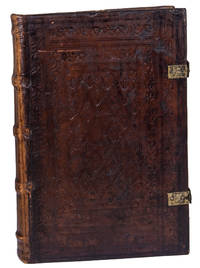
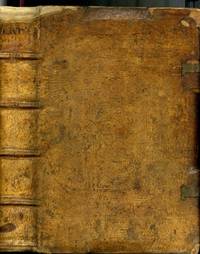
1531049721Basel: Officina Frobeniana Froben 1531. First Edition. Hardcover Vellum. Very Good Condition. Contemporary rolled pigskin worn and discolored with old repairs to spine ends and edges but quite sound. Clasps intact. Early notes and an old bookseller catalog entry to front pastedown. The notes appear to be in two hands one contemporary in the same or similar ink to Chripstoph Binder's signature to the title and the other a little later. Title page printer's device with early coloring. Neat marginal notes and underlining throughout heavier early on and at the end neat interlinear notes and notes to the Erasmus letter. Many of the later notes written in triangular format. Scattered stains tiny wormtrails heavier early on some marginal dampstaining at beginning and end. A nice copy. Separate title page for the Chronologia.<br /> <br /> 8 244 243 210 91 74 45 1 p.<br /> <br /> Provenance: With the signature on the ttitle page of Württemberg theologian Christoph Binder 1519-1596 the first Protestant abbot of Adelberg Abbey. Size: Folio. Quantity Available: 1. Shipped Weight: Under 1 kilo. Category: History; Antiquarian & Rare. Inventory No: 049721. Officina Frobeniana (Froben) hardcover
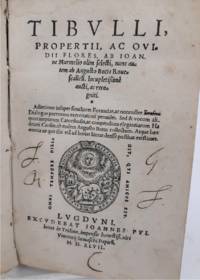
15471328082Lugdunum: Ioannes Pul Ioannes Pullonus 1547. Other. Tibulli propertii ac Ovidii flores ab Ioanne Murmelio olim selecti nunc autem ab Augusto Botta Rouescallen. Iocupletissimè aucti ac recogniti. Edited by Ioannes Murmellius and Augustus Botta Rouescallen. Lugdunum: Ioannes Pullonus 1547. 117 pp. Text in Latin. Duodecimo in early vellum boards. A partial title has been written on the spine in faded ink. The initials F.R.G.F.C. appear in ink on the title page and the name Erasmus has been crossed out in two instances. A book stamp likely placing this volume in a library or collection in Bologna in the 19th century appears on the final page of text. Condition: Very Good. The boards are very thin and have become cockled. The vellum is somewhat darkened with age and light staining and shows minor insect damage. There is evidence of a closure device now absent on both boards. Both paste downs are partially detached but the binding is overall very solid. The pages are somewhat age-toned with occasional foxing. There are a handful of small ink marks to the textblock. Dimensions 4.25 x 6.375 x 0.625 inches<br /> <br> <br /> <br> <br /> shelved case 3. 1328082. Shelved Dupont Bookstore. Ioannes Pul [Ioannes Pullonus] unknown
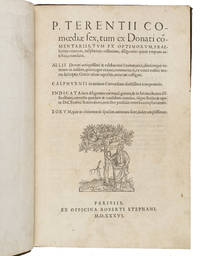
1536ABC_49923Paris: Robert Estienne 1536. Late 17th-century calf sewn on five supports with corresponding raised bands richly gold-tooled spine with the author title and year lettered in gold and red and-brown sprinkled edges. Small folio 20.2 x 30.3 cm. With Estiennes small woodcut device ona small woodcut the title page. Second edition of Terences Comoediae published by the French humanist and printer Robert Estienne 1503-1599. Publius Terentius Afer also known as Terence ca. 195-ca. 159 BCE was a Roman playwright of North African origin and one of the foremost authors of Latin comedy. The present work includes the commentary of Aelius Donatus 4th century CE based on a manuscript provided by Estiennes father-in-law Josse Bade 1462-1535. Donatus was a Roman grammarian and teacher of rhetoric best known for his grammatical works Ars Minor and Ars Maior. Building on Estiennes earlier 1529 folio edition this one was printed in the new Roman types and divided into acts and scenes a notable innovation. In addition Estienne incorporated Erasmus treatise on comedic metres which provided a scholarly analysis of the rhythmic and metric structures of classical comedies enhancing readers understanding of Terences original cadence and comedic effect.The boards are severely rubbed light foxing and staining throughout the title page is very slightly browned the head margin is cut slightly short. Otherwise in good condition.l Adams T 326; BM STC French p. 416; De Reuck 512; Inventaire chronologique des editions Parisiennes du XVIe siecle V 314; Renouard Estienne I 43 no. 15; Schreiber 52; USTC 147028 9 copies; Vander Haeghen II 55. Robert Estienne, hardcover
15672733Basileae : Apud haeredes Nicolai Brylingeri M. D. LXVII. 1567 1567. Hardcover. Good. 26 643 1 p. the last page blank ; 17 cm. 8vo ; References: Adams; T-361; VD16; T-466 ; OCLC: 35196231 ; preface by Desiderius Erasmus dated 1532 ; includes commentary on each play by Giovanni Calfurnio ; Title vignette; initials ; Signa tures: a-z8 A-T8 Nota Bene: incomplete volume : A-B are missing pages 339-375 comprising Actus II Scena I - Actus III Scena II of Adelphi ; Contemporary panel-stamped cream/butter-colored pig-skin binding ; raised bands ; green speckled fore-edg e ; two-tone silk headband ; bookplate "E Bibliotheca Collegii Cremsensis" dated 1818 with ownership written in ink across title page ; large crayon pencil mark in red "LVIII29" on lower portion of title page ; text in Latin italic type font f or the text of the plays ; only one other known institution copy held by the Newberry Library ; slight worm damage to top of spine ; soiling ; marginalia on some pages in a contemporary humanist hand on pages 2-5 17-19 439-40 445 478-79 491-92 529-30 615 640-42; name and text on back ep in a German hand writing Frakturschrift consisting of a paraphrased quote from the Psalms ; Contents : Terentii Vita -- Andria -- Evnvchvs. Eunuchus -- Heavtontim. Heautontimorumenos -- Adelph. A delphi -- Hecyra. -- Phormio. ; also contains a poem in Latin iambs by Erasmus printed on the reverse of title page ; G <br/> <br/> Basileae : Apud haeredes Nicolai Brylingeri, M. D. LXVII. (1567) hardcover
1556LLV2641Lugduni Lyon:: Seb. Gryphium 1556. 1556. Small 8vo. Pagination: 473 23 pp. Signatures: a-z8 A-H8. Printer's device on the title page woodcut initials printed marginalia; editor's name on title and p. 2 are lined out in ink three small worm holes from title-page. Nineteenth century quarter gilt-ruled calf red paper board boards. Early ink name on title of "Carolus . . ." and occasional marginalia pp. 58 61 62 80-83 heavy notes - in the same hand. Very good. Beautifully printed early pocket edition printed by Sebastianus Gryphius 1493-1556 of Suetonius' most famous work and one of the few of his texts that survive with excellent annotations by Desiderius Erasmus of Rotterdam. Commonly known as The Twelve Caesars the work contains a set of twelve biographies of Julius Caesar and the first eleven emperors of the Roman Empire Augustus Tiberius Caligula Claudius Nero Galba Otho Vitellius Vespasian Titus Domitian. It is a primary source for the study of Roman history. <br /><br /> The first edition of Suetonius with Erasmus' annotation was issued in 1533. <br /><br /> Baudrier Henri L. Bibliographie lyonnaise VIII p. 284; Gultlingen V p. 215: I369; French Books III & IV: Books published in France before 1601 . . . edited by Andrew Pettegree Malcolm Walsby Leiden: Brill 2012 87100. <br /><br /> Locations: BYU lacks everything after p. 340 and title is damaged; NYPL. Seb. Gryphium, 1556. hardcover
1515ABC_49919Basel: Johann Froben 1515. Contemporary blind-tooled calf over wooden boards with brass and leather clasps along the fore edge professionally re-backed with later blank pastedowns. Folio. With the title set in a splendid woodcut frame by Urs Graf including Froben's small woodcut device woodcut decorations in the fore-edge and gutter margins of the table of contents verso of the title page and another elaborate woodcut frame on the first page of the dedication. Further with some woodcut initials and Froben's large woodcut device below the colophon on the last page. Senecas complete works here carefully prepared by Erasmus and printed by the renowned Basel publisher Johann Froben are remarkable both for its scholarly rigor and its historical significance. The present work represents one of the earliest Renaissance printings of Senecas writings presenting essays letters and philosophical dialogues that guide the reader toward virtue wisdom and a well-examined life. Erasmus thorough editorial care ensured that the texts were largely purged of errors making this edition an important reference for both humanist scholars and students of classical literature.In addition to the main works this volume includes a number of supplementary writings added by Erasmus reflecting his deep engagement with Senecas philosophy and his commitment to moral and linguistic improvement. The preface encourages attentive reading promising both the refinement of language and the betterment of ones life.The work entitled Ludus de morte Claudii Caesaris includes marginal commentary by Beatus Rhenanus a German humanist and reformer who was a friend of Erasmus and actively involved in the publishing activities of Johann Froben.With printed ex libris bookplate mounted on the front pastedown manuscript waste visible between the front and back endpapers a few manuscript annotations in the margins and some of the text underlined. The binding shows signs of wear the boards have been rubbed some loss of material a small worm hole in the back board the pages are cut slightly short at the head not affecting the text and some occasional slight staining and browning. Otherwise in good condition.l BM STC German p. 808; USTC 667432; Vander Haeghen II 49; VD 16 S5758; not in Bezzel; De Reuck. Johann Froben, hardcover
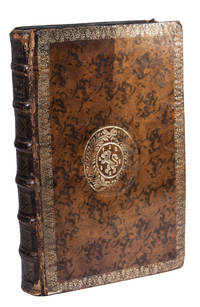
1514ABC_49925Paris 1514. Folio. Jodocus Badius 18th-century gold-tooled mottled calf sewn on 6 supports with corresponding raised bands on the spine the author and title lettered in gold on the spine both boards show a gold-tooled armorial centre piece incorporating the arms of the city of Nevers or the arms of the Conflans family from the Champagne region Rietstap I plate CXVIII within a gold-tooled floral frame blind-tooled board edges marbled edges. With a woodcut border and printers device on the title page printed in red and black along with numerous woodcut decorated initials throughout. 6 CCLXVII 1 ll. 1514 Paris edition of Senecas tragedies printed and edited by the humanist printer Jodocus Badius 1462-1535 with contributions from Erasmus and others. Although Erasmus had permitted Badius to use his preparatory work in his autobiographical letter to Botzheim he reflects on the painstaking effort that went into this preparation and subtly expresses his irritation at seeing Badius nostra cum alienis miscuisse that is having mixed Erasmus contributions with those of others. The present work comprises nine dramatic works and extensive scholarly commentary by leading Renaissance philologists.With a printed book plate of the Fossé d'Arcosse family and a manuscript presentation note dated 1828 Emilien Fossé Darcosse donné par Mr B. V. le 10 septembre 1828 on the front pastedown. On the first free endpaper an 18th-century Latin manuscript inscription records the awarding of a prize to Franciscus Vermeil a noble student at the Jesuit College of Nevers in France for his scholarly achievements. The prize which included an award for a Latin oration was granted on 4 September 1746 by virtue of a perpetual endowment from the city of Nevers. The award is formally attested by the Praefectus Studiorum director of studies J. Petrus Coriou whose autograph and the official seal of the college are present. The corners of the boards are bumped the front hinge is weakened the ends of the spine are slightly damaged with some minor loss of material and with some minor loss of material on the back board. The front board is slightly rubbed the outer half of both boards is slightly faded from sun exposure. The lower margin of the title page and the outer margin of the sixth preliminary leaf have been reinforced. The final privilege leaf blank on the verso except for some manuscript annotations has been mounted on the recto of the adjacent blank flyleaf. The first and last leaves are slightly water stained and the upper margins have been cut somewhat short. Otherwise in good condition.l De Reuck 497; Moreau and Renouard 967; Renouard Badius III 252-53; USTC 144361; Vander Haeghen II 49; not in Kossmann. hardcover
1514047405Paris: Jodocus Badius Ascensius 1514. First Edition. Hardcover Full Leather. Very Good Condition. Later ca. late 17th century or early 18th speckled paneled calf edges sprayed red. Front hinge cracked and a little loose but held by cords endpapers browned at edges two old bookplates contemporary signature and an old note to title. Title printed in red and black with an elaborate border with printed some red to the figures. Scattered very minor browning - a clean bright wide margined copy. 6 CCLXVII 1 leaves. Two blanks at front and two at rear. <br /> <br /> An important edition of Seneca the first with the new critical material by Erasmus including an account in the preliminaries of Seneca by Crinitus. Erasmus had done new critical work on the tragedies and supplied it to Bade who without his knowledge or consent commingled it with the criticism and notes of Caetani and Marmita. The Wrest Park copy.<br /> <br /> Bookplates of Anthony Earl of Kent 1702 and Thomas Philip Earl of Gray - Wrest Park. Old signature to title Jean Ma. and "sum I.ger amicorum" at bottom of title. <br /> <br /> Adams S 901 Size: Folio. Quantity Available: 1. Shipped Weight: 1-2 kilos. Category: Literature & Literary; Inventory No: 047405. Jodocus Badius Ascensius hardcover
1520ABC_49876Basel: Johann Froben 1520. Modern gold-tooled half calf and marbled paper sides with the author title and year of publication lettered in gold on the spine red sprinkled edges. 4to. With the title set within an elaborate woodcut frame a smaller woodcut frame on the verso of the title page and the first page of the first text. Further with 9 woodcut decorated initials woodcut headpieces and a small woodcut illustration incorporating Frobens device on the last page. This finely printed 1520 Basel edition presents a collection of Erasmus earliest translations from the works of the Greek moral philosopher Plutarch. The volume presents eight of Plutarch's shorter treatises addressing themes such as friendship health and the nature of the human soul.One of the most notable inclusions is De discrimine adulatoris et amici How to tell a flatterer from a friend a treatise Erasmus translated during his time in Cambridge and dedicated to King Henry VIII. The text which explores the subtle art of distinguishing true friendship from sycophancy resonated in an era when rulers were often surrounded by flattering courtiers. With characteristic tact Erasmus hoped the work might serve both as philosophical instruction and as a gentle warning to the young English king particularly in light of those who had encouraged Henrys war with France.Furthermore the present work includes two of Plutarchs important medical treatises in Erasmus translation: De tuenda bona valetudine Advice on keeping well and Utrum graviores sint animi morbi quam corporis Are diseases of the soul more serious than those of the body. The latter contains strikingly early and thoughtful reflections on what we now recognise as mental illness. Other works included in this volume are: Quo pacto quis efficere possit ut capiat utilitatem ab inimico reflections on transforming enmity into wisdom and personal growth. In principe requiri doctrinam on the necessity of wisdom and education in a prince. Cum principibus maxime philosophum debere disputare a meditation on the philosophers role in advising those in power. Num recte dictum sit e ßsa on the meaning of the maxim lathe biosas: to live quietly and modestly. De cupiditate divitiarum a discourse on avarice and the moral corruption born of greed.With a small manuscript note added above the title opuscula and a 17th- or 18th-century owners inscription by an otherwise unidentified Johannes below the colophon on the final page. Slightly foxed and browned throughout the fore-edge and lower margins are cut slightly short barely affecting the printed marginalia. Otherwise in good condition.l Adams p. 654; Ledo pp. 260-66; USTC 655014 6 copies; Vander Haeghen II 46; VD 16 P 3718; not in BM STC German; De Reuck. Johann Froben, unknown
15238509Argentorati Strasburg: Iohannes Cnobloch execudebat Quinto Idus Iunias Anno. M.D.XXIII. 1523. 1523 20 130 i.e. 120; 107 1 leaves ; 16 cm. Collates Aa8 Bb4CC8 a-p8 A-N8 O4. D&M 6103a. Recently bound in calf to style with blind decoration to the boards. The spine has raised bands and is titled in gilt. Marginal annotations thoughout. Part title to Epistolae Apostolicae and Cnobloch's device printed at the end of both parts. The imprint and date are supplied from the colophon. The text of each book begins with a 14 line rubricated initial including one decorated with three parrots at the start of Evangelium Secundum Ioannem. PROVENANCE: The title page verso has the bookplate of the Nuremburg bookseller collector and bibliographer of alchemical literature Friedrich Roth-Scholtz 1687-1736. The title page and part title have a neat 19th century stamp of the Univerity of Erlangen now Erlangen-Nuremberg. an excellent early printing of Erasmus' important NT. Argentorati (Strasburg): Iohannes Cnobloch execudebat Quinto Idus Iunias Anno. M.D.XXIII. hardcover
15791306270053Parisiis: Sumptibus Herculis Francois 1579-01-01. Hardcover. Acceptable. Early black pigskin raised bands. 12mo. 1296 25 pp. Later part of index bound in front. Title page in facsimile. Lacking first 24 pages of preface. Minor foxing marginal dampstaining affecting text. Restoration to final leaves. 1095-1296 is Parabolae sive similitudines: Des. Erasmi Roterodami. <br><br> The Alsatian humanist Conrad Lycosthenes Conrad Wolffhart compiled this collection of classical anecdotes. Lycosthenes was a noted populizer of classical science and medicine. Parisiis: Sumptibus Herculis Francois hardcover
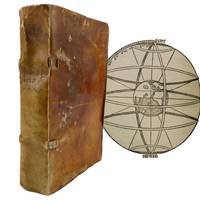
1558800Wittenberg: Krafft 1558. Softcover. Fair. Misc. A remarkable survivor clearly a student's copy of Sacrobosco's Libellus de Sphaera printed in 1558 with the student's inscription at the bottom of the title page and a question and answer styled study guide bound at the rear 1560 by Hartmann Beyer. The shared shelfmark from the title page to the binding indicates the wallet-style binding may be contemporary to the book. Also this copy still retaining its broadside with the locations of the sun updated since the 365.25 days per calendar year causes yearly drift in the location of the sun by day since the true day is slightly shorter. Sacrobosco's work was first produced around 1230 a text book dedicated to spherical astronomy. Although Sacrobosco did use the Earth as central to all rotation his methods of finding the locations of stars the sun and moon based on elliptical patterns was fairly reliable and became the standard of students for centuries to come. He also correctly identified the world as a sphere. By 1558 the idea of the Earth as the center of the universe was largely dispelled but Sacrobosco's calculations and tables were so good that they were yet to be replaced so academies were updating to accommodate the new science. This copy has the commentary and editing of several 16th century scholars Philip Melanchthon and Erasmus Reinhold as well as a second book with commentary of Hartmann Beyer. The university usage of this copy is clear and to be noted. The scholar one Wolfgang notes at the bottom of the title page that he is studying physics. The 17th century date of study denotes that an older book was still acceptable in studies. Yet despite the later date the binding contains both the 1558 Sacrobosco and essentially a 1560 study guide posing the question ""Has this book been used for study before Wolfgang wrote in it"" A mystery is the Cistercian monastery also holding the work. Did they possess the book before or after Wolfgang Or was it from a different Cistercian monastery that was dissolved during the protestant reformation years leading up to Wolfgang's study Bibliographic Details - 1558 Sacrobosco - Universal Short Title Catalogue USTC number 668014 6 copies recorded in the world's libraries. 1560 Quaestiones. - Universal Short Title Catalogue USTC number 689026 5 copies recorded in the world's libraries and USTC 689025 recording four more copies. Physical Attributes - Measures approx. 15 x 9 x 3 cm. Vellum wallet-style wrapper. Spine with two bands. Spine with author/title in old hand. Sacrobosco's work is illustrated throughout some with diagrams that could be used as the base for moving parts. Sacrobosco - Pages - Not paginated Collation - A-R8 with last two blank leaves present. Collates complete. Beyer - Pages - xxxii 302 2 blank pages last leaf blank Collation - aa8 a8 b-u8 collates complete. Condition - See pictures. Wallet-style vellum binding with wear and cockling waviness. Bottom of flap corner chipped away. Top front strap missing from binding to text block causing looseness still connected in back. No pastedowns used. Matching library number to title page written on front board inner as well as bookseller notes of date/publication and ex libris of Gingerich. 1st gathering almost loose chipping to top edge. Title page heavily annotated with two ex libris. One is the library of a Cistercian monastery and the other is of an early 16th century student. The title page has heavy toning and some chipping along edges. Bottom corner of front of text block dog eared. Throughout text block there is use consistent with student usage. Occasional thumbing dog-eared corners annotations page-edge chips/tears fox spots candle ember marks etc. Occasional moisture mark from edge second half from upper corner worst at last page. Occasional faded page E gathering ink light. Krafft
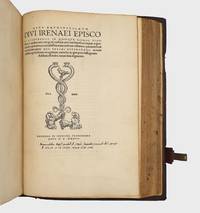
1534372762Basel: Froben 1534. Third revised Erasmus edition first 1526; second 1528 of Irenaeus' treatise "Against Heresies. Printer's device on titlepage and last page; head-pieces; initials; printed marginalia. 1 vols. Folio. Near contemporary dark calf over wooden boards stamped in blind upper board dated 1545 brass clasps. Headcaps worn one clasp perished. Third revised Erasmus edition first 1526; second 1528 of Irenaeus' treatise "Against Heresies". Printer's device on titlepage and last page; head-pieces; initials; printed marginalia. 1 vols. Folio. Third Erasmus edition of Irenaeus' treatise Against Heresies consisting of five books which are preserved in their entirety only in their Latin version. It is Irenaeus' principal literary work which had a significant impact on the development of the church during the first three centuries.<br /> <br /> Colophon: Basileae in officina Frobeniana per Hieronymum Frobenium et Nicolaum Episcopium An. M D XXXIIII mense Martio.<br /> The work is bound with an extensive commentary on the Gospel of Matthew by Wolgang Musculus 1544. The nicely preserved binding is dated M.D.XLV. 1545 on upper board. VD16 I 318. Provenance: Provenance: title page of Musculus signed: Ludovicus Rabus . 1544 and Iohannes Longlinus . 1550; bookseller's label on front paste-down: G. & B. Westermann Bros. Deutsche Buchhandlung 290 Broadway New-York; Bookplate of Rev. Edwin A. Dalrymple; Maryland Diocesan Library; General Theologiccal Seminary bookplates and stamps Froben unknown
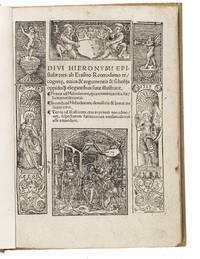
1518ABC_49875Cologne: Johann Gymnic 1518. Modern faux-leather-patterned paper with a grey paper label on the spine with the authors name lettered in silver Erasmus v. Rotterdam. 4to. With the title set with in a frame built up from 4 or possibly 6 woodcut illustrations including printer's initials and the date 1518 and 10 woodcut decorated initials. Selection of three letters by the Church Father Jerome of Stridon Saint Jerome ca. 342/47-420 CE edited and annotated by Erasmus. Erasmus felt a profound connection to Jerome. He saw in the ancient Church Father not only a kindred spirit but also a mirror for his own intellectual and spiritual journey. Included in this volume are three letters: first the epistle to Heliodorus on the praise of the solitary life de vita solitaria a stirring defence of ascetic withdrawal from the world; second the epistle to Heliodorus on the misery of human life de miseria vitae humanae a sombre reflection on the fleeting nature of earthly existence; and third the epistle to the monk Rusticus on avoiding familiarity with women de mulieribus evitandis a warning shaped by both monastic ideals and Jeromes personal convictions. Additionally a short fourth letter addressed to Onasus is included at the end of the volume though it does not appear on the title page. In this letter he satirically addresses the priest Onasus who had a deformed nose and his feeling of being unjustly attacked and being made a fool of in other letters and writings by Jerome.With early manuscript annotations corrections etc. of the printed text in the margins and occasional underlining of the text mainly concerning the third letter written in three different hands in both brown and black ink. With a 0.5 cm worm hole in the gutter margin not affecting the text. Occasional foxing and browning and some water staining in the fore-edge margin of several leaves. Overall a good copy.l BM STC German p. 440; USTC 640603 3 copies; Vander Haeghen II 29; VD 16 ZV 7938; not in Adams; De Reuck. Johann Gymnic, hardcover
15741304040108Paris : Hieronymum de Marnef Gulielmum Cauellat Cavellat 1574-01-01. Hardcover. Good. 16mo 12 cm. Bound in 19th-century sheepskin. Scuff to rear board. Printer's device on title-page. 382 28 p.; Title soiled remounted. <br><br> Francesco Patrizi of Siena Franciscus Patricius Senensis 1413-1494 was an Italian political writer and humanist. In De Institutione reipublicae Patrizi discusses how public speaking may influence the civil discussion and the ability to manipulate people through eloquence and rhetoric to the ends of the state rather than simply by force alone. Patrizi served as governor of Foligno in the Papal States and bishop of Gaeta. His political writings on had influence on the ideas of civic Humanism and is considered a predecessor of Machiavelli. Paris : Hieronymum de Marnef Gulielmum Cauellat (Cavellat) hardcover
15591807040010Basel: Frobenium et Nicol. Episcopium Froben 1559. Hardcover. Good. Bound in contemporary 1/2 vellum. Worn cover edges. Collated: 10 of 12 preliminary pages 886 pages blank 16 leaves. Lacking 2nd preliminary leaf and top half of 3rd. Handsome Froben printer's device on title and final leaf. Internally clean. Larger figurative initials at the start of each section and smaller historiated initials throughout. All edges red. Not in Adams See Adams J 360 for first edition of 1534 De bello Judaico; Contra Apionem; De imperio rationis Later Latin edition of one of the main works of the ancient historian Flavius Josephus 38-100 on Roman-Jewish history. Basel: Frobenium et Nicol. Episcopium (Froben) hardcover
15542212260023Basel: Froben 1554. First Edition. Hardcover. Acceptable. Opera of Josephus: Containing Sigmund Gelen and Erasmus's translations Folio. Bound in modern vellum with leather ties. Woodcut printer's device on title. 8 886 blank 24 of 32 pages. Lacking last 8 pages of the appendix. Some contemporary marginalia but generally sound. "De imperio rationis" is from Erasmus's 1517 translation. Hoffmann II:593. Not in Adams. Contents: 1. Antiquities of the Jews with Flavius's autobiography translated by the Czech philologist Sigmund Gelen 1497-1554; 2. the Jewish war; 3. Against Apion both in the late antique translation by Ruffinus of Aquilea 340-410 revised by Gelen; 4. a treatise on the martyrdom of the Maccabees edited by Erasmus. Froben hardcover
1557097858Paris: Robert Estienne 1557. Vellum. pp. 112 8; 128 16; 192 36 of 40: 2 leaves missing. 12mo. Vellum with hand-lettered spine and yapped edges with the ties missing. Each title shows the famous Estienne olive tree vignette on the title page first and last titles include a colophon. Very good. In "de Magistratibus" Fiocci lists and explains the offices of Roman priests and magistrates. This work was reprinted many times in the 15th-17th centuries. The second title which translates to "The Beauties of the Latin Language" was written in 1431 to praise the Latin language and advocate for its proper usage. The third is a reprint of Erasmus' Biblical paraphrases. All three titles were popular in the 16th century and these reprints are published by famous Parisien printer Robert Estienne who inherited the press from his father Henri in 1526: Francis I later made him the King's Printer. Robert Estienne unknown
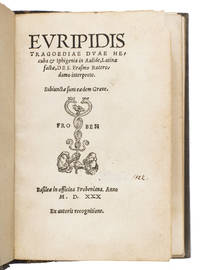
1530ABC_49914Basel 1530. 8vo 10.4 x 15.4 cm. Froben Office heirs of Johann Froben 19th-century half brown calf and grey paper sides. With a woodcut printer's device on the title page and final page and 7 decorated woodcut initials. 293 1 1 blank 1 pp. This volume brings together Erasmus renditions in Latin of two of Euripides most enduring tragedies titled Hecuba and Iphigenia in Aulis presented alongside the original Greek texts beginning on page 169. Euripides ca. 480-ca. 406 BCE was a Greek tragedian of classical Athens. He is one of only three Greek tragedians whose plays have survived in full the others being Aeschylus and Sophocles.Both plays in the present work explore the devastating costs of war through the eyes of women caught in its aftermath. In Hecuba the former queen of Troy endures unspeakable losses the sacrifice of her daughter Polyxena the murder of her son Polydorus and ultimately a brutal act of revenge that leads to her mythical transformation into a howling dog symbolising her complete descent into grief and rage.Iphigenia in Aulis is set on the eve of the Trojan War focusing on Agamemnons impossible decision to sacrifice his daughter Iphigenia to appease the goddess Artemis and allow the Greek fleet to sail. The play confronts themes of duty honour and the personal costs of collective ambition. These themes echo tragically in Hecuba which portrays the wars bitter consequences. Together these tragedies form a poignant narrative arc from the sacrifices made to start a war to the wreckage and human suffering left in its wake.With a partially erased manuscript note on the title page 1822. Some water staining in the margins and a few small holes in the inner margin not affecting the text. Otherwise in good condition.l Adams E 1042; BM STC German p. 289; De Reuck 425; Erasmus Online 4215; Vander Haeghen II 25; VD 16 E 4231; USTC 654881; not in Kossmann. unknown
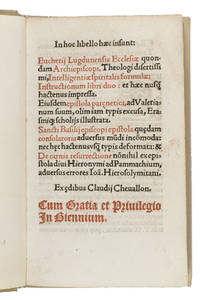
1523ABC_49898Colophon: Paris 1523. 8vo. Claude Chevallon Modern half vellum and beige paper sides blue sprinkled head- and fore-edge manuscript author and title on the spine in brown ink. With Cevallons woodcut device on the verso of the final leaf the title is printed in red and black and 10 woodcut decorated initials. 6 CVII 1 ll. Collection of patristic writings many of which appear here in print for the first time. The book opens with the spiritual writings of Eucherius ca. 380-ca. 449 CE Archbishop of Lyon including his Intelligentiae spiritalis formulae and two instructional treatises both of which are printed here for the first time.At the heart of the volume is Eucherius paraenetic letter to Valerianus a moral exhortation encouraging the rejection of worldly distractions and the pursuit of true Christian wisdom. Although this letter had been printed previously it is presented here together with annotations by Erasmus.Also included is a consolatory letter by Basil the Great Bishop of Caesarea 330-379 CE intended to support believers facing the hardships of earthly life. Like the instructional works of Eucherius this letter also appears here in print for the first time. The final text is a fragment from a letter by Saint Jerome ca. 342/7-420 CE to Pammachius d. 410 CE defending the doctrine of the resurrection of the flesh and refuting the teachings of John of Jerusalem.The exact date of publication remains uncertain but it is unlikely that the book appeared before 1520 the year when Chevallon first began using his soleil dor printers device.The pages show some browning and water staining throughout. Overall in good condition.l BM STC French p. 157; Erasmus Online 4203; Vander Haeghen II 25; Moreau & Renouard III 498; Renouard P. Marques 176; USTC 184320; not in Adams; De Reuck; Kossmann; Meyers. hardcover
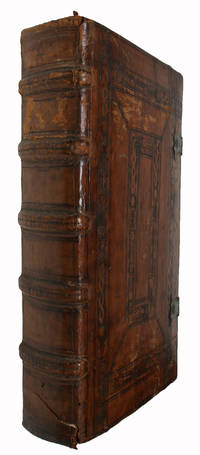
153147178Basel Froben 1531 Coloniae Petrus Quentell 1536. Folio. Bound together in a beautiful contemporary full calf binding over wooden boards. Blindstamped ornamental frames to boards. Five raised bands to spine. Remains of brass clasps to boards. Brass at corners of boards and brass strips to bottom edges of boards. A tear through the letter at the lower capital no loss. Some scrathing of leather mostly to back board and upper part of spine. The titles of the two works written in contemporary hand to the outer edge. The strong vellum cords which go through the the wooden boards can be seen on the inside of the wooden boards which also have some initials in red and blue paint possibly from a painted leaf that has rubbed off First title-page a bit dusty otherwise very nice clean and crisp throughout. Eucherius: Froben printer's device to title-page to final leaf of the first part to the half-title of the second part Episcopi Commentariorum in libros Regum ad Veranium & Salonium and to the last leaf of that part. Beautiful large woodcut initial at beginning of each new work. 8 194 2; 310 2 pp.Radulphus: Woodcut device to title-page. Numerous beautiful woodcut allegorical initials both large and smaller throughout. 4 - title dedications 14 - index 6 314 pp. <br/><br/><em>First editions of both works being the first edition of the works "Several Studies" of St. Eucharius most of them printed for the first time here as well as the first edition of Rodulfus Tortarius' or Radulphus Flaviacensis commentaries of Leviticus the third of the Books of Moses written in Latin in 20 books. Saint Eucherius bishop of Lyon ca. 380 - ca. 449 was a high-born and high-ranking ecclesiastic in the Christian Church of Gaul. He is remembered for his letters advocating extreme self-abnegation. Henry Wace ranked him "except perhaps St. Irenaeus the most distinguished occupant of that see"."St. Eucherius Bishop of Lyons theologian born in the latter half of the fourth century; died about 449. On the death of his wife he withdrew to the monastery of Lérins where his sons Veranius and Salonius lived and soon afterward to the neighbouring island of Lerona now Sainte-Marguerite where he devoted his time to study and mortification. Desirous of joining the anchorites in the deserts of the East he consulted John Cassian who in reply sent him some of his "Collationes" describing the daily lives of the hermits of the Thebaid. It was at this time that Eucherius wrote his beautiful letter "De laude Eremi" to St. Hilary of Arles c. 428. Though imitating the virtues of the Egyptian solitaries he kept in touch with men renowned for learning and piety e.g. Cassian St. Hilary of Arles St. Honoratus later Bishop of Marseilles and Valerian to whom he wrote his "Epistola parænetica de contemptu mundi". The fame of Eucherius was soon so widespread in southeastern Gaul that he was chosen Bishop of Lyons. This was probably in 434; it is certain at least that he attended the First Council of Orange 441 as Metropolitan of Lyons and that he retained this dignity until his death. In addition to the above-mentioned letters Eucherius wrote "Formularium spiritualis intelligentiæ ad Veranium" and "Institutiones ad Salonium" besides many homilies. His works have been published both separately and among the writings of the Fathers." Catholic Encyclopedia. His "Epistola paraenetica ad Valerianum cognatum de contemptu mundi "Epistle of exhortation to his kinsman Valerian On the contempt of the world" is an expression of the despair for the present and future of the world in its last throes shared by many educated men of Late Antiquity with hope for a world to come. Erasmus thought so highly of its Latin style that he edited and published it at Basel in 1520. His commentaries on the work are also included here. His "Liber formularum spiritalis intelligentiae" which is addressed to his son Veranius is a defence of the lawfulness of reading an allegorical sense in Scripture bringing to bear the metaphors in Psalms and such phrases as "the hand of God" The term anagoge in Greek is employed for the application of Scripture to the heavenly Jerusalem to come and there are other examples of what would become classic Medieval hermeneutics.Rodulfus Tortarius also known as Raoul of Tourtier Raoul de La Tourte Radulphus Flaviacensis c.1063 - c.1122 was a French Benedictine monk of the Abbey of Fleury-sur-Loire and a poet writing in Latin. He is known both for his style of writing his biblical commentaries and religious works and his literary and comic tales. His commentary on "Leviticus" is considered important and influential. The first edition of the work is rare. </em> hardcover
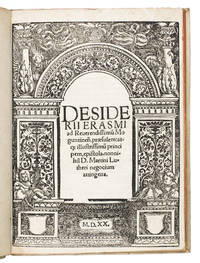
1520ABC_49889Augsburg 1520. 4to. Sigmund Grimm and Marcus Wirsung 19th-century gold-tooled vellum with a black morocco title label and a black morocco label with the year of publication on the spine lettered in gold a double fillet border on both boards red edges marbled endpapers. With an elaborate woodcut title border by Hans Weiditz. 4 ll. Early print of the letter Erasmus wrote to Cardinal Albrecht of Brandenburg Archbishop of Mainz in October 1519 with statements about Luther. In it Erasmus recommends to hear Luther whom he defends in several instances and suggests to help him where he errs. The letter was delivered by Ulrich von Hutten 1488-1523 and likely published without Erasmus's consent. The present edition is one of seven unauthorised editions published in the same year. It was printed by Marcus Wirsung ca. 1460-ca.1520 and Sigmund Grimm ca. 1480-1530 whose printing office was the most important publication centre for humanist literature in pre-Reformation Augsburg. Their edition includes a beautiful title border by Hans Weiditz 1495-ca.1537 and is among the rarest of the seven with only five copies recorded by the Universal Short Title Catalogue USTC. The present copy was auctioned at Sotheby's in 1955 and 1980 and is one of only two copies that we have been able to trace in sales records.The boards are somewhat warped. The work has been bound with 25 blank leaves. Otherwise in good condition.l Adams E 871; Allen Opus epistolarum Erasmi IV 1033; Bezzel 28; BM STC German p. 276; Erasmus Online 1957; Proctor 10920; USTC 635546 5 copies; Vander Haeghen I 93; VD16 E 1887; not in De Reuck. hardcover
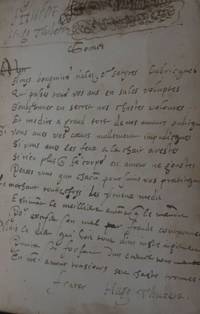
15233722Paris: apud Simon de Colines 1523. First edition. Contemporary French blind-stamped calf over wooden boards panelled with intersecting fillets and lozenge tools; remains of clasps present metal attachments preserved; spine with raised bands. Wide-margined and notably clean throughout. Early manuscript moral sonnet signed "Frater Hugo Thubert" on the front flyleaf and a biblical motto "Si quis vult post me venire." in a seemingly different sixteenth-century hand on the rear flyleaf. With a few early marginal annotations in a sixteenth-century hand on ff. 39 and 253 and f. 9 ruled with brown-ink frames. Leather somewhat worn including a damaged area on the front panel and some loss at the lower corners with surface abrasions and light cracking along the joints; spine rubbed at head and foot. A complete unsophisticated copy in its original binding retaining notable early reader's marks; overall in very good condition. First edition. Contemporary French blind-stamped calf over wooden boards panelled with intersecting fillets and lozenge tools; remains of clasps present metal attachments preserved; spine with raised bands. ff. 373 22. <p><br /> A rare example of early educational use of Erasmus's Adagia in its contemporary French leather binding and preserved with a handwritten French moral sonnet by its sixteenth-century owner Hugues Thubert.<br /> <p><p><br /> First edition of Jean Brouchier's pedagogical epitome of Erasmus's Adagia printed by Simon de Colines in the early years of his Paris press. Though derived entirely from Erasmus's celebrated Chiliades the structure and didactic programme are Brouchier's: an abridged sequence of selected adages arranged for the studiosa iuventus intended to make the moral historical and rhetorical substance of the Adagia usable in the Latin classroom at an elementary stage.<br /> <p><p><br /> Brouchier's dedicatory epistle explains the rationale behind the epitome: while the Adagia had become essential reading for humanist education their full scope far exceeded what younger students could manage. His selection extracts the most serviceable sententiae supplying a compact repertory suited to memorization written exercises and introductory rhetorical training. The epitome reflects early humanist classroom practice when teachers adopted shorter selections to provide beginners with a practical corpus for variation and elementary composition while still introducing Erasmus's ethical and stylistic programme.<br /> <p><p><br /> A dedicatory letter to the magistrates of Florence precedes the text outlining Brouchier's aims and directing readers to Erasmus for fuller commentary. The work aligns with Colines's broader programme of humanist educational printing which equipped collèges and monastic schools with clear reliable editions of classical and contemporary authors. Colines's architectural title border clean roman types and spacious mise-en-page underscore the book's intended function as a school text designed for legibility and daily use. As an adaptation of one of Erasmus's most influential works Brouchier's Epitome documents an early stage in the mediation condensation and classroom transmission of the Adagia illustrating the practical needs of humanist teaching in early sixteenth-century France.<br /> <p><p><br /> Brouchier's biography is largely undocumented; he is known only through a small group of humanist pedagogical editions issued in Paris between 1511 and 1534. Three of these-the present Epitome and the two editions of the Commentarii in Septem Sapientum Graeciae Apophthegmata-were printed by Simon de Colines placing Brouchier within the circle of authors associated with Colines's early humanist programme.<br /> <p><p><br /> This copy preserves an unpublished French moral sonnet in the hand of Hugues Thubert written on the front flyleaf and signed "Frater Hugo Thubert." The poem belongs to the broad and often fragmentary vernacular literary production of the sixteenth century when humanist education and the widespread use of printed and manuscript verse encouraged even non-professional writers to adopt classical forms for ethical reflection. Autograph poems of this type-especially those entered into the flyleaves of school and humanist books-are relatively uncommon and they offer intimate evidence of personal reading practices. Thubert's sonnet in fluent but regionally inflected French adapts the sonnet structure to a concise moral argument setting impurity and chastity in rhetorical opposition a mode familiar from contemporary humanist and devotional writing.<br /> <p><p><br /> An early owner of the present volume Hugues Hugo Thubert was a Benedictine of the Congregation of Chezal-Benoît listed in the 1529 matricule as a monk of Saint-Germain-des-Prés and later recorded as having left the order TELMA IRHT. He signs himself in this volume and appears again as owner of another book-Jean Grolier's former copy of Gaspar Bracellus's Ortus delitiarum Milan Minutianus 1515; Austin 357; Michon 24A-which he inscribed with his name and the date 1580 and which subsequently entered the abbey library of Saint-Germain-des-Prés. These traces collectively document a Paris-based sixteenth-century reader whose surviving books display consistent humanistic engagement.<br /> Rare; USTC lists 14 copies only six outside France and RBH records a single sale 2024.<br /> <p><p><br /> References: USTC 180884; IRHT-CNRS. n.d. Matricule de la Congrégation de Chezal-Benoît 1529. In TELMA - Traitement électronique des manuscrits.<br /> <p>. apud Simon de Colines unknown
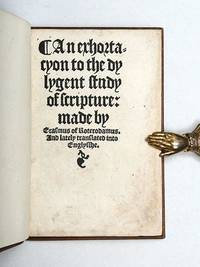
1534150904London: Robert Wyer c.1534. Erasmus on reading the Bible in the vernacular Rare English translation of Erasmus's Paraclesis "a cogently argued text in support of the Bible in the vernacular and it is this particular thrust of the work that must have drawn the early English reformers to it since they too like Erasmus spoke eloquently and at length. in support of the Bible in English" Douglas H. Parker. Based on a translation variously attributed to either William Joy or George Joye which was first printed at Antwerp in 1529 this is one of two editions printed for the first time in England in 1534. While the 1529 Antwerp edition had included a translation of Martin Luther's commentary on 1 Corinthians 7 both 1534 editions replace Luther's text with another Erasmus text "An exhortacyon to the study of the Gospell". This is the only copy to have appeared in commerce in the past 45 years. Octavo 135 x 94 mm in two parts. Woodcut opening initials printer's devices McKerrow 67c and 68 69 "dieu et mon droit" woodcut on I8r. Twentieth-century brown pigskin spine lettered in gilt marbled endpapers. Fore-margins restored throughout affecting woodcuts on final leaf and occasional shoulder notes numerous short wormtracks filled some just into text some mostly marginal staining washed still a presentable copy carefully restored of a notably rare book. STC 10494 four copies only: British Library Oxford Huntington and the present copy. unknown
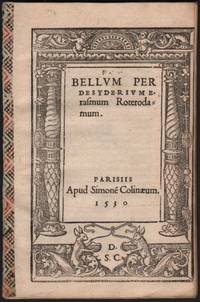
1530329Parisiis Paris: Apud Simonem Colinaeum Simon de Colines 1530. Reprint of the printer's edition of 1525. First printed by Johann Froben in 1517. Papered spine. In fine condition. Title within elaborate woodcut border with initials S.D.C. and Geoffroy Tory’s Lorraine cross. Title within elaborate woodcut border with initials S.D.C. and Geoffroy Tory’s Lorraine cross. Reprint of the printer's edition of 1525. First printed by Johann Froben in 1517. Papered spine. 8º a–c8 c8 blank; 23 1 blank leaves. <p><br /> Erasmus’ famous pacifist text on the adage “dulce bellum inexpertis" war is sweet to those who have not tried it. It was first published in the revised and enlarged edition of “Adages†called “Proverbiorum chiliades" 1515 Basel; Froben and published separately in 1517 also by Froben. <br /> <p><p><br /> “Bellum" is the first essay where Erasmus speaks of Jews contemporary to him praises them along with the Turks and the pagans as well as various peoples of Europe Asia and Africa for their virtuous living. He writes: “When has the sword murder arson plundering turned conquered people into good Christians! Openly to be a Turk or a Jew is lesser evil than to pretend to be a Christian. I prefer a real Turk to a false Christian.†<br /> <p><p><br /> The printer Simon de Colines 1480–1546 is most notable for his 1525 “Grandes Heures de Simon de Colines†the illustrator was the same Geoffroy Tory 1480–1533 who made the design of the woodcut border of this book.<br /> <p><p><br /> Bibl.: Markish Shimon: Erasmus and the Jews. Chicago. University of Chicago Press 1986.; Johnson Carina L.: Cultural hierarchy in sixteenth-century Europe. The Ottomans and Mexicans. Cambridge; New York. Cambridge University Press 2011.; Olin John C.: Six essays on Erasmus and a Translation of Erasmus' Letter to Carondelet 1523. New York. Fordham University Press 1979.<br /> <p><p><br /> Moreau III 2074. <br /> <p>. Apud Simonem Colinaeum (Simon de Colines) unknown